US investors · 2026 tax year

How dividends are taxed: qualified vs ordinary dividends

In the US, qualified dividends are taxed at 0%, 15% or 20%, the same rates as long-term capital gains. Ordinary dividends are taxed like your salary, at 10% to 37%. Most dividends from US companies are qualified once you've held the shares for more than 60 days around the ex-dividend date; REIT and money market fund payouts are usually ordinary. You owe the tax for the year the dividend is paid, even if you reinvest it, and your broker splits the two on Form 1099-DIV: box 1a is the total, box 1b the qualified part.

2026 federal rates on dividendsSingle filers. Limits are taxable income, dividends included
Qualified0%Up to $49,450

Married filing jointly: $98,900

Qualified15%Up to $545,500

Married filing jointly: $613,700

Qualified20%Above that

Plus 3.8% on investment income above $200,000 of income ($250,000 jointly)

Ordinary10% to 37%Your income tax bracket

REITs, money market and bond funds, short holds

Dividend tax calculator

Enter a year of dividends from your 1099-DIV and your other income. You get the federal tax the dividends add, with the 2026 brackets and standard deduction, the 3.8% surtax and your state's share.

$
$
$
$
%
Salary and other income is everything before the standard deduction: wages, interest, a pension. Leave capital gains out.
Tax on your dividends$0
Effective rate 0% of $0

    Federal figures use the 2026 brackets, the standard deduction and the Qualified Dividends and Capital Gain Tax Worksheet's stacking. The 3.8% surtax counts your dividends as your only investment income. Credits, itemized deductions and capital gains aren't included, and below $100,000 of taxable income the IRS Tax Table works in $50 steps, so a return can differ by a few dollars.

    The same $4,000 of dividends at four salaries

    A single filer with $4,000 of dividends in 2026, all qualified or all ordinary. The gap depends on where your salary sits against the 0/15/20 bands and your income tax brackets.

    $60,000salary
    Qualified$00%
    Ordinary$48012%

    $480 lessas qualified

    $85,000salary
    Qualified$60015%
    Ordinary$88022%

    $280 lessas qualified

    $250,000salary
    Qualified$75219%
    Ordinary$1,43236%

    $680 lessas qualified; both include $152 of the 3.8% surtax

    $700,000salary
    Qualified$95224%
    Ordinary$1,63241%

    $680 lessas qualified; both include $152 of the 3.8% surtax

    At a $60,000 salary the $4,000 is tax-free as qualified dividends: after the $16,100 standard deduction, taxable income stays under the $49,450 ceiling of the 0% band. The same money as ordinary dividends is taxed at 12%. At $700,000, qualified dividends pay 20% and ordinary ones 37%, and both pay the 3.8% surtax on top.

    What makes a dividend qualified

    A dividend has to pass three tests. Box 1b of your 1099-DIV shows the dividends your broker counts as qualified, but it can't always tell how long you held, so if you sold soon after an ex-dividend date, check the holding period yourself.

    Test 1 · Who paid it

    A US company or a qualified foreign one

    Any US corporation counts. A foreign company counts when its shares or ADRs trade on a US exchange such as the NYSE or Nasdaq, or when it qualifies for a comprehensive US tax treaty, like the UK's, Canada's, Germany's or Japan's. Passive foreign investment companies never count.

    Test 2 · How long you held

    More than 60 days in a 121-day window

    The window opens 60 days before the ex-dividend date. Days count from the day after you buy through the day you sell. Preferred dividends that cover more than 366 days need more than 90 days in a 181-day window.

    Test 3 · What it is

    Not a type the law leaves out

    Most REIT dividends, the interest that money market and bond funds pass on, and payments in lieu of dividends while your shares were lent out are ordinary, however long you held.

    Coca-Cola's $0.53 dividend, ex-dividend 15 September 2026

    The 121-day window runs from 17 July to 14 November 2026. Two buyers on 1 September, two outcomes.

    44 days

    Sold 15 October: ordinary44 days held, 17 short of the 61 needed. Taxed at the income rate.

    61 days

    Still held on 1 November: qualified61 days. Selling on 31 October or earlier would leave 60.

    Buying the day before the ex-dividend date means holding through 14 November, the last day of the window. Days the position was protected by a put you bought, or by a deep in-the-money call you sold, don't count.

    Qualified or ordinary: stocks, ETFs, REITs and funds

    Funds pass through what they earned. An ETF that holds US stocks pays mostly qualified dividends, one that earns interest or rent pays mostly ordinary ones, and option income funds depend on how they earn it.

    What pays itUsuallyWhy, and where it shows on the 1099-DIV
    US company sharesCoca-Cola (KO)QualifiedOnce you pass the 61-day test. Boxes 1a and 1b.
    Foreign shares or ADRsToyota (TM)QualifiedListed in New York and based in a treaty country. Tax withheld in Japan shows in box 7.
    Stock dividend ETFsSchwab US Dividend Equity (SCHD)QualifiedAlmost all of it, because the fund holds US dividend stocks. You still need the 61-day test on your ETF shares.
    REITsRealty Income (O)OrdinaryMostly ordinary, reported in box 5 as section 199A dividends, which usually get a 20% deduction. Part can be a return of capital (box 3).
    Option income ETFsJPMorgan Equity Premium Income (JEPI)OrdinaryMost of JEPI's payout comes from option income and is ordinary; only the stock dividends inside it can be qualified. Other option funds can pay capital gains or return of capital instead.
    Money market and bond fundsVanguard Federal Money Market (VMFXX)OrdinaryCalled dividends, but paid out of interest. Box 1a only. Municipal bond funds pay exempt-interest dividends in box 12.
    Partnerships (MLPs)Enterprise Products Partners (EPD)Not a dividendDistributions come with a Schedule K-1, not a 1099-DIV, and mostly lower your cost basis until you sell.
    Anything inside an IRA or 401(k)Traditional or RothNot taxed yearlyNo 1099-DIV and no tax while the money stays in. Withdrawals from a traditional account are taxed as income.

    A 1099-DIV worked through

    A single filer earning $85,000 gets $4,000 of dividends in 2026: $3,000 qualified from dividend stocks and a dividend ETF, $600 from a REIT and $400 from a money market fund.

    Form 1099-DIV

    One consolidated form from the broker, by mid-February.

    • 1aTotal ordinary dividendsEvery dividend, qualified ones included$4,000.00
    • 1bQualified dividendsThe part taxed at 0/15/20%$3,000.00
    • 5Section 199A dividendsThe REIT's payout, inside box 1a$600.00
    • 2aCapital gain distributions$0.00
    • 7Foreign tax paid$0.00

    What the dividends cost

    Taxable income is $85,000 + $4,000 − $16,100 standard deduction − $120 REIT deduction = $72,780, in the 22% bracket.

    1. $3,000 qualified at 15%, stacked on top of the rest$450.00
    2. $1,000 ordinary less the 20% section 199A deduction on the $600 REIT part ($120), at 22%$193.60
    3. 3.8% surtax: income is well under $200,000$0.00
    4. Federal tax on the dividends$643.60

    Had the $3,000 of qualified dividends been ordinary, the bill would be $853.60: the qualified label saves $210.00.

    • Form 1040 line 3bOrdinary dividends, box 1a: $4,000
    • Form 1040 line 3aQualified dividends, box 1b: $3,000
    • Schedule B, Part IIEach payer listed, because ordinary dividends are over $1,500
    • Form 8995The REIT's box 5 amount, for the $120 deduction

    Line numbers are from the 2025 Form 1040. The tax itself is worked out on the Qualified Dividends and Capital Gain Tax Worksheet in the 1040 instructions. The guide to reporting stocks on your taxes walks through sales on Form 8949 and Schedule D.

    The 1099-DIV boxes and where they go

    Most investors only use boxes 1a and 1b. The others show up with funds, REITs and foreign shares.

    BoxWhat it isWhere it goes
    1aTotal ordinary dividends, qualified ones includedForm 1040 line 3b, and Schedule B if over $1,500
    1bQualified dividends, the part of 1a taxed at 0/15/20%Form 1040 line 3a
    2aCapital gain distributions from funds and REITs, always long-termSchedule D line 13, or straight onto Form 1040 line 7a if it's your only capital gain and boxes 2b to 2d are empty
    3Nondividend distributions: a return of your own moneyNot taxed now. Lowers your cost basis; a gain once basis reaches zero
    5Section 199A dividends, mostly from REITsForm 8995 or 8995-A for the 20% deduction
    7Foreign tax paid on foreign dividendsForeign tax credit: straight onto Schedule 3 when all your foreign income is passive, it and its tax are reported on statements like the 1099-DIV, and the tax totals $300 or less ($600 jointly); Form 1116 otherwise
    12Exempt-interest dividends from municipal bond fundsForm 1040 line 2a. Not taxed federally, still reported

    When dividends are taxed, and when they aren't

    Taxed in the year they're paid

    • Reinvested dividendsTaxed like cash. Each reinvestment also adds to your cost basis.
    • Dividends under $10A broker needn't send a 1099-DIV below $10 a year, but they're still income.
    • Fund capital gain distributionsTaxed even if you never sold a share of the fund.
    • Fund and REIT dividends paid in JanuaryDeclared in October, November or December to shareholders of record then, they count for that year.

    Not taxed yearly

    • Traditional IRA and 401(k)Taxed as income when you withdraw, not as dividends.
    • Roth IRA and Roth 401(k)Qualified withdrawals are tax-free.
    • Health savings accountsTax-free when spent on medical costs.
    • Return of capital (box 3)Lowers your cost basis instead, until it reaches zero.

    Foreign dividends, and US dividends paid abroad

    US investor, foreign shares

    Taxed here, with a credit for tax paid there

    Count the dividend in dollars on the day it's paid. It's qualified if the company passes test 1 and you pass the holding period. The tax the other country withheld appears in box 7 and usually comes back as a foreign tax credit, so you aren't taxed twice on the same dollar.

    The UK doesn't withhold tax on ordinary company dividends.

    Non-US investor, US shares

    30% withheld, often 15% with a W-8BEN

    The US withholds 30% of dividends paid to foreign investors, and most treaty countries cut that to 15% once your broker has a W-8BEN on file. Your own country then taxes the dividend under its rules, usually with a credit for the US tax. The dividend withholding tax guide lists the rates by country.

    Every dividend from every broker in one report

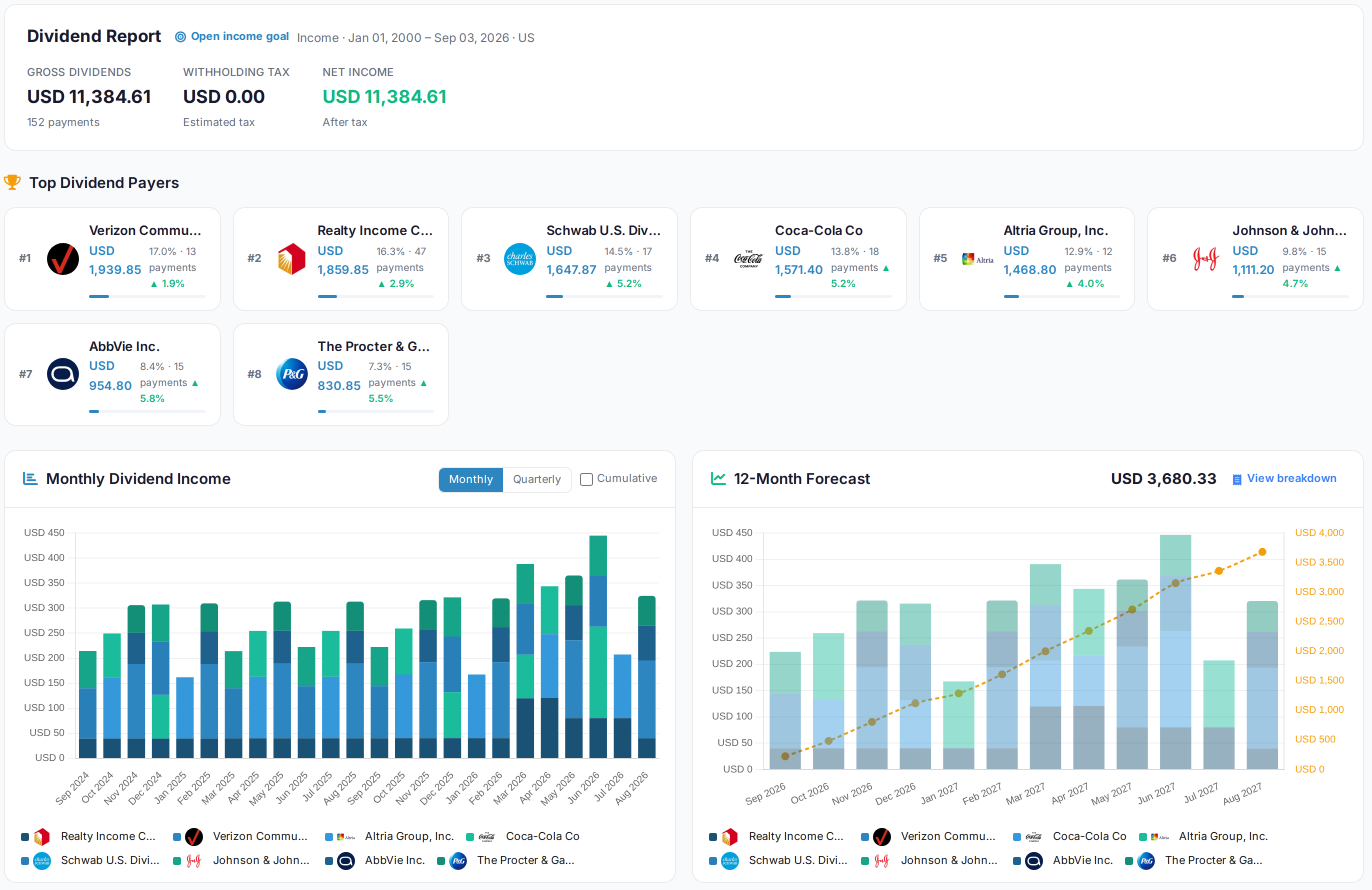
    With accounts at more than one broker you get more than one 1099-DIV. AllInvestView adds every payment up across all of them, so you can see the year's dividends before the forms arrive and check the totals when they do.

    Dividend report

    Gross, withheld and net, payer by payer

    Every payment is counted on the shares you owned going into the ex-dividend date, with any tax withheld at source. Export the year to CSV, Excel or PDF, and set a 0% rule for an IRA or Roth so its dividends don't count as taxable income. A 12-month forecast shows what's coming.

    See the dividend tracker
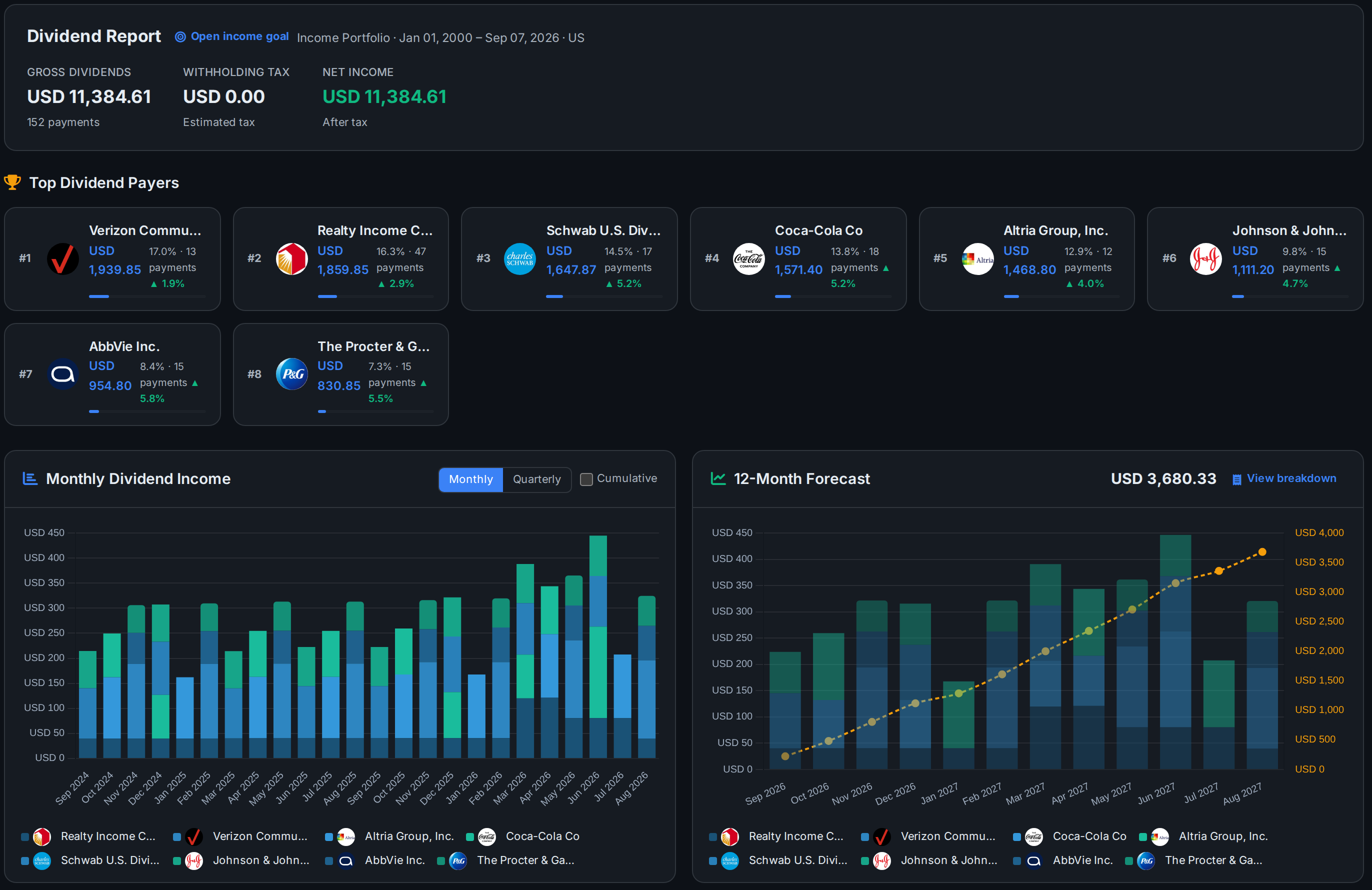
    AllInvestView AllInvestView dividend report: gross dividends USD 11,384.61 over 152 payments, withholding and net income, the top eight payers with their growth rates, monthly dividend income by payer and a 12-month forecast of USD 3,680.33 AllInvestView dividend report: gross dividends USD 11,384.61 over 152 payments, withholding and net income, the top eight payers with their growth rates, monthly dividend income by payer and a 12-month forecast of USD 3,680.33
    The dividend report on a demo income portfolio of eight payers held since 2022 and 2023.View full-size View full-size

    Five mistakes that cost dividend investors money

    1. Paying twice on reinvested dividends

      Every reinvested dividend was taxed when it was paid. Leave it out of your cost basis and the same money is taxed again as a gain when you sell. Check that your broker's basis includes reinvestments, especially for shares moved from another broker.

    2. Selling soon after the ex-dividend date

      Buy just before the ex-date and sell before you've held 61 days, and the dividend is ordinary. It can also cost more than it pays: the share price usually drops by about the dividend on the ex-date.

    3. Holding high-yield funds in a taxable account

      REITs, bond funds and option income ETFs like JEPI pay mostly ordinary dividends. Held in an IRA or 401(k), that income isn't taxed each year; held in a taxable account, it's taxed at your top rate.

    4. Leaving out the foreign tax credit

      Box 7 is money you already paid, and as a credit it comes off your US tax dollar for dollar. When all your foreign income is passive, it and its tax are reported on statements like the 1099-DIV, and the tax totals $300 or less ($600 jointly), it goes straight onto Schedule 3 without Form 1116.

    5. Adding up 1099s from several brokers by hand

      Each broker only sees its own account. A dividend tracker that pulls every account together shows the year's total before February, so a missing or late form stands out.

    Dividend tax questions

    How are dividends taxed?

    In the US, qualified dividends are taxed at 0%, 15% or 20%, the rates for long-term capital gains, and ordinary dividends are taxed at your income tax rate, 10% to 37% in 2026. Your broker splits them for you on Form 1099-DIV: box 1a is the total and box 1b the qualified part. You owe the tax for the year the dividend is paid, even if you reinvest it.

    What makes a dividend qualified?

    Three things. A US company or a qualified foreign company paid it, you held the shares for more than 60 days in the 121-day window that starts 60 days before the ex-dividend date, and it isn't a type the law excludes, such as most REIT dividends and money market fund payouts. Box 1b shows what your broker counts as qualified; if you sold soon after an ex-dividend date, check the holding period yourself.

    What is the qualified dividend tax rate for 2026?

    0% while your taxable income stays at or under $49,450 (single) or $98,900 (married filing jointly), 15% up to $545,500 or $613,700, and 20% above. The dividends sit on top of your other income, so part of them can fall in one band and the rest in the next.

    Do I pay tax on reinvested dividends?

    Yes. A reinvested dividend is taxed exactly like one paid in cash, and it shows up on the same 1099-DIV. Each reinvestment also buys shares, so add it to your cost basis; otherwise you pay tax on the same money again when you sell.

    Are REIT dividends qualified?

    Mostly not. REIT dividends are usually ordinary dividends, but the part your broker reports in box 5 as section 199A dividends usually gets a 20% deduction, so 80% of it is taxed, as long as you held the shares for more than 45 days around the ex-dividend date. Part of a REIT payout can also be a capital gain distribution (box 2a) or a return of capital (box 3).

    Do I pay tax on dividends in an IRA or 401(k)?

    No, not while they stay in the account. In a traditional IRA or 401(k) you pay income tax when you take money out, and in a Roth account qualified withdrawals are tax-free, so the qualified or ordinary label doesn't matter there.

    Do I have to report dividends under $10?

    Yes. A broker doesn't have to send a 1099-DIV when your dividends there total less than $10 for the year, but the income is still taxable and still goes on your return. If your ordinary dividends add up to more than $1,500, you also list each payer on Schedule B.

    How are dividends from foreign companies taxed?

    The same way, once you count them in dollars. They're qualified if the company qualifies for a US tax treaty or its shares trade on a US exchange, it isn't a passive foreign investment company, and you meet the holding period. Tax the other country withheld shows in box 7 and usually comes back to you as a foreign tax credit.

    See your dividends before the 1099s arrive

    Connect your brokers or import your trades, and every dividend lands in one report with what was withheld and what's coming next.

    Create a free account

    Related calculators and guides

    Sources

    Rates and thresholds checked on 26 October 2026 for the 2026 tax year. This page explains US federal rules in general terms; state rules differ.