
United Kingdom · for UK residents · tax years 2025/26 and 2026/27

Investing in the UK: Tax on Shares, ETFs and Dividends

Inside an ISA or a pension you pay no tax on your shares, ETFs or funds. In a general account, gains above £3,000 a year are taxed at 18% in your basic rate band and 24% above it, and dividends above £500 at 10.75%, 35.75% or 39.35% for 2026/27.

Your cost isn't each broker's figure: shares of the same company are pooled at one average cost across every account you hold outside ISAs and pensions, and a purchase in the 30 days after a sale is matched with it first. Most ETFs are based in Ireland or Luxembourg, and an accumulating one can leave you with tax to pay on income it never paid out.

ISA allowance£20,000a year, with no tax on anything inside
Gains18% or 24%above a £3,000 allowance, set by your income
Dividends, 2026/2710.75%above £500 at the basic rate; 35.75% and 39.35% above it
Rebuying30 daysafter a sale, matched before your average cost
Investment tax calculator One sale across two brokers Accumulating ETFs Rules checked against GOV.UK and HMRC on 24 October 2026

ISA, pension or general account: where the tax applies

The same fund can be tax-free or taxable depending on which account it sits in.

Stocks and Shares ISAPension (SIPP)General account
Gains when you sellNo taxNo tax18% or 24% above £3,000 a year
DividendsNo taxNo tax10.75%, 35.75% or 39.35% above £500 (2026/27)
InterestNo taxNo tax20%, 40% or 45% above your savings allowance
Income an ETF keepsNo taxNo taxTaxed each year as dividends or interest
Paying inUp to £20,000 a year across your ISAsTax relief on what you pay in, up to the annual allowanceNo limit
Taking money outAny time, no taxFrom 55 (57 from April 2028), usually 25% tax-free and the rest taxed as incomeAny time; selling can mean a gain to report
Your tax returnNothing to reportNothing until you draw itGains, dividends and fund income go on it

Stocks and Shares ISA

Tax
None on gains, dividends, interest or fund income
Paying in
Up to £20,000 a year
Return
Nothing to report

Pension (SIPP)

Tax
None while it's invested
Paying in
Tax relief, up to the annual allowance
Taking out
From 55 (57 from April 2028), usually 25% tax-free

General account

Gains
18% or 24% above £3,000
Dividends
10.75% to 39.35% above £500
ETF income
Taxed each year, paid out or not
Return
Gains, dividends and fund income go on it

ISA and pension first

Most people fill their ISA each year before anything else, and use a SIPP for money they won't need until retirement. Moving shares you already own into an ISA is a sale and a purchase, a Bed and ISA, so the gain on the way in counts for this year.

The general account on top

Once the ISA is full, the rest goes in a general account, and that's where everything on this page applies. Hold one at two brokers and HMRC still sees one investor: your cost, your 30 days and your £3,000 run across both.

UK tax on investments calculator

For a general account. Enter your income and the year's interest, dividends and gains to see the tax on each and where they fall in your bands.

Tax on interest, dividends and gains

Tax year
Before tax. Rent counts here too.
From savings, bonds and bond funds outside ISAs.
Including income your ETFs reported but didn't pay.
The year's gains minus the year's losses and any losses you carry in.
Tax on your investments
£0
Interest£0
Dividends£0
Gains£0
Your taxable income and gains, stacked
Salary and otherInterestDividendsTaxable gains

How it's worked out

Salary comes first, then interest, then dividends, and the gains sit on top. Each part is taxed at the rate of the band it lands in.

Uses the rates and bands for England, Wales and Northern Ireland. Scottish taxpayers pay Scottish rates on salary, but interest, dividends and gains use these same UK rates and bands. The tax on your salary itself isn't included. The personal allowance shrinks by £1 for every £2 of income above £100,000. Pension contributions and Gift Aid widen your basic rate band, so your real bill can be lower. Tax kept abroad on foreign dividends comes off the dividend tax and isn't shown here.

One sale worked through: two brokers, one pool and the 30-day rule

Tax year 2025/26. HSBC shares bought at Hargreaves Lansdown and Trading 212, sold at one and bought back at the other. Example figures.

Hargreaves Lansdown10 March 2021

Bought 2,000 HSBC at £4.20

£8,400
Trading 21214 June 2023

Bought 1,000 HSBC at £6.30

£6,300
One pool for all 3,000 sharesSection 104 holding, whichever broker holds them
£14,700 for 3,000 shares, so every share in the pool costs £4.90
Sold 1,500 HSBC at £9.80Hargreaves Lansdown, 12 September 2025

Then on 2 October 2025, 20 days later, bought 500 HSBC at £9.50 at Trading 212. Those 500 are matched with the sale first; the other 1,000 come from the pool.

  • Sale price, 1,500 × £9.80£14,700
  • Cost: 500 × £9.50 + 1,000 × £4.90£9,650
  • Gain£5,050
  • Annual exempt amount−£3,000
  • Taxable gain£2,050
  • Tax at 24%, a higher rate taxpayer£492

At the basic rate, with £30,000 of salary, it's all at 18%: £369. The pool keeps 2,000 shares at £9,800, still £4.90 each.

Using one broker's reportHargreaves Lansdown only knows its own 2,000 shares at £4.20, so its figures show a gain of £8,400. That's £3,350 more gain than you really made, and £804 of tax at 24% you'd pay for nothing.
Had it been a lossThe same 30-day match would have cut the loss on the 500 shares to the gap between the sale and the new purchase. Waiting 31 days, or buying back inside an ISA, leaves the loss in place.
Inside an ISA insteadThe same sale in an ISA has no gain to report, no pool and no 30-day matching.

Accumulating ETFs: tax on income you never received

Most ETFs UK investors buy, like VWRP, CSPX and SWDA, are funds based in Ireland. The UK taxes the income such a fund earns, whether it pays it out or keeps it.

Vanguard FTSE All-World, accumulating

For its year to 30 June 2025 the fund reported $2.2479 a share of income it had kept. Someone holding 200 shares outside an ISA on that date was treated as receiving $449.58 on 31 December 2025, about £334, and pays dividend tax on it for 2025/26.

Fund year ends. Count the shares you hold
$2.2479 × 200From the fund's report. $449.58, or £333.88
Treated as paid: dividend income for 2025/26
  • Taxed as a dividend, in 2025/26£333.88
  • Added to the cost of your 200 shares+£333.88
  • Tax for a higher rate taxpayer, 33.75%, with the £500 allowance already used£112.68

Equity funds: taxed as dividends

The reported income uses your £500 allowance and the dividend rates. A distributing fund only adds what it reported above what it paid you, often nothing.

Bond funds: taxed as interest

A fund with more than 60% of its money in bonds and cash at any point in its year reports interest instead, taxed at 20%, 40% or 45% above your savings allowance.

Your cost goes up by the same amount

Add it to the pool for that fund, so you aren't taxed on the same money again when you sell. Leave it out and you pay twice.

No UK reporting status: the gain is income

Sell an offshore fund that isn't a reporting fund and the whole gain is taxed as income at your income tax rates, with no £3,000 allowance. HMRC publishes the list of reporting funds; check before you buy.

When your investments need a tax return

Below these lines HMRC can usually collect the tax through your tax code, if you tell it.

What you had in the yearWhat to do
Gains above £3,000Report them on a Self Assessment return, on the capital gains pages (SA108), or through HMRC's real-time capital gains service if you don't otherwise file
Sales above £50,000 and you already file a returnReport them on SA108 even if the gain is under £3,000
Dividends or interest above £10,000File a Self Assessment return
Dividends between £500 and £10,000Tell HMRC, and the tax is usually collected through your tax code
Income from an offshore fund, paid or keptThe foreign pages (SA106), next to your other foreign dividends
A lossClaim it within four years of the end of that tax year, and it carries forward until you use it

Gains above £3,000

Do
Self Assessment (SA108), or the real-time service if you don't otherwise file

Sales above £50,000

Do
On SA108 if you already file, even with a small gain

Dividends

Above £10,000
Self Assessment, and the same for interest
£500 to £10,000
Tell HMRC; usually through your tax code

Offshore fund income

Do
The foreign pages (SA106)

A loss

Do
Claim within four years; it carries forward
Paper return for 2025/26.
Online return for 2025/26, and the tax to pay with it.
Last day to sell at a loss, or use your £3,000 and ISA allowance, for 2026/27.
Register for Self Assessment if 2026/27 is your first year with gains or income to report.

The rules that catch people out

One pool across every broker

Shares of the same class in the same company form one Section 104 pool at average cost, across all your accounts outside ISAs and pensions. A broker's own gain figure only knows its own shares.

Same day, then 30 days, then the pool

A sale is matched first with shares bought the same day, then with any bought in the next 30 days, and only then with the pool. Selling for a loss and buying back the next week doesn't bank the loss.

Losses don't expire, the claim does

Claim a loss within four years of the end of the tax year you made it, and it carries forward until it's used. Old losses only bring your gains down to £3,000, so the allowance isn't wasted.

Stamp duty on UK shares, not ETFs

Buying shares in UK companies costs 0.5% stamp duty. Most AIM shares and ETFs don't pay it. It adds to your cost, and so do dealing fees.

Foreign dividends: the gross amount

With a W-8BEN the US keeps 15%. In a general account you declare the full dividend and the 15% comes off the UK tax on that dividend, as far as that tax goes. In an ISA the US 15% stays with the US.

Each trade in pounds on its own date

A share bought in dollars is costed at the exchange rate on the day you bought, and the sale at the rate on the day you sold. The currency move is part of your gain.

Your UK figures from every broker

The UK filing pack, run on the example above.

SA108

One pool across Hargreaves Lansdown and Trading 212

Add each broker as its own account, mark which are ISAs and pensions, and the pack matches every sale across the taxable ones: same day, then the next 30 days, then one Section 104 pool per share. It applies your £3,000, the losses you choose to bring in, and splits the taxable gain between 18% and 24% using the income you enter. Each sale shows which rule matched it and each share keeps its own pool ledger, all of it exportable as PDF, Excel or CSV. Reported fund income goes on its own SA106 sheet and into the pool at the same time.

See the UK tax report
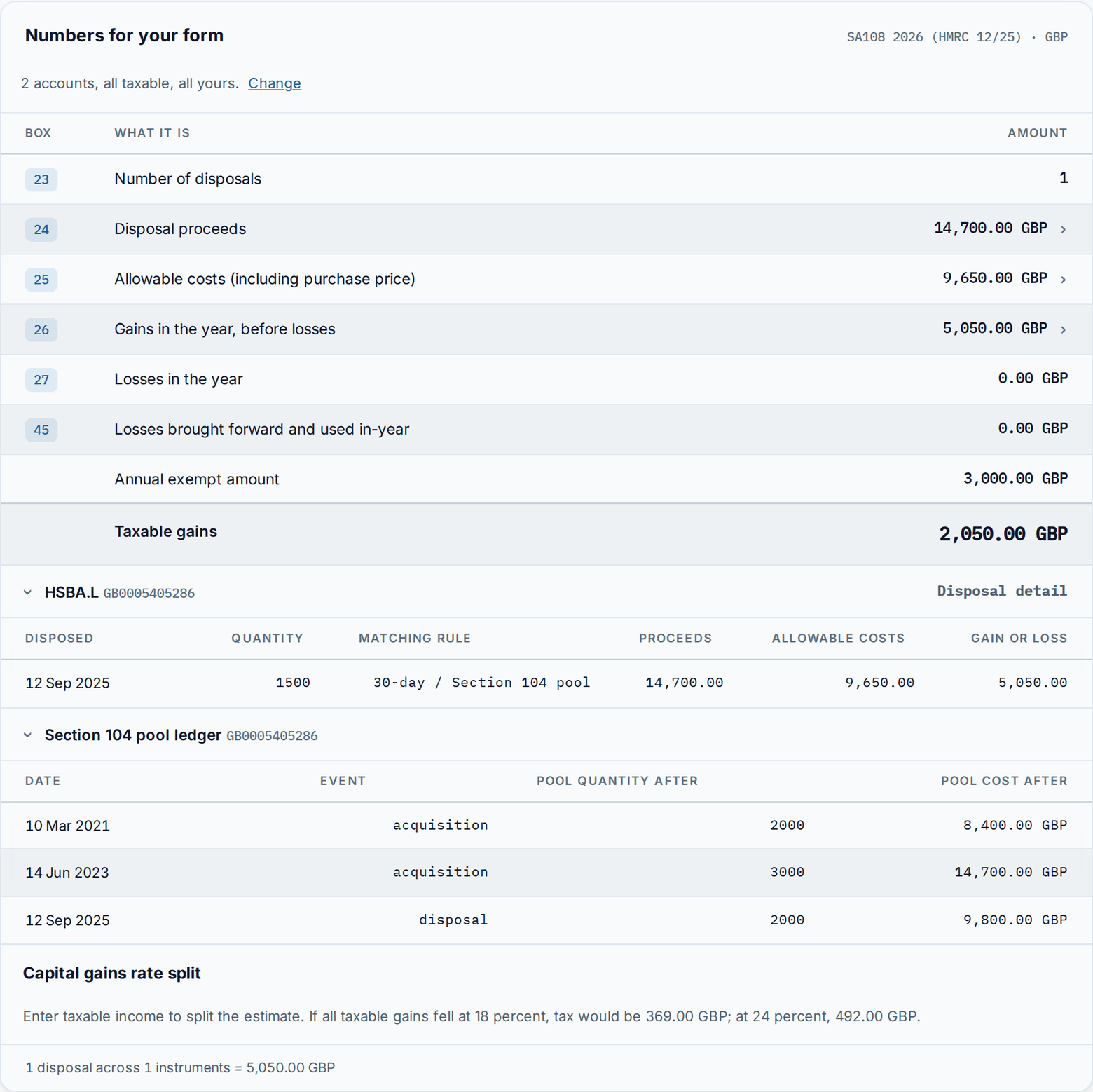
AllInvestView AllInvestView UK filing pack, SA108 for 2025/26, two taxable accounts. Box 23 one disposal, box 24 proceeds 14,700.00 GBP, box 25 allowable costs 9,650.00 GBP, box 26 gains 5,050.00 GBP, boxes 27 and 45 0.00, annual exempt amount 3,000.00 GBP, taxable gains 2,050.00 GBP. HSBA.L sold 12 Sep 2025, 1500 shares, matching rule 30-day / Section 104 pool. Pool ledger: 2000 shares at 8,400.00 GBP on 10 Mar 2021, 3000 at 14,700.00 GBP on 14 Jun 2023, 2000 at 9,800.00 GBP after the sale. Rate split: 369.00 GBP at 18 percent or 492.00 GBP at 24 percent AllInvestView UK filing pack, SA108 for 2025/26, two taxable accounts. Box 23 one disposal, box 24 proceeds 14,700.00 GBP, box 25 allowable costs 9,650.00 GBP, box 26 gains 5,050.00 GBP, boxes 27 and 45 0.00, annual exempt amount 3,000.00 GBP, taxable gains 2,050.00 GBP. HSBA.L sold 12 Sep 2025, 1500 shares, matching rule 30-day / Section 104 pool. Pool ledger: 2000 shares at 8,400.00 GBP on 10 Mar 2021, 3000 at 14,700.00 GBP on 14 Jun 2023, 2000 at 9,800.00 GBP after the sale. Rate split: 369.00 GBP at 18 percent or 492.00 GBP at 24 percent
The example above in the pack: 500 shares matched with the purchase 20 days later and 1,000 with the pool, for a 5,050 gain and 2,050 taxable, and the pool left at 2,000 shares costing 9,800. Demo filer, invented figures.View full-size View full-size
Every account in one place

See your ISA, SIPP and general accounts together, in pounds

All your brokers side by side with real returns and dividends, ISAs and pensions kept out of the tax figures, and an SA108 pack that runs the pool and the 30-day rule across every taxable account.

Section 104 across brokers SA108 and SA106 Free plan available

Questions about investing in the UK

How much tax do you pay on shares in the UK?

Nothing inside an ISA or a pension. In a general account, gains above £3,000 in a tax year are taxed at 18% if they fit in your basic rate band and 24% above it. Dividends above £500 are taxed at 10.75%, 35.75% or 39.35% in 2026/27, up from 8.75% and 33.75% at the lower two rates in 2025/26. You also pay 0.5% stamp duty when you buy most UK shares.

How are ETFs taxed in the UK?

Like shares for gains and dividends, with one extra: most ETFs are domiciled in Ireland or Luxembourg, and the UK taxes the income such a fund reports to HMRC whether it paid it out or not. That's excess reportable income, and it's taxed as dividends, or as interest for a fund mostly in bonds. Check the fund has UK reporting status; without it, the whole gain when you sell is taxed as income.

What is excess reportable income?

It's the income an offshore reporting fund earned but didn't pay out, which mostly matters for accumulating ETFs. You're taxed on your share of it on the fund's distribution date, six months after its reporting period ends, and the same amount is added to the cost of your units so it isn't taxed again when you sell. Vanguard FTSE All-World Accumulating reported $2.2479 a share for the year to 30 June 2025.

Do I pay tax on investments in an ISA or a SIPP?

No UK tax on gains, dividends, interest or fund income inside either, and nothing goes on your tax return. You can put up to £20,000 a year into ISAs. A pension is taxed when you take money out, apart from the tax-free part. The 15% the US keeps on dividends inside an ISA can't be set against UK tax.

Do I need to file a Self Assessment return for my investments?

You need a return if your dividends or your interest are above £10,000, or if you already file one and sold more than £50,000 of assets. Gains above £3,000 must be reported too, on a return or through HMRC's real-time service if you don't otherwise file. Below those, dividends over £500 or interest over your savings allowance can usually be taxed through your tax code if you tell HMRC. The online return for 2025/26 is due by 31 January 2027.

How does the 30-day rule work for shares?

When you sell shares and buy the same shares again within the next 30 days, the sale is matched with the new purchase first, not with your average cost. It applies across all your accounts outside ISAs and pensions, so rebuying at another broker doesn't avoid it. Buying back inside an ISA, a Bed and ISA, isn't caught.

Do I pay UK tax on US shares?

Yes, a UK resident pays UK tax on gains and dividends wherever the shares are. Sign the W-8BEN your broker gives you and the US keeps 15% of dividends instead of 30%; in a general account that 15% comes off the UK tax on the same dividends, up to the UK tax due on them. The US doesn't tax your gains, so those are taxed only in the UK.

Sources

Checked on 24 October 2026.

Written for UK residents. It isn't personal tax advice.