What a Multi-Asset Tracker Must Get Right About Bonds
This guide is for investors who want one portfolio record for individual bonds, bond ETFs, stocks, cash and other assets. It compares how five approaches consolidate a mixed portfolio without flattening every holding into the same data model. If your main question is dedicated bond calculation, brokerage search, execution or institutional research, use our bond tracking software comparison instead.
Most portfolio trackers were built around listed securities and a latest market price. Individual bonds do not work that way. A bond's theoretical value changes as the yield curve moves, even when no fresh dealer quote is available. A bond that cost 98 can reasonably be worth 96 or 100 later as rates and credit conditions change, while a generic tracker may continue to display the last stored price.
A bond-aware portfolio tracker should preserve contract terms, calculate price and YTM, show the source of each valuation, measure rate risk, visualize the maturity ladder, and project coupon and principal cash flows. It should also track listed bond ETFs as funds rather than forcing them into an individual-bond schedule. We reviewed five tools against those needs.
Review Criteria
Cross-Asset View
Can bonds, funds, stocks and cash share one useful portfolio and allocation view?
Bond-Aware Valuation
Can individual bonds preserve terms, price and yield without being treated like stock tickers?
Account Coverage
Can holdings from more than one broker or account be consolidated?
Income + Reporting
Are coupons, fund distributions, cost and performance kept in the right context?
Price Transparency
Does the tracker distinguish broker, market, manual and theoretical values?
Multi-Currency
Can the total portfolio and its underlying holdings be read across currencies?
Our goal is not to pick a single winner for every investor. It is to help you match the right tool to a mixed portfolio. Each review below flags concrete pros and cons against the criteria above, and the decision boxes summarize which approach fits which use case.
Five Approaches for a Mixed Portfolio

AllInvestView Best mixed-portfolio fit
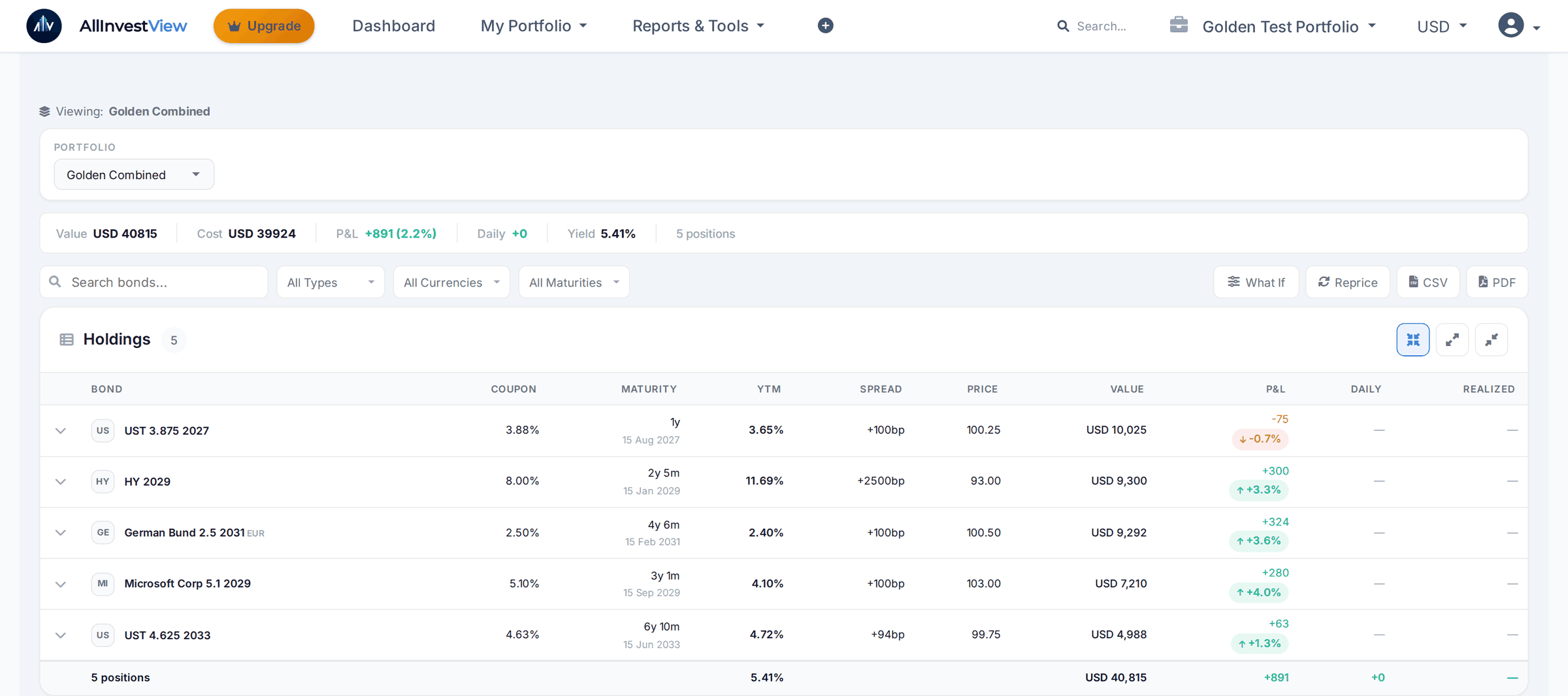
AllInvestView combines standard-bond definition, price-to-YTM and YTM-to-price calculation, cash flows, rate-risk metrics and a dedicated Bond Report with the wider investment portfolio. Eligible bonds can use five base government benchmark families, with country-specific euro sovereign adjustments, when complete terms and a valid spread anchor are available. Broker, market and theoretical prices are labelled rather than treated as equivalent.
Pros
- Five base benchmark families plus eligible euro adjustments
- Yield-to-maturity, duration, convexity, and accrued-interest calculations
- CUSIP + ISIN + credit spread editing
- Household consolidation for advisors
- Free tier covers core bond tracking
Cons
- PDF branded reports not yet available
- Theoretical values are models, not executable quotes
Sharesight
Sharesight is a solid general-purpose tracker with very good tax reporting, especially for Australian, UK, and New Zealand investors. Bond support exists but is limited — you can enter bonds as holdings, but there is no yield curve repricing, no credit spread tracking, and the maturity ladder and coupon calendar have to be built manually. If you hold a small number of bonds alongside mostly equities, Sharesight handles the cost-basis side well. If bonds are a core allocation, it will frustrate you.
Pros
- Excellent tax reports (AU, UK, NZ)
- Clean multi-asset portfolio view
- Good multi-currency handling
Cons
- No yield curve repricing
- No credit spread tracking
- Manual price updates for bonds
Fidelity (in-app tools)
Fidelity's in-app bond tools are genuinely good for customers holding bonds with Fidelity. Bond screener, maturity ladder builder, and yield calculations are all built in. The obvious limitation: it only tracks bonds held in Fidelity accounts. If you have holdings at a second broker, a trust account elsewhere, or an international account, Fidelity's tools stop at the border.
Pros
- Integrated with Fidelity bond inventory
- Built-in bond ladder tool
- Free for Fidelity customers
Cons
- Only tracks Fidelity-held bonds
- No cross-broker consolidation
- Limited credit spread analytics
BondbloX
BondbloX is an interesting specialist platform focused on fractional bond investing, mainly for Asian and some international issues. Their portfolio manager handles what you buy on their platform well, but it is not a general-purpose tracker — you cannot easily import holdings from elsewhere, and Canadian and US government bond curve integration is not a focus.
Pros
- Bond-specific features
- Fractional bond investing
Cons
- Narrow coverage (mostly Asia)
- Limited curve coverage
- Platform-bound holdings
Excel / Google Sheets
Most bond investors end up here by default. A spreadsheet can do anything you want it to do — in theory. In practice, maintaining accurate YTM calculations, pulling current yield curve data, computing accrued interest with the right day-count convention, and keeping a maturity ladder up to date is a full-time job nobody wants. For a handful of holdings it works. Past that, it does not.
Pros
- Free
- Fully customizable
Cons
- Manual everything
- Error-prone (day counts, accruals)
- No yield curve data
- High maintenance cost
Ready to try the top-ranked tracker?
AllInvestView's core bond workflow is free. Add your bonds, use compatible government benchmarks and an anchored spread for theoretical repricing, then inspect the maturity ladder and coupon calendar. Create your free account →
When a Multi-Asset Tracker Needs Bond-Specific Depth
A mixed portfolio view is only useful if it keeps the economics of each asset intact. Listed bond ETFs need shares, market value, distributions and total return. Individual bonds need face value, contractual cash flows, accrued interest, yield, maturity and a clearly labelled valuation source. Combining the allocation does not mean combining those two data models.
AllInvestView keeps both records in one portfolio, then provides dedicated bond calculations and reporting when the holding is an individual bond. That is the relevant distinction on this page. The detailed pricing methodology belongs in the technical guide to tracking a bond portfolio, while the bond tracking software comparison covers calculators, brokers, spreadsheets and institutional platforms.
Choose the guide that matches the job
Stay here when the job is consolidating bonds with the rest of a household portfolio. Use the dedicated software comparison when the job is bond calculation, security search, execution or institutional research.
Feature Comparison Matrix
This matrix focuses on mixed-portfolio fit. Specialist execution and institutional research features are covered in the separate bond tracking apps comparison.
| Feature | AllInvestView | Sharesight | Fidelity | BondbloX | Excel |
|---|---|---|---|---|---|
| Stocks and listed ETFs alongside bonds | Yes | Yes | Within Fidelity | No | Manual |
| Compatible curve repricing | Yes (5 base + 7 EU shifts) | No | Partial | Partial | Manual |
| CUSIP + ISIN support | Both (auto-convert) | Both | Both | ISIN mainly | Type-what-you-want |
| Maturity ladder visualization | Yes | Manual | Yes | Basic | Build your own |
| Forward coupon calendar | 12-month | No | Yes | Limited | Manual |
| Credit spread tracking | Yes (editable) | No | No | Partial | Manual |
| Multi-currency (CAD/USD/EUR/GBP) | All four | Broad | USD mainly | Limited | Type anything |
| Household consolidation | Yes | Per-portfolio | Within Fidelity | No | Separate files |
| Free tier | Yes (core) | Limited | Fidelity only | Paid | Yes |
Which Tool Is Right for You?
For individual investors with 5-50 bonds
Pick AllInvestView. The free tier covers curve-based theoretical repricing for eligible bonds, CUSIP support, a maturity ladder and a coupon calendar, without requiring a manual spreadsheet model.
For wealth advisors managing client households
AllInvestView with household consolidation. See the advisor-focused page for multi-household workflows, rebalancing, and client reporting.
For Fidelity-only bond investors
Start with Fidelity's built-in tools. If all your bonds are held at Fidelity, their in-app ladder builder and bond screener are free and well-integrated. Move to AllInvestView if you add a second broker or want credit spread tracking.
For tax-focused investors with mixed equity + bond portfolios
Sharesight + AllInvestView. Use Sharesight for tax reports if you need country-specific tax handling (AU, UK, NZ). Use AllInvestView alongside it for the bond-specific analytics Sharesight does not cover.
For spreadsheet die-hards
Use a spreadsheet for 1-5 bonds, switch to AllInvestView past that. A spreadsheet is fine when you have a single Treasury bond sitting in an IRA. Once you have a dozen holdings with different currencies, day counts, and credit risks, the maintenance cost exceeds the cost of a purpose-built tracker.
What about Bloomberg Terminal?
Bloomberg is outside this retail-focused matrix because it is a different product for a different audience. Its professional data, portfolio analytics and trading workflows are designed for institutional users and come with a correspondingly different cost and complexity profile. For the broader comparison, see the best bond tracking apps guide.
Frequently Asked Questions
Track Bonds Without Losing the Rest of Your Portfolio
Keep individual bonds, bond ETFs, stocks, cash and other assets in one view while preserving the analytics each instrument needs.