A stock tracker can often rely on ticker, quantity and a recent price. An individual bond adds contractual coupons, accrued interest, settlement conventions and a maturity date. Any useful comparison must first establish whether the product understands that instrument or merely stores it as another line item.
How we evaluated the options
We compared publicly documented capabilities and the workflow available inside AllInvestView. The order below is not a single numerical ranking. Each product is assessed for the job where it is strongest.
| Instrument model | Can the tool represent an individual bond's terms, schedule, face value, accrued interest and maturity rather than treating it as a stock? |
|---|---|
| Valuation | Can it calculate price from yield or yield from price, show risk measures, and distinguish market evidence from a model value? |
| Portfolio work | Can it connect position cost, value, income, maturity and rate risk across accounts and currencies? |
| Market workflow | Is the product primarily for monitoring, broker search and execution, broad performance reporting, or institutional analysis? |
| Transparency | Are important limitations visible, including stale prices, manual updates, closed broker scope and theoretical pricing assumptions? |
What we did not do
We did not assign stars, fabricate user scores or declare one product best for every portfolio. Pricing and product capabilities change, so external claims are limited to official documentation reviewed on the date above.
The short answer
| Primary job | Best fit in this guide | Why | Access model |
|---|---|---|---|
| Calculate and monitor individual bonds | AllInvestView | Manual contract definition, two-way price and yield calculation, Bond Report and multi-asset portfolio. | Calculator without an account; account required to save and track. |
| Search, quote and execute bonds | Interactive Brokers | Broker marketplace, bond screener, yield comparison and order workflow. | Brokerage account. |
| Track listed assets and tax performance | Sharesight | Broad portfolio reporting with listed bonds and custom fixed-interest investments. | Free and paid portfolio plans. |
| Build a bespoke manual model | Spreadsheet | Maximum control when the investor is willing to own formulas, data and maintenance. | Free web tools or a spreadsheet license. |
| Institutional research and portfolio risk | Bloomberg | Professional fixed-income data, analytics, risk, attribution and connected trading workflows. | Professional subscription. |
The important distinction is between a portfolio tracker and an execution platform. A broker can show strong market access without being the best neutral record for holdings across several institutions. A tracker can model a portfolio well without being a trading venue.
Detailed reviews by workflow
AllInvestView
Best for individual-bond portfolio trackingAllInvestView connects a free bond calculator to a dedicated Bond Report and a wider multi-asset portfolio. A standard fixed-rate or zero-coupon bond with finite maturity can be defined from its contract terms, so calculation does not depend on finding an identifier or market-data record first.
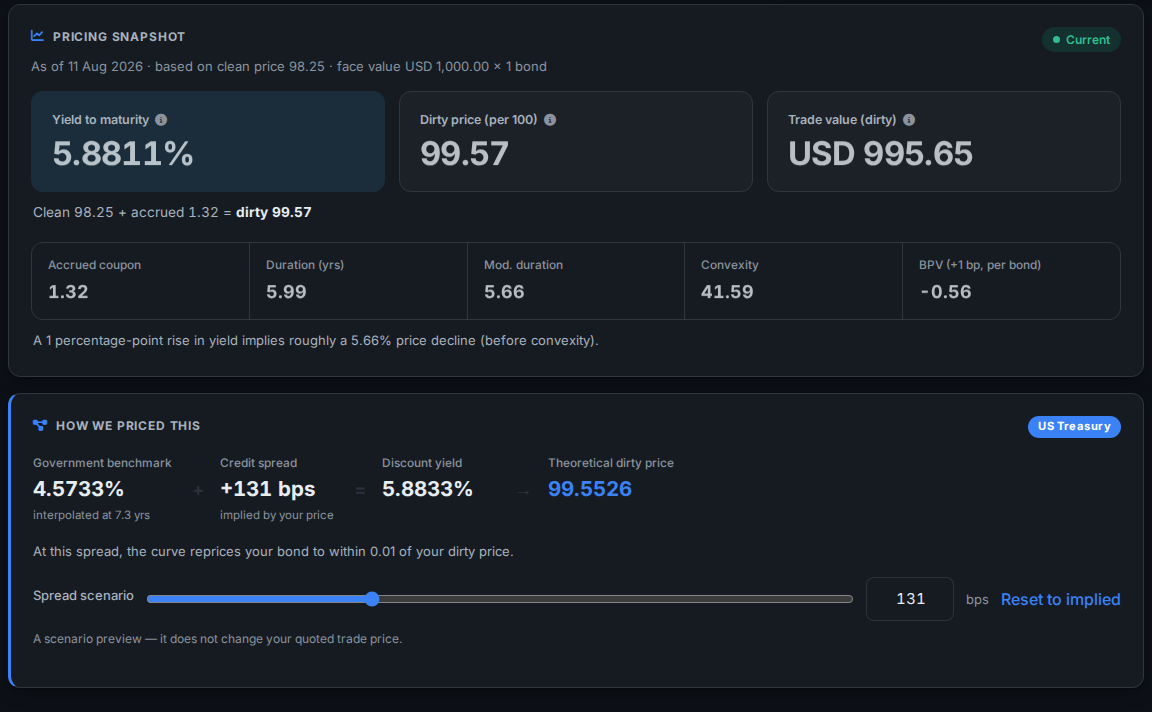
The calculator works in both directions. Enter a clean or dirty price to solve YTM, or enter a target YTM to solve price. The result includes accrued interest, payment schedule, duration, modified duration, convexity and BPV. When complete terms, a compatible government benchmark and a spread anchor are available, the platform can also produce a theoretical curve-based value.
- Manual definition of supported standard bonds
- Price-to-YTM and YTM-to-price calculation
- Cash flows, accrued interest and rate-risk metrics
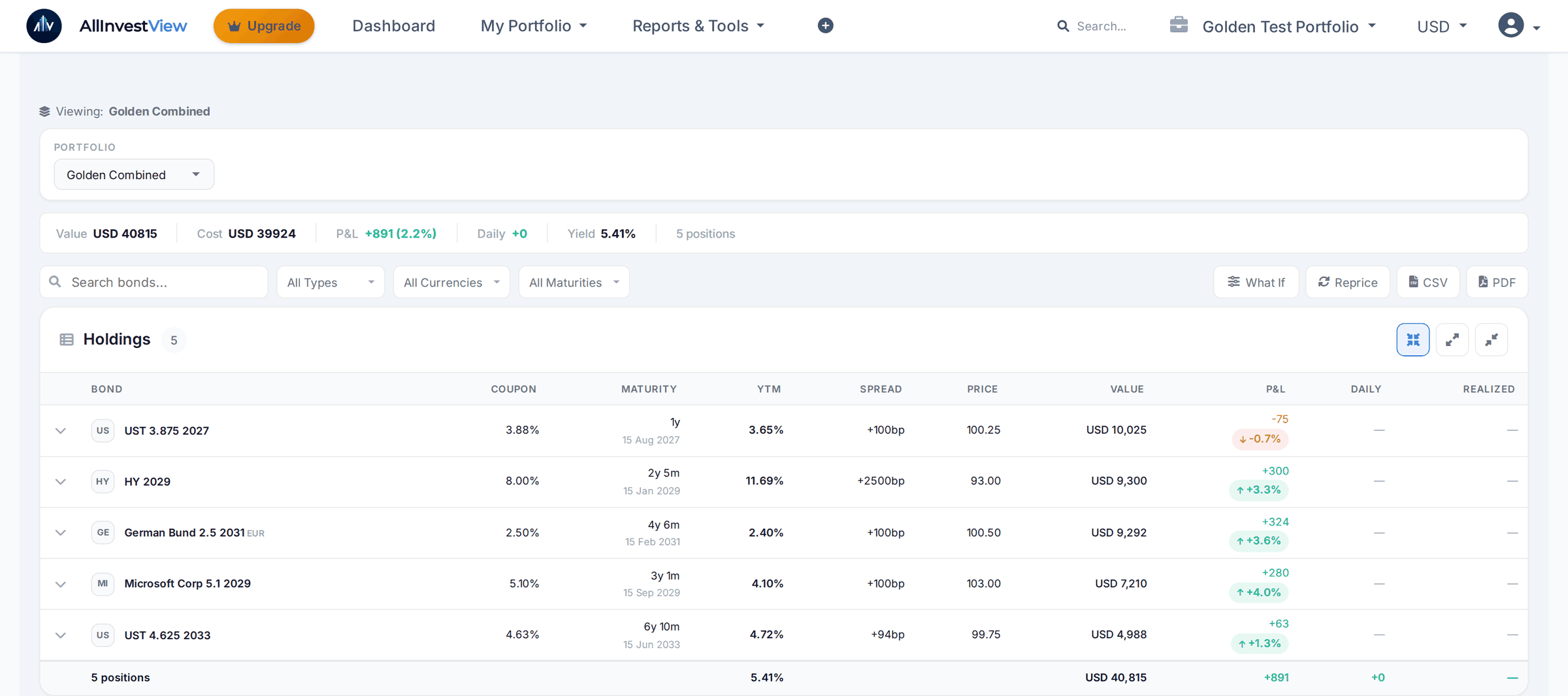
- Bond Report, payments, maturities and portfolio P&L
- Individual bonds alongside stocks, ETFs and other assets
- Not a bond execution venue
- Theoretical values are not executable quotes
- Curve repricing requires compatible terms and a spread anchor
- The stored spread does not update as a live credit feed
- Complex structures are not covered by the standard manual workflow
You already own individual bonds across one or more accounts and need calculation, valuation context, income planning and portfolio reporting in the same place.
Interactive Brokers
Best for bond search and executionInteractive Brokers is the most execution-oriented option in this comparison. Its official Bond Marketplace describes a global fixed-income universe, transparent commission structure and a search tool for comparing available yields. Its Bond Screener supports filters such as maturity, yield, credit rating and issuer type.
That makes IBKR a strong choice for discovering and trading bonds inside the brokerage. It is a different job from maintaining a neutral contract-aware record across multiple brokers, manually defined positions and model valuations.
- Bond search and screening
- Broker quotes, commissions and order entry
- Government, corporate, municipal and other fixed-income instruments
- Positions connected directly to the execution account
- Broker-led rather than broker-neutral workflow
- Best fit for assets available through the platform
- Interface and market terminology can be dense
- Not designed primarily as a manual bond-contract notebook
Your main task is finding available bonds, comparing yields and executing trades in the same brokerage environment.
Sharesight
Best for broad performance and tax reportingSharesight focuses on portfolio performance, income and tax reporting across a broad investment set. Its official help documentation says listed bonds on supported exchanges can be added like shares, while unlisted bonds and other fixed-interest securities can be tracked as custom investments.
This is useful for investors whose fixed-income exposure is mainly listed bond ETFs, exchange-listed bonds or manually priced custom holdings. It is less aligned with users who want to define the full contract schedule and run a transparent benchmark-plus-spread valuation for each individual bond.
- Broad performance and income reporting
- Tax-oriented portfolio workflow
- Listed securities, ETFs and funds
- Custom investment path for unlisted fixed interest
- Custom fixed interest can require manual pricing
- Not centered on full bond schedule definition
- Less emphasis on curve and spread methodology
- Bond analytics depend on how the holding is represented
Your priority is consolidated performance and tax reporting, particularly when most fixed-income exposure comes through listed funds or exchange-listed securities.
Spreadsheet
Best for bespoke manual controlA spreadsheet is transparent in one important sense: you own the file, formula and structure. It can represent unusual fields, custom scenarios and a small portfolio exactly as you prefer. It can also calculate price, yield and duration when the formulas and conventions are implemented correctly.
The cost is operational. The investor must source curve data, maintain schedules, handle day-count conventions, update prices, convert currencies and test formulas. A spreadsheet can be sophisticated, but sophistication comes from the model builder rather than the software itself.
- Complete customization
- Offline ownership and portability
- Transparent formulas when documented well
- Useful for small, stable or unusual portfolios
- Manual data and formula risk
- No automatic source governance
- Schedules and conventions are easy to misapply
- Maintenance grows quickly across accounts and currencies
You need a custom research model, understand the bond math and accept responsibility for every input, update and validation.
Bloomberg Terminal
Best for institutional research and riskBloomberg serves professional investment workflows rather than the retail tracker market. Its official Portfolio and Risk Analytics materials describe cross-asset coverage, including fixed income, with portfolio construction, performance attribution, scenario analysis, risk and reporting. The broader Terminal connects those analytics to professional data, research and trading tools.
That depth is valuable to institutions with dedicated research, trading and risk functions. It is generally disproportionate when the requirement is simply to calculate a personal bond, monitor coupons and maturities, or consolidate a household portfolio.
- Professional fixed-income data and analytics
- Portfolio risk, attribution and scenarios
- Research and relative-value workflows
- Connected institutional infrastructure
- Designed and priced for professional use
- Training and workflow complexity
- Far more capability than basic household monitoring needs
- Not positioned as a lightweight personal tracker
You work in an institutional environment and need professional data, research, portfolio risk and trading workflows rather than a focused personal tracker.
Feature comparison at a glance
This table describes workflow fit, not every feature that may exist somewhere in each platform.
| Workflow | AllInvestView | IBKR | Sharesight | Spreadsheet | Bloomberg |
|---|---|---|---|---|---|
| Manual standard-bond definition | Built in | Inventory led | Custom holding | Build it | Professional |
| Price from YTM and YTM from price | Built in | Analytics | Not the core workflow | Build it | Professional |
| Bond-specific portfolio report | Built in | Broker view | General portfolio | Build it | Professional |
| Curve and spread explanation | Transparent model | Market analytics | Not the core workflow | Build it | Deep |
| Multi-asset portfolio | Yes | Broker account | Yes | Manual | Yes |
| Bond search and execution | No | Core strength | No | No | Professional |
| Tax and broad performance focus | Portfolio tools | Broker reporting | Core strength | Build it | Professional |
Which approach fits your portfolio?
Start with AllInvestView when contract-aware calculations, portfolio cash flows and a neutral consolidated record matter more than execution.
Use Interactive Brokers when available inventory, screening, yield comparison and order entry are the primary job.
A broad tracker such as Sharesight may be sufficient when the important measures are market value, distributions, performance and tax reporting.
Use a spreadsheet when customization outweighs automation and you can validate the schedule, formulas and source data yourself.
Bloomberg belongs in the professional category when research, risk, attribution and trading infrastructure must work together.
Choose a multi-asset tracker that preserves contract analytics for the bonds while treating funds as traded securities.
What AllInvestView actually shows
Because this comparison is published by AllInvestView, the product should be judged through visible evidence rather than marketing adjectives. The calculator shows how a single result was constructed. The Bond Report shows how that calculation connects to portfolio value, income and risk.
Government benchmark + anchored spread = discount yield → theoretical priceAutomatic theoretical repricing requires complete terms, a compatible benchmark and a valid spread anchor.The five base benchmark families are US Treasury, Government of Canada, UK Gilt, ECB AAA and Australian government curves. Eligible euro sovereign bonds can use country-specific adjustments. The platform uses the latest available source observation, and some adjustments update less frequently than the main daily series.
What this does not claim
The model does not provide an executable quote, infer a live credit spread or guarantee coverage for every bond structure and currency. It provides a transparent reference when the required terms and benchmark evidence are available.
Individual bonds and bond funds are not interchangeable
| Tracking need | Individual bond | Bond ETF or fund |
|---|---|---|
| Economic unit | Face value and a quoted price per 100. | Shares and market price or NAV. |
| Cash flows | Contractual coupons and principal repayment. | Fund distributions that can change. |
| Maturity | Defined for the security. | No single contractual redemption date for the investor. |
| Core analysis | YTM, accrued interest, schedule, duration, convexity, BPV and spread. | Total return, distributions, allocation, volatility and tracking. |
Frequently asked questions
What should a bond tracking app calculate?
For individual bonds, look for clean and dirty price, YTM, accrued interest, cash flows, duration, convexity, BPV, spread, maturity and price-source transparency. Bond ETFs need market-price, distribution, allocation and performance tracking.
What is the best bond tracker for individual investors?
It depends on the job. AllInvestView is designed for calculating and monitoring individual bonds. IBKR is stronger for search and execution. Sharesight focuses on broad performance and tax reporting. Bloomberg serves institutional workflows.
Can I track a bond that has no market-data record?
Yes in AllInvestView. Define a standard fixed-rate or zero-coupon bond with finite maturity from its terms, then enter a price to solve YTM or a target YTM to solve price.
Is a theoretical bond price the same as a market quote?
No. It is a model value based on remaining cash flows, a compatible government benchmark and an anchored spread. A broker may quote a different executable price.
Can one app track individual bonds and bond ETFs?
Yes, but the data model should differ. Individual bonds need contract schedules, yield and maturity analytics. Bond ETFs are traded funds tracked through market price, distributions and performance.
Do I need an account to calculate a bond?
No. The AllInvestView Bond Calculator works without an account. Create an account only to save and monitor the bond in a portfolio.
Sources and further reading
External product capabilities were checked against the official pages linked in each review. For AllInvestView's own methodology, use the technical and product resources below.