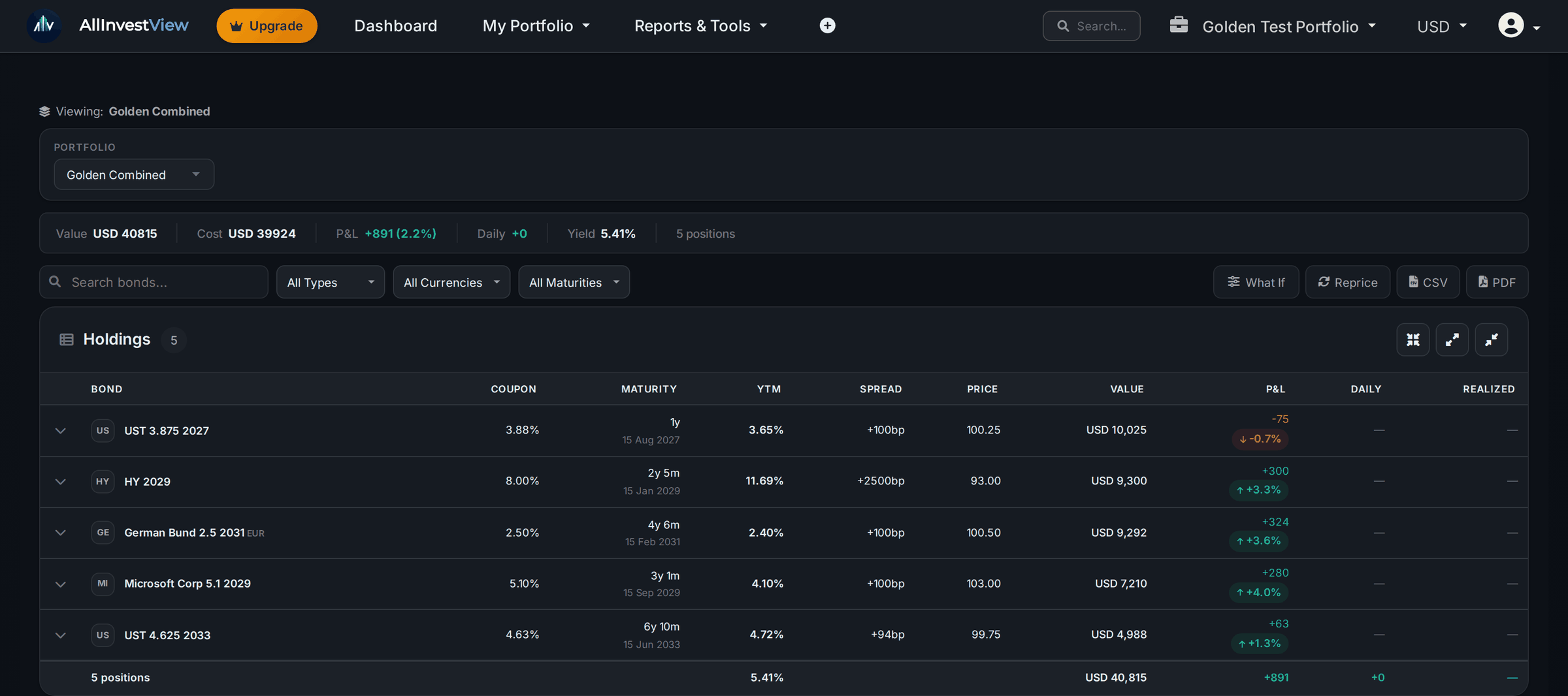
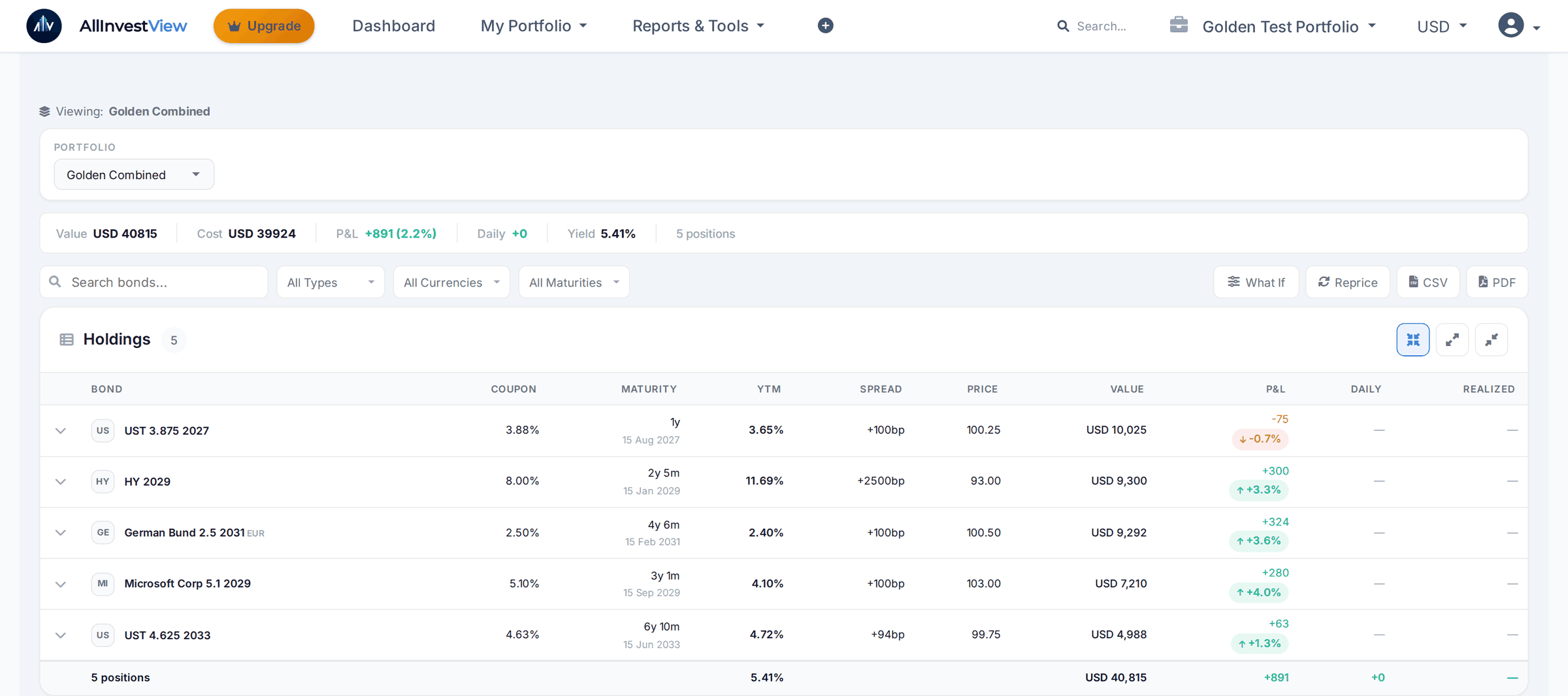
Bond tracking fails when software copies the stock model: identifier, quantity and last price. That is enough to draw an allocation chart, but not enough to explain settlement value, future income, interest-rate sensitivity or what happens at maturity.
In this technical guide
What a bond portfolio tracker must preserve
Every position sits at the intersection of four different records. Combining them into one undifferentiated number is the source of many fixed-income tracking errors.
| Contract | Issue and maturity dates, coupon, payment frequency, day-count convention, schedule rule, stub, face value and currency. |
|---|---|
| Position | Quantity or face amount, purchase date, clean or dirty cost, account, transaction history and realized activity. |
| Valuation | Observed broker or market evidence, calculated price or YTM, accrued interest, timestamp and a clearly labelled price source. |
| Portfolio context | Upcoming payments, maturity concentration, duration, currency exposure, cost, value, profit and loss, and total allocation. |
The latest number is not automatically the best number
A broker quote, a last-traded market price and a theoretical value answer different questions. A useful report preserves the source and date instead of presenting every value as equally executable.
Start with the contract, then attach the portfolio position
The bond schedule drives nearly every useful calculation. Coupon frequency and day count determine accrual. Issue and maturity dates determine the payment timeline. Schedule rules and stubs determine whether the first or final period is irregular. Face value determines the actual cash amount behind a quoted price per 100.
An identifier can accelerate data entry, but it should not be a prerequisite for analysis. In AllInvestView, a standard fixed-rate or zero-coupon bond with finite maturity can be defined manually using its contract terms. An ISIN, CUSIP or existing market-data record is optional for the calculation itself.
Minimum record for an individual bond
- Issue date, maturity date and settlement or valuation date.
- Coupon rate, payment frequency and day-count convention.
- Schedule generation rule and stub when the prospectus requires one.
- Face value, currency, position quantity and transaction price.
- The price basis: clean, dirty, broker, market, user supplied or theoretical.
Price and yield are two views of the same cash-flow schedule
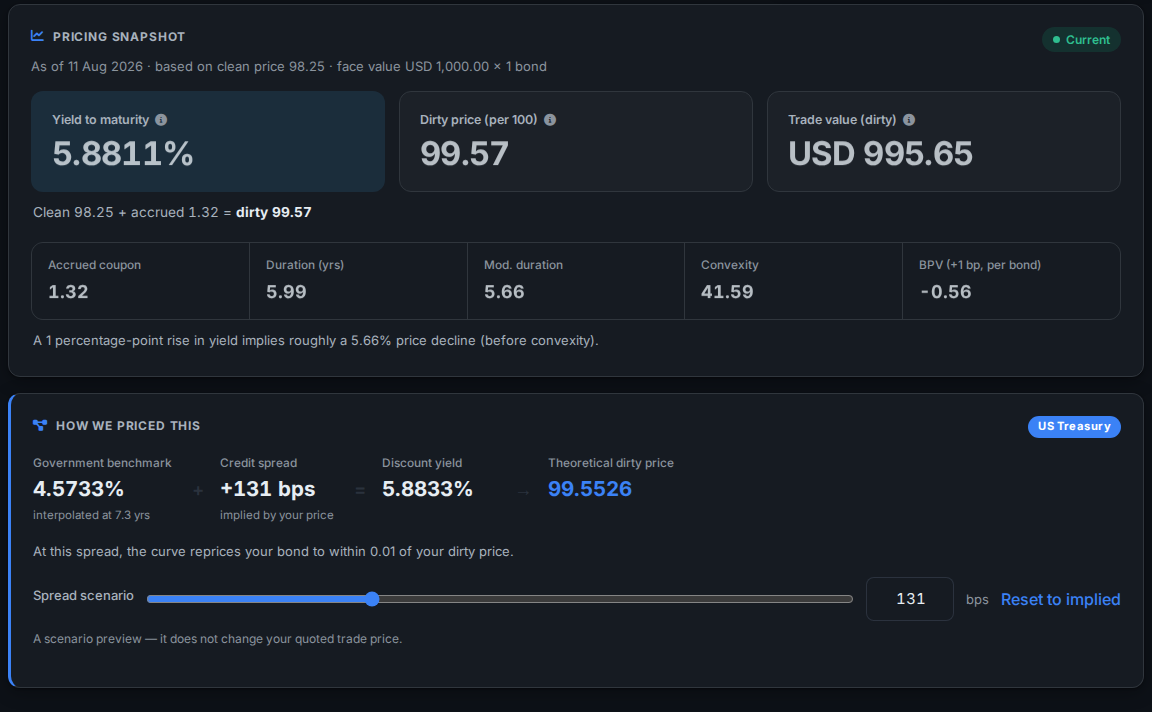
A useful calculator works in both directions. If you know the price, it solves the yield that discounts the remaining payments to that price. If you know the target yield, it discounts the same payments to solve price.
Dirty price = Clean price + Accrued interest
Quoted price and settlement value should remain separate throughout the portfolio.
I know the price
Enter clean or dirty price to calculate YTM, accrued interest, cash flows, duration, modified duration, convexity and BPV.
I know the yield
Enter a target YTM to calculate clean and dirty price using the bond's schedule, compounding basis and day-count convention.
YTM is useful, but it is not a forecast. It is the single discount rate that equates the present value of the scheduled payments to the chosen price under the stated conventions. Reinvestment assumptions, default risk and an early sale can make the realized return different.
How curve and spread repricing fits into the portfolio
Illiquid bonds may go days or weeks without a useful trade. A valuation model can provide a consistent reference between observations, but only when its inputs are complete and its limitations are visible.
Theoretical value = PV(remaining cash flows, compatible benchmark + anchored spread)
The result is a model value, not a promise that a broker will transact at that price.
- Build the remaining coupons and principal from the bond's contractual schedule.
- Select a compatible base benchmark using currency and remaining maturity.
- Derive the spread from a supplied starting price, or use a spread set by the user.
- Add that spread to the latest available benchmark curve and discount each remaining cash flow.
Supported benchmark families
| USD | US Treasury term structure. |
|---|---|
| CAD | Government of Canada term structure. |
| GBP | UK Gilt term structure. |
| EUR | ECB AAA base structure. Eligible Italian, Spanish, French, Portuguese, Irish, Greek and Belgian sovereign bonds can receive country-specific adjustments. |
| AUD | Australian government term structure, with a less frequent fallback where required. |
Cadence is part of the evidence
The platform uses the latest available official observation. Not every source updates at the same frequency: euro sovereign adjustments and an Australian fallback can update less frequently than the main daily series.
Holding the spread constant isolates the effect of benchmark-rate movement. It does not detect a new credit event. When market evidence changes, the spread must be recalibrated or edited. This is why a stored spread is an input to a model, not a live credit-risk feed.
Move from single-bond math to portfolio decisions
A calculator explains one security. A portfolio tracker must aggregate the results without losing the contract behind each line. The finished view should answer questions in six areas.
| Valuation | Current value, cost, unrealized profit and loss, daily movement and the source of the displayed price. |
|---|---|
| Income | Next coupon, expected coupon cash flow, accrued interest, coupon history and upcoming principal repayments. |
| Yield | YTM, current yield, benchmark yield and the spread used for theoretical valuation. |
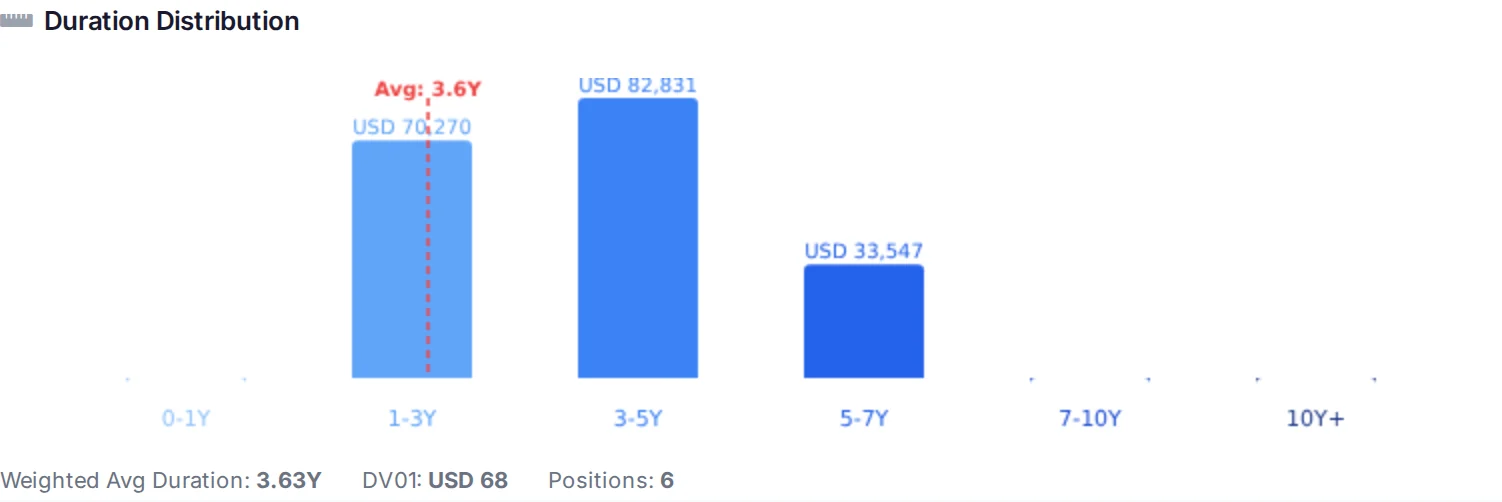
| Rate risk | Duration, modified duration, convexity and BPV at position and portfolio level. |
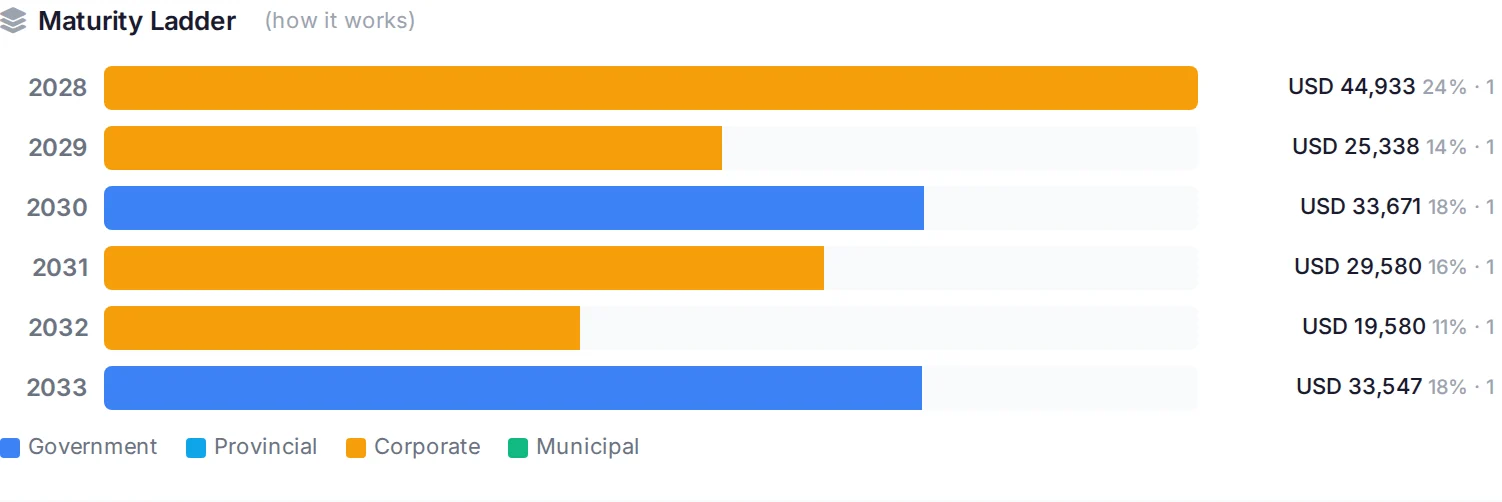
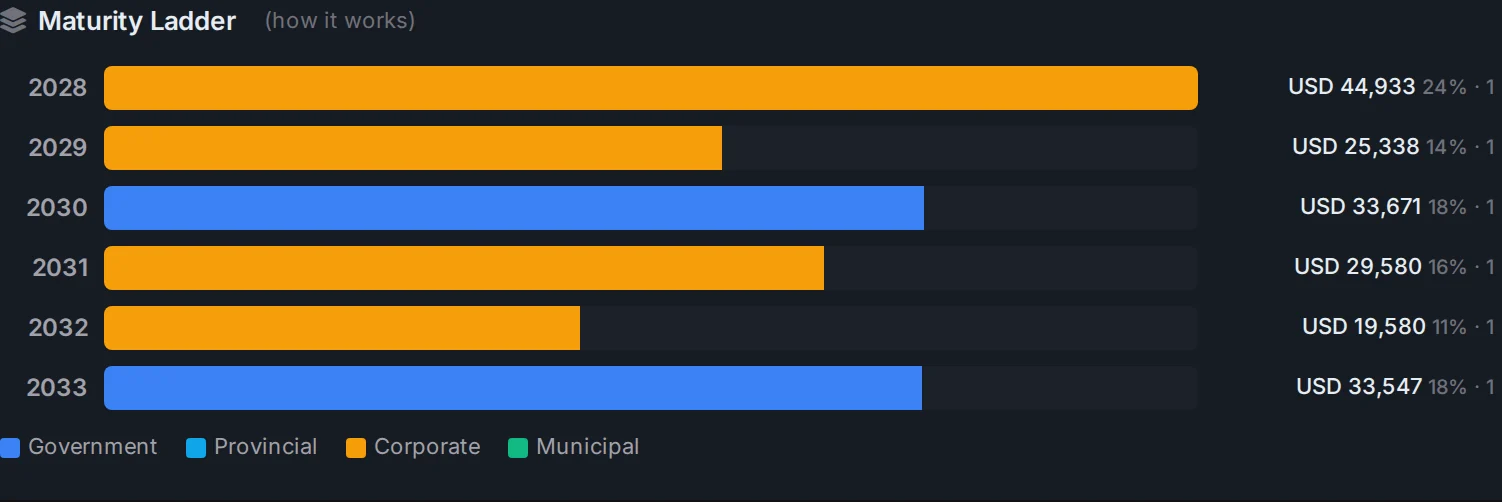
| Maturity | Maturity ladder, concentration by time band and capital becoming available for reinvestment. |
| Exposure | Issuer, country, currency, account and allocation alongside stocks, ETFs and other assets. |
A practical review rhythm
- At entry, validate terms, price basis and schedule against the trade confirmation or prospectus.
- After settlement, confirm accrued interest, face amount, cost and the first expected payment.
- During monitoring, review price source, curve date, spread and material changes in duration or value.
- Before maturity, plan principal reinvestment and confirm the final coupon and redemption amount.
CSV and PDF exports are useful only after these definitions are consistent. Exporting a stale or ambiguously sourced number does not make it more reliable.
Individual bonds and bond ETFs need different records
Both belong in the same total allocation, but they do not have the same economics for the investor.
| Question | Individual bond | Bond ETF or fund |
|---|---|---|
| Maturity | Contractual date for principal repayment. | The fund normally continues while its holdings change. |
| Position unit | Face value and quoted price per 100. | Shares and market price or NAV. |
| Income | Scheduled coupons and principal. | Fund distributions, which can vary. |
| Core analytics | YTM, accrued interest, schedule, duration, convexity, BPV and spread. | Total return, distributions, allocation, volatility, tracking and fund duration where published. |
| Valuation | Broker, market or theoretical bond price. | Exchange price and NAV context. |
One portfolio, two correct models
AllInvestView treats listed bond ETFs as traded securities and individual bonds as contractual cash-flow instruments, while keeping both inside the same allocation and performance view.
Bond portfolio tracking FAQ
What information do I need to track an individual bond?
Record issue date, maturity, coupon, frequency, day count, schedule rule, face value, currency, purchase date, quantity and either price or yield. Include stub details for irregular coupon periods.
Can I calculate a bond without an ISIN or market-data record?
Yes. Define a standard fixed-rate or zero-coupon bond with finite maturity from its terms. Enter a price to solve YTM or a target YTM to solve price.
How should I value a bond without a recent market quote?
You can calculate price from a target yield. Automatic theoretical repricing also requires complete terms, a compatible benchmark and a starting price or user-set spread. The result is a model value.
Should bond ETFs be tracked like individual bonds?
No. Track an ETF through shares, market price or NAV, distributions and performance. Track an individual bond through its schedule, accrued interest, yield, risk and maturity.
Which risk metrics matter for a bond portfolio?
Duration, modified duration, convexity and BPV describe rate sensitivity. Benchmark and spread add pricing context. Maturity and payment concentration reveal liquidity and reinvestment risk.
Is a theoretical bond price the same as a market quote?
No. It is a model value calculated from remaining cash flows, a compatible benchmark and a spread. A broker or dealer may quote a different executable price.