- Home
- Canada tax report
- Adjusted cost base calculator
Adjusted Cost Base Calculator
Enter your buys and sells of one stock or ETF. You get the ACB per share after every trade, the capital gain on each sale, any superficial loss, and your taxable capital gain.
After the last trade you hold 30 shares with an adjusted cost base of $1,505.68, or $50.19 a share. Your 2025 net capital gain is $342.72, and 50% of it, $171.36, is taxable.
- ACB per share
- Buy price
- Sale price
Capital gain on each sale
| Sale | Proceeds | ACB | Gain or loss |
|---|
ACB after every trade
| Trade | Shares held | Total ACB | ACB per share |
|---|
What adjusted cost base means
Your adjusted cost base is what the shares you own cost you, commissions included. In Canada, identical shares share one average cost. Buying changes that average. Selling removes the cost of the shares sold and leaves the average where it was.
That is why the cost your broker shows can differ from the one your return needs. The CRA pools identical shares across all your non-registered accounts, so a second broker, a dividend reinvestment plan or a trade in US dollars all feed the same ACB.
The ACB formula
A purchase adds its price × shares + commission to the total ACB.
A sale removes ACB per share × shares sold from it.
Capital gain = proceeds − ACB of the shares sold − selling costs
Taxable capital gain = net capital gain for the year × 50%
Here is the example loaded in the calculator above, worked by hand.
- You buy 100 shares at $48.20 with a $9.99 commission. The ACB is $4,829.99.
- You buy 50 more at $52.10. The ACB grows by $2,614.99 to $7,444.98 for 150 shares, which is $49.63 a share.
- You sell 60 at $61.75. The proceeds are $3,705.00, the ACB of those shares is $2,977.99 and the commission is $9.99, so the capital gain is $717.02. The ACB per share of what you still hold stays at $49.63.
Pooled ACB example: two buys and a partial sale
You buy 100 shares on 15 January 2025 at C$20, then another 100 on 15 March at C$30. Each purchase costs C$10 in commission. These are identical shares in your own non-registered accounts, so they share one pool even if you used two brokers.
- The first purchase adds C$2,010 to ACB. The second adds C$3,010.
- Total ACB is C$5,020 for 200 shares, or C$25.10 per share. This is a weighted average of the costs, including purchase commissions.
- On 15 June you sell 80 shares at C$40 with C$10 commission. Proceeds are C$3,200, the ACB sold is 80 × C$25.10 = C$2,008, and selling expenses are C$10. Your capital gain is C$1,182.
- You still hold 120 shares with C$3,012 of ACB. The cost per share stays C$25.10. With no other gains or losses, the 50% inclusion rate gives C$591 of taxable capital gain, not C$591 of tax.
A Canadian ACB tracker needs the history from every taxable account holding the same security. A broker's average purchase price can miss commissions, earlier purchases at another broker or later cost-base adjustments.
Superficial loss example: buy back half the shares
In a separate example with no commissions, buy 100 shares on 15 January 2025 at C$30. Sell all 100 on 1 July at C$20 for a C$1,000 loss. Buy back 50 identical shares in your taxable account on 15 July at C$22 and still hold them on 31 July, 30 days after the sale.
Half the sold shares have been replaced and are still held, so C$500 of the loss is denied. The remaining C$500 capital loss is allowed. The C$1,100 replacement purchase gains C$500 of ACB, giving C$1,600 total ACB, or C$32 per share. The calculator shows the denied amount and a separate ACB addition after the 30-day window.
Superficial losses
A superficial loss applies when you or an affiliated person acquire identical shares within 30 days before or after a loss-making sale and still own the replacement shares 30 days after the sale. The CRA denies the loss and adds it to the ACB of the shares you bought back, so the loss is postponed rather than lost. Only the part that matches the shares you bought back is denied.
In the example, the sale on 3 April 2025 loses $231.32 on 40 shares, and 30 shares are bought back 21 days later. So 30/40 of the loss, $173.49, is denied and moves into the ACB of the new shares. The calculator flags it on the sale and shows the ACB addition on its own row.
The rule also looks at purchases by your spouse or common-law partner and inside your own TFSA or RRSP. A buyback in a registered account denies the loss for good, because there is no ACB there to carry it. This calculator checks the trades you enter. The Canadian filing pack checks the accounts included in your report and the spouse or partner holdings you declare.
Where the numbers go on your return
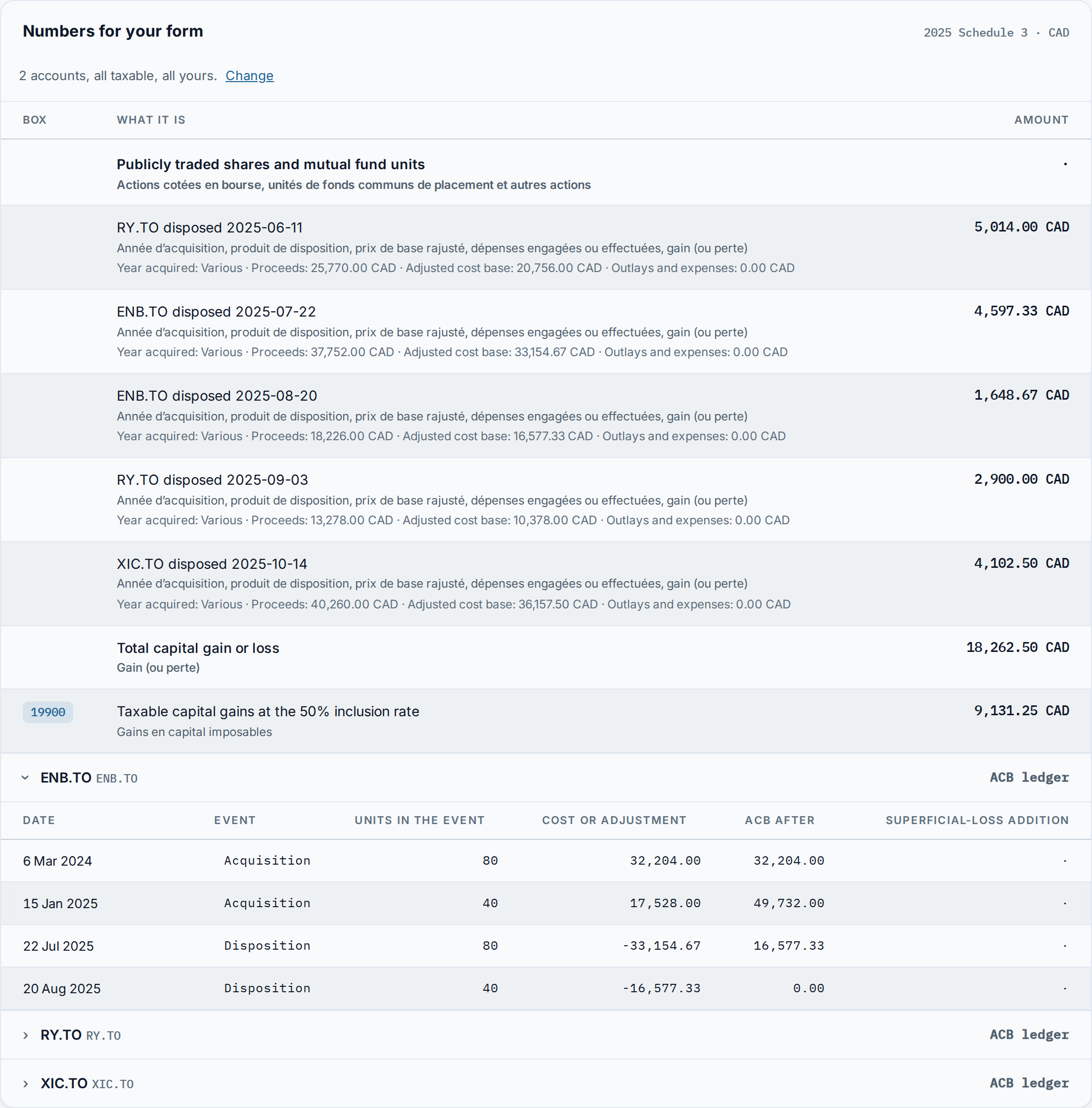
Each sale is a line on Schedule 3, in the section for publicly traded shares and mutual fund units: the year you bought, the proceeds, the adjusted cost base, your outlays and expenses, and the gain or loss. Half of your net capital gain for the year goes on Schedule 3 line 19900 and T1 line 12700. Losses carried forward from earlier years are claimed separately on T1 line 25300. Your federal and provincial rates then decide the tax.
A sale counts in the year it settles, so one made on 31 December that settles in January belongs to the next year. That is why the calculator asks for settlement dates, and why a US dollar trade uses the exchange rate for its settlement date.
The T5008 slip from your broker shows proceeds, and sometimes a cost. Use the ACB from your own records instead when you hold the same shares in more than one account or switched brokers along the way.
Every broker, one ACB, ready for Schedule 3
Import the trades from all your brokers into AllInvestView and the Canadian filing pack keeps one ACB ledger per security across every non-registered account. It converts each US dollar leg at its own Bank of Canada rate and checks superficial losses against your registered accounts too.
- Schedule 3 rows in Canadian dollars and line 19900 at the 50% inclusion rate
- Superficial-loss checks across your TFSA, RRSP and a spouse you declare
- T5008 reconciliation, T1135 screening, and PDF, Excel or CSV exports
14-day trial with the filing pack included. No card required.
 AllInvestViewCanadian filing pack
Questions about adjusted cost base
Do I pool adjusted cost base across different brokers?
Yes. Identical shares you own in non-registered accounts use one pooled ACB, even across brokers. Combine the purchases and commissions before calculating the average. Keep registered accounts outside that taxable pool, but include their purchases when checking for superficial losses.
How do you calculate adjusted cost base?
Add up everything you paid for the shares, commissions included, and divide by the number you hold. Each new purchase adds its cost to the pool. A sale takes out its share of the pool at the average cost, so selling never changes the ACB per share of what is left.
Is the commission on a sale part of the ACB?
No. Commission on a purchase goes into the ACB. Commission on a sale is an outlay and expense of selling, which comes off the proceeds of that sale instead. The calculator shows it in its own column.
What is a superficial loss?
A loss is superficial when you, or someone affiliated with you, buy the same shares in the 30 days before or after the sale and still hold them 30 days after it. The loss is denied. The denied loss increases the ACB of replacement shares in a taxable account.
How do I enter US dollar trades?
Choose USD and enter the Bank of Canada rate for each settlement date, as Canadian dollars per US dollar. Each purchase and sale is converted at its own rate.
Where does the gain go on my tax return?
Each sale goes on Schedule 3 with the proceeds, the ACB and the outlays. Half of your net capital gain for the year goes on Schedule 3 line 19900 and T1 line 12700. Losses carried forward from earlier years are claimed separately on T1 line 25300.
Do I need to track ACB in a TFSA or RRSP?
You do not report capital gains from investments held inside a TFSA or RRSP on Schedule 3. Purchases there still matter for superficial losses: a buyback inside your TFSA or RRSP can deny a loss in your taxable account permanently.
Keep going
An estimate from the trades you enter, at the 50% inclusion rate that applies to sales from 2001 on. It is not tax advice, and the tax you pay depends on your income and province.
Sources: CRA guide T4037, Capital Gains; Income Tax Act sections 38, 40(2)(g), 47, 53 and 54.