Dispositions
- Rule
- Year acquired, proceeds, adjusted cost base, outlays, and the gain or loss.
- Line
- Schedule 3, publicly traded shares
- Pack
- Prepared. One row per disposition in Canadian dollars.
Adjusted cost base is pooled by property across all your non-registered accounts, which is why a cost figure from one broker is rarely the one Schedule 3 wants. The Canadian pack keeps a single ACB ledger and works every disposition out in Canadian dollars from it.
What the return needs from a portfolio, and how far the pack takes each piece.
| Item | The rule | Form and line | What the pack produces |
|---|---|---|---|
| Dispositions | Each disposition reports the year acquired, proceeds, adjusted cost base and any outlays, and the resulting gain or loss. | Schedule 3, publicly traded shares | Prepared One row per disposition in Canadian dollars, with the bilingual caption the form uses. |
| Adjusted cost base | Identical property is pooled across every non-registered account you hold, not kept separately by broker. | Behind the Schedule 3 rows | Reconciled One ledger per property with units, cost, the ACB after each event and any manual adjustment you record. |
| Superficial losses | A loss is denied when you or an affiliated person buys the property back in the window and still holds it, and the denied amount is added to the replacement's cost. | Reduces the Schedule 3 loss | Checked Against your own replacements, your registered accounts and a spouse or partner you declare. |
| Foreign-currency trades | Each leg converts on its own operative date, so a purchase and a sale do not share one annual average. | Inside every Schedule 3 amount | Converted Acquisition and disposition legs use their own operative-date Bank of Canada rates. |
| Taxable capital gains | Half of the net capital gain enters taxable income. The tax itself depends on your total income and your province. | Schedule 3, line 19900 | Prepared The total gain and line 19900 at the 50% inclusion rate, with prior net capital losses you select applied first. |
| Foreign property | Specified foreign property whose cost passes CA$100,000 at any point in the year has to be reported. | T1135 | Screened Peak tracked cost against the CA$100,000 test, with simplified-method availability shown while cost stays under CA$250,000. |
| Submitting the return | Schedule 3 is filed with your T1, and T1135 separately when the threshold is met. | Schedule 3 with the T1 | You file Everything leaves as a file for you or your accountant. |
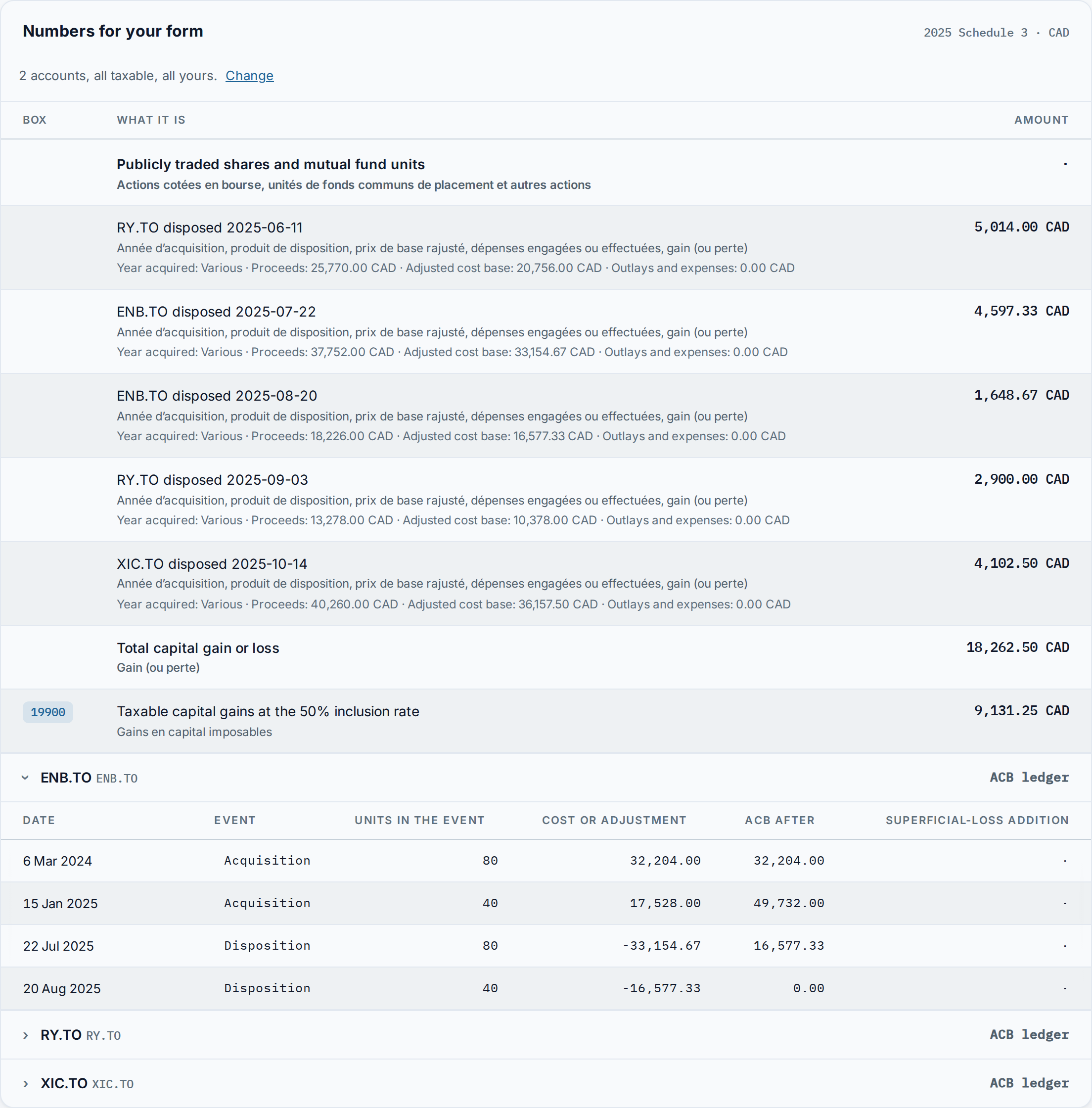
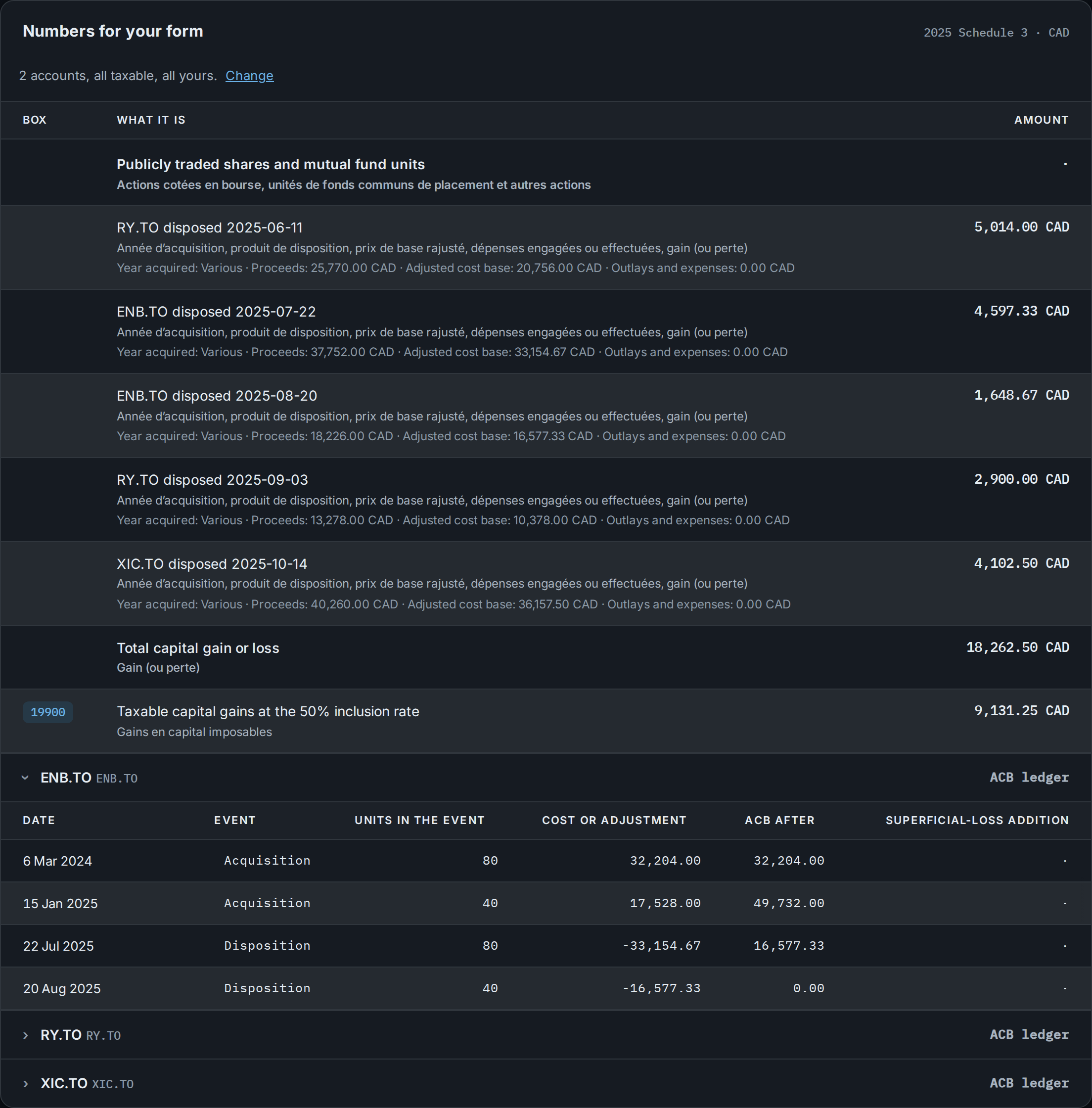
Each Schedule 3 row shows the year acquired, proceeds, adjusted cost base and outlays in Canadian dollars, under the bilingual caption the form prints. Below them sit the total capital gain and line 19900 at the fifty percent inclusion rate. Open a holding and the pooled ACB ledger shows every acquisition and disposition, the cost after each one, and any superficial-loss amount added back.
Open the Canadian pack AllInvestView
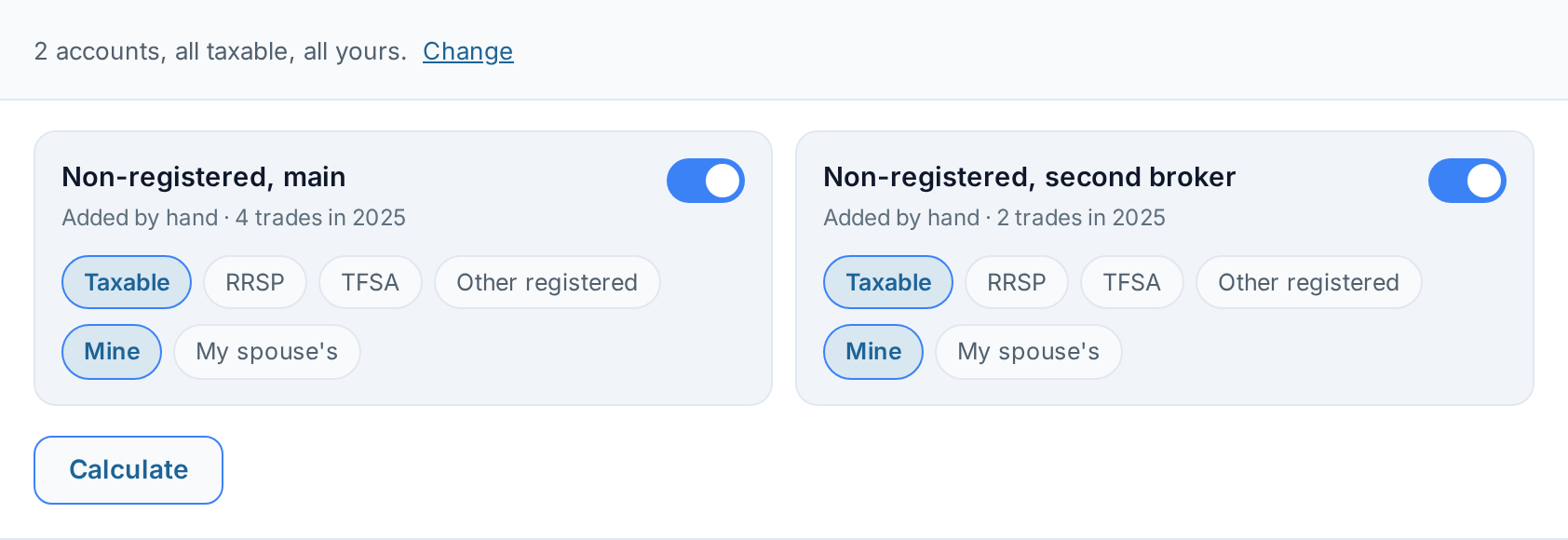
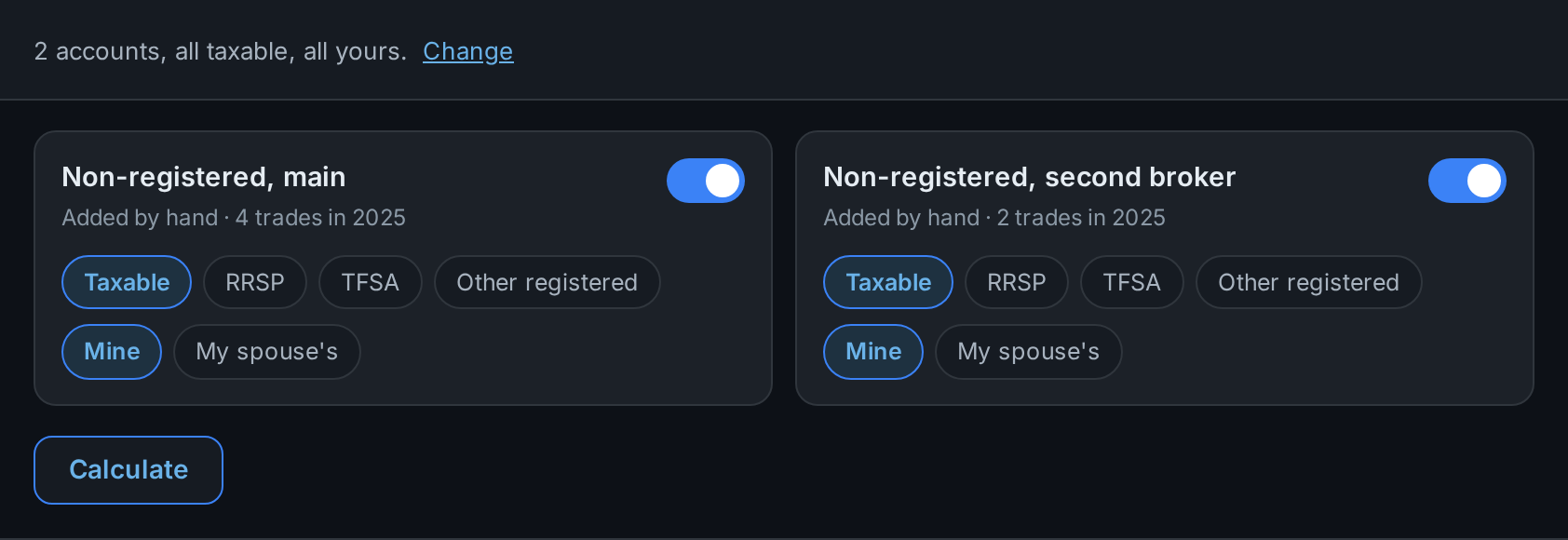
Pooling and superficial-loss checks both depend on seeing everything, so the pack asks about each account up front. Each card carries the wrappers a Canadian investor really holds: taxable, RRSP, TFSA or another registered plan, plus whose account it is. An RRSP or TFSA never adds a gain to your return, but a rebuy inside one can still deny a loss outside it, which is why naming them matters.
See the accounts stepAllInvestView
PDF, Excel and CSV carry the Schedule 3 rows together with the ACB ledger and the T5008 reconciliation behind them. A gap in the cost history or two manual adjustments that disagree keep the buttons off until you resolve them. Closing the year freezes the calculation revision, so next year's pool starts from the cost you actually filed.
See what exportsAllInvestView
It does not file Schedule 3 or T1135, and it does not work out your federal and provincial marginal tax, because that depends on income the pack never sees. The T1135 result is a cost-exposure screen, not a completed form.
It follows the 2025 Schedule 3 revision and refuses form years it has not verified. Where the cost history is incomplete, a Bank of Canada rate is missing, or two manual ACB adjustments disagree, the affected total is blocked rather than estimated.
Canadian adjusted cost base is pooled by identical property across the taxpayer's non-registered accounts. The cost a single brokerage shows you is its own view of its own account, and it can differ from the pooled ACB the return needs whenever the same property is also held or traded somewhere else.
The pack builds one ACB ledger across the accounts in scope, recording units, cost, adjustments, the ACB after each event and any superficial-loss addition. A coverage list separates the taxable accounts included in the calculation from the registered accounts used only as evidence.
The superficial-loss test looks at replacement purchases by you, inside your registered accounts, and by an affiliated spouse or partner when you declare one. Where the rule bites, the denied amount is not lost: it is added to the cost of the replacement property, and the ledger records it there.
Missing taxpayer-wide coverage, an incomplete cost history, a missing Bank of Canada rate, or manual adjustments that contradict each other will stop a filing total. That is the point: incomplete evidence should not quietly become a finished number.
Foreign-currency acquisition and disposition legs use separate Bank of Canada rates for their own operative dates, so a 2022 purchase and a 2025 sale are not flattened into one average. The Schedule 3 rows then show proceeds, ACB, outlays and the result in Canadian dollars.
When a required rate is missing the pack blocks the affected result rather than substituting a nearby one.
The T1135 check follows the peak historical cost of tracked specified foreign property in the taxable accounts you selected. It flags when that cost passes CA$100,000 and shows that the simplified method remains available while it stays under CA$250,000.
It sits beside the Schedule 3 work deliberately, because the threshold is easy to cross and easy to forget while you are reconciling disposals.
Not tax advice. AllInvestView prepares evidence for review. You or your tax adviser remain responsible for checking the figures and filing with the Canada Revenue Agency.
Bring the cost history together once and the pool, the superficial-loss checks and the foreign-property screen keep themselves current.
Identical property is pooled across all non-registered accounts for the taxpayer. The Canadian pack keeps one ACB ledger across the accounts in scope rather than relying on an account-local broker cost.
Yes. It checks replacement activity for the taxpayer, registered accounts, and a declared affiliated spouse or partner. The ledger records superficial-loss additions to replacement-property ACB.
Each foreign-currency acquisition and disposition leg uses its own operative-date Bank of Canada rate. A missing required rate blocks the affected filing total.
The pack tracks peak historical cost of specified foreign property and flags when it exceeds CA$100,000. It also shows simplified-method availability while tracked cost remains below CA$250,000.
The calculator uses a 50% inclusion rate. Half of the net capital gain enters taxable income, while the final tax depends on the taxpayer's income and province.
The current calculator supports the 2025 Schedule 3 revision. It blocks unsupported form years rather than mapping figures into an unverified layout.