1. A worked example: a 5-yr corporate bond and its hedge
You own a 5-year investment-grade corporate bond at a yield-to-maturity of about 5%. You don't want to take a view on rates, only on the issuer's credit. So you short a 5-year U.S. Treasury futures contract against it. Rates rise, the Treasury leg gains, the corporate loses, and the two largely cancel.
Largely. Not exactly. The leftover is the asset-swap spread — what the bond pays you over the rates curve in exchange for taking the issuer's credit. Two related concepts hide inside it:
- CDS-bond basis: the difference between the bond's traded credit spread and the same issuer's credit default swap spread. In stress regimes this basis can sit at minus 200 bps for weeks (2008) or briefly hit minus 400 (March 2020), even when the rates hedge is doing its job perfectly.
- Cheapest-to-deliver basis: the Treasury future is priced off the cheapest-to-deliver bond in the deliverable basket. When the CTD switches, your hedge ratio quietly shifts and the residual moves with it.
The hedge: rates cancel, basis remains
2. Three places bond investors hit basis risk
The list is shorter than the textbooks suggest. Most retail bond exposure to basis lives in three families.
2.1 Cross-hedge and correlation risk
Strictly speaking, hedging a high-yield position with an IG ETF or hedging an Italian BTP with a Bund future is cross-hedge risk rather than narrow basis. The vocabulary distinction matters to a desk; the failure mode is identical to a reader. The proxy you picked moves differently from the position you actually hold. In calm regimes the correlation holds at 0.85; in stress it drops to 0.55 and your "hedge" is no longer a hedge.
The retail version: bond ETFs hedged with a different bond ETF, or a portfolio of HY names hedged with a sector index. The hedge ratio is right on average and wrong when it matters.
2.2 Curve construction and proxy risk
This is the basis hiding in the pricing engine, not in the hedge. When the curve a bond is priced against is built from mixed-source pillars — say, an interbank rate at 3 months and a government yield at 10 years — the curve between those pillars is partly basis. Most days the gap between interbank and government rates is 5 to 40 basis points and largely stable. In funding stress that gap widens fast.
This applies to fewer pricing sources than you might think. Most major-currency curves (USD UST, EUR ECB AAA, GBP Gilt, CAD GoC) are pure govt at every published pillar. The currencies where curve construction risk is real are smaller markets where the only available public data mixes instruments — Australian govt yields fall back to an OECD-published basket that includes the RBA cash rate and BBSW interbank when the RBA's direct feed is unreachable. We talk about that case in the bond pricing methodology article.
2.3 FX and cross-currency basis
For an EUR-based investor holding USD bonds, two FX basis risks stack:
- Hedge cost: an FX forward to convert future USD coupons into EUR has a hedge cost that drifts with the EUR/USD interest rate differential. Mostly predictable.
- Cross-currency basis swap: the premium one currency pays to borrow another in the swap market beyond what interest-rate differentials would imply. This is the wild card. EUR/USD basis sat near zero through most of 2024, then turned mildly negative through 2025. In March 2020 it blew out by 80+ bps over a week and stayed wide for a month.
The same applies in the other direction: a USD investor in EUR sovereigns, a JPY investor in anything global. Currency-hedged bond ETFs internalise this and pass the hedge cost through to investors as a drag on returns — and an opaque drag, because the underlying basis-swap moves aren't broken out in most ETF reporting.
3. Basis risk vs tracking error vs spread risk
These three get conflated constantly. They aren't the same thing.
| Concept | What it measures | Where you see it |
|---|---|---|
| Basis risk | Residual P&L when your hedge or pricing reference doesn't move identically to your underlying | Asset-swap spreads, CDS-bond basis, cross-currency basis, futures CTD switch |
| Tracking error | Historical standard deviation of a fund's return minus its benchmark's return | ETF / mutual fund factsheets, performance reports |
| Spread risk | Outright widening or tightening of a credit, sovereign, or sector spread to its benchmark | Daily bond marks, credit indices, sovereign spreads (BTP-Bund, OAT-Bund) |
The mental model: spread risk is the level of credit premium moving. Basis risk is whether your reference and your holding move together. Tracking error is the realised history of (mostly) the second one. A position can have low tracking error against its benchmark for years and still carry sizeable basis risk that hasn't shown up because the regime has been calm.
4. When basis matters and when it's noise
Most retail bond portfolios live in the noise band. Basis on a $50k currency-hedged bond ETF position sits at a 5-20 bp drag versus the underlying through normal years. Annoying but not portfolio-changing.
It matters in three specific situations:
- Funding stress: any episode that breaks bank-funding markets — September 2019 repo, March 2020 dash-for-cash, 2008 Lehman week. Basis between govt and interbank, between cash bonds and CDS, and across currencies all widen in lockstep.
- Concentrated illiquid positions: a large position in an illiquid corporate hedged with a liquid index. Both legs are priced fairly on a normal day. In stress the illiquid leg can't be exited at the marked price; the hedge can.
- Currency-hedged income strategies: living off the income from a cross-currency hedged bond portfolio means the hedge cost is part of your yield. When cross-currency basis turns negative for your direction, the hedge cost eats into the carry. The position is "still working" but earning less than the marketing numbers implied.
The modern institutional touchstone
LIBOR ceased in 2023; synthetic USD LIBOR ended 2024. The live touchstones in 2026 are the SOFR-IORB spread (US dollar funding stress), FRA-OIS (forward bank-funding pressure), and the EUR/USD cross-currency basis swap (the canonical retail-accessible cross-currency basis read). When any of the three move three standard deviations from their trailing mean, retail bond investors with cross-currency or hedged-ETF exposure should re-check their hedge assumptions.
5. A practical investor checklist
Five steps a bond investor can run today
- List every position whose pricing depends on a reference other than itself — bond ETFs vs their underlying baskets, cross-currency holdings, any bond priced off a benchmark curve rather than a direct dealer quote.
- Tag the source per position. Which curve, which vendor, which hedge instrument. A position priced off a mixed-source curve carries more basis than one off a direct govt yield.
- Stress test in the 2020 regime. Re-price assuming cross-currency basis widens 80 bps, repo blows 100 bps, ETF-to-iNAV gaps open 1.5%. Anything that breaks at that level is your real basis exposure.
- Size for the gap, not the mean. Basis is mean-reverting until it isn't. Size positions assuming the gap can sit at the stress level for weeks.
- Watch the three modern indicators. FRA-OIS, EUR/USD cross-currency basis swap, and ETF premium-discount to iNAV. They are the retail-accessible reads on whether basis is widening systemically.
6. How AllInvestView surfaces it
Most retail trackers handle bond pricing one of two ways. Either they don't price bonds at all and rely on whatever number the broker last sent (usually purchase price, sometimes a stale market mark), or they pull from a single mixed-source vendor feed and don't disclose what's behind it.
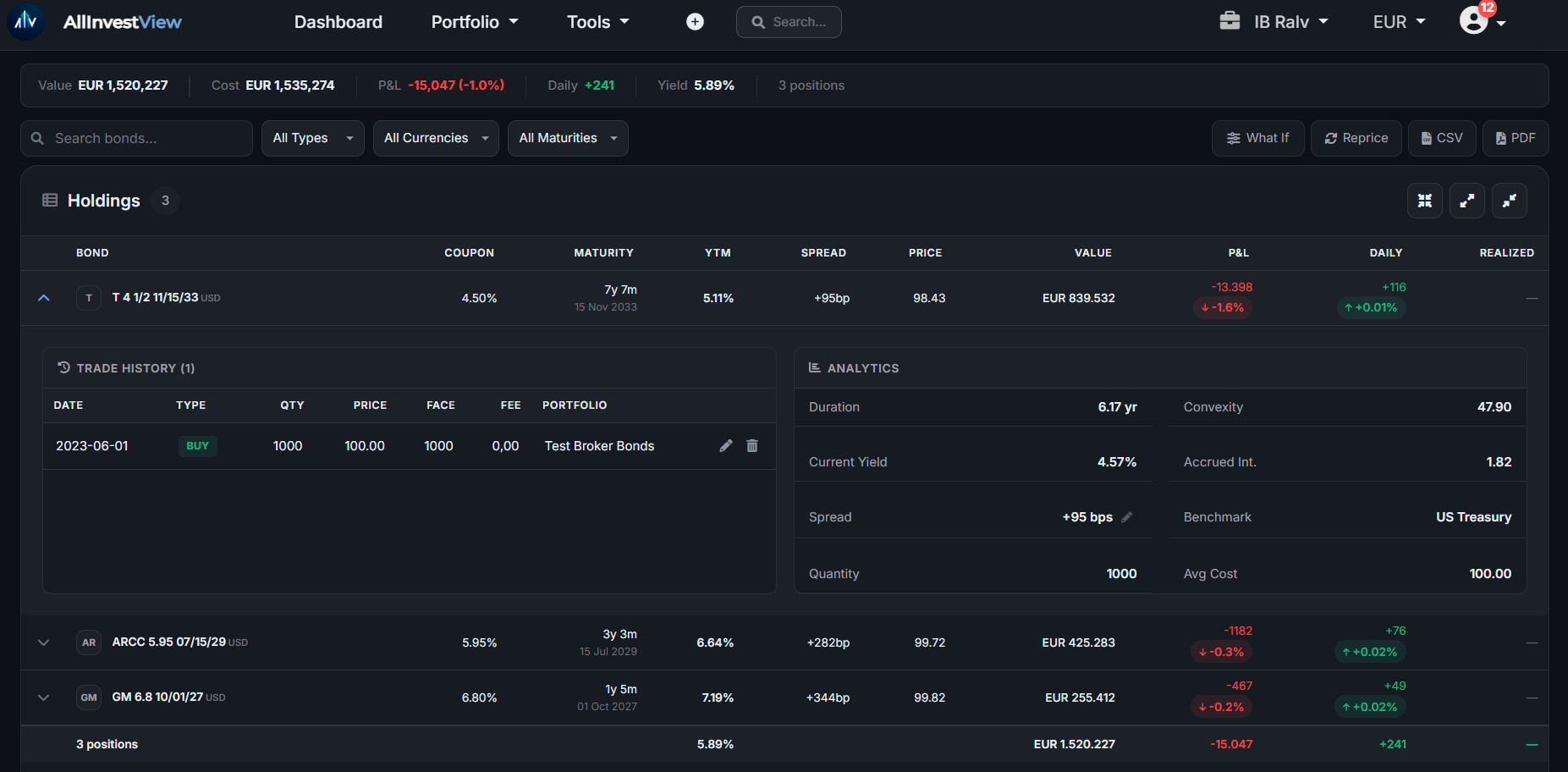
AllInvestView prices every bond off a named source curve: U.S. Treasury, ECB AAA par, Bank of England gilt, Bank of Canada, RBA F2 for Australian govt, and country-shifted variants for IT, ES, FR, PT, IE, GR, BE EU sovereigns. The bond report shows the named benchmark next to the spread on every row. When a primary source is unreachable, the fallback path is documented and the per-pillar source is tagged on the stored data so a fallback-priced bond can be identified after the fact.
This is a methodology choice, not a feature. It exists because a bond mark that doesn't tell you what curve it came from is hiding the basis from you. For a passive holder of a few sovereigns that doesn't matter much. For someone running a cross-currency book, a leveraged carry trade, or a concentrated position in a niche issuer — it matters a lot.
The full methodology, including how implied spreads are calibrated at trade date and how the engine refuses to publish a number when the inputs aren't credible, is in the bond pricing engine article. The Bond Spread Calculator covers how I-spread, Z-spread, and OAS relate; the Yield Curve Calculator covers the term-structure side.
If you run a fixed-income book yourself, our bond portfolio tracker page compares the bond-side features across major retail platforms. For advisors managing client books, the advisor-focused bond tracker page covers the workflow side.
7. Frequently asked questions
See the basis on your own bonds
Each bond in AllInvestView shows its spread to a named benchmark curve. For sophisticated holders, that means the basis you're carrying is in front of you on every row, not hidden inside a black-box mark.
Start Free Try the Bond Calculator