- What it tracks
- Crypto, stocks, ETFs, funds, bonds, options, property and cash
- How crypto gets in
- Coinbase, Binance and Kraken sync on paid plans; any other exchange from its export file
- At tax time
- Crypto sales in the same capital gains report as your shares, with FIFO, LIFO, HIFO and average cost side by side
- Price
- Free for 10 holdings; from $6.99/month billed annually
Best Crypto Portfolio Trackers 2026: 8 Compared
AllInvestView is our pick if your crypto sits next to stocks, ETFs or bonds: Coinbase, Binance and Kraken sync, your coins share one dashboard and one return with everything else, and every crypto sale lands in the same capital gains report, with FIFO, LIFO, HIFO and average cost compared for each coin. Start free with 10 holdings; paid plans from $6.99 a month billed annually. If your coins live in self-custody wallets and DeFi, CoinStats reads 120+ blockchains. For crypto tax forms on their own, Koinly and CoinTracker do that job.
- Trackers compared
- 8
- Exchanges that sync
- 3
- Cost methods
- 4
- Checked
- 22 October 2026
Picks by what you need
Six common ways people hold crypto, and the tracker that fits each.
Eight crypto trackers compared
What each one holds, how your coins get in, what it gives you at tax time, and the price.
| Tracker | What it tracks | How crypto gets in | At tax time | Price |
|---|---|---|---|---|
| Crypto, stocks, ETFs, funds, bonds, options, property and cash | Coinbase, Binance and Kraken sync on paid plans; any other exchange from its export file | Crypto sales in the same capital gains report as your shares, with FIFO, LIFO, HIFO and average cost side by side | Free for 10 holdings; from $6.99/month billed annually | |
| Coins, DeFi positions and NFTs across 120+ blockchains | 300+ wallets and exchanges, with read-only access | Tax reports through CoinLedger, a separate service | Free plan; Premium $13.99/month | |
| Crypto, including DeFi, NFTs, staking and mining | 900+ exchanges and wallets, by read-only API key or CSV | Form 8949 and Schedule D, and reports for 100+ countries | Free to track up to 10,000 transactions; reports from $49 per tax year | |
| Crypto, DeFi, staking and NFTs | 500+ wallets, exchanges and blockchains, read access only | Form 8949 and Schedule D on paid plans; TurboTax and H&R Block | Free tracking; Base $59/year for 100 transactions | |
| Crypto, stocks, ETFs and funds | Exchange API keys, wallet addresses and eToro sign-in | Realized and unrealized gains reporting on PRO+ | Free for 10 assets; PRO $53.88/year | |
| Coins and NFTs | Wallet addresses on 19+ chains, or entered by hand | Portfolio transactions can’t be downloaded or exported | Free for 2 wallets and 500 manual transactions; Premium $99.90/year | |
| Coins, with profit and loss per holding | Wallet addresses on 26 networks; Binance and OKX sync | Portfolio figures only; its own guide says this is not a tax return | Free; no paid tier for portfolio tracking | |
| Crypto and DeFi with property, private investments, stocks and bank accounts | 20+ crypto exchanges, plus wallets on many chains | No capital gains or taxable income reports | From $250/year; 14-day trial |
- What it tracks
- Coins, DeFi positions and NFTs across 120+ blockchains
- How crypto gets in
- 300+ wallets and exchanges, with read-only access
- At tax time
- Tax reports through CoinLedger, a separate service
- Price
- Free plan; Premium $13.99/month
- What it tracks
- Crypto, including DeFi, NFTs, staking and mining
- How crypto gets in
- 900+ exchanges and wallets, by read-only API key or CSV
- At tax time
- Form 8949 and Schedule D, and reports for 100+ countries
- Price
- Free to track up to 10,000 transactions; reports from $49 per tax year
- What it tracks
- Crypto, DeFi, staking and NFTs
- How crypto gets in
- 500+ wallets, exchanges and blockchains, read access only
- At tax time
- Form 8949 and Schedule D on paid plans; TurboTax and H&R Block
- Price
- Free tracking; Base $59/year for 100 transactions
- What it tracks
- Crypto, stocks, ETFs and funds
- How crypto gets in
- Exchange API keys, wallet addresses and eToro sign-in
- At tax time
- Realized and unrealized gains reporting on PRO+
- Price
- Free for 10 assets; PRO $53.88/year
- What it tracks
- Coins and NFTs
- How crypto gets in
- Wallet addresses on 19+ chains, or entered by hand
- At tax time
- Portfolio transactions can’t be downloaded or exported
- Price
- Free for 2 wallets and 500 manual transactions; Premium $99.90/year
- What it tracks
- Coins, with profit and loss per holding
- How crypto gets in
- Wallet addresses on 26 networks; Binance and OKX sync
- At tax time
- Portfolio figures only; its own guide says this is not a tax return
- Price
- Free; no paid tier for portfolio tracking
- What it tracks
- Crypto and DeFi with property, private investments, stocks and bank accounts
- How crypto gets in
- 20+ crypto exchanges, plus wallets on many chains
- At tax time
- No capital gains or taxable income reports
- Price
- From $250/year; 14-day trial
One bitcoin sale, four cost methods
Two buys and one sale at real bitcoin closing prices. The money from the sale never changes; which coins count as sold does.
The trades
Bitcoin's closing price in US dollars on each day, before fees.
- 10 Jan 2023Bought 0.5 BTC at $17,446.29$8,723.15
- 14 Mar 2024Bought 0.3 BTC at $71,396.59$21,418.98
- 6 Oct 2025Sold 0.4 BTC at $124,752.53$49,901.01
0.4 BTC is left after the sale. Which coins it is decides the cost of the ones you sold, and so the gain you report.
The gain on the same $49,901.01
Cost of the 0.4 BTC sold under each method, and the gain left.
$16,185.09 between the highest and lowest gain, from the method alone.
| Country | Which coins count as sold | Source |
|---|---|---|
| United States | FIFO within each wallet or account, unless you identify the units you sold. Long-term after more than a year. | Official page |
| United Kingdom | Same-day and 30-day matches first, then one pooled average cost per token. | Official page |
| Canada | Average cost across identical coins (adjusted cost base). | Official page |
| Spain | FIFO across all your exchanges; the gain goes in the savings base. | Official page |
| Germany | The coins you can identify. Otherwise each wallet uses average cost, or FIFO as a simplification. Coins held for more than a year are sold tax-free, and every coin in this sale was. | Official page |
FIFO within each wallet or account, unless you identify the units you sold. Long-term after more than a year. Official page
Same-day and 30-day matches first, then one pooled average cost per token. Official page
Average cost across identical coins (adjusted cost base). Official page
FIFO across all your exchanges; the gain goes in the savings base. Official page
The coins you can identify. Otherwise each wallet uses average cost, or FIFO as a simplification. Coins held for more than a year are sold tax-free, and every coin in this sale was. Official page
What AllInvestView does with your crypto
The same bitcoin trades, inside a portfolio that also holds an S&P 500 fund and two shares.
AllInvestView
AllInvestView
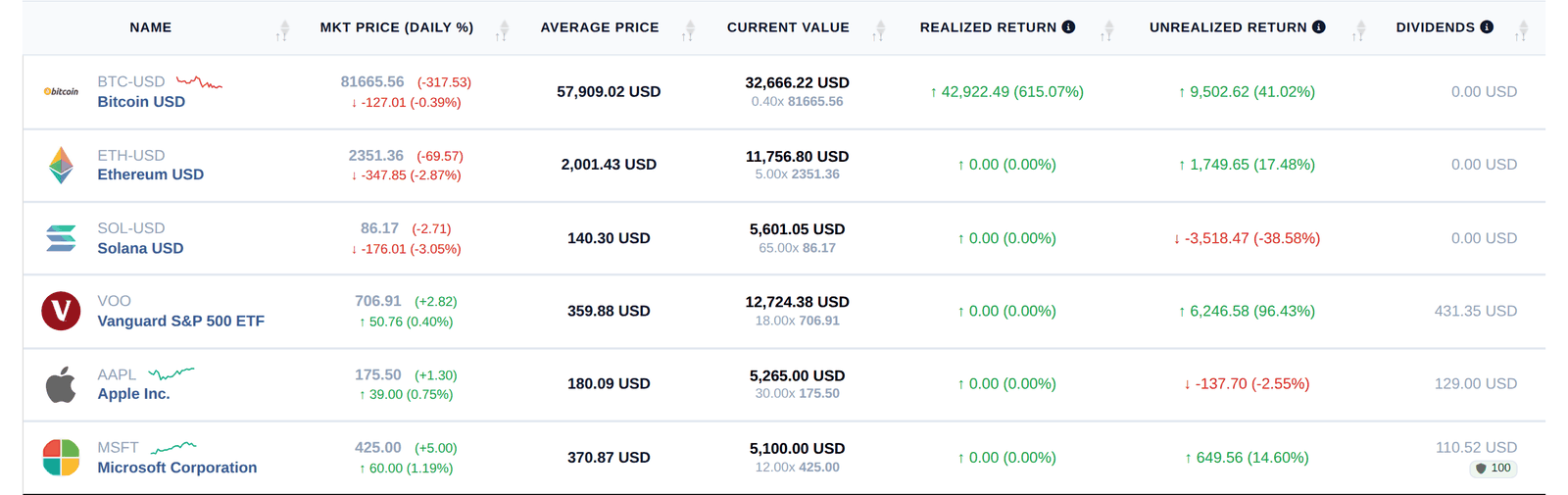
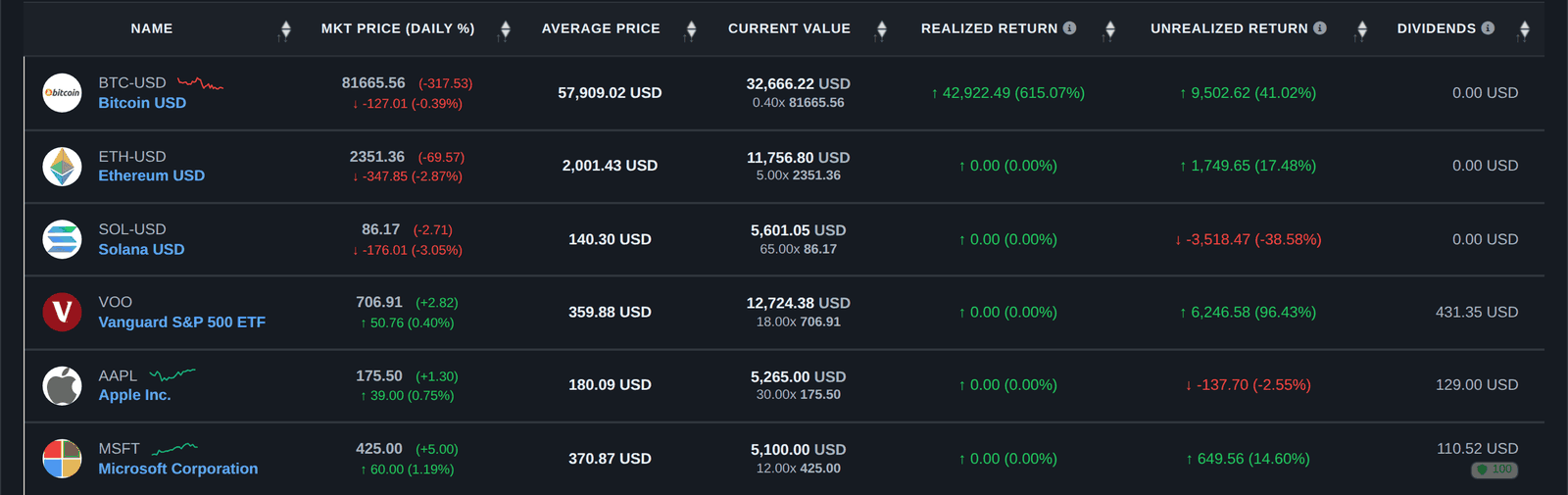
- Exchanges that syncCoinbase, Binance and Kraken connect on paid plans with read-only access. Any other exchange comes in from its export file.
- One return for everythingCoins sit in the same holdings table, allocation and IRR as your shares, funds and bonds.
- Prices on weekends tooCrypto prices refresh every 10 minutes through most of the day, seven days a week.
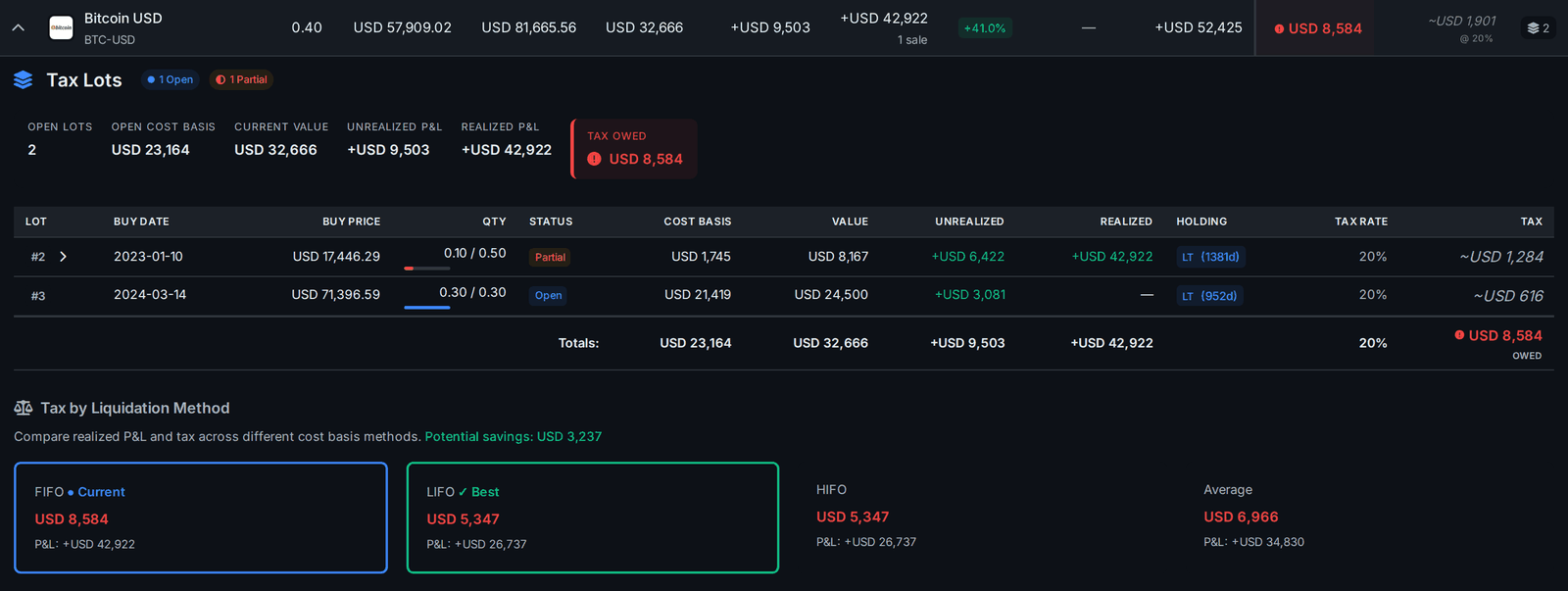
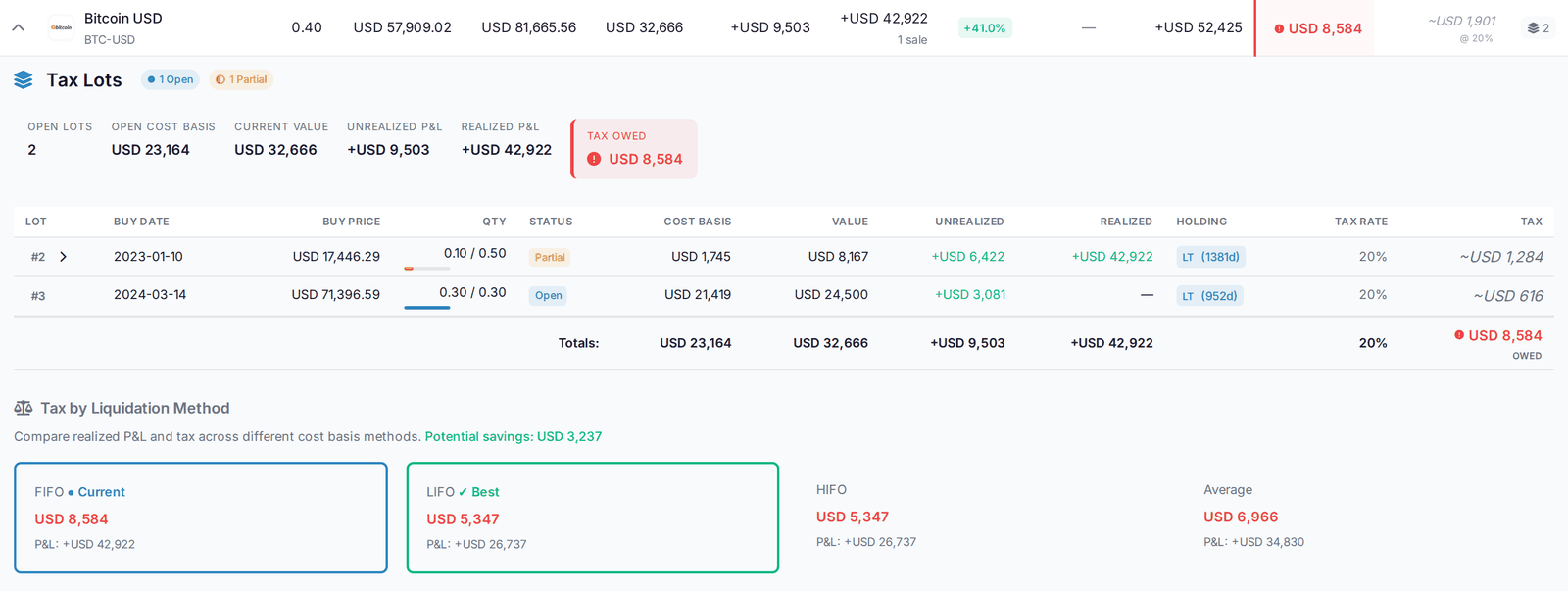
- Every lot and every saleThe tax report keeps each buy as its own lot and shows the realized gain on each sale, held short or long term.
- Four methods side by sideFIFO, LIFO, HIFO and average cost for each coin, with the tax each one gives at your rates.
- Losses you could still useCoins sitting below cost show up as tax-loss harvesting candidates, next to your losing shares.
Before you decide
What tends to go wrong with crypto records after the first tax year.
Is your history complete?
Cost basis starts at your first buy. An exchange you closed years ago, or coins moved between exchanges, still need their original price and date, or every later gain is wrong.
Which method does your country use?
The same sale gave gains from $26,737 to $42,922 above. Pick a tracker that applies your country’s method, not the one it happens to default to.
Where do your coins live?
If most of it sits in self-custody wallets and DeFi, a chain-aware tracker reads it for you. If it sits on exchanges and next to a brokerage account, exchange sync and a tracker that also holds your shares matter more.
What else do you own?
A crypto-only app answers how your coins are doing. Whether you are on track needs the coins, your funds and your cash in one number.
Crypto tracker questions
What is the best crypto portfolio tracker?
If your crypto sits next to stocks, ETFs or bonds, AllInvestView: Coinbase, Binance and Kraken sync, and coins share one dashboard and one capital gains report with your shares. For self-custody wallets and DeFi, CoinStats reads 120+ blockchains. For a crypto tax report once a year, Koinly charges per tax year and CoinTracker per year.
Is there a free crypto portfolio tracker?
Yes. CoinMarketCap has no paid tier for portfolio tracking. CoinGecko is free for 2 wallets and 500 manual transactions, Koinly tracks up to 10,000 transactions for free, and AllInvestView is free for 10 holdings, crypto and shares together.
Can I track crypto and stocks in the same portfolio?
Yes, with a multi-asset tracker. AllInvestView, Delta and Kubera all hold crypto and shares together. AllInvestView also keeps bonds, options and property in the same portfolio and puts crypto sales in the same capital gains report as your shares.
How is crypto taxed when I sell?
In the US the IRS treats crypto as property, so a sale gives a capital gain or loss, long-term after more than a year. The UK pools each token like shares. Spain puts the gain in the savings base. Germany taxes coins sold within a year, and gains under €1,000 in a year from all private sales are exempt.
Which cost basis method applies to crypto?
It depends on your country. The US uses FIFO unless you identify the units you sell, Spain uses FIFO, Germany uses the coins you can identify, or else average cost or FIFO per wallet, the UK pools each token after same-day and 30-day matches, and Canada uses average cost. In our bitcoin example the method alone moved the gain by $16,185.
Will Form 1099-DA give me my crypto cost basis?
Usually not. US brokers report gross proceeds for sales from 1 January 2025. They only have to report cost basis for certain sales from 2026 on, of coins bought in 2026 or later and kept in the same broker account, so for coins bought earlier your own records still carry the basis.
Keep comparing
Your first 10 holdings are free, crypto and shares together. No card needed.
Competitor prices and features were checked on the vendors' own pages on 22 October 2026. This comparison is for information only and is not financial, tax or investment advice. © 2026 AllInvestView.