Sell on the anniversary instead
Change only the sale date to 1 July 2025. The discount does not apply. After the A$1,000 loss, all A$1,386 is taxable, giving A$415.80 at 30%. Selling on 2 July passes the holding test.
Enter what you paid, what you sold for and your tax rate. You get the capital gain, the 50% discount if you held for 12 months, the tax on it, and how many days you would need to wait if you are not there yet.
Enter valid values to calculate.
Calculating…
| Capital proceeds | |
| Cost base, with brokerage both ways | |
| Capital gain | |
| Carried-forward losses applied | |
| 50% CGT discount | |
| Net capital gain, added to your income | |
| Estimated tax | |
| Capital loss to carry forward |
Worked out with the same parcel matching, loss order and discount test as the AllInvestView Australian filing pack.
You buy 500 shares on 1 July 2024 at A$40 each, with A$10 brokerage. On 2 July 2025 you sell 200 at A$52, paying another A$10. You have A$1,000 of capital losses carried forward.
The remaining 300 shares keep A$12,006 of purchase cost. Selling part of a parcel does not use up the cost base of the shares you still own.
Change only the sale date to 1 July 2025. The discount does not apply. After the A$1,000 loss, all A$1,386 is taxable, giving A$415.80 at 30%. Selling on 2 July passes the holding test.
Suppose you also bought 200 of the same shares on 1 March 2025 at A$48, with A$10 brokerage. Selling those 200 on 2 July 2025 for A$52 with A$10 sale brokerage gives an A$780 gain, with no discount. The A$1,000 loss covers it, leaving A$220 to carry forward.
Compare each parcel separately in this calculator. The Australian report combines your sales and applies losses to gains without the discount first.
A capital gain is not taxed on its own. It is added to your taxable income for the year you sign the sale contract and taxed at your marginal rate. What gets added depends on four things, in this order.
A loss works the other way. It is not deductible from your salary, but it carries forward with no time limit and comes off your next capital gains.
The discount needs 12 months of ownership, not counting the day you buy and the day you sell. Shares bought on 1 January qualify on a sale from 2 January the following year. Selling on the anniversary itself is one day too early.
Use the contract dates on your confirmations for the holding test and the income year.
On the example the calculator opens with, a A$5,980 gain sold at month ten is taxed in full. Sold after the 12-month mark at the same price, only half of it is added to your income, and the tax halves with it.
Waiting only pays if the price holds, so weigh the tax saved against the risk of the next few weeks.
Capital proceeds minus the cost base gives the capital gain, and the cost base includes brokerage on both the purchase and the sale. Capital losses come off next, the gain is halved if you held the shares for at least 12 months, and what is left is added to your taxable income and taxed at your marginal rate.
You must hold the shares for at least 12 months, not counting the day you buy or the day you sell. Shares bought on 1 January qualify on a sale from 2 January the following year. The dates that count are the contract dates, not settlement.
Before. Losses reduce the gain first and the 50% discount applies to what remains, so A$1,000 of loss removes A$1,000 from a gain without the discount but only A$500 from a discounted one. That is why losses go against gains that do not get the discount first.
No. Capital losses only offset capital gains. A loss you cannot use this year carries forward with no time limit, and it must be used against your next capital gains.
You can choose, as long as your records identify the parcels you sold. Without that, first in first out is the default. Selling a parcel held for more than 12 months, or one with a higher cost base, can change the tax a lot.
No. Individuals and trusts get 50%, complying super funds get one third, and companies get no discount at all. This calculator uses the rules for an individual.
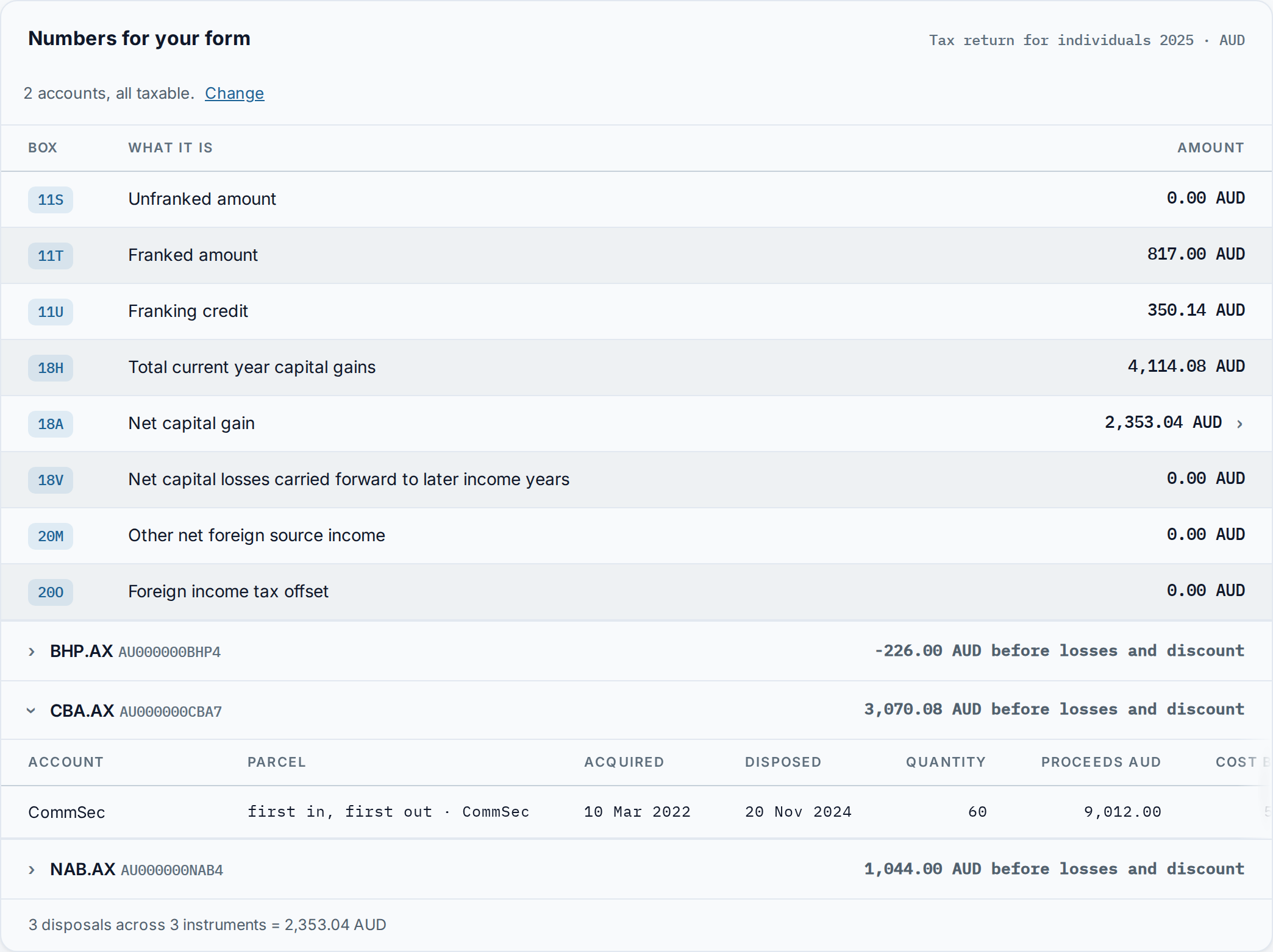
Keep the purchase parcels behind every sale, even when the trades sit with different brokers. AllInvestView imports your trades and the Australian filing pack works out item 18 for the whole year with the same rules as above, next to franked dividends at item 11 and foreign income at item 20.
Start free. No card required.
 AllInvestViewAustralian filing pack
Sources: ATO, choosing the CGT calculation method, resident tax rates. This calculator uses the discount rules for sales before 1 July 2027 and does not model the later indexation rules. The tax shown applies one marginal rate to the whole net gain for an Australian resident individual; a large gain can cross into a higher bracket, and other sales in the same year change the netting. This is an estimate, not tax advice.