 MyInvestor
 Trade Republic
 Trading 212
Accounts, securities and property held outside Spain, each block counted on its own. You file the first year a block is over €50,000, with accounts counted at 31 December or on their last-quarter average, whichever is higher. You file again when a block has grown by more than €20,000 since you last declared it, or when something you declared is sold or closed. No tax is paid with it.
Modelo 720 explained for foreignersInvesting in Spain: Taxes, Brokers and Modelo 720
If you live in Spain, your gains, dividends and interest are taxed together as savings income: 19% on the first €6,000, rising in steps to 30% above €300,000. A Spanish bank or broker keeps 19% of your dividends and interest and reports to Hacienda for you.
A broker abroad usually keeps no Spanish tax and sends nothing to your Spanish tax data, so you declare it all yourself, and once what you hold abroad passes €50,000 you also file Modelo 720 by 31 March. Gains are worked out with FIFO across every broker you use, and moving money from one investment fund to another by traspaso puts the tax off until you finally sell.
Savings tax19% to 30%on gains, dividends and interest, in five bands
Kept in Spain19%of dividends and interest, counted as tax already paid
Modelo 720€50,000held abroad in accounts, securities or property, each counted on its own
Losses4 yearsto use them, and up to 25% of your dividends and interest can absorb them
Savings tax calculator
One sale across two brokers
Rules checked against the BOE and the AEAT on 23 October 2026
A Spanish broker or a broker abroad: what changes
The tax is the same; what changes is who does the paperwork.
| Bank or broker in Spain | Broker abroad | |
|---|---|---|
| Dividends and interest | 19% kept as you're paid. It comes off your tax bill on the return | No Spanish tax kept on foreign ones. You declare them and pay with your return |
| Selling shares and ETFs | No tax kept. The sale is reported to Hacienda, so it shows in your tax data | Usually missing from your tax data. You add each sale yourself |
| Selling a fund | 19% of the gain kept. A traspaso to another fund pays no tax yet | Depends on the broker. Selling one ETF to buy another is a sale anywhere |
| Modelo 720 | Not needed for what's held in Spain | Due once the accounts or the securities you hold abroad pass €50,000 |
| Your return | Mostly prefilled. Check the cost behind each sale | You enter sales, dividends and the tax kept abroad |
In Spain
- Dividends
- 19% kept, credited on the return
- Sales
- Reported to Hacienda for you
- Funds
- 19% kept on a sale; a traspaso defers the tax
- Modelo 720
- Not needed
- Return
- Mostly prefilled
Abroad
- Dividends
- No Spanish tax kept on foreign ones; you pay with the return
- Sales
- You add each one
- Funds
- Depends on the broker
- Modelo 720
- Above €50,000 abroad
- Return
- You enter it all
Held in Spain
MyInvestor and the Spanish banks report to Hacienda. Trade Republic does too once your account has moved to its Spanish branch, which it started doing in June 2025. Check the date on your own account.
Held abroad
These keep your shares outside Spain. A Spanish IBAN doesn't change that on its own: Revolut gives you one, but its investment account is Lithuanian. Hacienda still hears about foreign accounts through the international exchange of account data.
Spanish savings tax calculator
Enter your year's gains, dividends and interest to see the tax and what's left to pay. It starts with the example further down.
Your savings tax
€0
Tax abroad you deduct€0for dividends from abroad
Left to pay€0with your return, after what was kept
How the savings base is built
Gains and losses from sales go in one box, dividends and interest in the other. A net loss in one can offset up to 25% of the other.
Uses the savings scale for 2025 and 2026 for residents under the common regime; the Basque Country and Navarre set their own. It assumes your personal allowance is already used by your salary or other income, as it is for most people who work. Old losses from sales come off this year's gains first, then off up to 25% of your dividends and interest, less what this year's loss already took. The deduction for tax kept abroad can't be more than the Spanish tax on those dividends at your average rate. Losses you carry over still expire four years after the year they were made.
One sale worked through: two brokers, one FIFO queue
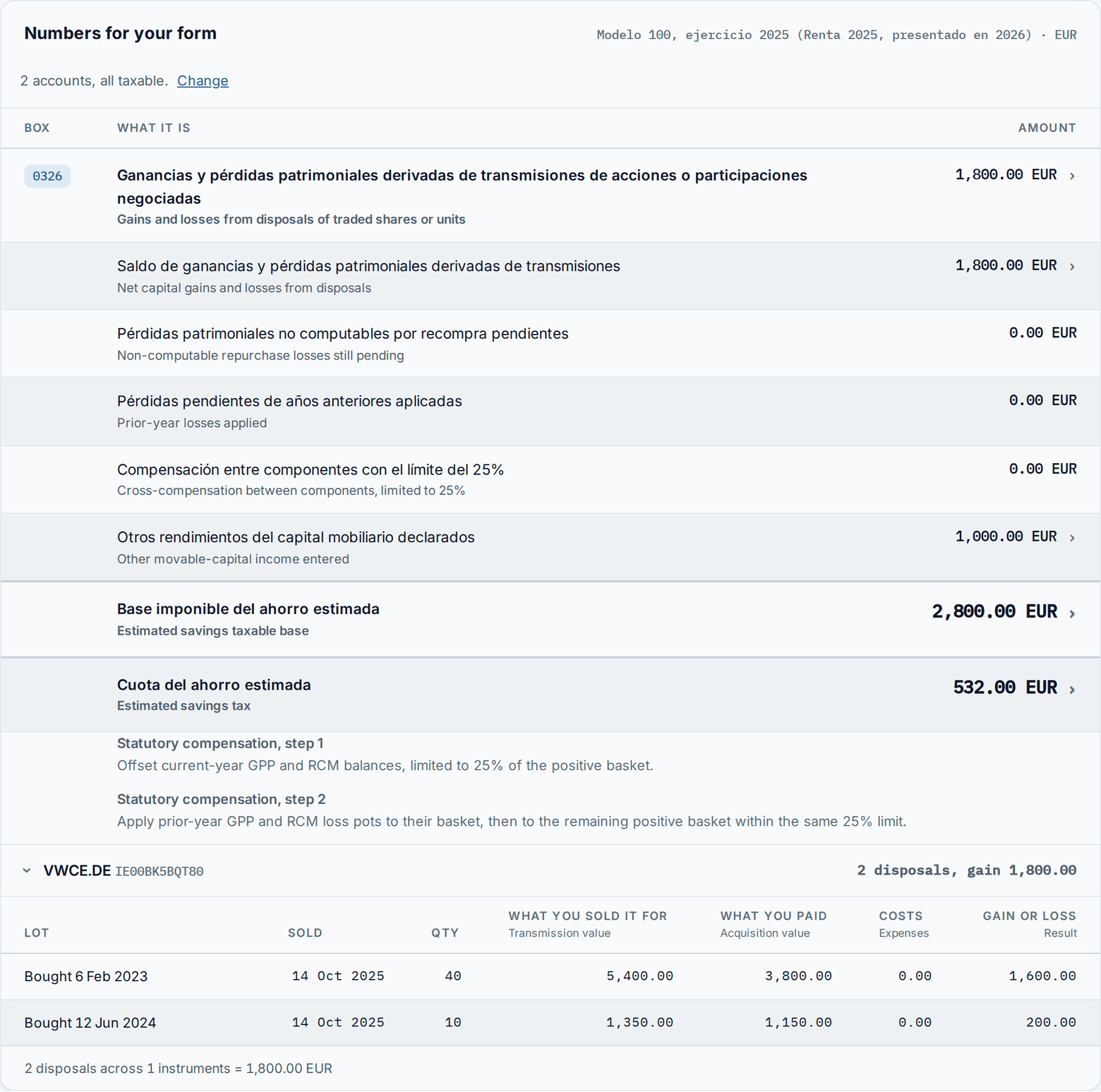
Tax year 2025. The same ETF bought at DEGIRO and Interactive Brokers, then sold from Interactive Brokers.
DEGIRO6 February 2023
Bought 40 VWCE at €95
€3,800
Interactive Brokers12 June 2024
Bought 60 VWCE at €115
€6,900One queue for all 100 sharesThe oldest go first, whichever broker sells
40 at €951050 kept
Sold: 40 from DEGIRO, 10 from Interactive Brokers
Sold 50 VWCE at €135Interactive Brokers, 14 October 2025
- Sale price€6,750
- Cost: 40 × €95 + 10 × €115€4,950
- Gain from the sale€1,800
- US dividends €600, Spanish interest €400€1,000
- Savings base€2,800
- Savings tax, all in the 19% band€532
- US tax kept on the dividends, 15%−€90
- Kept in Spain on the interest, 19%−€76
- Left to pay with the return€366
Using one broker's reportInteractive Brokers only knows its own shares, so its report costs the 50 at €115 and shows a gain of €1,000. That leaves €800 of gain off your return, €152 of tax Hacienda can come back for.
Had it been a lossBuying VWCE again within two months before or after the sale would hold back the loss on as many shares as you bought, until you sold them.
A fund instead of an ETFMoving between two funds by traspaso would have put the tax off. The new fund keeps the old cost and date, and you pay when you finally cash out.
Where each part goes in Renta Web
The Renta (Modelo 100) is filed online. The section names are the ones you'll see on screen.
| What you had | Where it goes | What to check |
|---|---|---|
| Shares sold | Ganancias y pérdidas patrimoniales, transmisión de acciones negociadas | Sale and cost from FIFO across all brokers, fees included |
| ETFs sold | Ganancias y pérdidas patrimoniales, IIC cotizadas no sujetas a retención | A foreign broker's ETF sales usually aren't in your tax data |
| Funds sold | Ganancias y pérdidas patrimoniales, participaciones en IIC | Spanish sales arrive filled in; the cost after a traspaso is the original one |
| Dividends | Rendimientos del capital mobiliario, participación en fondos propios | The gross amount, with Spanish tax kept entered as a withholding |
| Interest | Rendimientos del capital mobiliario, intereses de cuentas y depósitos | Interest from a foreign account usually isn't in your tax data |
| Tax kept abroad | Deducciones, doble imposición internacional | Never as a Spanish withholding |
Shares and ETFs sold
- Where
- Ganancias y pérdidas patrimoniales: acciones negociadas, or IIC cotizadas for ETFs
- Check
- FIFO across all brokers, fees included
Funds sold
- Where
- Ganancias y pérdidas patrimoniales: participaciones en IIC
- Check
- The original cost after a traspaso
Dividends and interest
- Where
- Rendimientos del capital mobiliario
- Check
- Gross amounts; income at a foreign broker usually isn't prefilled
Tax kept abroad
- Where
- Deducciones: doble imposición internacional
- Check
- Never as a Spanish withholding
Beyond the Renta: Modelo 720, Modelo 721 and wealth tax
Two information returns for what you hold abroad, and a tax on large fortunes.
The same idea for crypto kept for you by a provider outside Spain, valued at 31 December. Coins in a wallet only you control don't go on it.
How crypto gains are taxed in SpainThe Impuesto sobre el Patrimonio is run by the regions, and many set their own allowance or relief. A separate solidarity tax applies wherever you live once your taxable wealth passes €3 million after that allowance, less any wealth tax you already paid.
Modelo 720 and 721 for what you held on 31 December 2026, filed from 1 January.
The Renta for tax year 2026, usually early April to 30 June. The 2025 return ran from 8 April to 30 June 2026.
Last day to sell at a loss for 2026, and the last year 2022's leftover losses can be used.
The rules that catch people out
FIFO covers every broker you have
Shares of the same security in every account in your name form one queue. The oldest are sold first, whichever broker you sell from, so no single broker's report can be trusted on its own.
The two-month rule on losses
Sell at a loss and buy the same security in the two months before or after, and while you still hold those shares the loss on them waits until you sell them. It's one year for securities outside an EU or equivalent market, and London listings have counted that way since Brexit.
Losses last four years
A net loss from sales offsets up to 25% of that year's dividends and interest, and the rest carries forward for four years. Losses from 2022 can still be used in 2026, their last year.
Spanish dividends lose 19% at any broker
A Spanish company keeps 19% of its dividend wherever your shares are held, so a Santander or Iberdrola dividend at a broker abroad arrives with Spanish tax already taken. It goes on your return as a Spanish withholding.
Foreign dividends: declare the gross amount
With a W-8BEN on file the US keeps 15%, and you deduct that on your return. Where a country keeps more than its treaty rate, like Germany at 26.375% or Switzerland at 35%, you claim the extra back from that country.
Fees count, in two different places
Buying and selling fees go into the gain: they add to the cost and come off the sale price. Custody fees come off your dividends and interest instead.
Your Spanish figures from every broker
The Spanish filing pack, run on the example above.
Modelo 100
One FIFO queue across DEGIRO and Interactive Brokers
Add DEGIRO, Interactive Brokers and any other broker as separate accounts, and the pack runs one FIFO queue per security across them all, converting trades in other currencies to euros. It holds back losses caught by the two-month rule, applies your losses from earlier years and the 25% offset, and ends with the savings base and the estimated tax. Every sale opens into the purchases behind it, ready to export as PDF, Excel or CSV.
See the Spanish tax report AllInvestView
Every broker in one place
See your Spanish and foreign accounts together, in euros
Your accounts at Spanish and foreign brokers side by side, with real returns, dividends and the tax kept on them, a Renta pack that runs FIFO across all of them, and a Modelo 720 report.
FIFO across brokers
Modelo 100 and 720
Free plan available
Questions about investing in Spain
How much tax do you pay on investments in Spain?
Gains, dividends and interest are added up as savings income and taxed in bands: 19% on the first €6,000, 21% up to €50,000, 23% up to €200,000, 27% up to €300,000 and 30% above that. Those rates apply to 2025 and 2026. A Spanish payer keeps 19% of dividends and interest, which counts as tax you've already paid.
Do I pay Spanish tax on investments I hold abroad?
Yes. A Spanish resident is taxed on income from anywhere, so a sale at a foreign broker or a dividend from a US company goes on your Spanish return. Tax kept abroad comes off your Spanish bill, up to the treaty rate and never more than the Spanish tax on that income. Once what you hold abroad passes €50,000 in a block you also file Modelo 720.
Is a Spanish broker or a foreign broker better for tax?
The tax is the same. A Spanish bank or broker keeps 19% of your dividends and interest, reports your sales and keeps you off Modelo 720. A broker abroad leaves all of that to you, which is more work but not more tax. Many people use both, and then FIFO runs across all of them.
Can I buy US shares from Spain?
Yes, through a Spanish broker or one abroad. Sign the W-8BEN form your broker gives you so the US keeps 15% of dividends instead of 30%, and deduct that 15% on your Spanish return. Gains on US shares are taxed only in Spain.
Are ETFs and investment funds taxed differently in Spain?
The rates are the same, but most funds sold in Spain can be switched by traspaso: you move from one fund to another without paying tax yet, and the new fund keeps the old cost and date. Selling an ETF to buy another one is a sale, and any gain is taxed that year.
I just moved to Spain. When do these rules start?
From the first calendar year you're resident, which is when you spend more than 183 days in Spain or your main business or economic interests are here. Spain doesn't split a year, so a resident year covers your income from 1 January. People who moved for work under the special regime, the Beckham law, are taxed much like non-residents instead.
When is the Spanish tax return due?
The return for 2025 ran from 8 April to 30 June 2026. The one for 2026 opens in spring 2027 and normally closes on 30 June. Modelo 720 and 721 for what you held on 31 December 2026 are due by 31 March 2027.
Sources
Checked on 23 October 2026.
- Ley 35/2006 del IRPF, arts. 66 and 76, the savings scale with the 30% band from 2025.
- Ley 35/2006 del IRPF, art. 37, FIFO for securities of the same kind.
- Ley 35/2006 del IRPF, art. 33.5, the two-month and one-year repurchase rules.
- Ley 35/2006 del IRPF, arts. 46 and 49, the savings base, the 25% offset and the four years.
- Ley 35/2006 del IRPF, art. 80, the deduction for tax paid abroad.
- Ley 35/2006 del IRPF, art. 94, traspasos between investment funds.
- CNMV: Traspasos entre fondos, how a fund switch works.
- Real Decreto 1065/2007, arts. 42 bis, 42 ter, 42 quater and 54 bis, what Modelo 720 and 721 cover and when to file again.
- AEAT: Modelo 720, the filing window and the form.
- Ley 19/1991 del Impuesto sobre el Patrimonio, the €700,000 and €300,000 allowances.
- Ley 38/2022, art. 3, the solidarity tax on fortunes above €3 million.
- AEAT: Renta, filing dates and Renta Web.
Written for people resident in Spain under the common regime. It isn't personal tax advice.