Recover the source
Collect old confirmations, statements and tax forms. Ask a former broker for archived records while they remain available. Record what each document proves and where the chain still has a gap.
Your broker may keep required records for only 3–6 years under SEC Rule 17a-4. Your cost basis may need to survive for as long as you hold an investment, through every broker you will ever use, and beyond the eventual sale.
Statements in a portal are temporary access to somebody else's archive. A continuing ledger keeps your buys, sells, dividends, fees, corporate actions and per-lot cost basis under one history you maintain.
A current balance tells you what is there now. Tax reporting depends on the chain of events that made it so.
AAPL, 120 shares, current value $27,480. Useful for seeing allocation and net worth, but silent about when those shares arrived, which lots were sold, and how fees or reinvestments changed cost.
Each purchase date, quantity and price; every sale matched to lots; fees, dividends, splits and transfers retained in sequence. AllInvestView is the ledger, while its dashboard gives you the balance-sheet view built from that history.
That difference matters after a transfer, when a feed begins late, or when a tax authority asks how you reached a figure. A folder of PDFs preserves evidence. A ledger also keeps the arithmetic usable.
Keep the source records that establish acquisition, ownership, income and disposal. In the US, that means trade confirmations, brokerage statements, Forms 1099-B, 1099-DIV and 1099-INT, dividend-reinvestment records, fee records and corporate-action notices. For gifted or inherited property, retain documents supporting the relevant fair market value and any donor basis information. A year-end statement alone may not preserve everything needed to establish a particular lot.
The IRS says records supporting an item on a return should remain available until the limitation period for that return expires. The common minimum is three years, but property records must be kept until after the year in which the property is disposed of. The practical rule is therefore: keep basis evidence throughout ownership, then retain it with the disposal-year return for at least the applicable review period. Keep it longer when a loss carryforward, amended return, underreported income or another extended limitation period applies.
In the UK, keep contract notes, account statements, consolidated tax certificates, dividend vouchers, charges, foreign-exchange evidence and every notice for a split, rights issue, takeover or other reorganisation. HMRC's HS284 explains the share-matching sequence: same-day acquisitions, acquisitions within the following 30 days, then the Section 104 holding. One missing purchase can change the pooled average cost of shares you still hold, so the history matters before any disposal is made.
For an on-time Self Assessment return, UK records not connected with self-employment normally need to be kept for at least 22 months after the end of the relevant tax year. Records supporting a capital gains calculation must be kept for at least a year after the Self Assessment deadline, and longer if the return was late or HMRC has started a check. Self-employed people must keep business records for at least five years after the 31 January submission deadline. These are post-disposal minimums, not permission to discard purchase records while the asset is still held. A platform's displayed “book cost” is helpful, but the taxpayer remains responsible for the calculation reported to HMRC.
Primary references: SEC broker-dealer records rule, 17 CFR § 240.17a-4; IRS record-retention guidance; IRS Publication 550; and HMRC HS284. Tax rules depend on circumstances; this guide is general information, not tax advice.
A new connection may begin with the transactions a broker currently exposes. That can be enough for today's quantity and still leave the oldest lots, transfers or reinvestments outside the record. Build from the earliest available evidence, then continue the same ledger.
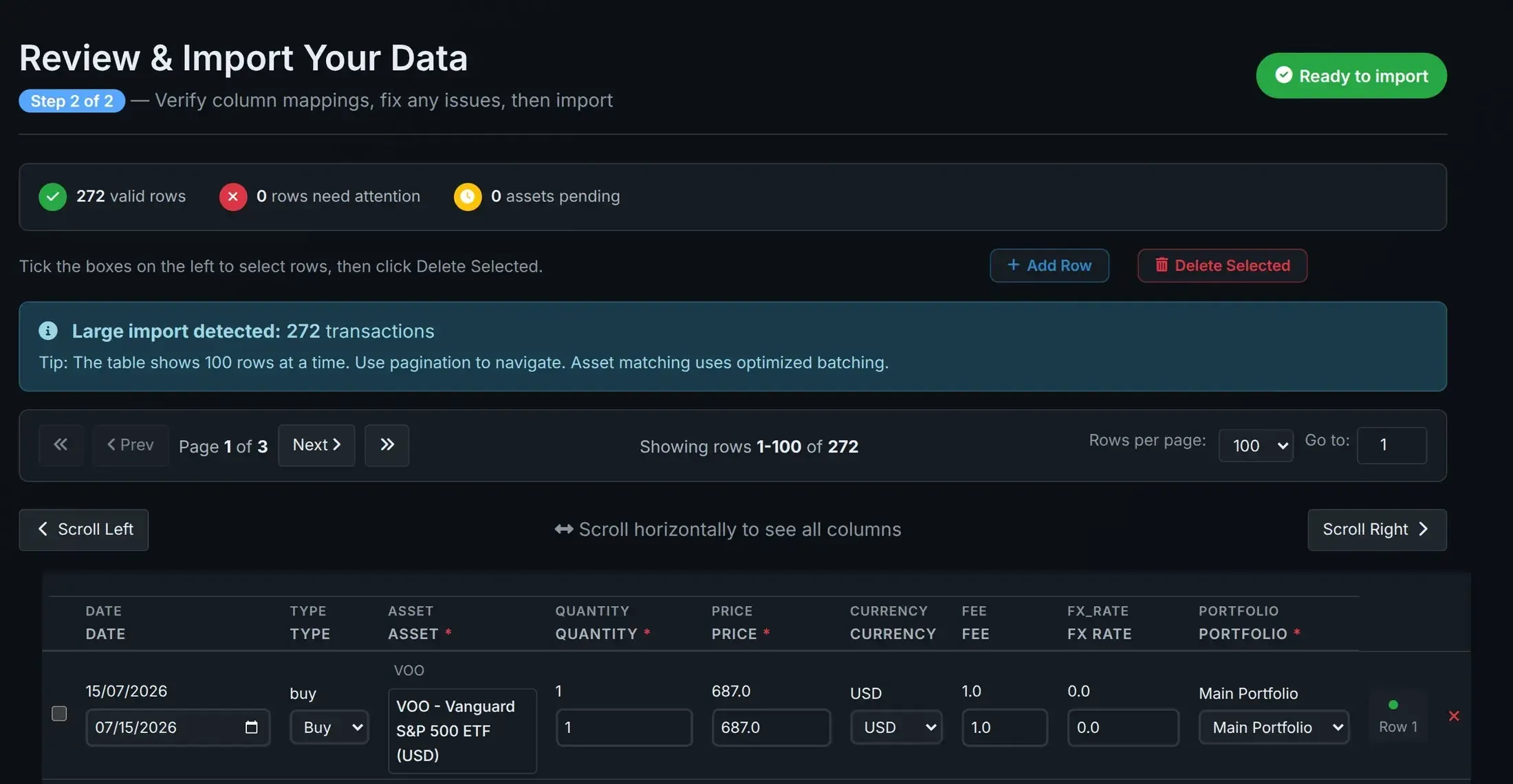
AllInvestView gives you three supported paths. CSV import auto-detects 28 broker formats, with a generic CSV path for others. The assistant can read trades from a photo, screenshot or PDF and shows what it found before anything is added. Automatic read-only sync with 30+ brokers is on the paid plans; the connection cannot place trades or move money. Import, manual entry and the assistant work on Free.
Use the method that gives the best evidence for each period. An old CSV can establish the early years, statement photos can fill a small gap, and read-only sync can carry the record forward. Import confirmation is the checkpoint: verify dates, symbols, quantities, prices and currencies before saving.
For broker-specific export instructions, use the investment import guides. If your question is mainly how to view several active accounts together, read how to track multiple broker accounts.
 Interactive Brokers
 Schwab
 Fidelity
 DEGIRO
Do not patch a current total and leave the history unexplained. Find the earliest place where quantity or cost diverges.
Collect old confirmations, statements and tax forms. Ask a former broker for archived records while they remain available. Record what each document proves and where the chain still has a gap.
Enter buys and sells chronologically, then apply dividend reinvestments and corporate actions on their effective dates. A later split or spin-off depends on the quantity and cost immediately before it.
Match each holding's units before comparing market value. Once quantity agrees, inspect original trade currency, pence-versus-pounds scale and foreign-exchange treatment rather than overwriting the result.

In the US, Form 8949 and Schedule D ultimately depend on acquisition date, disposal date, proceeds, basis and adjustments. Covered-basis reporting from a broker helps, but it does not remove the need to keep supporting records, especially for non-covered securities or events the broker did not receive.
In the UK, HMRC does not receive a broker-calculated Section 104 pool as the answer to your Self Assessment. You calculate allowable expenditure using the share-matching rules. A missing contract note can change the pool for later disposals and shares still held.
AllInvestView keeps per-lot transaction data and lets the assistant propose corrections with a before-and-after view. The edit waits for confirmation. For the calculation methods themselves, use the dedicated FIFO cost basis tracker and investment tax reporting guide. For cross-account reporting, see the multi-broker tax report.
Three interactions already available in AllInvestView: statement import with confirmation, a before-and-after price-scale correction, and a standing alert.
| Ticker | Date | Qty | Price |
|---|---|---|---|
 VWCE VWCE | 14 Mar 2019 | 18 | €72.40 |
 MSFT MSFT | 08 Jun 2020 | 5 | $187.20 |
 SHEL SHEL | 22 Sep 2021 | 60 | £14.86 |
A securities transfer moves assets. It does not guarantee that every historic detail will appear correctly in the receiving broker's interface. In the US, covered securities generally carry reported basis, yet pre-coverage holdings, average-cost fund elections, fractional transactions and off-market details may need attention. In the UK, the displayed book cost after a transfer can be incomplete or reset, while your own Section 104 calculation continues across the change.
Before initiating a move, export the complete transaction CSV and download every available statement, confirmation or contract note. Record account identifiers and the transfer date. After the move, compare securities and quantities first. Then compare lot-level basis and acquisition dates. Do not discard the old archive merely because the receiving account now displays a plausible total.
A broker-independent ledger keeps both sides understandable. Label the outgoing and incoming accounts, retain the transfer event, and continue adding later transactions to the same investment history. There is no need to merge the brokerage accounts themselves. AllInvestView can track stocks, ETFs and funds, bonds, options, crypto, cash accounts, real estate, and custom assets in one portfolio while preserving which account each transaction belongs to.
If the receiving broker shows an opening position rather than the original lots, use the source records to preserve the earlier purchases in your ledger. Avoid recording the transfer as a fresh taxable purchase or sale unless that is what legally occurred. If acquisition records cannot be recovered, document every request and assumption and ask a qualified tax professional how to report the unsupported portion.
Automated feeds are useful, but they transmit what a provider exposes in the shape it exposes it. A feed may start after your earliest purchase, represent a transfer as an opening balance, or omit a dividend reinvestment or corporate action. Foreign listings introduce another familiar problem: a London price quoted in pence can be read as pounds, producing a value exactly 100× too large.
Treat the ledger as the durable layer. Keep the imported transactions, attach meaning to corrections, and compare feed updates against the established record. When something differs, isolate one holding and work in sequence: opening quantity, buys, sells, reinvestments and corporate actions, then price currency and scale, then market value.
This is why forcing a dashboard total is the wrong fix. It can make today look right while leaving every return and tax figure downstream wrong. A confirmed transaction or scale correction repairs the event that drives those calculations. The permanent record remains understandable even if you disconnect the broker later.

The dashboard agrees for a day, but original lots, returns and tax calculations still depend on a broken history.
Add the omitted reinvestment, apply the corporate action, correct the transfer, or confirm the pence scale. Current balances then follow from the ledger.
Short answers to the questions that surface when records are missing, a broker changes, or tax time exposes a gap.
Import the records you already have, review every proposed addition, and keep future transactions in the same continuing history.
Read-only broker sync with 30+ brokers on paid plans · CSV import auto-detects 28 formats on every plan