Butterfly Spread: How It Works, With a Real SPY Trade
A butterfly spread buys one option below the price, sells two at the price and buys one above, all with the same expiry. It costs little, can't lose more than that, and pays the most if the stock ends right on the middle strike. It's a bet that the price stays put, with the risk fixed on day one.
On 23 October 2026 SPY closed at $759.97. The 20 November 740/760/780 call butterfly cost $527 and pays up to $1,473 if SPY ends at $760. It makes money anywhere between $745.27 and $774.73, about 1.9% either way, and SPY ended a four-week stretch inside that range 37% of the time since 1993.
A butterfly in three numbers
What it costs
Low call + high call − 2 middle calls
($29.61 + $4.74 − 2 × $14.54) × 100 = $527
Most it can make
Wing width − cost
($20 − $5.27) × 100 = $1,473
Breakevens
Low strike + cost·High strike − cost
$745.27 and $774.73
Cost today$527for one SPY 740/760/780 call butterfly expiring 20 Nov; the most it can lose
Most it can make$1,473if SPY ends at exactly $760 on 20 November, 2.8 times what it costs
How often SPY ended in range37%of 8,472 four-week stretches since 1993, between −1.9% and +1.9%
The same tent-shaped payoff, built four ways. All use SPY's 20 November options at the 23 October bid and ask.
Pay to open · calls
Long call butterfly
Buy a call below the price, sell two at the price, buy one above. The most common way to build it, and the one this guide follows.
Buy the 740 call, sell two 760 calls, buy the 780 call: −$527; up to +$1,473 at $760
Pay to open · puts
Long put butterfly
The same strikes with puts. At expiry it pays the same as the call version; only the price you get filled at differs.
Buy the 740 put, sell two 760 puts, buy the 780 put: −$574; up to +$1,426 at $760
Paid to open · a put and a call
Iron butterfly
Sell a put and a call at the middle strike and buy a cheaper put below and call above. You're paid up front instead of paying, and the payoff has the same shape.
Sell the 760 put and 760 call, buy the 740 put and 780 call: +$1,497; at worst −$503
Little or no cost · one wing wider
Broken wing butterfly
Move one outer strike further away. The wide side carries more risk, the narrow side often none, and the trade can open for a small credit.
Buy the 770 put, sell two 760 puts, buy the 740 put: +$40; up to +$1,040 at $760, at worst −$960
Selling a call or put butterfly instead of buying it flips the tent: you're paid for a big move either way. The long straddle is the simpler way to make that bet, and the iron condor is the iron butterfly with its short strikes pulled apart.
A butterfly spread example: SPY, 23 October to 20 November 2026
Real prices from the 23 October close. Pick the call butterfly, the iron butterfly or the broken wing, and drag where SPY might close on 20 November. Switch to 6 November to see what the same trade is worth with two weeks still to go.
SPDR S&P 500 ETF (SPY)Closed at $759.97 on 23 October 2026
Buy 1$740 callat $29.61
Sell 2$760 callsat $14.54
Buy 1$780 callat $4.74
Cost, the most you can lose
$527
Most you can make, at $760
$1,473
Breakevens
$745.27 / $774.73
Room either way
−1.9% / +1.9%
Time decay
+$7 a day
Delta
−0.08
Time works for you while SPY sits near $760, and a jump in volatility works against you: about −$26 for each point it rises. Bought at the midpoints it would have cost $491.
Buy 1$740 putat $6.48
Sell 1$760 putat $11.65
Sell 1$760 callat $14.54
Buy 1$780 callat $4.74
Paid to you, the most you can make
$1,497
Most you can lose
$503
Breakevens
$745.03 / $774.97
Margin held
$2,000
Time decay
+$8 a day
Delta
−0.07
The margin is one side's $20 width, and the $1,497 you receive covers most of it. You keep all of it only at $760 on the last day. Sold at the midpoints it would have paid $1,516.
Buy 1$770 putat $16.42
Sell 2$760 putsat $11.65
Buy 1$740 putat $6.48
Paid to you
$40
Most you can make, at $760
$1,040
Most you can lose, at $740 or below
$960
Breakeven
$749.60
Room below
−1.4%
Delta
+0.06
Above $770 every put expires worthless and you keep the $40, so a rally can't hurt you. The risk sits on the wide side, below $749.60. Opened at the midpoints it would have paid $79.
Where does SPY close on 20 November?
At expiry6 November, 14 days left
Profit or loss at expiry+$1,473the 740 call is worth $20, both 760 calls nothing
On the $527 at risk+279.5%SPY 0.0% from $759.97
SPY ends on the middle strike, the best case: the butterfly makes $1,473.
Why a butterfly pays late
The call butterfly's value if SPY sits still at $759.97 all month, with each option's volatility unchanged. It was bought for $527.
Model value of the SPY 740/760/780 call butterfly bought for $527 on 23 October 2026, if SPY stays at $759.97, by date
Date
Days left
Worth
Profit
Share of the $1,473 top
23 Octbought
28
$491
−$36
30 Oct
21
$554
+$27
6 Nov
14
$657
+$130
13 Nov
7
$868
+$341
17 Nov
3
$1,159
+$632
19 Nov
1
$1,492
+$965
20 Novexpiry
0
$1,997
+$1,470
Half the month gone, SPY exactly where you wanted it, and the trade is up $130. Most of a butterfly's profit arrives in the last few days, because the two short calls you sold lose their time value fastest in the final days. The first row is the bid-ask spread: the model value right after buying is $491, $36 under what you paid. Holding to the last week for the payout means sitting through the days when a move hurts most, which is why many traders settle for part of the top and close early (see managing it).
How often does SPY stay inside a butterfly's range?
SPY's price change over every 20-trading-day stretch since January 1993, the same length as the 23 October to 20 November trade. The shaded band is where today's butterfly makes money at expiry.
8,472 four-week SPY moves, 1993 to 2026
Butterfly makes moneyEnded insideEnded outside
740/760/780: SPY ended inside $745.27 to $774.73 in 37.0% of the stretches. Bought for $527, it pays up to $1,473.
Hover or tap a bar. Price change only, without dividends; overlapping stretches from each trading day's close. The end bars hold every move past 9.5%. Our calculations from SPY's daily closes; the dollar results apply the 23 October prices to each past move.
Typical four weeks
Median move
2.7%
Above $774.73
41%
SPY drifts up more often than down, so the upper side breaks more
Call butterfly paid
Wins
37.0%
Average
−$28
Within $5 of $760, a profit of $973 or more, 12.5% of the time
Lost the whole $527
Since 1993
50.6%
Last 10 years
53.0%
SPY ended below $740 or above $780
Broken wing paid
Wins
74.7%
Average
−$49
Lost the full $960 in 17.6% of the stretches
A win rate near 37% sounds poor until you set it against the payout: risk $527 to make up to $1,473. Over 33 years the two nearly cancelled out, about −$28 a trade at today's prices, roughly the bid-ask spread you pay to get in. A butterfly isn't an edge on its own; it's a cheap, capped way to act on a view that a price will hold. The broken wing flips the profile: it won three times in four and still lost a little on average, because its losses are big and its usual win is the $40 credit.
Choosing the wings and the middle strike
SPY's 20 November call butterflies centred on $760, from 10 to 40 dollars wide, at the 23 October bid and ask. The last column counts the four-week stretches since 1993 that ended inside each range.
SPY 20 November 2026 call butterflies by wing width, 23 October 2026 close, SPY at $759.97
Strikes
Cost
Most it makes
Breakevens
Iron version
Ended inside
750/760/770$10 wings±1.1%
$148
$852
$751.48 / $768.52±1.1%
+$863 / −$137
21.1%
740/760/780$20 wings, the example±1.9%
$527
$1,473
$745.27 / $774.73±1.9%
+$1,497 / −$503
37.0%
730/760/790$30 wings±2.5%
$1,121
$1,879
$741.21 / $778.79±2.5%
+$1,905 / −$1,095
46.6%
720/760/800$40 wings±2.8%
$1,881
$2,119
$738.81 / $781.19±2.8%
+$2,144 / −$1,856
52.0%
Narrow wings are a lottery ticket: $148 to make up to $852, but SPY has to land within about 1.1% of $760. Wide wings win more often and pay less for the risk, until the 40-dollar butterfly risks $1,881 to make $2,119. Each step out roughly trades payout for room, and in this history every width averaged a small loss of $20 to $28.
Put the middle where you expect the price
The middle strike doesn't have to be today's price. A butterfly above it is a cheap bet on a small rise; below it, on a small fall.
760/780/800 calls: $624 to make up to $1,376 at $780; won 40.3% since 1993. 720/740/760: $327 to make up to $1,673 at $740; won 23.4%
Pick the expiry for your view, not the payout
With the same strikes and SPY near the middle, a shorter expiry costs more and leaves a narrower range, because more of the payout is already in the price. A longer one is cheaper but takes longer to pay.
740/760/780 calls: $594 for 13 November, $527 for 20 November, $481 for 27 November, $398 for 18 December
Butterfly vs iron condor vs straddle
Five ways to trade a calm SPY on the same 20 November expiry, priced at the 23 October close, with how each did over the 8,472 four-week stretches since 1993.
Strategy
The trade
Paid or cost
Most you can lose
Makes money if SPY ends
Won since 1993
Long call butterfly
Buy the 740 call, sell two 760 calls, buy the 780 call
−$527
$527
Between $745.27 and $774.73; up to $1,473
37.0%
Iron butterfly
Sell the 760 put and call, buy the 740 put and 780 call
Buy the 770 put, sell two 760 puts, buy the 740 put
+$40
$960
Above $749.60; up to $1,040 at $760
74.7%
The butterfly and the iron butterfly are the same trade at expiry; here the iron version came out $24 cheaper because of where each option's bid and ask sat. The iron condor trades the butterfly's big payout for a wide range: it won twice as often and pays $197 against $803 at risk. The short straddle collects the most and wins often, but its worst four weeks in this history would have cost about $21,000. If you want to own a view that SPY stays near one price and know your worst case in advance, the butterfly is the cheapest way to do it.
Managing a butterfly: taking profit, adjusting and expiry
Each card uses the 740/760/780 call butterfly.
Set a profit target and close
Waiting for the full $1,473 means SPY has to sit on $760 at the final bell. Many traders close once the butterfly shows a set share of its top profit, such as a quarter or a half, and take the sure thing.
SPY at $760 on 13 November: worth about $868, a $341 profit with a week to go
Close or move it when SPY leaves the tent
Once SPY is past a breakeven with little time left, the butterfly is worth little and the loss is already capped at $527. You can sell what's left or close it and open a new one around the new price, which is a new cost, not a repair.
SPY at $790 on 17 November: the butterfly is worth about $70
Don't hold the short strikes into the close
SPY options settle in shares. If SPY ends a few cents above $760, you won't know until after the close whether your two short calls are assigned. If they are, you start Monday short 100 SPY shares. Close the whole spread on the last day.
SPY at $760.10 at the close: the 740 call becomes 100 shares, the two 760 calls can take 200 away
Early assignment is rare while an option still has time value. The usual exception is a short call deep in the money the day before an ex-dividend date; SPY's next one falls in December, after this expiry. On SPX, the index itself, options are European-style and settle in cash, so there's no early assignment and no shares at expiry.
How butterfly spreads are taxed in the US
IRS Publication 550 treats each option leg on its own, so a butterfly is three or four option trades for tax purposes.
SPY and stock butterflies
Options closed or left to expire within a year give short-term gains or losses, and closing every leg in the same year nets them into one result. If a leg is exercised or assigned, its premium goes into the cost or sale price of the shares instead.
Bought for $527, closed for $868: a $341 short-term gain across the legs
SPX and index butterflies
Options on broad indexes such as SPX are Section 1256 contracts: 60% long-term and 40% short-term however long you held them, and open positions are marked to market at year end on Form 6781.
A $1,000 SPX butterfly gain: $600 long-term, $400 short-term
The legs of a butterfly offset each other, so closing one at a loss while keeping the others open can bring in the straddle loss-deferral rules. Closing all of it together avoids that. Other countries have their own rules; our options tax tracker keeps each realized leg and the open ones apart for the report.
Five butterfly spread mistakes
Expecting the payout early
Two weeks in, with SPY right on $760, the butterfly was up $130 of a possible $1,473. It's a trade for the last week, not the first.
Paying the spread on four options
You buy two options at the ask and sell two at the bid. On this butterfly that's $36 of the $527 before SPY moves, and again when you close. Use limit orders near the midpoint.
Holding the short strikes into expiry
With SPY close to $760 at the bell, you can't know whether your short calls will be assigned. Close the spread on the last day.
Centring it on hope
The middle strike is where you think the price will be in four weeks, not where you'd like it. SPY ended above this butterfly's $774.73 breakeven in 41% of past four-week stretches.
Treating the broken wing as free
It opened for a $40 credit and risks $960 on the wide side. It won three times in four and still lost on average.
Plan and track your butterflies
Three strikes bought and sold for one view belong together. AllInvestView shows them as one butterfly, whether the trades sync from your broker or come from a file.
Options book
One butterfly, not four loose options
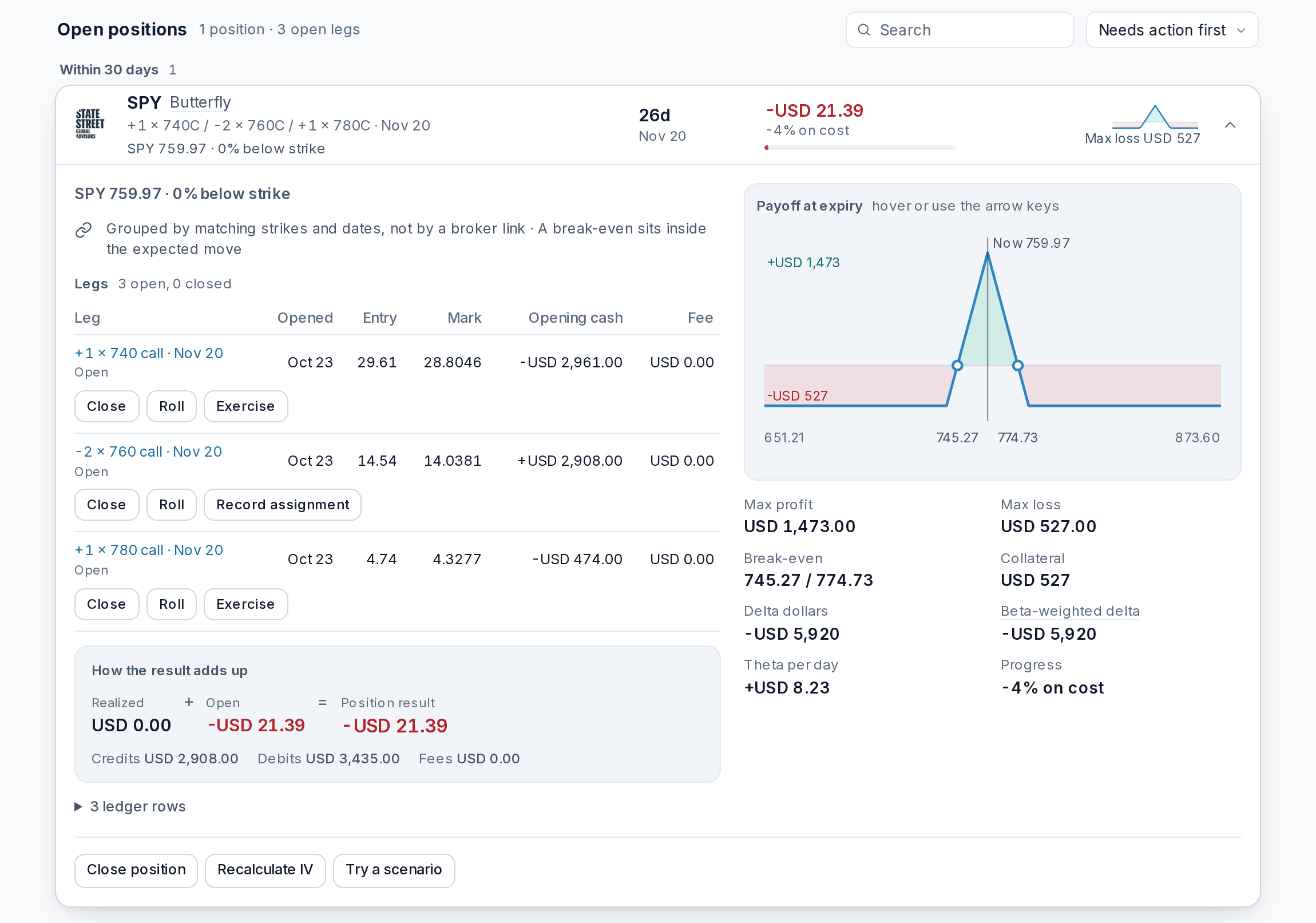
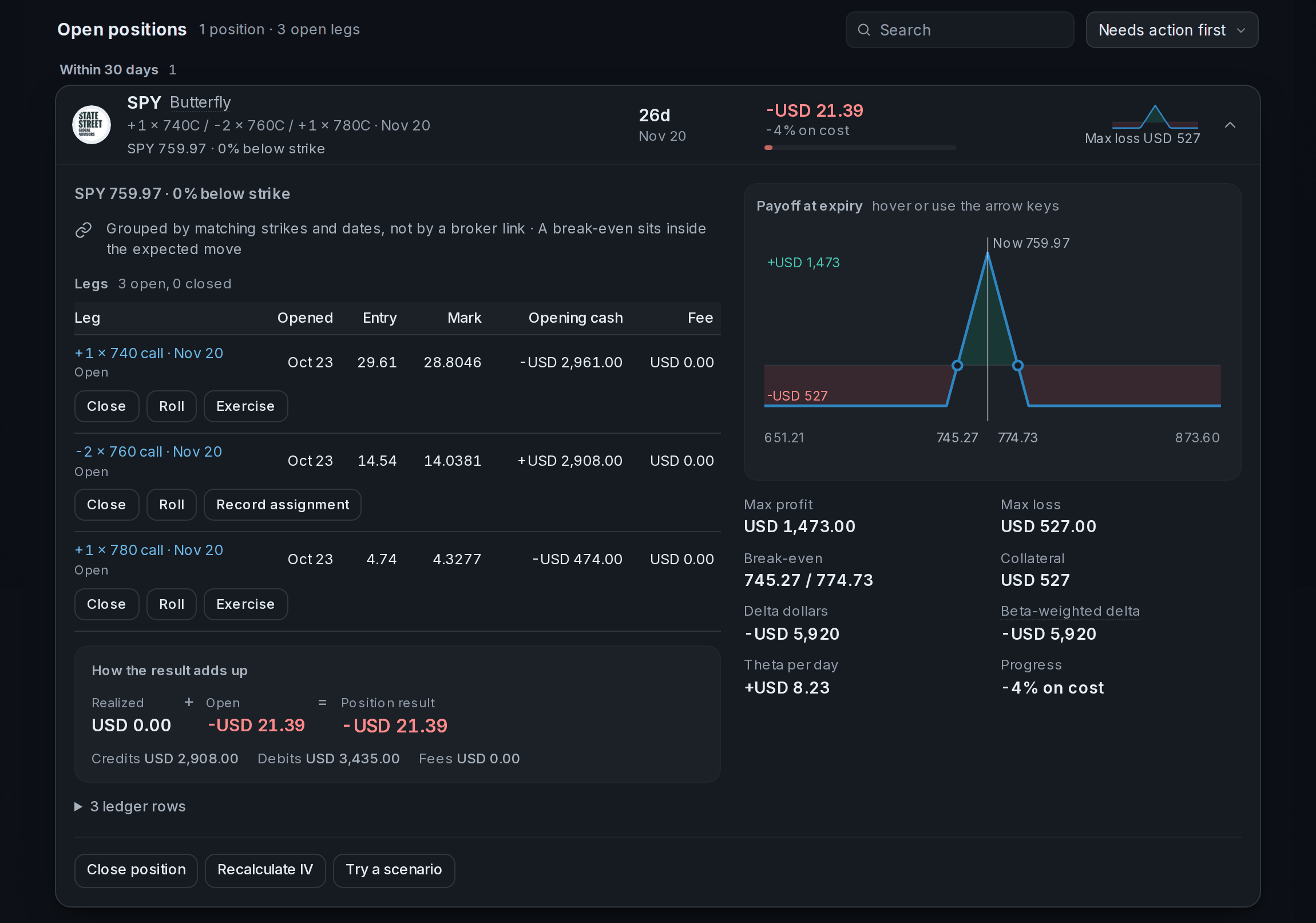
Call, put, iron and broken wing butterflies are grouped as one position, with the cost, the most it can make and lose, both breakevens and the payoff at expiry.
The whole position's delta and theta, and vega by leg and underlying
Days to expiry and every open option sorted by when it ends
Close, roll or record an assignment from the leg itself
Each closed butterfly's result kept for the tax report
AllInvestViewThe SPY 740/760/780 call butterfly in the options book, staged with the 23 October prices and viewed on 25 October.View full-size View full-size
Every broker in one place
See what your butterflies really made
Butterflies, condors, spreads, shares, ETFs, bonds and dividends on one dashboard, synced from your brokers or imported from a file, with every closed trade's result kept.
Three strikes grouped as one butterfly Payoff and breakevens on every position 14-day free trial, no card required
It's three strikes with the same expiry: buy one option below the price, sell two at the price and buy one above. It costs little, the most you can lose is what you paid, and it pays the most if the stock ends on the middle strike. On 23 October 2026 SPY's 20 November 740/760/780 call butterfly cost $527 and paid up to $1,473.
When does a butterfly spread make money?
When the stock ends between the breakevens: the low strike plus what you paid and the high strike minus it. The SPY butterfly bought for $5.27 a share makes money between $745.27 and $774.73 at expiry, most of all at $760. Before expiry it's worth much less, because most of the profit arrives in the last week.
What's the difference between a butterfly and an iron butterfly?
A call or put butterfly uses one type of option and you pay to open it. An iron butterfly sells a put and a call at the middle strike and buys a put below and a call above, so you're paid to open it. At expiry they pay the same. On SPY the 740/760/780 iron butterfly paid $1,497 and could lose at most $503.
What is a broken wing butterfly?
A butterfly with one outer strike further away than the other. It can open for a small credit, and then it has no loss on the narrow side at expiry, but more risk on the wide side. SPY's 740/760/770 put version paid $40, made up to $1,040 at $760 and could lose $960 below $740.
Is a butterfly better than an iron condor?
They suit different views. A butterfly pays more but needs the price close to one strike; an iron condor pays less over a much wider range. On SPY's 20 November options the butterfly risked $527 to make up to $1,473, the condor $803 to make $197. Since 1993 SPY ended a four-week stretch inside the butterfly's range 37% of the time and inside the condor's 76%.
Should you hold a butterfly spread to expiry?
Usually not to the final bell. With the price near the middle strike, you can't know whether the two short options will be assigned, which can leave you with shares over the weekend. Many traders close once the butterfly shows a set share of its top profit and close all of it on the last day.
How are butterfly spreads taxed in the US?
Each leg is an option trade. On stocks and ETFs such as SPY, options closed or expired within a year give short-term gains or losses, and closing every leg together nets them into one result. Butterflies on broad indexes such as SPX are Section 1256 contracts, taxed 60% long-term and 40% short-term and marked to market at year end.
FINRA Rule 4210 and the Cboe margin manual, margin on butterfly and iron butterfly spreads
SPY closing price and 20 November 2026 option quotes (bid and ask) at the 23 October 2026 close; SPY daily closes from January 1993
Costs use the ask for options bought and the bid for options sold, before commissions. Implied volatilities, deltas, time decay and the 6 November and later values come from AllInvestView's Black-Scholes engine with a 3.94% rate and each option's volatility solved from its midpoint price, held fixed. No SPY ex-dividend date falls before 20 November. Four-week moves are SPY's price change over each overlapping stretch of 20 trading days.

 AllInvestView