Take profits early
Many traders buy the whole condor back once it has made about half the credit. The rest of the profit would mean weeks more exposed to a move, for less money.
Sold for $1.97, bought back near $0.99: about $98 kept
An iron condor is four options on the same stock or ETF with the same expiry. You sell a put below the price and a call above it, and buy a cheaper put and call further out so the loss has a floor. You're paid a credit up front and keep all of it if the price ends between the two strikes you sold. If it runs past either side, you can lose the width of that spread minus the credit, and no more.
On 23 October 2026 SPY closed at $759.97. Selling the 20 November 710/720 put spread and 790/800 call spread paid $197. Anywhere between $718.03 and $791.97 on 20 November, the trade makes money. The most it can lose is $803.
$1.97 × 100 = $197
$720 − $1.97 = $718.03 · $790 + $1.97 = $791.97
($10 − $1.97) × 100 = $803
The prices are real, from the 23 October close. Drag where SPY might close on 20 November, or switch to two weeks before expiry to see what the condor would be worth if you closed it then.

Margin is one spread's width, because SPY can't end below $710 and above $800 at once; the $197 you receive covers part of it. Filled at the midpoints the credit would have been $205.50. No SPY ex-dividend date falls before 20 November, but a Fed decision does, on 28 October.
The two weeks line uses each option's implied volatility at the 23 October close and assumes it doesn't change. It shows why many traders don't wait for expiry: with SPY unchanged the condor is already up about $109, more than half the credit, and the last two weeks add $88 while a move to either short strike now costs far more than it would at expiry.
The same 20 November expiry and $10 wings, with the short strikes at four deltas, all at the 23 October bid and ask. Closer strikes pay more and leave SPY less room.
| Short put / call | Credit | Most you can lose | Keep it allrough chance |
|---|---|---|---|
| $700 / $800delta 0.08 to 0.10−7.9% / +5.3% | $92 | $908 | 82% |
| $720 / $7900.16, the example−5.3% / +4.0% | $197 | $803 | 68% |
| $730 / $785delta about 0.21−3.9% / +3.3% | $283 | $717 | 58% |
| $740 / $780delta about 0.27−2.6% / +2.6% | $396 | $604 | 46% |
Delta doubles as a rough chance of an option ending in the money, so one minus the two short deltas is a rough chance that both expire worthless. Every row is a trade-off, not a bargain: the 0.10 condor keeps its $92 about 4 times in 5 but risks $908 to do it, so one full loss wipes out about ten wins. At 0.16 you need about four full wins for each full loss. Notice the put sits further from the price than the call at the same delta. Puts are priced for sharper falls than rises, which is why most condors end up lopsided.
The short strikes stay at $720 and $790; only the protective put and call move. Wider wings collect more because you pay less for protection, and you can lose much more.
| Wings | Credit | Most you can lose | Return on risk |
|---|---|---|---|
| $5 wide$715 / $795 | $107 | $393 | 27.2% |
| $10 widethe example$710 / $800 | $197 | $803 | 24.5% |
| $20 wide$700 / $810 | $308 | $1,692 | 18.2% |
| $30 wide$690 / $820 | $372 | $2,628 | 14.2% |
The breakevens barely move, and the return on what you risk falls as the wings widen. Two $5 condors pay $214 against $197 for one $10 condor with almost the same $786 at risk, though they mean eight fills instead of four. Pick the width from the loss you can take on a bad month, then size the number of condors from that.
Condors with short strikes near 0.16 delta and $10 wings at four expiries, at the 23 October bid and ask. Longer condors pay about the same credit with a wider range, and earn less per day.
| Expiry | Credit | Credit a day |
|---|---|---|
| 20 Nov 2026monthly, the example710/720 · 790/800 | $197 | $7.04 |
| 27 Nov 2026weekly705/715 · 795/805 | $176 | $5.03 |
| 30 Nov 2026month end705/715 · 795/805 | $188 | $4.95 |
| 18 Dec 2026monthly695/705 · 805/815 | $196 | $3.50 |
Time decay speeds up near expiry, so the 28-day condor earns the most per day, and it also reacts hardest when SPY moves. The December condor gives SPY a range about 40% wider for the same money and more time for things to go wrong. That's the reason behind the common habit of opening 30 to 45 days out and closing well before the last week. The monthly expiries also carry far more open interest than the weeklies, which usually means tighter prices when you want out.
You don't have to hold to the end, and many traders don't. Each card uses the SPY condor above.
Many traders buy the whole condor back once it has made about half the credit. The rest of the profit would mean weeks more exposed to a move, for less money.
If SPY falls toward $720, the call spread is nearly worthless. Buying it back and selling a call spread closer to the price adds credit and moves your upper breakeven down, so a rebound can hurt.
SPY options are American-style and settle in shares. If SPY ends between a short and a long strike, only the short option is exercised. You start Monday owning 100 SPY on the put side, or short 100 on the call side.
Early assignment is rare while an option still has time value, because the holder gets more by selling it. The exception is a short call that's in the money the day before SPY goes ex-dividend, which happens each quarter; the next one comes after 20 November. If a short leg is assigned, your long option on that side still caps the loss, but closing the spread early is simpler than handling the shares.
Cboe runs two indexes that trade these every month on the S&P 500. The Iron Condor Index (CNDR) sells a put and a call at about 0.20 delta and buys wings at about 0.05. The Iron Butterfly Index (BFLY) sells both at the money and buys wings 5% out. Both hold to expiry and keep the cash in one-month Treasury bills.
Hover or tap a year; a green dot marks a year the index won. S&P 500 measured with SPY, dividends reinvested. Index values from Cboe.
The condor index did what it promises: small, steady results. It rose in 147 of the 226 months since 2008, and lost only 4.0% in 2008 when the S&P 500 lost 36.8%. But the average down month (−2.0%) was bigger than the average up month (+1.2%), and over ten years that left almost nothing: less than the 2.4% a year one-month Treasury bills paid. The butterfly, which sells at the money, lost money. The index holds every condor to expiry and trades straight through every Fed meeting and crash. Taking profits early and skipping big events changes the result, which is why it pays to track what your own condors earn.
Five ways to trade a range or a breakout on the same SPY expiry, priced at the 23 October close.
| Strategy | The trade | Paid or cost | Most you can lose | Makes money if SPY ends |
|---|---|---|---|---|
| Iron condor | Sell the 720 put and 790 call, buy the 710 put and 800 call | +$197 | $803 | Between $718.03 and $791.97 |
| Iron butterfly | Sell the 760 put and 760 call, buy the 720 put and 800 call | +$2,144 | $1,856 | Between $738.56 and $781.44; all of it only at $760 |
| Short strangle | Sell the 720 put and 790 call, no wings | +$593 | No limit above; up to $71,407 if SPY went to zero | Between $714.07 and $795.93 |
| Put credit spread | Only the 720/710 put side | +$74 | $926 | Above $719.26 |
| Reverse iron condor | Buy the 720 put and 790 call, sell the 710 put and 800 call | −$214 | $214 | Below $717.86 or above $792.14; up to $786 |
The condor is a strangle with insurance. The $396 it gives up to the wings is what turns an open-ended loss into $803, and it's why brokers hold $1,000 of margin instead of the far larger sum a naked strangle needs. A put credit spread on its own suits a view that SPY won't fall, much like a cash-secured put with a floor under it; the condor adds a call spread for a view that it won't rise much either. Price any of these with your own strikes in the options payoff calculator.
The same condor can be traded on an ETF, an index or a single stock. The choice changes how it settles, its size and, in the US, how it's taxed under IRS Publication 550.
| Underlying | Exercise and settlement | Size | US tax on the result |
|---|---|---|---|
SPYETF options | American-style, can be exercised any day; settles in shares | 100 shares of SPY, about $76,000 of exposure per contract | Capital gain or loss, short-term when held a year or less |
 SPXS&P 500 index options | European-style, exercised only at expiry; settles in cash | 100 times the index, about ten times one SPY contract | Section 1256: 60% long-term, 40% short-term, marked to market at year end |
| A single stock | American-style; settles in shares | 100 shares of the stock | As SPY; earnings reports can jump a stock past both wings overnight |
For options you sold, the gain or loss is short-term, booked when the option expires or is bought back. Options you bought are short- or long-term by how long you held them. If a leg is assigned, its premium moves into the cost or sale price of the shares instead.
Broad-based index options are Section 1256 contracts, reported on Form 6781. Any gain or loss counts as 60% long-term and 40% short-term however briefly you held it, and open positions are valued as if sold on the last business day of the year.
The legs of a condor offset each other, so the straddle rules can apply: closing one side at a loss while the other side shows a gain can defer the loss. Other countries have their own rules.
A condor that keeps its credit two times in three can still lose money, because one full loss is four times the credit. What matters is how much you keep on the wins and how often you take a full hit.
The final week brings little extra credit and the biggest swings in value near the short strikes. A close between a short and long strike also hands you shares on Monday.
Earnings for a stock, or a Fed decision or inflation report for the index, can move the price past a wing in a day. The extra premium before an event is the market pricing that move.
Four legs means four bid-ask spreads. The SPY example paid $197 at the bid and ask and $205.50 at the midpoints; on a thinly traded stock the gap is far wider.
Opening more condors to win back a full loss raises the size of the next one. Size each trade from the most you can lose, not the credit.
A condor is four positions that only make sense together. AllInvestView prices the trade before you place it and keeps the legs together once it's open, across every broker you use.
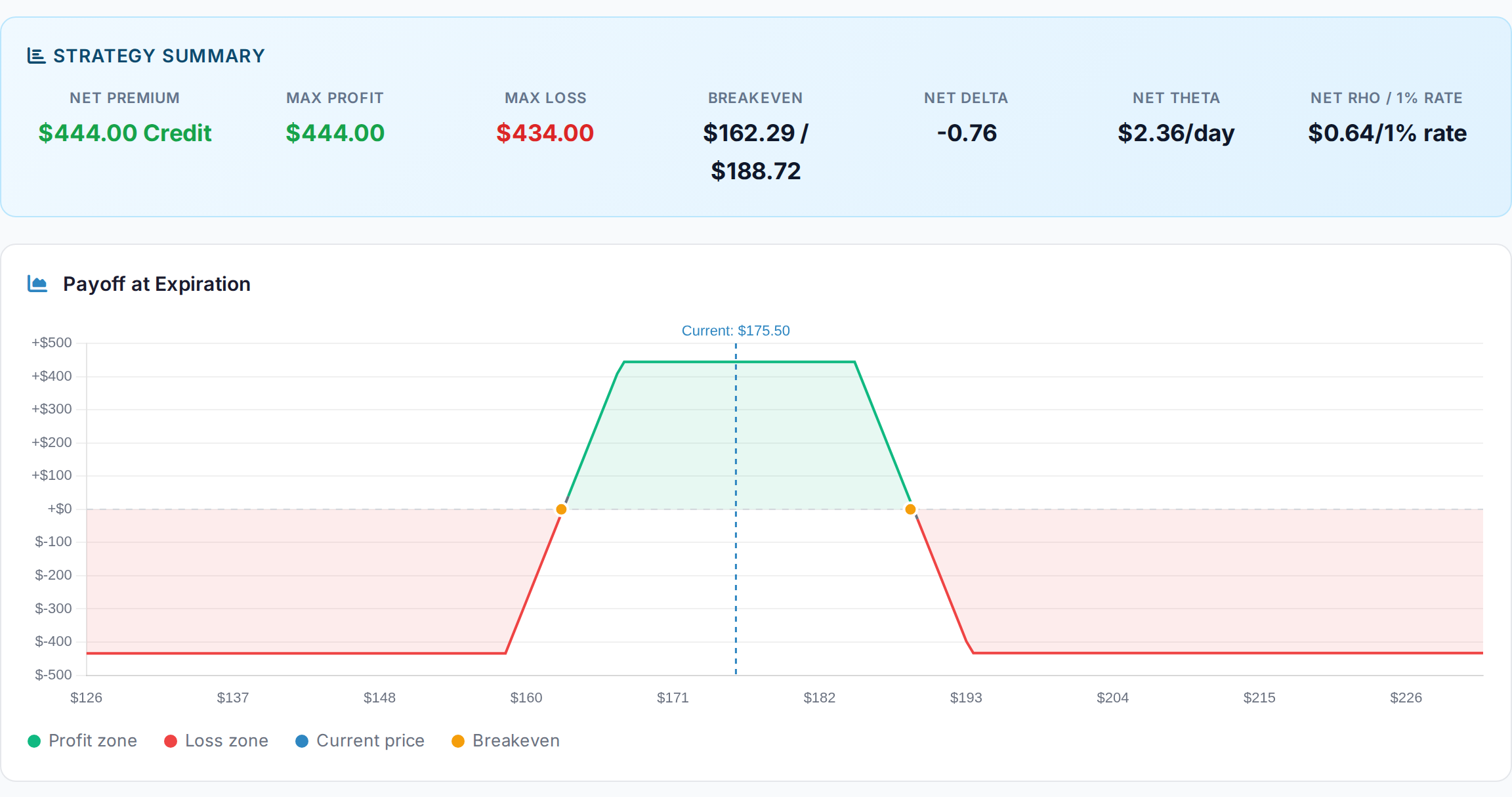
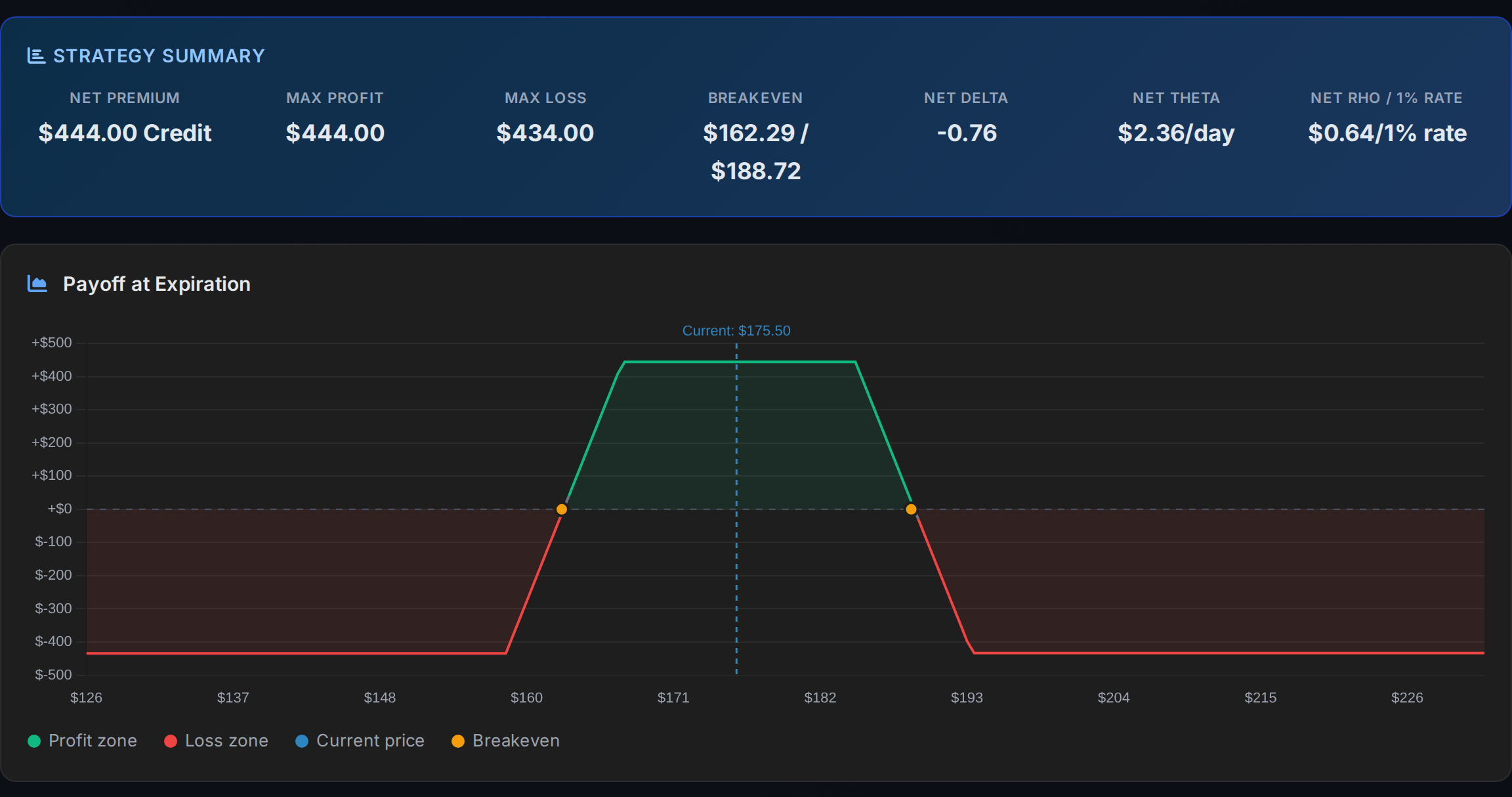
The Strategy Builder has an Iron Condor template that fills in the four legs. Its summary shows the net credit, the most you can make and lose, both breakevens, the combined Greeks and the payoff at expiry.
 AllInvestView
Condors, spreads, shares, ETFs, bonds and dividends on one dashboard, synced from your brokers or imported from a file, with the premium you've kept each month.
It's two credit spreads on the same stock or ETF and expiry: a put spread below the price and a call spread above it. You're paid up front and keep the whole credit if the price ends between the two strikes you sold. The options you buy further out cap what you can lose if it doesn't.
You can make the credit and lose the width of one spread minus the credit. Selling SPY's 20 November 710/720 put spread and 790/800 call spread paid $197 on 23 October 2026, with SPY at $759.97. The most it can lose is $803, if SPY ends below $710 or above $800. Between $718.03 and $791.97 it makes money.
It's a steady, low-volatility trade that earns little when markets trend. Over the 10 years to 23 October 2026, Cboe's S&P 500 Iron Condor Index, which sells a monthly 0.20-delta condor, returned 0.9% a year against 15.3% for the S&P 500 with dividends. Its worst fall since 1993 was 19.7%, against 55.2% for SPY.
An iron butterfly sells the put and the call at the same strike, at the money, so it pays far more but only keeps all of it if the price ends exactly there. On SPY on 23 October 2026, a 720/760/800 butterfly paid $2,144 against $197 for the 710/720/790/800 condor, and needed SPY between $738.56 and $781.44 to make money.
If the price is between the short strikes, all four options expire worthless and you keep the credit. If it's past a short strike, that option is in the money: SPY options are exercised into shares, so close the spread before the end of the last day. SPX options settle in cash, so nothing is delivered.
It's the same four options the other way round: you buy the inner put and call, sell the outer ones and pay a debit. It makes money when the price moves a lot in either direction. Buying the SPY 710/720/790/800 condor cost $214 on 23 October 2026 and could make up to $786 if SPY ended below $710 or above $800.
On SPY and other ETF or stock options, a condor that expires or is closed within a year gives a short-term capital gain or loss. On SPX and other broad index options it counts as Section 1256 contracts: 60% long-term and 40% short-term whatever the holding period, marked to market at year end on Form 6781.
Checked on 25 October 2026.
Credits use the bid for options sold and the ask for options bought, before commissions. Deltas and the 14-days-left line come from AllInvestView's Black-Scholes engine with a 3.94% rate and each option's implied volatility solved from its midpoint price. Index statistics are our calculations from Cboe's daily values and SPY's dividend-adjusted closes.