Straddle vs Strangle: How Both Work, With Real Microsoft Trades Before Its Earnings
A straddle buys a call and a put at the same strike and expiry. A strangle buys them at two strikes, the put below the price and the call above. Both pay when the stock moves a lot in either direction and lose when it barely moves. Selling them is the opposite bet: you're paid up front for the stock staying put, and the loss has no limit.
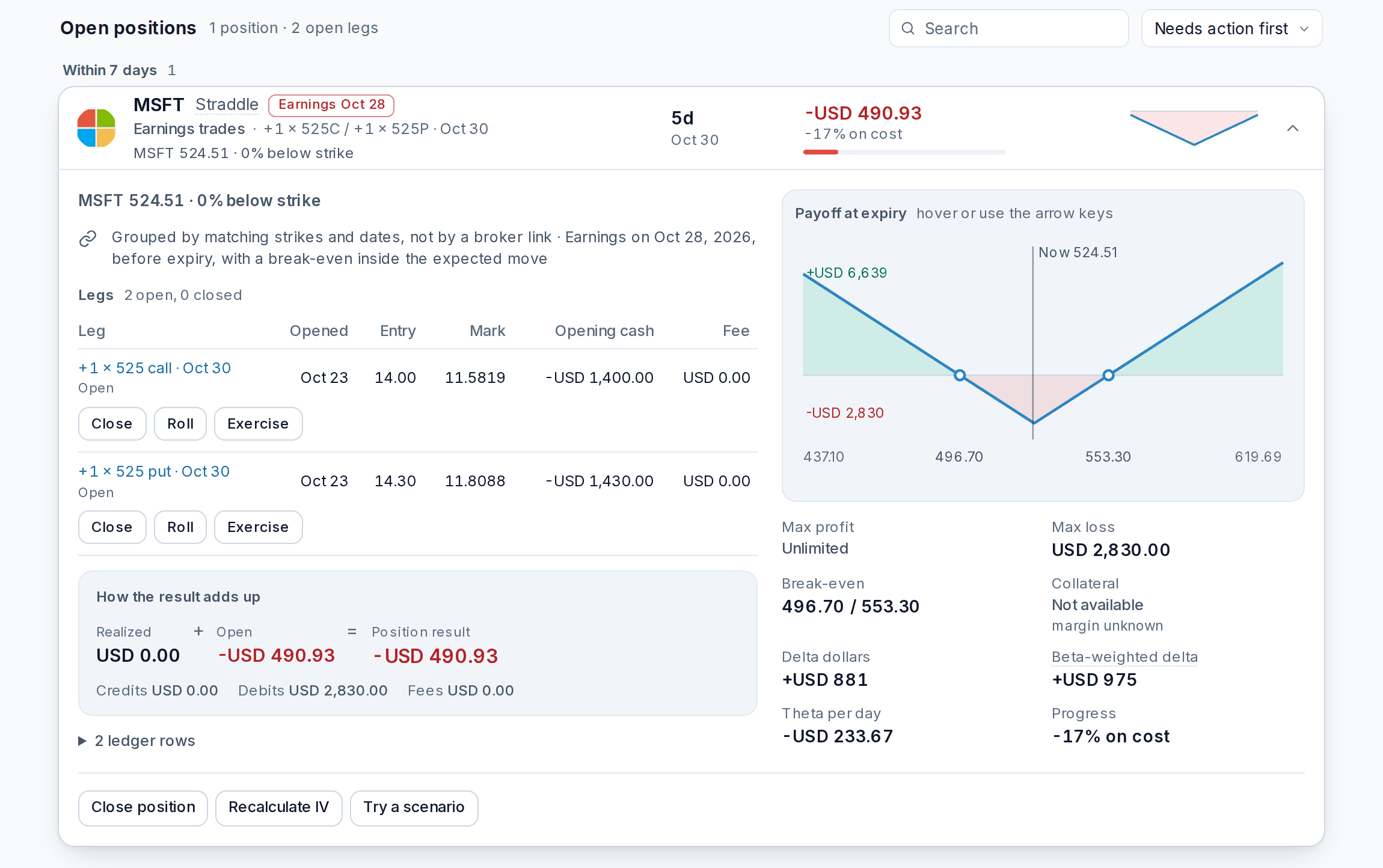
On 23 October 2026 Microsoft closed at $524.51, with earnings due on 28 October. Buying the 30 October $525 straddle cost $2,830, and it makes money only if Microsoft ends that Friday below $496.70 or above $553.30, about 5.4% either way. The 500/550 strangle cost $1,000 and needs Microsoft below $490 or above $560.
A straddle in three numbers
What it costs
Call + put×100
($14.00 + $14.30) × 100 = $2,830
Lower breakeven
Strike − cost
$525 − $28.30 = $496.70
Upper breakeven
Strike + cost
$525 + $28.30 = $553.30
Cost today$2,830for one Microsoft $525 straddle expiring 30 Oct, both options bought at the ask; the most it can lose
Move it needs±5.4%by Friday 30 October, two days after the report: −5.3% down or +5.5% up
How often Microsoft moved that far8 of 24earnings weeks since October 2020, Friday before the report to Friday after
Same idea, two choices: one strike or two, and buying the move or selling the calm. All four use Microsoft's 30 October options at the 23 October bid and ask.
Buy · you need a big move
Long straddle
Buy a call and a put at the strike nearest the price. It costs more than the strangle and starts making money after a smaller move.
Buy the $525 call and $525 put: −$2,830; wins below $496.70 or above $553.30
Buy · you need a bigger move
Long strangle
Buy a put below the price and a call above it. It's cheaper because both options start out of the money, so the stock has to travel further before it pays.
Buy the $500 put and $550 call: −$1,000; wins below $490 or above $560
Sell · you need a quiet stock
Short straddle
Sell the call and put at one strike. You collect the most premium of the four, keep all of it only if the stock ends on the strike, and lose more with every dollar it travels.
Sell the $525 call and $525 put: +$2,705; makes money between $497.95 and $552.05
Sell · you need a calm-ish stock
Short strangle
Sell a put below the price and a call above it. Less premium, a wider range where you keep all of it, and the same open-ended loss once the stock breaks out.
Sell the $500 put and $550 call: +$935; makes money between $490.65 and $559.35
Selling a strangle with a cheaper put and call bought further out caps the loss: that's an iron condor, and the same thing around a short straddle is an iron butterfly. Both are compared below.
A straddle example: Microsoft's earnings week, 23 to 30 October 2026
The prices are real, from the 23 October close. Pick the straddle or the strangle, buy or sell it, and drag where Microsoft might close on 30 October. Or switch to Thursday, the day after the report, to see what's left of the trade once the earnings premium is gone.
Microsoft (MSFT)Closed at $524.51 on 23 October 2026
Buy$525 callat $14.00
Buy$525 putat $14.30
Cost, the most you can lose
$2,830
Breakevens
$496.70 / $553.30
Move needed
−5.3% / +5.5%
Implied volatility
48%
Delta
+0.02
Most you can make
No limit
The delta near zero means the straddle doesn't care which way Microsoft goes, only how far. Bought at the midpoints it would have cost $2,767.50.
Buy$500 putat $5.15
Buy$550 callat $4.85
Cost, the most you can lose
$1,000
Breakevens
$490.00 / $560.00
Move needed
−6.6% / +6.8%
Implied volatility
50% / 46%
Delta
+0.01
Most you can make
No limit
About a third of the straddle's price. Between $500 and $550 both options expire worthless, so the whole $1,000 is lost across that range. Bought at the midpoints it would have cost $967.50.
Sell$525 callat $13.55
Sell$525 putat $13.50
Paid to you, the most you can make
$2,705
Breakevens
$497.95 / $552.05
Room either way
−5.1% / +5.3%
Margin held (Reg T)
$13,195
Delta
−0.02
Most you can lose
No limit
You keep all $2,705 only if Microsoft ends at exactly $525, and less for every dollar it moves away. Sold at the midpoints it would have paid $2,767.50.
Sell$500 putat $4.85
Sell$550 callat $4.50
Paid to you, the most you can make
$935
Breakevens
$490.65 / $559.35
Room either way
−6.5% / +6.6%
Margin held (Reg T)
$8,974
Delta
−0.01
Most you can lose
No limit
You keep all $935 anywhere between $500 and $550 on 30 October. Sold at the midpoints it would have paid $967.50.
Where does Microsoft close on 30 October?
At expiryThursday close, one day left
Profit or loss at expiry−$2,781only the put is worth anything
On the $2,830 paid−98.3%Microsoft 0.0% from $524.51
Microsoft is between the breakevens, so the straddle loses money.
The Thursday line assumes implied volatility drops from about 48% to 27% once the report is out, the level Microsoft's longer options imply without an earnings day in them (more on that below). With Microsoft unchanged on Thursday, the straddle bought for $2,830 would be worth about $595. Nearly all of what you pay for an earnings straddle is the earnings move; if it doesn't come, the money is gone within a day.
How far does Microsoft move after earnings? Its last 24 reports
Microsoft's price change from the Friday close before each report to the Friday close after it, the same window as the 30 October straddle, for every report from October 2020 to July 2026. The shaded band is where today's trade loses for the buyer.
Microsoft's earnings-week moves, October 2020 to July 2026
Buyer loses inside this bandMoved past a breakevenStayed inside
Straddle: Microsoft moved past −5.3% or +5.5% in 8 of 24 earnings weeks.
Hover or tap a bar. Price change only, without dividends. Our calculations from Microsoft's closing prices and the release times in its SEC filings; every report in the period came after the US close. The dollar figures apply the 23 October prices to each past move, since each quarter's options were priced differently.
Typical move
Average
4.8%
Median
3.4%
Up or down, over the earnings week
Long straddle paid
Wins
8 of 24
Average
−$326
Best +$8,529 in July 2026; the 16 losses ran from −$604 to −$2,375
Long strangle paid
Wins
6 of 24
Average
−$177
Lost the full $1,000 in 16 of the 24 weeks
Short straddle paid
Wins
16 of 24
Average
+$201
Worst −$8,654 in July 2026, when Microsoft rose 21.8%
The market priced a move of about 5.4%. Microsoft's average earnings week moved 4.8% and the median 3.4%, so most weeks the straddle buyer lost and the seller won. The seller's 16 winning weeks made about $22,900 between them, and the 8 losing weeks gave back about $18,100, $8,654 of it in July 2026 alone. Buyers lose most weeks and live on the rare big one; sellers win most weeks, and one big move can take back a year and a half of premium.
Picking the strikes: from straddle to wide strangle
Microsoft's 30 October options at five pairs of strikes, priced at the 23 October bid and ask. The last column counts the past 24 earnings weeks that moved past each breakeven.
Microsoft 30 October 2026 straddle and strangles by strike, 23 October 2026 close, Microsoft at $524.51
Put / call
Buy for
Breakevens
Move needed
Sell for
Moved pastof 24 reports
$525 / $525straddle, the example−5.3% / +5.5%
$2,830
$496.70 / $553.30
−5.3% / +5.5%
$2,705
8
$520 / $530$5 each side−5.4% / +5.5%
$2,360
$496.40 / $553.60
−5.4% / +5.5%
$2,245
8
$510 / $540about 3% each side−5.7% / +5.9%
$1,565
$494.35 / $555.65
−5.7% / +5.9%
$1,505
8
$500 / $550about 5% each side−6.6% / +6.8%
$1,000
$490.00 / $560.00
−6.6% / +6.8%
$935
6
$490 / $560about 7% each side−7.8% / +8.0%
$626
$483.74 / $566.26
−7.8% / +8.0%
$563
2
Moving the strikes apart makes the trade cheaper, not easier. The 510/540 strangle costs 45% less than the straddle and needs only a slightly bigger move, because the market priced the earnings jump into every strike. What changes is the payout: past the breakevens, the straddle and the strangle gain the same dollar for dollar, so the cheaper one returns more on the money paid when the big week comes, and loses everything more often when it doesn't. Sellers face the mirror image: the 490/560 strangle collected $563 and was beaten twice in 24 weeks, but one of those was the 21.8% jump.
The volatility crush: why a straddle can lose even when the stock moves
Options priced across an earnings date carry the expected jump. Once the report is out, implied volatility falls back and takes that value with it.
Microsoft $525 straddles by expiry, 23 October 2026 close: cost, move needed and implied volatility
Expiry
Days
Straddle costs
Move needed
Implied volatility
Cost per day
30 Oct 2026weekly, the examplecosts $2,830
7
$2,830
±5.4%
48%
$404
6 Nov 2026weeklycosts $3,255
14
$3,255
±6.2%
38%
$233
13 Nov 2026weeklycosts $3,645
21
$3,645
±7.0%
35%
$174
20 Nov 2026monthlycosts $3,930
28
$3,930
±7.5%
33%
$140
18 Dec 2026monthlycosts $5,035
56
$5,035
±9.6%
30%
$90
Every one of these expiries holds the same earnings day, and the shorter the option, the bigger the share of its life that one day is. Splitting the prices into an ordinary daily volatility and one jump gives about 27% a year plus a one-day move of about 5.4%, the same move the 30 October straddle priced. Here's what that means for someone who buys the 20 November straddle for $3,930, thinking the extra time makes it safer, and looks at it on Thursday after the report:
Value of the Microsoft 20 November $525 straddle bought for $3,930, at the close on Thursday 29 October, by Microsoft's move, if implied volatility stays at 33% or falls to 27%
Microsoft on Thursday
If volatility stayed at 33%
After the crush to 27%
Down 10%$472.06
+$1,697
+$1,485
Down 5.4%$496.19
+$132
−$323
Unchanged$524.51
−$527
−$1,151
Up 5.4%$552.83
+$257
−$241
Up 10%$576.96
+$1,822
+$1,536
After the crush, the 20 November straddle needs Microsoft up about 6.1% or down about 6.4% just to break even the next day, more than the 5.4% the market expected. The longer expiry doesn't escape the earnings premium; it pays it too, and then pays for three more weeks of time on top. If you buy a straddle for an event, the event has to beat the move already in the price.
Selling a straddle or strangle: margin, and how to cap the loss
Four ways to sell Microsoft's earnings week, all on the 30 October expiry at the 23 October bid and ask. The first two have no limit on the loss; the last two buy options further out to set one.
Strategy
The trade
Paid to you
Margin held
Most you can lose
Makes money if Microsoft ends
Short straddle
Sell the $525 call and $525 put
+$2,705
$13,195
No limit above; $49,795 if Microsoft went to zero
Between $497.95 and $552.05
Short strangle
Sell the $500 put and $550 call
+$935
$8,974
No limit above; $49,065 if Microsoft went to zero
Between $490.65 and $559.35
Iron butterfly
Sell the $525 straddle, buy the $500 put and $550 call
Sell the $510 put and $540 call, buy the $490 put and $560 call
+$879
$2,000
$1,121
Between $501.21 and $548.79
The margin figures are the US Reg T minimum. Each naked option needs its premium plus 20% of the share price, less any amount it's out of the money, and never less than its premium plus 10% of the share price for a call or of the strike for a put. A short straddle or strangle holds the larger side plus the other side's premium. For the defined-risk trades it's the width of the wider side, and your broker's own rules are often stricter. Selling naked options also needs the top options approval level at most brokers. In July 2026 the short straddle above would have lost $8,654 on a $2,705 credit; the iron butterfly's worst case was $795.
Managing the trade: after the report, at expiry and on assignment
Each card uses the Microsoft trades above.
Decide the morning after
Microsoft reports after Wednesday's close, so the move shows up in Thursday's opening price. What's left after that is a little time value that disappears by Friday, so most earnings straddles are sold or bought back on Thursday rather than held.
Microsoft up 10% on Thursday: the straddle is worth about $5,200
Sell the leg that's worth something
After a big move one option holds almost all the value and the other is worth a few cents. You can sell the winner and leave the loser to expire, though that leaves the cheap leg's small time value on the table.
Up 10%: the $525 call is worth about $52 a share, $5,200 for the contract; the put a few cents a share
Watch the expiry
Options a cent or more in the money are exercised automatically at expiry. Hold a long straddle to the end and the leg in the money becomes 100 Microsoft shares bought or sold at $525; on a short one, the assigned leg means shares you must take or deliver.
Microsoft at $560 on 30 Oct: the call becomes 100 shares at $525
Early assignment on a short straddle is rare while the options still have time value. The usual exception is a short call that's deep in the money the day before an ex-dividend date; Microsoft's next one falls in November, after this expiry. Closing both legs before the last day avoids the automatic exercise at expiry.
How straddles and strangles are taxed in the US
Under IRS Publication 550, a call and a put on the same stock held together are offsetting positions, so the tax straddle rules apply on top of the normal option rules.
Closing or letting both legs expire
Options bought and sold or left to expire within a year give short-term gains or losses. A short straddle that expires worthless is a short-term gain of the premium in the year it expires. If a leg is exercised or assigned, its premium goes into the cost or sale price of the shares instead.
Short straddle expires with Microsoft at $525: $2,705 short-term gain in 2026
Closing one leg at a loss
If you close the losing leg and keep the winner open, the loss is deferred to the extent the open leg shows an unrealized gain at the end of the tax year. Straddles on broad index options such as SPX are Section 1256 contracts: 60% long-term, 40% short-term, marked to market at year end on Form 6781.
Put sold at a $1,400 loss, call open on 31 Dec with a $3,000 gain: the loss waits
Other countries have their own rules; our options tax tracker keeps the realized and open legs apart for the report.
Five straddle and strangle mistakes
Buying the event without checking its price
Everyone knows earnings move a stock. The question is whether it moves more than the 5.4% already in the price. Compare it with the stock's own past reports before you pay.
Thinking a longer expiry avoids the crush
The 20 November straddle carries the same earnings premium as the weekly, plus three weeks of time. With Microsoft unchanged it would lose about $1,151 the next day.
Selling naked because it usually wins
The short straddle won 16 of 24 earnings weeks and still lost $8,654 in one. An iron butterfly or condor gives up some premium to cap that.
Ignoring the spread on two legs
You pay the ask on both options going in and take the bid on both coming out. On the straddle that's $125 of the $2,830 before the stock moves at all.
Holding to Friday's close
A long straddle near a strike at expiry can turn into 100 shares, and a short one into an assignment you have to fund. Close both legs before the bell.
Plan and track your straddles
A call and a put bought for one move belong together. AllInvestView prices the straddle before you place it and shows it as one position after, synced from every broker you use.
Options book and Strategy Builder
One straddle, not two loose options
A call and a put on the same stock and expiry are grouped as one straddle or strangle, with the cost, both breakevens and the payoff at expiry, and a flag when earnings fall before the expiry.
Straddle and strangle templates in the Strategy Builder, long and short
Expected move on open options, from their implied volatility
Delta and theta for the whole position, vega by leg and underlying
Close, roll or record an assignment from the leg itself
AllInvestViewThe Microsoft $525 straddle in the options book, staged with the 23 October prices and viewed on 25 October.View full-size View full-size
Every broker in one place
See what your earnings trades really made
Straddles, spreads, condors, shares, ETFs, bonds and dividends on one dashboard, synced from your brokers or imported from a file, with every closed trade's result kept.
Two legs grouped as one straddle Earnings dates next to your options 14-day free trial, no card required
It's a call and a put on the same stock with the same strike and expiry. Buying both pays when the stock moves far in either direction; selling both pays when it stays near the strike. On 23 October 2026, buying Microsoft's 30 October $525 straddle cost $2,830.
What's the difference between a straddle and a strangle?
A straddle uses one strike for the call and the put. A strangle uses two: the put below the price and the call above it. The strangle is cheaper and needs a bigger move. Microsoft's 500/550 strangle cost $1,000 against $2,830 for the $525 straddle, and needed a move of about 6.7% instead of 5.4%.
When does a long straddle make money?
When the stock ends past either breakeven: the strike minus what you paid, or the strike plus it. The Microsoft $525 straddle bought for $28.30 a share makes money below $496.70 or above $553.30 on 30 October. In between it loses, most of all at $525.
What is IV crush?
It's the fall in implied volatility once an expected event such as earnings has happened. Options priced across the report carry the expected jump, and after it that value goes. With Microsoft unchanged the day after its report, the 30 October straddle bought for $2,830 would be worth about $595.
Is a straddle or a strangle better for earnings?
Neither wins by default. The straddle costs more and starts paying after a smaller move; the strangle costs less and needs a bigger one. Over Microsoft's last 24 earnings weeks, the $525 straddle at today's prices paid 8 times and the 500/550 strangle 6 times. Both lost on average, because the market usually prices the move fully.
How risky is selling a straddle or strangle?
The loss has no limit on the upside and runs to almost the strike's full value if the stock collapses. Selling Microsoft's $525 straddle paid $2,705 and would have kept money in 16 of the last 24 earnings weeks, but lost $8,654 in July 2026. Brokers ask for the top options approval level, and the Reg T margin was about $13,195.
How are straddles taxed in the US?
Options closed or expired within a year give short-term gains or losses. Because a call and a put on the same stock offset each other, the IRS straddle rules apply: a loss on one closed leg is deferred to the extent the other leg shows an unrealized gain at the end of the tax year. Broad index options such as SPX are Section 1256 contracts, taxed 60% long-term and 40% short-term.
FINRA Rule 4210 and the Cboe margin manual, margin on uncovered options, straddles and spreads
Microsoft closing price and option quotes (bid and ask) at the 23 October 2026 close; Microsoft daily closes from October 2020
Costs use the ask for options bought and the bid for options sold, before commissions. Implied volatilities, deltas and the Thursday values come from AllInvestView's Black-Scholes engine with a 3.94% rate, each option's volatility solved from its midpoint price, and Microsoft's $0.98 dividend, ex-dividend 19 November, for the 20 November and 18 December expiries. The 27% volatility and 5.4% earnings move come from fitting the five expiries' at-the-money volatilities to an ordinary volatility plus one jump. Earnings-week moves run from the last close of the week before each report to the Friday close after it.

 AllInvestView