Credit Spreads: How Put and Call Credit Spreads Work, With Real QQQ Trades
A credit spread is two options of the same type and expiry. You sell one and buy a cheaper one further out of the money, so you're paid a credit up front. You keep all of it if the price stays on the right side of the strike you sold. If it doesn't, the option you bought caps the damage at the gap between the strikes minus the credit.
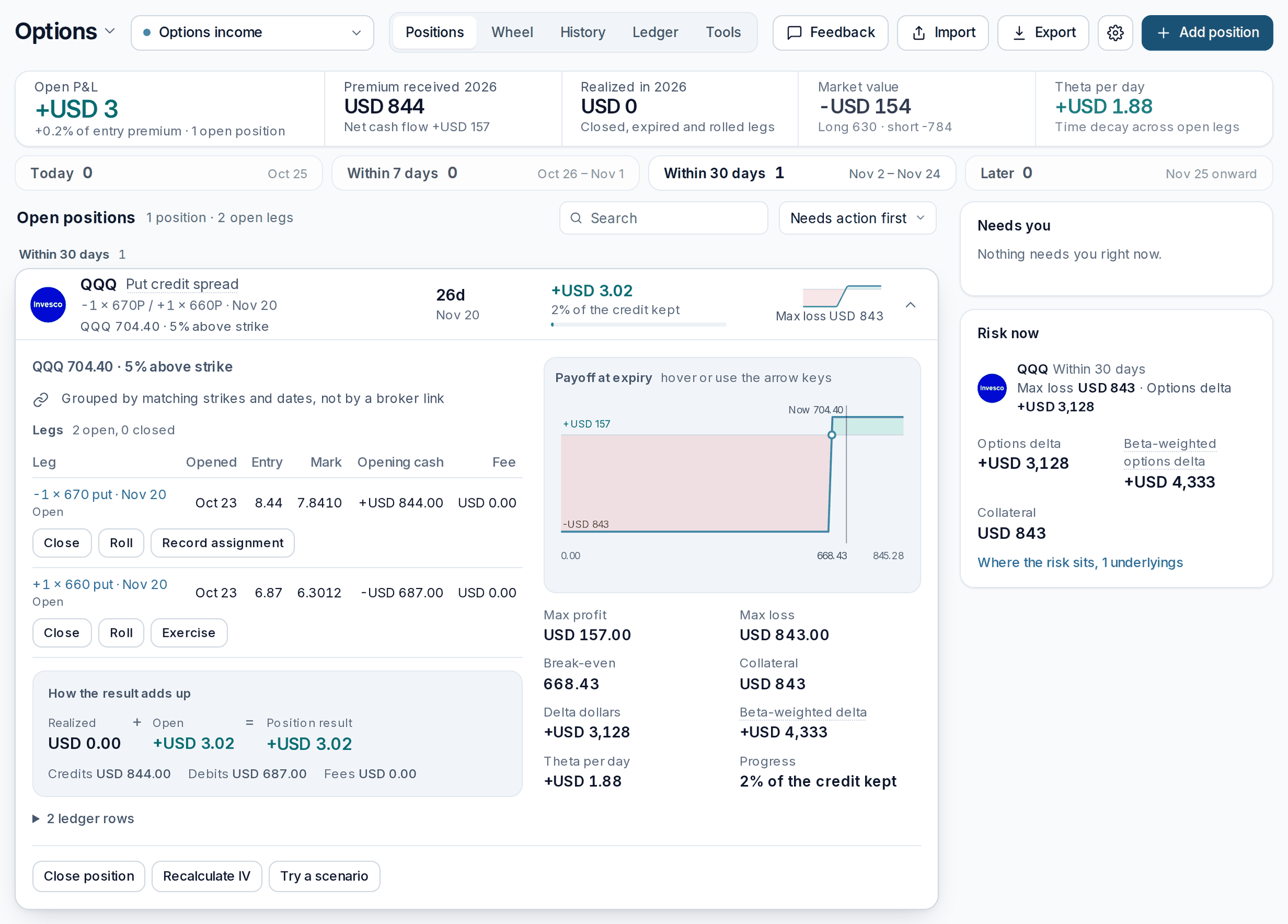
On 23 October 2026 QQQ closed at $704.40. Selling the 20 November 670/660 put spread paid $157. If QQQ is above $670 on 20 November you keep it all, and above $668.43 you still make money. The most it can lose is $843, if QQQ ends below $660.
A credit spread in three numbers
Most you can make
Net credit×100
$1.57 × 100 = $157
Breakeven
Short put strike − credit
$670 − $1.57 = $668.43
Most you can lose
(Width − credit)×100
($10 − $1.57) × 100 = $843
Paid today$157for one QQQ put spread expiring 20 Nov, selling at the bid and buying at the ask: 18.6% of the $843 at risk
Room to fall−4.9%QQQ can drop to $670 by 20 November and you keep the full $157
How often QQQ fell that far11.6%of 4-week stretches in the last 10 years ended more than 4.9% lower
The two credit spreads: put credit spread and call credit spread
Both pay you up front and both have a loss with a limit. The difference is which way the price can't go.
Bullish or neutral
Put credit spread (bull put spread)
Sell a put below the price and buy a lower put. It wins if the price rises, stays flat or falls a little, and loses money once it falls below the strike you sold by more than the credit.
Sell a call above the price and buy a higher call. It wins if the price falls, stays flat or rises a little, and loses money once it rises above the strike you sold by more than the credit.
Selling both on the same expiry is an iron condor. In bonds, "credit spread" means something else: the extra yield a corporate bond pays over a government bond, which our bond spread calculator works out.
A credit spread example: QQQ, 23 October to 20 November 2026
The prices are real, from the 23 October close. Pick the put or the call spread, drag where QQQ might close on 20 November, or switch to two weeks before expiry to see what the spread would be worth if you closed it then.
Invesco QQQ Trust (QQQ)Closed at $704.40 on 23 October 2026
Sell$670 putat $8.44
Buy$660 putat $6.87
Net credit
$157
Most you can lose
$843
Breakeven
$668.43
Delta of the short put
0.24
Return on the money at risk
18.6%
Margin held (Reg T)
$1,000
The broker holds the $1,000 width; the $157 you receive covers part of it, so $843 of your own money is tied up. Filled at the midpoints the credit would have been $166.
Sell$740 callat $5.44
Buy$750 callat $3.37
Net credit
$207
Most you can lose
$793
Breakeven
$742.07
Delta of the short call
0.23
Return on the money at risk
26.1%
Margin held (Reg T)
$1,000
The short call sits 5.1% above the price, about as far as the short put sits below it, with almost the same delta, and pays $50 more. Filled at the midpoints the credit would have been $214.50.
Where does QQQ close on 20 November?
At expiryWith 14 days left
Profit or loss at expiry+$157both puts expire worthless
On the $843 at risk+18.6%QQQ 0.0% from $704.40
QQQ is above $670, so you keep the whole $157.
−$843below $660
−$843 to +$157$660 to $670, breakeven $668.43
+$157anywhere above $670
+$207anywhere below $740
+$207 to −$793$740 to $750, breakeven $742.07
−$793above $750
The two weeks line uses each option's implied volatility at the 23 October close and assumes it doesn't change. Time works slowly on the put spread at first: with QQQ unchanged it's up only about $39 after two weeks, a quarter of the credit, because the puts were priced for a choppy market. The calls were priced at a lower volatility, so the call spread decays faster: up about $97 by then. Either way the last two weeks carry most of the decay and the sharpest swings near the short strike.
Picking the short strike: more credit or more room
Put credit spreads on the same 20 November expiry, all $10 wide, at five short strikes, priced at the 23 October bid and ask. The last two columns compare the win rate each one needs with how often QQQ actually stayed above its breakeven over 4 weeks.
QQQ 20 November 2026 put credit spreads, $10 wide, by short strike, 23 October 2026 close, QQQ at $704.40
Wins needed is the share of trades you'd have to win if every loss were a full one: the most you can lose divided by the width. The example has to win more than 84 times in 100, since each full loss of $843 wipes out more than five $157 wins. Over the 10 years to September 2026, QQQ stayed above that breakeven in 89% of 4-week stretches; going back to 1999, which takes in the dot-com crash and 2008, it was 86%. Counting the partial wins and losses between the strikes, selling this spread at the 23 October price in every one of those stretches would have made about $60 a trade over 10 years, and about $26 since 1999. That's a thin edge, and one bad month uses up a lot of it. Call spreads work the same way above the price: the 740/750 call spread has to win more than 79 times in 100.
Picking the width: how much you can lose
The short put stays at $670; only the put you buy moves. A wider spread collects more because the protection is cheaper, and it can lose far more.
QQQ 20 November 2026 put credit spreads with the short put at $670, by width, 23 October 2026 close
Width
Long put
Credit
Most you can lose
Breakeven
Return on risk
$5 widebuy the $665 put
$665
$79
$421
$669.21
18.8%
$10 widethe examplebuy the $660 put
$660
$157
$843
$668.43
18.6%
$20 widebuy the $650 put
$650
$290
$1,710
$667.10
17.0%
$30 widebuy the $640 put
$640
$391
$2,609
$666.09
15.0%
$50 widebuy the $620 put
$620
$540
$4,460
$664.60
12.1%
The breakeven hardly moves, and the return on what you risk falls as the spread widens, because the further put you buy is pricier for its distance. Pick the width from the loss you can live with on a bad month, then decide how many spreads to sell. Two $5 spreads collect $158 against $157 for one $10 spread with almost the same $842 at risk, though they mean four fills instead of two.
Picking the expiry: 30 to 45 days is the usual range
Put credit spreads with the short put near 0.24 delta and $10 wide at three expiries, at the 23 October bid and ask. Longer spreads pay about the same with more room, and earn less per day.
QQQ put credit spreads with the short put near 0.24 delta and $10 wide by expiry, 23 October 2026 close
Expiry
Days
Strikes
Credit
Breakeven
Per day
QQQ ended belowbreakeven, 10 years
20 Nov 2026monthly, the example670/660
28
670/660
$157
$668.43 −5.1%
$5.61
11.1%
4 Dec 2026weekly665/655
42
665/655
$156
$663.44 −5.8%
$3.71
9.9%
18 Dec 2026monthly660/650
56
660/650
$162
$658.38 −6.5%
$2.89
9.7%
Time decay speeds up near expiry, so the 28-day spread earns the most per day and also reacts hardest when QQQ moves. The December spreads give QQQ more room for about the same money, and more time for something to go wrong; over the last 10 years they lost slightly less often. That trade-off is why many traders open 30 to 45 days out and close well before the last week.
How often does a credit spread lose? QQQ's 4-week moves since 1999
Every 28-day stretch of QQQ from March 1999 to October 2026, 6,930 of them, sorted by how much QQQ moved. The example spreads lose when QQQ moves about 5% the wrong way; the coloured bars are the stretches where that happened.
QQQ price change over 4 weeks
Past the short strikePast the long strike, full lossSpread keeps the credit
Put spread: QQQ fell more than 4.9% in 14.9% of stretches, and more than 6.3%, the full loss, in 11.1%.
Hover or tap a bar. Price change only, without dividends; moves beyond 30% are in the end bars. Our calculations from QQQ's daily closes.
Short put in the money
Last 10 years
11.6%
Since 1999
14.9%
QQQ down more than 4.9% after 4 weeks
Put spread full loss
Last 10 years
7.8%
Since 1999
11.1%
QQQ down more than 6.3%, past the $660 put
Short call in the money
Last 10 years
22.9%
Since 1999
22.2%
QQQ up more than 5.1% after 4 weeks
Call spread full loss
Last 10 years
12.7%
Since 1999
13.8%
QQQ up more than 6.5%, past the $750 call
The market priced the two example spreads as roughly equal bets: both short strikes had a delta near 0.24. History wasn't even. Over the last 10 years QQQ rose more than 5% in 4 weeks about twice as often as it fell that far, so call credit spreads on a rising index lost far more often than put credit spreads. The losses also bunch together: in 2022 QQQ fell more than 4.9% in 42% of its 4-week stretches, and in 2000 to 2002 in over 40% each year. Put spreads look safest right up to the month they aren't, which is why the width, not the credit, should set your size.
Managing a credit spread: taking profits, rolling and expiry
You don't have to hold to the end, and many traders don't. Each card uses the QQQ put spread above.
Take profits early
Many traders buy the spread back once it has made half the credit or more. The rest would mean weeks more exposed to a fall, for less money.
Sold for $1.57, bought back near $0.78: about $79 kept
Roll down and out
If QQQ falls toward $670, you can buy the spread back and sell a lower spread on a later expiry. It only makes sense for a credit, or a small debit, and it adds time to a trade that's going against you.
670/660 for 20 Nov rolled to 660/650 for 18 Dec
Close before the last day
QQQ options settle in shares. If QQQ ends between $660 and $670, only your short put is exercised and you start Monday owning 100 QQQ at $670, a $67,000 position on a spread that risked $843.
QQQ at $665 on expiry: 100 QQQ bought at $670
Early assignment is rare while an option still has time value, because the holder gets more by selling it. The exception is a short call that's in the money the day before QQQ goes ex-dividend, which happens each quarter; the last one was 21 September and the next comes in December, after this expiry. If a short leg is assigned, the option you bought still caps the loss on the price, though after an early call assignment you'd also owe the dividend on the short shares. Closing the spread is simpler.
Credit spread vs debit spread
A debit spread buys the more expensive option and sells the cheaper one, so you pay up front. Here are all four verticals on QQQ for 20 November, priced at the 23 October bid and ask.
Spread
The trade
Paid or cost
Most you can make / lose
Makes money if QQQ ends
Put credit spreadbullish
Sell the 670 put, buy the 660 put
+$157
$157 / $843
Above $668.43, even if it falls 5%
Call debit spreadbullish
Buy the 700 call, sell the 710 call
−$616
$384 / $616
Above $706.16, so it needs a small rise
Call credit spreadbearish
Sell the 740 call, buy the 750 call
+$207
$207 / $793
Below $742.07, even if it rises 5%
Put debit spreadbearish
Buy the 710 put, sell the 700 put
−$419
$581 / $419
Below $705.81, so unchanged works too
Neither kind is better. These credit spreads sit out of the money, so they win more often and pay less when they win; the debit spreads sit at the money and pay more, less often. With the same strikes the two are the same bet: a 660/670 call debit spread has exactly the payoff of the 670/660 put credit spread. At the midpoints they priced within a few cents of each other, but at the bid and ask the call spread cost $927 for at most $73 back, $84 worse than selling the put spread, because deep in-the-money calls trade with much wider quotes. Sell the side whose options are out of the money.
Credit spread vs cash-secured put and iron condor
Three ways to collect premium on the same QQQ expiry, priced at the 23 October close.
Strategy
The trade
Paid
Money held
Most you can lose
Makes money if QQQ ends
Cash-secured put
Sell the 670 put with $67,000 set aside
+$844
$67,000
$66,156 if QQQ went to zero
Above $661.56; below $670 you own the shares
Put credit spread
Sell the 670 put, buy the 660 put
+$157
$1,000
$843
Above $668.43
Iron condor
Both example spreads: 670/660 puts and 740/750 calls
+$364
$1,000
$636
Between $666.36 and $743.64
The $660 put costs $687 of the $844, and it cuts the worst case from $66,156 to $843 while freeing $66,000 of cash. A cash-secured put suits someone happy to own QQQ at $670. A credit spread suits a view on the price without buying it, and the iron condor adds the call side because QQQ can't end below $660 and above $750 at once, so the margin stays at $1,000. Price any of them with your own strikes in the options payoff calculator.
Margin, account approval and US taxes
Brokers ask for a higher options approval level for spreads than for covered calls or cash-secured puts, and usually a margin account. What you trade on also changes how it settles and, in the US, how it's taxed under IRS Publication 550.
Underlying
Exercise and settlement
Margin on a credit spread
US tax on the result
QQQETF options
American-style, can be exercised any day; settles in shares
The width × 100: $1,000 for a $10 spread, less the credit you keep
Capital gain or loss, short-term when held a year or less
NDXNasdaq-100 index options
European-style, exercised only at expiry; settles in cash
The same rule, on a contract many times larger than one QQQ option
Section 1256: 60% long-term, 40% short-term, marked to market at year end
A single stock
American-style; settles in shares
The width × 100, less the credit
As QQQ; earnings can jump a stock past both strikes overnight
A QQQ spread that expires or is closed
For the option you sold, the gain or loss is short-term, booked when it expires or you buy it back. The option you bought is short-term too unless held over a year, and the straddle rules can delay when that clock starts. If a leg is assigned, its premium moves into the cost or sale price of the shares instead.
Expires worthless on 20 Nov 2026: $157 short-term gain in 2026
An NDX spread
Broad-based index options are Section 1256 contracts, reported on Form 6781. Any gain or loss counts as 60% long-term and 40% short-term however briefly you held it, and open positions are valued as if sold on the last business day of the year.
A $1,570 gain on an NDX spread: $942 long-term, $628 short-term
The two legs offset each other, so the straddle rules can apply: closing one leg at a loss while the other shows a gain can defer the loss. Other countries have their own rules.
Five credit spread mistakes
Reading the win rate and not the loss
A spread that keeps its credit 80 times in 100 can still lose money, because one full loss is more than five wins. Compare how often you win with how often you need to.
Holding to the last day
The last days bring the biggest swings in value near the short strike. A close between the strikes also hands you 100 shares, or a short position, on Monday.
Selling across a big event
Earnings for a stock, or a Fed decision or inflation report for an index fund, can move the price past both strikes in a day. The extra premium before an event is the market pricing that move.
Selling calls into a rising market
Over the last 10 years QQQ rose more than 5% in 4 weeks about twice as often as it fell that far. A call credit spread on a growth index is a bet against its trend.
Sizing by the credit
Ten spreads that pay $1,570 risk $8,430. Size each trade from the most you can lose, and don't add spreads to win back a loss.
Plan and track your credit spreads
A credit spread is two positions that only make sense together. AllInvestView prices the trade before you place it and keeps the legs together once it's open, across every broker you use.
Options book and Strategy Builder
One spread, not two loose options
Open legs on the same underlying and expiry are grouped as one put or call credit spread, with the most it can make and lose, the breakeven, how much of the credit you've kept and the payoff at expiry.
Bull Put Spread and Bear Call Spread templates in the Strategy Builder
Close, roll or record an assignment from the leg itself
Delta, theta and the days left on every open spread
Premium income month by month, next to your dividends
AllInvestViewThe QQQ 670/660 put spread in the options book, staged with the 23 October prices.View full-size View full-size
Every broker in one place
See what your credit spreads really earn
Spreads, condors, shares, ETFs, bonds and dividends on one dashboard, synced from your brokers or imported from a file, with the premium you've kept each month.
Two legs grouped as one spread Greeks on every open option 14-day free trial, no card required
It's two options of the same type and expiry on the same stock or ETF. You sell one and buy a cheaper one further out of the money, so you're paid up front. You keep the whole credit if the price stays on the right side of the strike you sold, and the option you bought caps what you can lose if it doesn't.
How much can you make and lose on a credit spread?
You can make the credit and lose the gap between the strikes minus the credit. Selling QQQ's 20 November 670/660 put spread paid $157 on 23 October 2026, with QQQ at $704.40. It keeps the $157 if QQQ ends above $670, makes money above $668.43, and loses at most $843 if QQQ ends below $660.
What's the difference between a put credit spread and a call credit spread?
A put credit spread, or bull put spread, sells a put below the price and wins if the price doesn't fall far. A call credit spread, or bear call spread, sells a call above the price and wins if it doesn't rise far. On QQQ on 23 October 2026, the 670/660 put spread paid $157 and the 740/750 call spread paid $207.
Is a credit spread better than a debit spread?
Neither is better. An out-of-the-money credit spread wins more often and earns less when it wins; an at-the-money debit spread wins less often and earns more. On QQQ's 20 November options, the 670/660 put credit spread paid $157 to risk $843, while the 700/710 call debit spread cost $616 to make up to $384.
What happens to a credit spread at expiry?
If the price ends above the short put of a put spread, or below the short call of a call spread, both options expire worthless and you keep the credit. If it's past the strike you bought, you lose the full width less the credit. If it ends between the two, only your short option is exercised: on QQQ that means 100 shares bought or sold at the short strike, so most traders close before the last day.
Do you need margin for a credit spread?
Usually. Brokers ask for a higher options approval level for spreads than for covered calls or cash-secured puts, and for QQQ or stock spreads a margin account. The margin held is the width of the spread times 100, $1,000 for a $10 QQQ spread, and the credit you receive covers part of it.
How are credit spreads taxed in the US?
On QQQ and other ETF or stock options, a spread that expires or is closed within a year gives a short-term capital gain or loss. On NDX, SPX and other broad index options it counts as Section 1256 contracts: 60% long-term and 40% short-term whatever the holding period, marked to market at year end on Form 6781.
FINRA Rule 4210 and the Cboe margin manual, margin on spreads
QQQ closing price, option quotes (bid and ask) and open interest at the 23 October 2026 close; QQQ daily closes from 10 March 1999 and dividend dates
Credits use the bid for options sold and the ask for options bought, before commissions. Deltas and the 14-days-left line come from AllInvestView's Black-Scholes engine with a 3.94% rate and each option's implied volatility solved from its midpoint price. The 4-week figures are our calculations from QQQ's closing prices: each stretch starts on a trading day and ends on the last close on or before 28 days later, the last one starting on 25 September 2026.

 AllInvestView