Debit Spreads: How Bull Call and Bear Put Spreads Work, With a Real Tesla Trade
A debit spread is two options of the same type and expiry. You buy one and sell a cheaper one further out of the money, so you pay up front, the debit. The option you sell cuts the cost, so the price has to move less to break even, and it caps the gain at the gap between the strikes minus what you paid. The most you can lose is the debit.
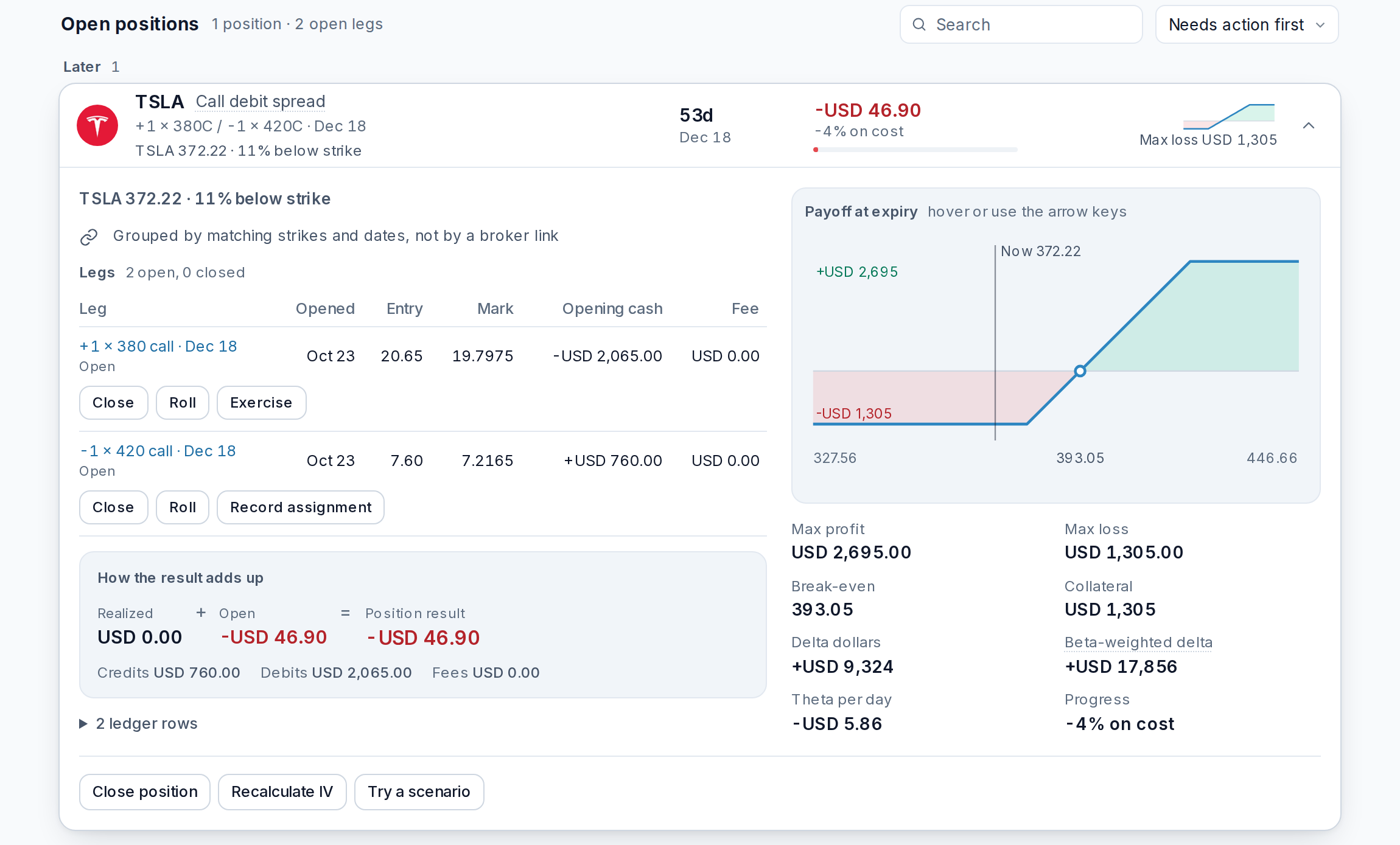
On 23 October 2026 Tesla closed at $372.22. Buying the 18 December $380 call and selling the $420 call cost $1,305. Above $420 on 18 December the spread is worth $4,000, a $2,695 profit, and it breaks even at $393.05. The $380 call on its own cost $2,065 and needed Tesla at $400.65.
A debit spread in three numbers
What it costs
Bought − sold×100
($20.65 − $7.60) × 100 = $1,305
Breakeven
Bought strike + debit
$380 + $13.05 = $393.05
Most you can make
(Width − debit)×100
($40 − $13.05) × 100 = $2,695
Cost today$1,305for one Tesla 380/420 call spread expiring 18 December, 37% less than the $380 call alone
Tesla has to rise+5.6%to $393.05 by 18 December to break even, against +7.6% for the call alone
How often it rose that far47.3%of 8-week stretches in the last 10 years ended more than 5.6% higher
The two debit spreads: call debit spread and put debit spread
Both cost money up front, both lose at most what you paid and both cap the gain. The difference is the direction you need.
Bullish
Call debit spread (bull call spread)
Buy a call near the price and sell a higher call. It makes money if the price rises past the bought strike by more than the debit, and makes the most at or above the strike you sold.
Buy a put near the price and sell a lower put. It makes money if the price falls below the bought strike by more than the debit, and makes the most at or below the strike you sold.
Both are vertical spreads: same expiry, different strikes. Selling the spread the other way round, so you're paid instead of paying, is a credit spread.
A bull call spread example: Tesla, 23 October to 18 December 2026
The prices are real, from the 23 October close. Drag where Tesla might close on 18 December and compare the spread with buying the $380 call on its own, or switch to four weeks before expiry to see what both would be worth if you sold then. The second button shows the put side on SPY.
Tesla (TSLA)Closed at $372.22 on 23 October 2026
Buy$380 callat $20.65
Sell$420 callat $7.60
Net cost
$1,305
Most you can make
$2,695
Breakeven
$393.05
Delta
0.25, half the call's 0.49
Gain if it works, per $1 paid
$2.07
The $380 call alone
$2,065
Bought at the ask and sold at the bid. Filled at the midpoints the spread would have cost $1,275. The money held is just the $1,305 you paid.
SPDR S&P 500 ETF (SPY)Closed at $759.97 on 23 October 2026
Buy$760 putat $16.57
Sell$720 putat $7.46
Net cost
$911
Most you can make
$3,089
Breakeven
$750.89
Delta
−0.24, about half the put's −0.45
Gain if it works, per $1 paid
$3.39
The $760 put alone
$1,657
The $720 put you sell was priced at a higher volatility (20.2%) than the $760 put you buy (15.8%), so the spread costs only 55% of the put alone. Filled at the midpoints it would have cost $901.50.
Where does Tesla close on 18 December?
The spreadThe $380 call aloneSpread with 4 weeks left
The spread at expiry−$1,305both calls expire worthless
The $380 call alone−$2,065Tesla 0.0% from $372.22
Tesla is below $380, so both calls expire worthless and you lose the $1,305 you paid.
−$1,305below $380
−$1,305 to +$2,695$380 to $420, breakeven $393.05
+$2,695anywhere above $420
+$3,089anywhere below $720
+$3,089 to −$911$720 to $760, breakeven $750.89
−$911above $760
The four-weeks line holds each option's implied volatility from the 23 October close. Time hurts the spread less than the call: with Tesla unchanged on 20 November the spread is down about $268 and the call alone about $737, because the $420 call you sold loses value too. The flip side is that the spread is slow to pay. At $420 with four weeks left it's up about $1,359, half of what it makes at expiry, while the call alone is up $2,454. A debit spread collects most of its gain in the last weeks, once the option you sold has little time value left.
Bull call spread vs buying the call
The spread is the $380 call with the $420 call sold against it. Selling the $420 call pays $760, which buys a lower breakeven and a smaller loss, and costs you everything above $420. Here is each outcome on 18 December.
Profit or loss on 18 December 2026 of the Tesla 380/420 bull call spread and the $380 call alone, by Tesla's closing price
Tesla on 18 Dec
Bull call spreadcost $1,305
$380 call alonecost $2,065
Better choice
$340−8.7%
−$1,305
−$2,065
Spread, by $760
$372.22unchanged
−$1,305
−$2,065
Spread, by $760
$393.05+5.6%, spread breakeven
$0
−$760
Spread, by $760
$400.65+7.6%, call breakeven
+$760
$0
Spread, by $760
$420+12.8%
+$2,695
+$1,935
Spread, by $760
$427.60+14.9%, where they meet
+$2,695
+$2,695
Equal
$460+23.6%
+$2,695
+$5,935
Call, by $3,240
$500+34.3%
+$2,695
+$9,935
Call, by $7,240
$427.60
Below this price on 18 December the spread does better than the call, by up to $760. Above it the call wins, and the gap grows by $100 for every dollar Tesla adds. Over the last 10 years Tesla ended an 8-week stretch more than 14.9% higher in 33.3% of them.
Over those 2,475 stretches, the spread at today's prices made money 47.3% of the time and the call alone 44.6%. The call's average result was far higher, about $2,984 a trade against $475, because Tesla had several huge rallies in that decade and the call kept all of each one. That's the real choice. The spread wins a little more often and loses less when it's wrong; the call is the one to own if you expect a very large move.
Picking the strikes: cheaper or more likely to pay
Tesla call spreads for 18 December, all $40 wide, at six strikes, priced at the 23 October bid and ask. The last two columns compare the share of trades you'd need to win with how often Tesla actually ended an 8-week stretch above the strike you sold.
Tesla 18 December 2026 bull call spreads, $40 wide, by strike, 23 October 2026 close, Tesla at $372.22
Buy / sell call
Cost
Most you can make
Breakeven
Wins neededto break even
Ended above the sold strikelast 10 years
$350 / $390in the moneymakes $1,880 · breakeven −0.3%
$2,120
$1,880
$371.20 −0.3%
53%
48.4%
$360 / $400makes $2,155 · breakeven +1.7%
$1,845
$2,155
$378.45 +1.7%
46%
44.9%
$370 / $410at the moneymakes $2,435 · breakeven +3.6%
$400 / $440out of the moneymakes $3,150 · breakeven +9.7%
$850
$3,150
$408.50 +9.7%
21%
29.4%
Wins needed is the cost divided by the width: the share of trades you'd have to win in full if every other one lost in full. The in-the-money 350/390 spread needs Tesla only to stay where it is, and has to win more than half the time because it pays less than it costs. The out-of-the-money 400/440 spread pays $3.71 for every $1 and needs Tesla up almost 10%. Moving the strikes up trades how often you win for how much. Over these 10 years every row came out ahead on average, by $171 to $609 a trade, because Tesla rose so much; a stock that went sideways would have turned most of them into losers.
Picking the width: how much upside you keep
The bought call stays at $380; only the call you sell moves. A wider spread costs more, keeps more of the upside and gets closer to owning the call outright.
Tesla 18 December 2026 bull call spreads with the bought call at $380, by width, 23 October 2026 close
Width
Cost
Most you can make
Breakeven
Per $1 paid
$20 widesell the $400 call
$790
$1,210
$387.90 +4.2%
$1.53
$30 widesell the $410 call
$1,080
$1,920
$390.80 +5.0%
$1.78
$40 widethe example
$1,305
$2,695
$393.05 +5.6%
$2.07
$60 widesell the $440 call
$1,620
$4,380
$396.20 +6.4%
$2.70
$80 widesell the $460 call
$1,802
$6,198
$398.02 +6.9%
$3.44
No capthe $380 call alone
$2,065
No limit
$400.65 +7.6%
No limit
$20 wide38%
$40 wide63%
$80 wide87%
The call alone100%
A narrow spread is cheap and needs the smallest move, but even a big rally pays little. The $80-wide spread costs 87% of the call and still gives up everything past $460. Pick the width from the price you think Tesla can realistically reach by expiry: sell the call near that target, so you're not paying for upside you don't expect.
Picking the expiry: time costs money, and buys room
The same 380/420 call spread on three monthly expiries, at the 23 October bid and ask, with how often Tesla ended that much time above $420 over the last 10 years.
Tesla 380/420 bull call spreads by expiry, 23 October 2026 close
Expiry
Days
Cost
Most you can make
Breakeven
Ended above breakevenlast 10 years
Ended above $420last 10 years
20 Nov 20264 weeksmakes $2,963
28
$1,037
$2,963
$390.37 +4.9%
41.2%
24.5%
18 Dec 20268 weeks, the examplemakes $2,695
56
$1,305
$2,695
$393.05 +5.6%
47.3%
35.8%
15 Jan 202712 weeksmakes $2,555
84
$1,445
$2,555
$394.45 +6.0%
48.7%
40.3%
The November spread is the cheapest and pays the most if it works, but Tesla has only four weeks to get there; over the last 10 years it ended four weeks above $420 about one stretch in four. Each extra month adds $268 and then $140 to the cost, well under half of what the same months add to the $380 call alone ($735 and $610). If you're not sure when the move will come, the extra month is usually the cheaper mistake.
How often does a bull call spread pay? Tesla's 8-week moves since 2016
Every 8-week stretch of Tesla from October 2016 to October 2026, 2,475 of them, sorted by how much Tesla moved. The colours show what the 380/420 spread at today's prices would have done.
Tesla price change over 8 weeks
Below $380, the full $1,305 lostBetween the strikesAbove $420, the full $2,695
Tesla ended below the $380 strike (+2.1%) in 47.2% of stretches and above $420 (+12.8%) in 35.8%.
Hover or tap a bar. Bars are 2.5% wide; moves beyond −40% and +57.5% are in the end bars. Our calculations from Tesla's daily closes.
Made money
Last 10 years
47.3%
Since 2010
46.0%
Tesla up more than 5.6%, past the $393.05 breakeven
Full $2,695 gain
Last 10 years
35.8%
Since 2010
34.2%
Tesla up more than 12.8%, past the $420 call sold
Full $1,305 loss
Last 10 years
47.2%
Since 2010
47.9%
Tesla below $380, up less than 2.1% or down
Call alone did better
Last 10 years
33.3%
Since 2010
31.5%
Tesla up more than 14.9%, past $427.60
The results were mostly all or nothing: in 83% of stretches the spread either lost the whole $1,305 or made the whole $2,695. That's normal for a debit spread on a stock that moves this much, and it's why the debit is the number to size by. The years weren't even, either. In stretches starting in 2020 Tesla passed the breakeven 81% of the time; in 2022, 35%; for the last five years as a whole, 40.2%. Ten years of a stock that rose this much flatter any bullish trade, so treat these as the size of the moves, not the odds for the next eight weeks.
The put side: a bear put spread on SPY
A bear put spread is the same trade for a fall. On 23 October 2026 SPY closed at $759.97; buying the 18 December $760 put and selling the $720 put cost $911.
The trade
It makes money below $750.89, a 1.2% fall, and makes the most, $3,089, if SPY ends below $720, 5.3% lower. Above $760 both puts expire and the $911 is gone.
Cost $911 · at most +$3,089 · breakeven $750.89
Why it's cheap next to the put
Index puts further below the price trade at higher implied volatility, because so many investors buy them as insurance. You sell the expensive one, so the spread costs 55% of the $760 put alone ($1,657) and keeps all of the move down to $720.
$760 put at 15.8% volatility, $720 put at 20.2%
How often it paid
Over the last 10 years SPY ended an 8-week stretch below the breakeven in 18.8% of them and below $720 in 8.6%. On average the spread lost $311 a trade. As a bet it runs against the trend; as cheap protection on SPY shares it's a cost you choose to pay.
Below $750.89 in 18.8% of 2,475 stretches
With four weeks left, a fall to $740 would already put the spread up about $717, nearly the same as the put alone ($722), because the put you sold hasn't gained much yet. The put alone pulls ahead only on a deeper fall: at $720 it's up $2,308 against $1,558 for the spread. If you hold SPY and want a hedge with a cap on the cost, our protective put guide and collar guide cover the other ways to do it.
Debit spread vs credit spread
A credit spread sells the option nearer the price and buys the further one, so you're paid instead. With the same strikes, a call debit spread and a put credit spread are the same bet.
Tesla 380/420, 18 Dec
The trade
Paid or received
Most you can make / lose
Breakeven
Call debit spreadbull call spread
Buy the $380 call, sell the $420 call
−$1,305
$2,695 / $1,305
$393.05
Put credit spreadbull put spread
Sell the $420 put, buy the $380 put
+$2,575
$2,575 / $1,425
$394.25
At the midpoints the two priced within $5 of each other. At the bid and ask the debit spread came out $120 better on both ends, because the $420 put is in the money and its quotes were $2.50 apart against 25 cents for the $420 call. Buy the side whose options are out of the money or near it. The real difference is time. A debit spread usually sits at or out of the money and needs the price to move, so time works against it until the move comes. A credit spread usually sits out of the money and is paid for each day nothing happens. Pick a debit spread when you expect a move and want a known cost; pick a credit spread when you expect the price to stay on one side.
Managing a debit spread: profits, expiry and assignment
The most you can lose is fixed the day you open it, so most of the decisions are about when to take the money. Each card uses the Tesla spread above.
Take profits before the last week
If Tesla jumps early, the spread is worth well under its $4,000 maximum because the $420 call you sold still has time value. Waiting for the last few dollars means weeks more of risk that Tesla falls back.
Tesla at $420 on 20 Nov: worth about $2,664, up $1,359
Close it if Tesla ends between the strikes
A call that's in the money by a cent or more at expiry is normally exercised automatically. If Tesla closes at $400, your $380 call becomes 100 shares bought for $38,000 on Monday, and the $420 call expires.
Tesla at $400 on expiry: 100 TSLA bought at $380
Roll or let it go
If Tesla stalls, you can sell the spread and buy a later one, which costs a fresh debit. Rolling a losing spread is a new bet on the same view. Letting it expire below $380 loses the debit you planned for, and nothing more.
380/420 for 18 Dec rolled to 380/420 for 15 Jan
Early assignment on the option you sold is rare while it still has time value. Tesla pays no dividend, so the usual reason to exercise a call early doesn't apply. On SPY, a short put deep in the money near expiry can be assigned early; you'd then own 100 SPY at $720, and your $760 put still caps the loss. Either way, the bought option protects you on price, and closing the spread is simpler than handling the shares.
Margin, account approval and US taxes
Brokers ask for a spreads approval level, and usually a margin account. Because the most you can lose is the debit, the debit is all they hold. What the options are on changes how they settle and, in the US, how they're taxed under IRS Publication 550.
Underlying
Exercise and settlement
Money held
US tax on the result
TSLAStock options
American-style, can be exercised any day; settles in shares
The debit, paid in full
Capital gain or loss, short-term when held a year or less
SPYETF options
American-style; settles in shares
The debit, paid in full
As Tesla
SPXS&P 500 index options
European-style, exercised only at expiry; settles in cash
The debit, on a contract about ten times the size of one SPY option
Section 1256: 60% long-term, 40% short-term, marked to market at year end
A Tesla spread that's closed or expires
The gain or loss on each leg is short-term when held a year or less, booked when you close it or it expires. If the bought call is exercised, what you paid for it goes into the cost of the shares instead, and the holding period of the shares starts then.
Sold for $4,000 on 18 Dec 2026: $2,695 short-term gain in 2026
An SPX spread
Broad-based index options are Section 1256 contracts, reported on Form 6781. Any gain or loss counts as 60% long-term and 40% short-term however briefly you held it, and open positions are valued as if sold on the last business day of the year.
A $3,089 gain on an SPX spread: $1,853 long-term, $1,236 short-term
The two legs offset each other, so the straddle rules can apply: closing one leg at a loss while the other shows a gain can defer the loss. Other countries have their own rules.
Five debit spread mistakes
Capping a trade you expect to run
If you think Tesla can go well past $427.60, the call alone does better. The spread is for a move to a target, not a breakout.
Forgetting how often it loses everything
The Tesla spread lost the full $1,305 in 47.2% of 8-week stretches. A capped loss is still the whole debit, so size each trade by it.
Buying at the ask and selling at the bid
Enter the spread as one order with a limit on the net price. The Tesla spread cost $1,305 at the bid and ask and $1,275 at the midpoints, $30 on one spread.
Buying too little time
The 4-week spread was $268 cheaper, but Tesla ended 4 weeks above $420 about one time in four. Being right about the direction and wrong about the timing still loses the debit.
Holding between the strikes into the close
A finish between $380 and $420 turns the bought call into 100 shares on Monday, a $38,000 position from a $1,305 trade. Close the spread before the bell.
Plan and track your debit spreads
A debit spread is two positions that only make sense together. AllInvestView prices the trade before you place it and keeps the legs together once it's open, across every broker you use.
Options book and Strategy Builder
One spread, not two loose options
Open legs on the same underlying and expiry are grouped as one call or put debit spread, with the most it can make and lose, the breakeven, what it's worth now and the payoff at expiry.
Bull Call Spread and Bear Put Spread templates in the Strategy Builder
Close, roll or record an exercise from the leg itself
Delta, theta and the days left on every open spread
Options next to your shares, ETFs and bonds from every broker
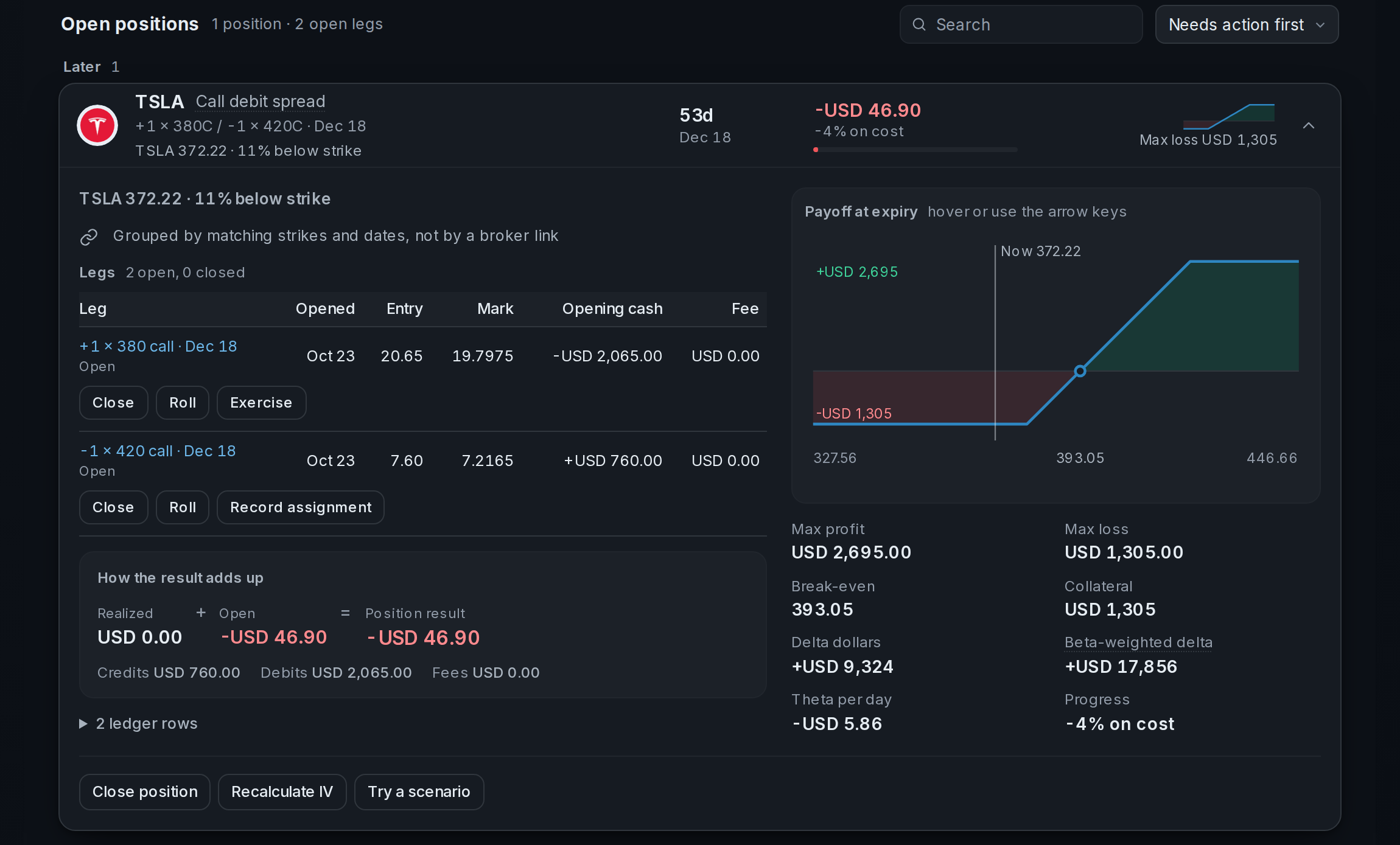
AllInvestViewThe Tesla 380/420 call spread in the options book, staged with the 23 October prices.View full-size View full-size
Every broker in one place
See how your spreads actually did
Spreads, single options, shares, ETFs, bonds and dividends on one dashboard, synced from your brokers or imported from a file, with every closed trade's real result.
Two legs grouped as one spread Greeks on every open option 14-day free trial, no card required
It's two options of the same type and expiry where you buy one and sell a cheaper one further out of the money, so you pay a net debit up front. The most you can lose is that debit, and the most you can make is the gap between the strikes minus it. On 23 October 2026 Tesla's 18 December 380/420 call spread cost $1,305 and could make at most $2,695.
What's the difference between a bull call spread and a bear put spread?
A bull call spread uses calls and makes money when the price rises: buy a call near the price, sell a higher one. A bear put spread uses puts and makes money when it falls: buy a put near the price, sell a lower one. On 23 October 2026 SPY's 18 December 760/720 put spread cost $911 and could make $3,089 if SPY ended below $720.
How do you work out the breakeven and maximum profit of a debit spread?
For a call spread the breakeven is the bought strike plus the debit per share; for a put spread it's the bought strike minus it. The maximum profit is the width between the strikes minus the debit, times 100. The Tesla 380/420 call spread bought for $13.05 a share breaks even at $393.05 and makes at most ($40 − $13.05) × 100 = $2,695.
Is a bull call spread better than buying a call?
It's cheaper, breaks even at a lower price at expiry and loses less, but it stops gaining at the strike you sold. The Tesla 380/420 spread cost $1,305 against $2,065 for the $380 call, and did better at any price below $427.60 on 18 December. Over the last 10 years the spread made money in 47.3% of 8-week stretches and the call in 44.6%, but the call's big wins in Tesla's rallies gave it the higher average.
Is a debit spread better than a credit spread?
Neither is better. A bull call spread and a bull put spread on the same strikes are the same bet. The difference is where they usually sit: a debit spread at or out of the money needs a move, and time works against it until the move comes, while a credit spread out of the money is paid for each day nothing happens. Choose a debit spread when you expect a move and want a fixed cost.
What happens to a debit spread at expiry?
Above the higher strike, a call spread is worth the full width and below the lower one it expires worthless. If the price ends between the strikes, the bought option is in the money and is normally exercised automatically, so you'd own (or be short) 100 shares on Monday. Close the spread before the close to avoid that.
Can a debit spread be assigned early?
The option you sold can be, though it's rare while it still has time value. Short calls are most often assigned the day before an ex-dividend date; Tesla pays no dividend. If it happens, the option you bought still caps the loss, and you can exercise it or close the position.
How are debit spreads taxed in the US?
Stock and ETF options held a year or less give short-term capital gains or losses, booked when you close them or they expire. Broad index options such as SPX are Section 1256 contracts, taxed 60% long-term and 40% short-term and marked to market at year end. Because the two legs offset each other, the straddle rules can defer a loss on one leg while the other shows a gain.
FINRA Rule 4210 and the Cboe margin manual, margin on long spreads
Tesla and SPY closing prices, option quotes (bid and ask) and open interest at the 23 October 2026 close; Tesla daily closes from 29 June 2010 and SPY daily closes from October 2016
Costs use the ask for options bought and the bid for options sold, before commissions. Deltas and every value before expiry come from AllInvestView's options pricing engine with a 3.94% rate and each option's implied volatility solved from its midpoint price, held fixed; the model leaves out dividends, which the market prices already include. The 8-week figures are our calculations from Tesla's and SPY's closing prices, without dividends: each stretch starts on a trading day and ends on the last close on or before 56 days later, the last one starting on 28 August 2026. This guide explains how the trade works; it isn't advice to make it.


 AllInvestView