Protective Put: How It Works, With a Real NVIDIA Example
A protective put is a put option you buy on a stock you already own, one contract for every 100 shares. It gives you the right to sell at the strike price until it expires, so however far the stock falls, your loss stops there. You pay a premium for that. If the stock doesn't fall, the premium is gone, and if it rises, it comes off your gain.
On 23 October 2026 NVIDIA closed at $210.96, 11.8% below its 6 October close. A put to sell 100 shares at $190 until 15 January 2027 cost $700, 3.3% of the $21,096 position. Until then, the most those shares can lose from $210.96 is $2,796, even if NVIDIA halves. To come out ahead, the stock has to end above $217.96.
A protective put in three numbers
Most you can lose
(Share price − strike + premium)×100
($210.96 − $190 + $7.00) × 100 = $2,796
Breakeven
Share price + premium
$210.96 + $7.00 = $217.96
Most you can make
No limit−premium
Every dollar above $217.96, × 100
Cost today$700for one $190 put to 15 January 2027, bought at the ask: 3.3% of the shares for 84 days
The floor$190NVIDIA can fall 9.9% before the put pays anything, and nothing more is lost below it
Put protection vs the S&P 500, 10 years12.4% vs 15.3%a year: Cboe's S&P 500 5% Put Protection Index against the S&P 500 with dividends
A protective put example: NVIDIA, 23 October 2026 to 15 January 2027
The prices are real, from the 23 October close. Drag where NVIDIA might close on 15 January, or switch to a dearer or cheaper put.
NVIDIA (NVDA)Closed at $210.96 on 23 October 2026
Own100 sharesat $210.96
Buy$190 put, 15 Jan 2027at $7.00
Cost of the put
$700
Floor
$190 (−9.9%)
Most you can lose
$2,796
Breakeven
$217.96
Delta of the put
−0.25
Time decay today
about $7 a day
With a delta of −0.25 the put offsets about a quarter of the shares' daily moves now, and more as NVIDIA falls toward $190. Bought at the midpoint it would have cost $692.50. NVIDIA's next quarterly results are expected before 15 January, inside the cover.
Where does NVIDIA close on 15 January?
Put
NVIDIA ends
With the $190 putShares alone
With the $190 put−$700the put expires worthless
Shares alone$0NVIDIA 0.0% from $210.96
Nothing happened, so the $700 was the price of three months' cover.
−$2,796anywhere below $190
−$2,796 to $0$190 to $217.96, the breakeven
Profit, no limitabove $217.96: the shares' gain less $700
With the $190 put, the two lines cross at $183. If NVIDIA ends below that, the put has more than paid for itself, and at $150 it saves $3,300 on the shares' $6,096 loss. Anywhere above $183 you'd have been better off without it, by at most the $700 it cost.
Picking the strike: how much of a fall you'll take yourself
Five NVIDIA puts to 15 January 2027, all at the 23 October ask. The strike works like the excess on an insurance policy: the more of the fall you keep, the cheaper the cover.
NVIDIA puts expiring 15 January 2027 by strike, 23 October 2026 close, NVIDIA at $210.96
Strike
Cost
Of the shares
Most you can lose
Breakeven
Delta
A yearat this rate
$210at the money
$1,430
6.8%
$1,5267.2%
$225.26
−0.43
29.5%
$2005.2% below
$1,020
4.8%
$2,11610.0%
$221.16
−0.34
21.0%
$1909.9% below, the example
$700
3.3%
$2,79613.3%
$217.96
−0.25
14.4%
$18014.7% below
$470
2.2%
$3,56616.9%
$215.66
−0.18
9.7%
$17019.4% below
$310
1.5%
$4,40620.9%
$214.06
−0.12
6.4%
"A year at this rate" is the cost stretched to a full year: the premium as a share of the position, times 365 over the days covered. An at-the-money put caps the loss at $1,526, but it costs about 30% of the position a year, more than most stocks earn. Puts 10% to 20% below the price suit a holding you mean to keep: they ignore the ordinary swings and cover the fall that would really hurt. Lower strikes are cheap in dollars, though not in volatility: the $170 put is priced at 44.7% implied volatility against 41.3% for the $190, because the market charges more for crash cover.
Picking the expiry: longer cover costs less per month
The same $190 strike at six expiries, all at the 23 October ask. A long put costs more in dollars and much less for each month it covers.
NVIDIA $190 puts by expiry, 23 October 2026 close
Expiry
Days
Cost
Per 30 days
Breakeven
A yearat this rate
Open interest
20 Nov 2026monthly
28
$320
$343
$214.16
19.8%
90,661
18 Dec 2026
56
$535
$287
$216.31
16.5%
40,519
15 Jan 2027the example
84
$700
$250
$217.96
14.4%
55,614
16 Apr 2027
175
$1,215
$208
$223.11
12.0%
7,326
17 Jun 2027
237
$1,500
$190
$225.96
11.0%
24,500
17 Dec 2027LEAPS
420
$2,120
$151
$232.16
8.7%
6,131
Time decay is the reason. The November put loses about $13 a day now and the December 2027 put about $3, so cover bought a month at a time costs more than twice as much per year as cover bought for 14 months. The catch is the upfront cheque: the long put raises your breakeven to $232.16. A common middle way is three to six months, sold and replaced before the last month, when a put near the price loses value fastest.
What a protective put costs: an index ETF, Apple or NVIDIA
A put about 10% below the price, expiring 15 January 2027, on three things many people own. Prices at the 23 October ask.
Puts about 10% below the price to 15 January 2027 on SPY, Apple and NVIDIA, 23 October 2026
Holding
Price
Put
Cost per 100 shares
Of the position
A yearat this rate
Implied volatility
SPYS&P 500 ETF
$759.97
$6859.9% below
$638
0.84%
3.6%
23.1%
AAPLApple
$347.73
$3159.4% below
$555
1.60%
6.9%
28.3%
NVDANVIDIA
$210.96
$1909.9% below
$700
3.32%
14.4%
41.3%
Insurance is priced on how much the thing moves. Covering NVIDIA costs four times as much of the position as covering the S&P 500, because the market expects it to move nearly twice as much. If what worries you is the whole market, a put on an index ETF protects a diversified portfolio for a fraction of the cost, though it won't help if one of your stocks falls on its own.
When the stock falls: sell the put, roll it or let it go
Most protective puts are never exercised. Each card uses the NVIDIA $190 put above.
Sell the put, keep the shares
After a fall, a put with time left is usually worth more than the gap below the strike. Selling it banks that value and leaves you holding the stock for the rebound.
NVIDIA at $170 a month before expiry: the put is worth about $21.50, against $20 if exercised
Roll it down and out
Sell the put after a fall and buy a lower strike further out. You take cash off the table and keep a floor under the shares, just a lower one.
Sell the $190 put, buy a $160 put for April: cash in, cover kept
Let it expire, or exercise it
If NVIDIA ends above $190 the put expires worthless and the $700 is spent. If it ends below, exercising sells your shares at $190, and a put in the money by a cent or more at expiry is exercised automatically unless you tell your broker otherwise.
NVIDIA at $160 on 15 January: shares sold at $190, a $2,796 loss in all
Do protective puts pay off? Put protection since 2008
Cboe's S&P 500 5% Put Protection Index (PPUT) holds the S&P 500 with dividends reinvested and buys a one-month put about 5% below the index every month. It's the textbook protective put, run without a break through every crash and every quiet year.
Calendar-year total return, 2008 to 2026
Put Protection Index (PPUT)S&P 500
2026 to 23 October: put protection 7.5%, S&P 500 12.3%
Hover, tap or use the arrow keys on a year; a green dot marks a year put protection won. It beat the S&P 500 in 3 of the 18 full years from 2008 to 2025. 2026 runs to 23 October. S&P 500 measured with SPY, dividends reinvested. Index values from Cboe.
A year, 10 years to Oct 2026
Put protection
12.4%
Collar
11.9%
S&P 500
15.3%
Annualized total return
$10,000 over those 10 years
Put protection
$32,302
Collar
$30,675
S&P 500
$41,588
From 21 October 2016
Covid crash, 19 Feb to 23 Mar 2020
Put protection
−11.8%
Collar
−14.9%
S&P 500
−33.7%
A sudden fall: what puts are for
2007 to 2009 bear market
Put protection
−41.5%
S&P 500
−55.2%
9 Oct 2007 to 9 Mar 2009, peak to bottom
The puts did their job in a crash. In five weeks of 2020 the protected index lost about a third of what the S&P 500 lost, and it ended that year up 29.1%. But a put that's 5% below the price and renewed every month only limits each month's loss. In a slow decline like 2007 to 2009, or 2022, the index can lose 5% a month, every month, and still lose most of the fall: in 2022 it lost 19.8% against 18.2%. Over ten years it returned about 2.9 points a year less than the S&P 500. Cboe's 95-110 Collar Index (CLL), which pays for three-month puts by selling one-month calls 10% above the index, did a little worse. Longer puts, bought for the risk you actually face, cost less than the index's monthly habit, which is why it pays to track what your own hedges have cost and saved.
Protective put vs collar, put spread and stop-loss
Five ways to protect the same 100 NVIDIA shares to 15 January, priced at the 23 October close.
Selling a call above the price pays for the put. The $235 call almost exactly paid for the $190 put, so the same floor cost $5 instead of $700. The price is any rise above $235: the shares get called away there.
Range for 15 January: −$2,101 to +$2,399, for $5
A stop-loss can't stop a gap
A stop order becomes a market order once the price touches it, so it fills at whatever the next price is. On 2 August 2024 NVIDIA closed at $107.27; on 5 August it opened at $92.06. A stop at $100 would have sold near $92, and NVIDIA closed that day at $100.45.
A put pays the strike however far the price gaps
A stop costs nothing upfront, which is why it's the most common hedge. But it sells your shares, which can mean a tax bill and missing the rebound, and a dip of an hour can set it off. A put keeps you in the stock and gives you until expiry to decide. Price your own version of any of these in the options payoff calculator, or see the other side of the collar in the covered call guide.
Protective put vs married put, and US taxes
A married put is a protective put bought on the same day as the shares. The payoff is identical. In the US the timing changes the tax, under IRS Publication 550 and section 1233 of the tax code.
Shares held over a year
Buying a put doesn't restart their holding period. If the put expires, its cost is a capital loss. Shares and a put on them usually count as a straddle, and because these shares are already long-term, the loss is long-term too. If you exercise, the put's cost comes off what you get for the shares.
NVIDIA put expires on 15 Jan 2027: usually a $700 long-term loss
Shares held a year or less
Buying a put counts as a short sale for the holding period. Any gain on the put is short-term, and the shares' holding period starts again only when you sell them or the put is exercised, sold or expires.
Shares bought in May, put bought in October: the one-year clock restarts
Married put, same day
If you buy the put on the same day as the shares and identify them as hedged together, the short-sale rule doesn't apply. If the put expires unused, its cost is added to the cost basis of those shares.
100 shares at $210.96 and the put at $7.00: basis $217.96 a share if it expires
Shares and a put on them can also be a straddle for tax purposes, so a loss on the put can be deferred while you still hold the shares with an unrealized gain. Other countries have their own rules.
Five protective put mistakes
Buying cover after the fall
Puts get dearer when the market is scared. The time to buy is when it's calm and cover feels unnecessary; after a crash you're paying the most for the least.
Insuring every month, forever
At about 14% a year, the NVIDIA cover above would eat most of a good year's return. Buy it for a reason and a period: earnings, a concentrated position, money you'll need soon.
Picking the strike too close
An at-the-money put covers every dip, including the ones you'd shrug off. Decide how much of a fall you'll take yourself and buy cover below that.
Exercising when you could sell
Before expiry a put in the money is usually worth more than the gap to the strike. Selling it keeps that extra value and your shares.
Forgetting the cost when you judge the result
A put that expired worthless wasn't a mistake, and one that paid out wasn't free. Judge the hedge on what it cost and saved over the years, next to the shares it protected.
Track your protective puts with the shares they protect
A hedge only makes sense next to what it hedges. AllInvestView keeps the put and the shares together, across every broker you use.
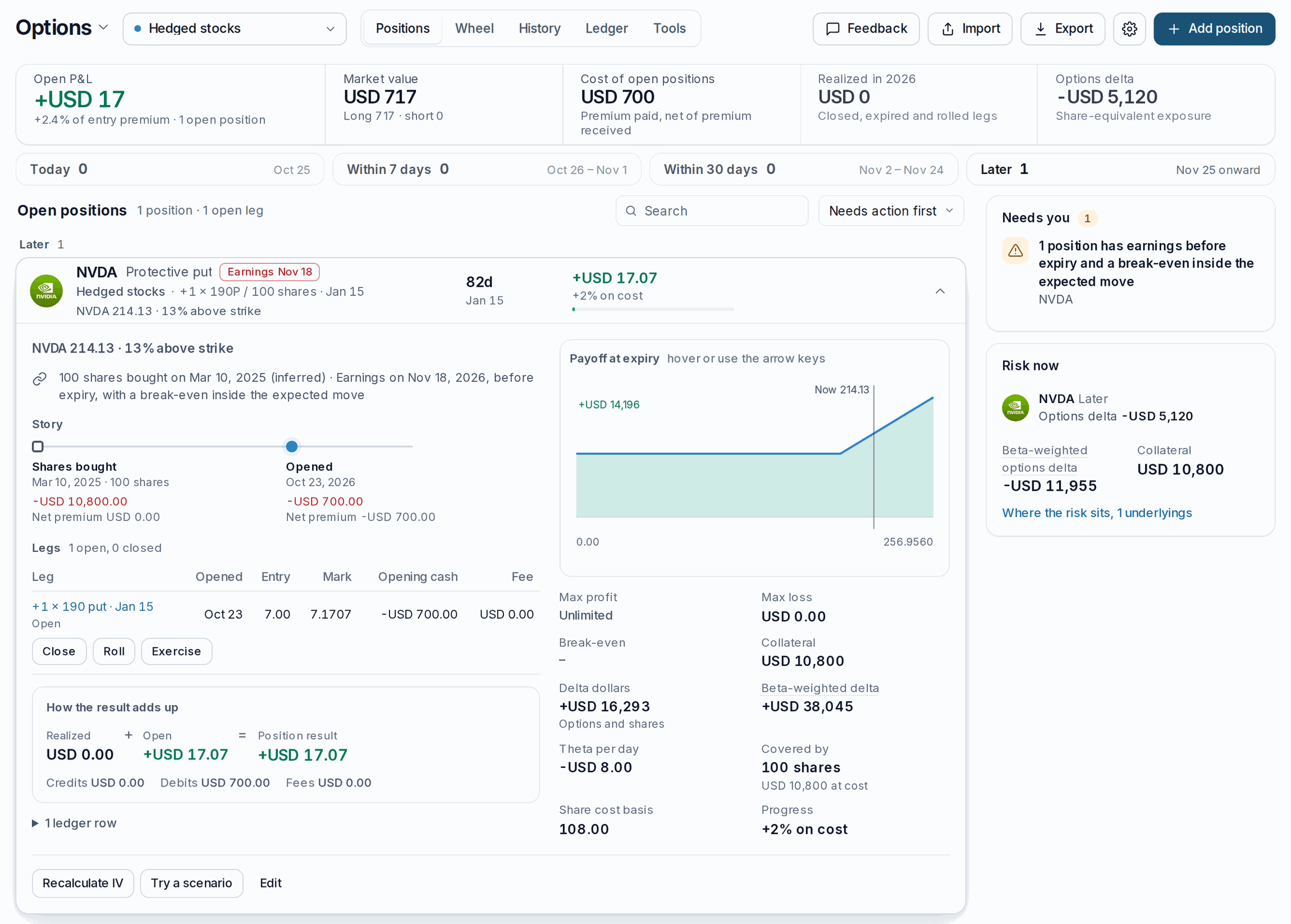
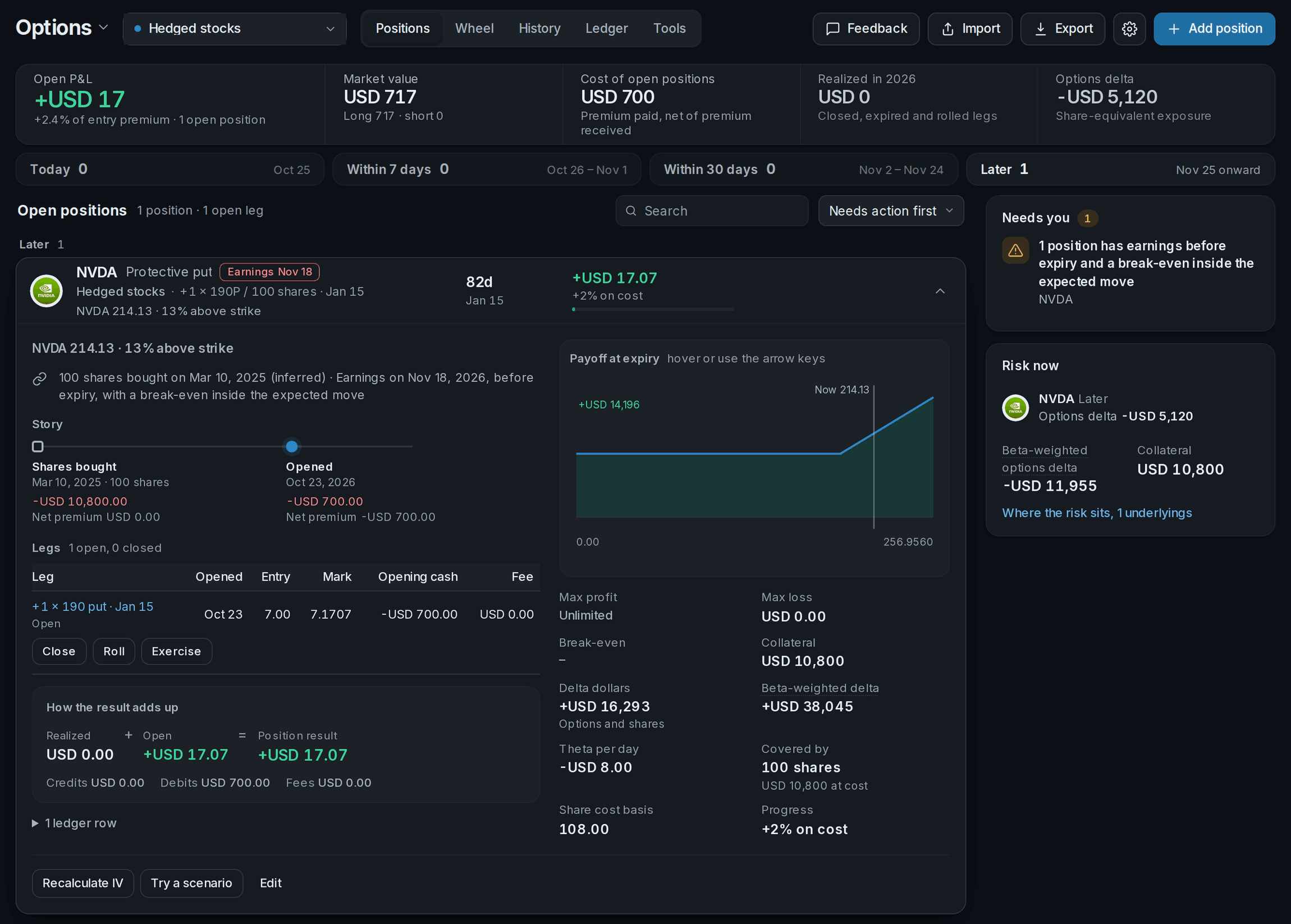
Options book
The shares and the put as one position
When you hold a long put and the shares under it, the options book groups them as a protective put, and a put with a call sold against the same shares as a collar. You see the hedge with the stock it covers, not as a stray losing option.
Protective puts and collars recognized from your trades
Greeks on every open option, so you see how much of the stock is covered
A scenario grid that reprices your options across price moves and dates
Shares, ETFs, bonds and dividends from every broker on one dashboard
Puts, collars, shares, ETFs, bonds and dividends on one dashboard, synced from your brokers or imported from a file, with each put shown next to the shares it protects.
Puts grouped with their shares Greeks on every open option 14-day free trial, no card required
It's a put option you buy on shares you already own, one contract per 100 shares. It lets you sell them at the strike price until it expires, so it works like insurance: you pay a premium, and however far the stock falls, your loss stops at the strike.
How much does a protective put cost?
It depends on how far below the price the strike is, how long it runs and how much the stock moves. On 23 October 2026 a put about 10% below the price to 15 January 2027 cost 0.84% of the position on SPY, 1.60% on Apple and 3.32% on NVIDIA, where the $190 put cost $700 for 100 shares.
What is the most you can lose with a protective put?
The share price minus the strike, plus the premium, times 100. For 100 NVIDIA shares at $210.96 with the $190 put bought for $7.00, that's ($210.96 − $190 + $7.00) × 100 = $2,796 until 15 January 2027, however far NVIDIA falls.
What's the difference between a protective put and a married put?
The payoff is the same. A married put is bought on the same day as the shares, a protective put on shares you already hold. In the US, a put bought the same day and identified with those shares isn't treated as a short sale, and if it expires its cost is added to the shares' cost basis.
Protective put or covered call: which should I use?
They do opposite jobs. A protective put costs money and limits the fall while leaving the rise open. A covered call pays you a premium and caps the rise while leaving the fall open. Doing both on the same shares is a collar: on NVIDIA, selling the $235 call paid for all but $5 of the $190 put.
Is a protective put worth it?
In a sudden crash, yes. Cboe's S&P 500 5% Put Protection Index lost 11.8% from 19 February to 23 March 2020 while the S&P 500 lost 33.7%. Bought every month, though, it costs you in normal years: over the 10 years to 23 October 2026 the index returned 12.4% a year against 15.3%.
How are protective puts taxed in the US?
If the put expires, its cost is a capital loss; if you sell it, the gain or loss is capital; if you exercise it, its cost reduces what you get for the shares. On shares held a year or less, buying a put counts as a short sale and restarts their holding period. The shares and the put can also form a straddle, which can defer a loss on the put.
NVIDIA, Apple and SPY closing prices and option quotes (bid and ask) and open interest at the 23 October 2026 close; NVIDIA daily prices for August 2024; SPY total return with dividends reinvested
Costs use the ask price for options bought and the bid for options sold, before commissions. Deltas, implied volatilities, time decay and the value of the put a month before expiry come from AllInvestView's Black-Scholes engine with a 4.04% rate (the three-month Treasury bill) and each option's volatility solved from its midpoint price. Index statistics are our calculations from Cboe's daily values and SPY's dividend-adjusted closes.



 AllInvestView