Gains on shares
- Rule
- 33% after allowable losses and the €1,270 personal exemption.
- Line
- CG1, chargeable gains
- Pack
- Prepared. Proceeds, gains, losses, prior-year losses, the section 601 exemption and the net chargeable gain.
Shares and funds are taxed under different regimes in Ireland, and the pack keeps them apart: CG1 chargeable gains with the €1,270 exemption applied and the tax split across its two payment dates, and the Form 11 offshore funds line for exit tax.
The two regimes, the payment dates that catch people out, and how far the pack takes each line.
| Item | The rule | Form and line | What the pack produces |
|---|---|---|---|
| Gains on shares | Gains on individual shares and most assets are charged at 33%, after allowable losses and the €1,270 personal exemption. | CG1, chargeable gains | Prepared Proceeds, chargeable gains, allowable losses, prior-year losses used, the section 601 exemption and the net chargeable gain. |
| The four-week rule | Section 581 takes the cost from shares of the same class bought in the previous four weeks, latest first, and ring-fences a loss to gains on shares you buy back in the four weeks after. | Behind the CG1 gain | Prepared Each disposal row names the section it was matched under, so an ordinary FIFO match and a four-week match are told apart. |
| When the tax is due | CGT on disposals from January to November is due by 15 December of the same year, and December disposals by 31 January. | CG1, tax payable | Prepared Two separate payable lines, so the December bill is not mistaken for the whole year. |
| Fund exit tax | Irish and EU-domiciled funds sit outside CGT at 38% from 1 January 2026, with no personal exemption and no relief against other gains. | Form 11, offshore funds | Prepared A net exit tax due or repayable figure that consumes the existing deemed-disposal and credit records. |
| The eight-year clock | You are treated as selling each fund holding on its eighth anniversary and every eight years after, and taxed on the gain even though you still own it. | Feeds the Form 11 line | Tracked The clock runs per lot and is flagged before an event falls due. Model it in the deemed disposal calculator. |
| Dividends and withholding | Irish Dividend Withholding Tax is 25%, and encashment tax on some foreign dividends paid through an Irish agent is also 25% and creditable. | Form 11 income pages | Partly The dividend report gives you gross, withheld and net per holding. You claim treaty relief on the return. |
| Submitting the return | Chargeable persons file Form 11 through ROS; PAYE taxpayers who are not chargeable persons use CG1 for gains only. | Form 11 or CG1 | You file Everything leaves as a file for you or your accountant. |
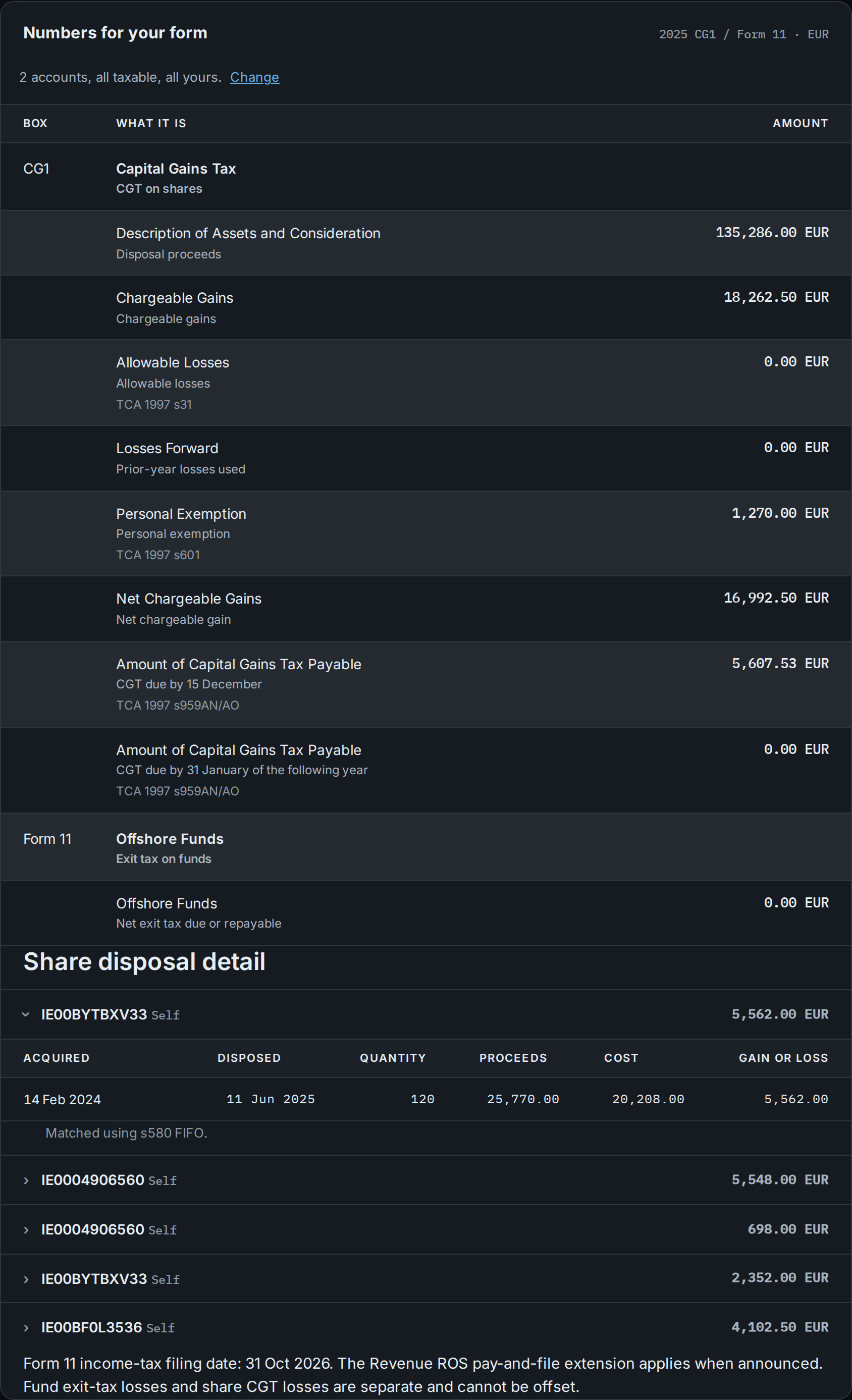
Every row carries the CG1 caption Revenue uses, and the rows that turn on a particular section name it, so you can read the sheet and the form side by side. The personal exemption is taken off inside the pack, and the tax lands on two lines, one for the 15 December payment and one for 31 January. The Form 11 offshore funds line sits below the CG1 block, kept separate because exit tax losses and share losses cannot be set against each other.
Open the Irish pack AllInvestView
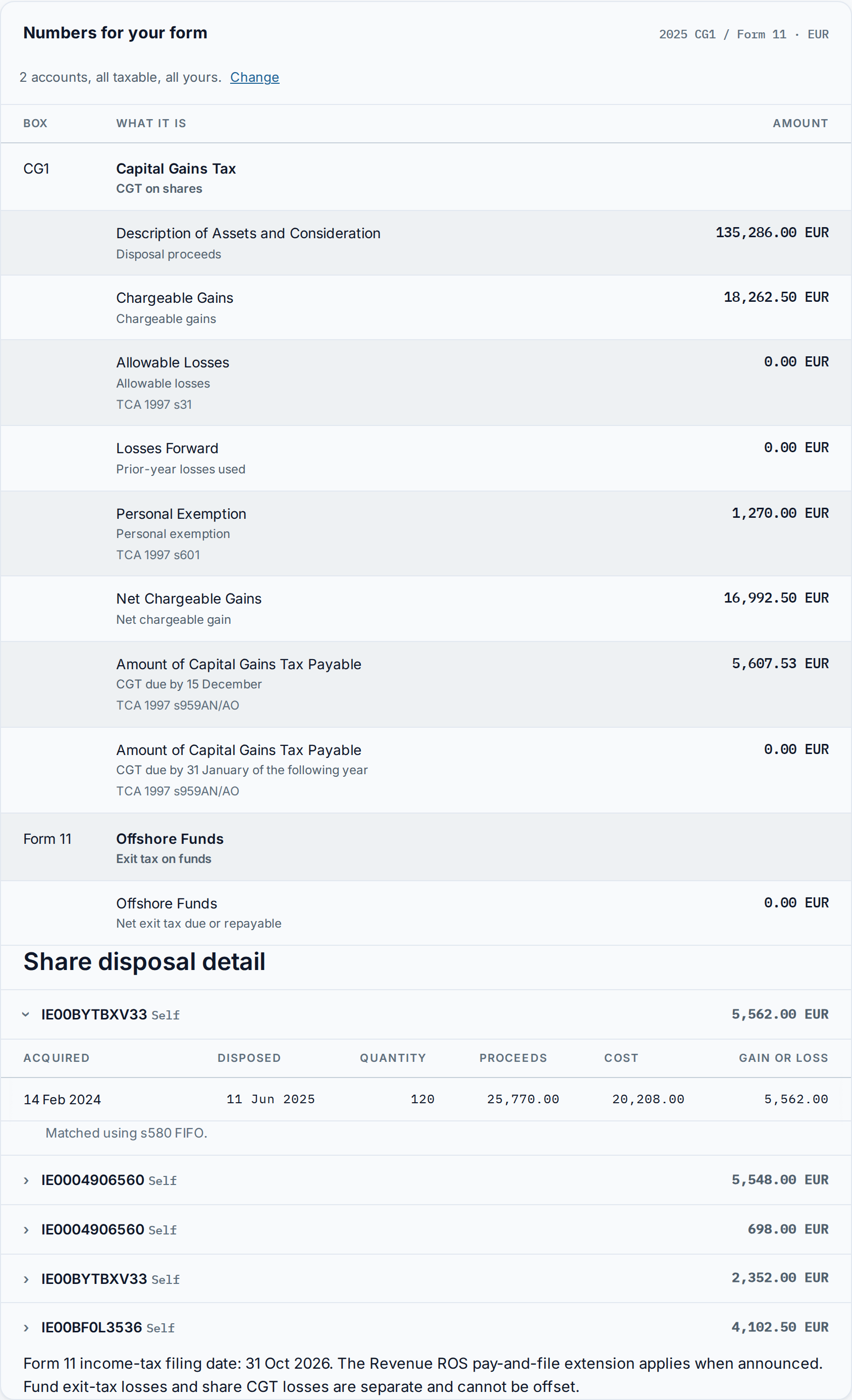
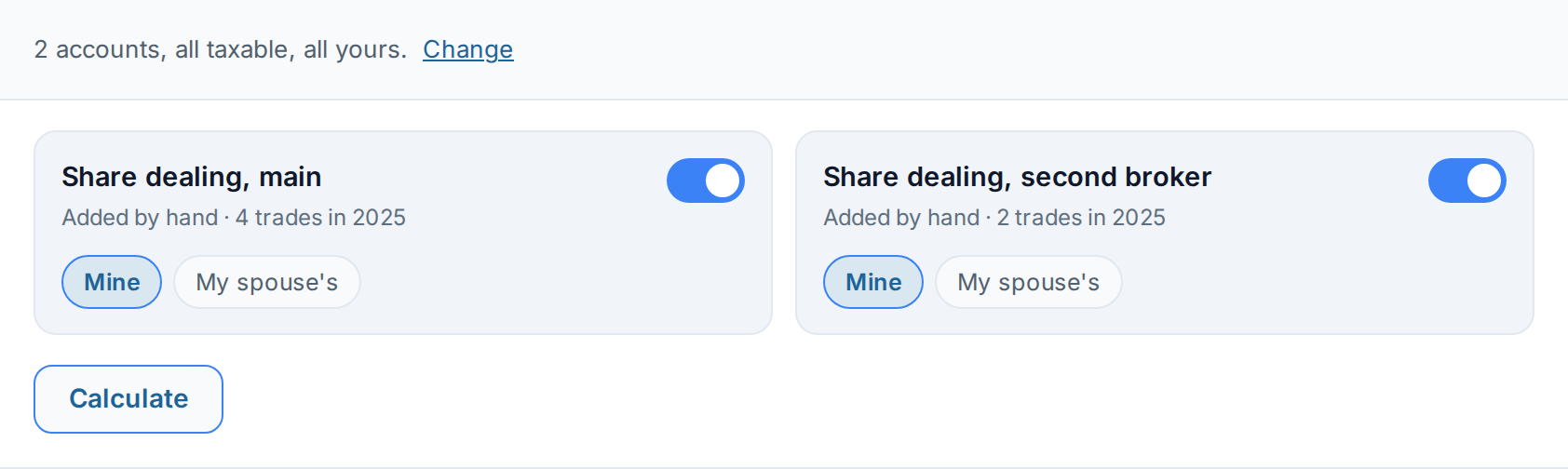
Section 581 looks at what you bought either side of a sale, so the pack asks which accounts belong in the return before it matches anything. Ireland has no tax-free investment wrapper to declare, so the cards ask only whether the account is yours or your spouse's. The same control shows ISA and pension chips to a British reader and RRSP and TFSA to a Canadian one.
See the accounts stepAllInvestView
PDF, Excel and CSV carry the CG1 lines with the disposal detail and the matching sections behind them. The buttons stay off until every blocked figure is settled. Closing the year freezes the calculation revision, which matters when a deemed disposal in a later year credits tax you paid in this one.
See what exportsAllInvestView
It does not file with Revenue and it does not tell you whether you are a chargeable person, which is the question that decides between Form 11 and CG1.
The Irish calculation covers share disposals and consumes the existing exit-tax records for funds rather than recomputing them. Where a security cannot be identified, an exchange rate is missing, or a fund has no active deemed-disposal rule set, it blocks the affected total instead of presenting a number it cannot stand behind.
Gains on individual shares, Irish or foreign, are charged Irish Capital Gains Tax at 33%. Every individual has an annual personal exemption of €1,270, which cannot be transferred between spouses or carried forward when unused. Losses in the CGT system offset gains and carry forward.
Two payment dates matter. CGT on disposals between 1 January and 30 November is due by 15 December of the same year, and CGT on December disposals by 31 January of the following year. The return itself is filed the year after the disposal, with the Form 11 income tax filing date on 31 October.
Ireland has its own version of the anti-avoidance rule, and it works in both directions. Under section 581 a disposal takes its cost from shares of the same class you bought in the previous four weeks, latest first, ahead of the ordinary section 580 first in first out order. Separately, a loss on shares you buy back within four weeks after the sale can only be set against a gain on those repurchased shares.
Sell at a loss in December and buy back in the first week of January and you are inside the window, which is exactly when people rebalance. Each disposal row in the pack names the section it was matched under, so the restriction is visible rather than buried.
Irish and EU-domiciled ETFs and investment funds are taxed under an exit-tax regime rather than ordinary CGT. From 1 January 2026 the rate is 38%, reduced from 41% by Finance Act 2025 as the first step of a wider reform. The eight-year deemed disposal remains: you are treated as selling each holding on its eighth anniversary, and every eight years after, and you pay 38% on the unrealised gain even though you still own it. Tax paid at a deemed disposal is credited against the tax due when you really sell, so the gain is not taxed twice.
Because each purchase lot starts its own eight-year clock, someone buying monthly can end up with dozens of separate dates for a single ETF, and Revenue sends no reminders. Our free deemed disposal calculator works out the next date and the tax at each event, and AllInvestView keeps that history per lot inside the portfolio.
Irish Dividend Withholding Tax is charged at 25% on distributions from Irish companies. Encashment tax, also 25%, can apply to certain foreign dividends and interest collected through an Irish paying agent, and it is creditable against your income tax. Foreign dividends are taxable in Ireland, and foreign withholding may be relievable under the relevant treaty, which commonly reduces US withholding once a W-8BEN is in place.
Which form you use depends on whether you are a self-assessed chargeable person:
| Form 11 | Form CG1 |
|---|---|
| Filed by self-assessed chargeable persons through ROS, covering income and capital gains together. | Used by PAYE taxpayers who are not chargeable persons, to report capital gains only. |
| Includes non-PAYE income, dividends and the CGT computation. | A shorter capital gains return where no full income-tax self-assessment is needed. |
Either way you need the same underlying figures: cost per lot, disposal proceeds, gains and losses, deemed-disposal events, and dividend income with withholding.
Not tax advice. This page summarises the main Irish investment tax rules for the 2025 and 2026 tax years. Rates and rules change and your circumstances differ. Confirm your position with the Revenue Commissioners or a qualified tax adviser before acting.
One import, and the four-week matching, the exemption and every eight-year clock keep running without you.
The standard Irish Capital Gains Tax rate is 33% on gains from individual shares and most assets. Each individual has a 1,270 euro annual personal exemption, which is not transferable between spouses. This is separate from the fund exit-tax regime that applies to ETFs.
From 1 January 2026 the exit tax on Irish and EU-domiciled ETFs and investment funds is 38%, reduced from 41% by Finance Act 2025. The 8-year deemed disposal rule still applies, so you are treated as selling every eight years and pay 38% on the gain at that point.
It works in both directions. Section 581 takes the cost of a disposal from shares of the same class you bought in the previous four weeks, latest first, ahead of the ordinary section 580 first in first out order. Separately, a loss on shares you buy back within four weeks after the sale can only be set against a gain on those repurchased shares. The Irish pack applies both parts for you.
Self-assessed chargeable persons file Form 11, which covers income and capital gains together. PAYE taxpayers who are not chargeable persons can report gains on Form CG1. CGT on disposals from January to November is due by 15 December of the same year; December disposals are due by 31 January.
Irish Dividend Withholding Tax is charged at 25%. Encashment tax on certain foreign dividends collected through an Irish agent is also 25% and is creditable against your income tax liability.
Yes. The pack subtracts allowable losses and any prior-year losses you confirm, then applies the personal exemption under section 601 and shows the net chargeable gain. It also splits the tax due between the 15 December and the 31 January payment dates.
No. AllInvestView prepares the CG1 and Form 11 figures with the lot matching and evidence behind them, and exports them as PDF, Excel or CSV for you or your accountant. It does not submit returns to Revenue.