The savings-income brackets, 19% to 30%
In Spain, capital gains, dividends and interest are pooled in the savings income tax base (base del ahorro) and taxed on a progressive scale rather than a single flat rate. For the 2025 tax year, filed in 2026, and continuing into 2026, the bands are:
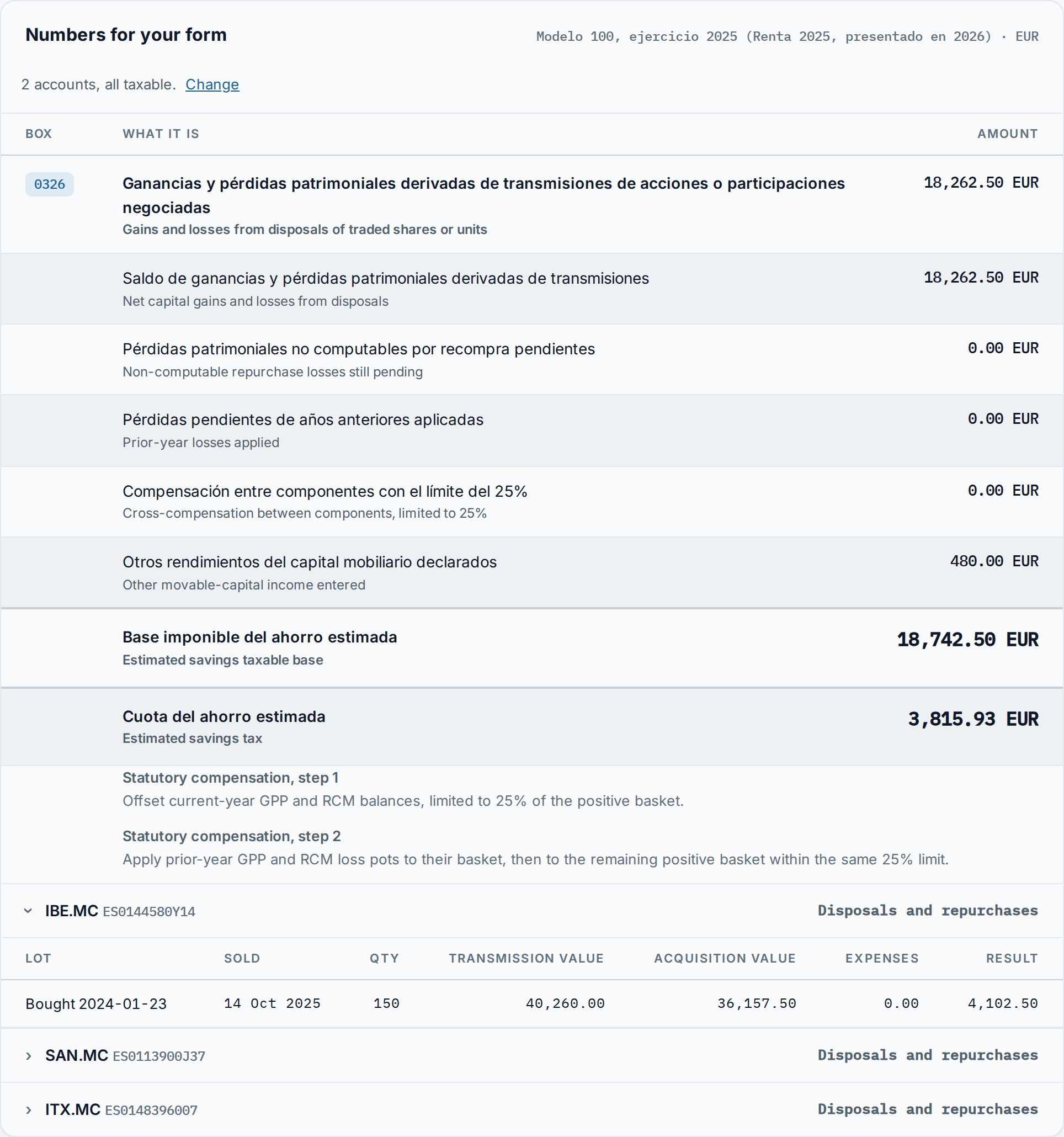
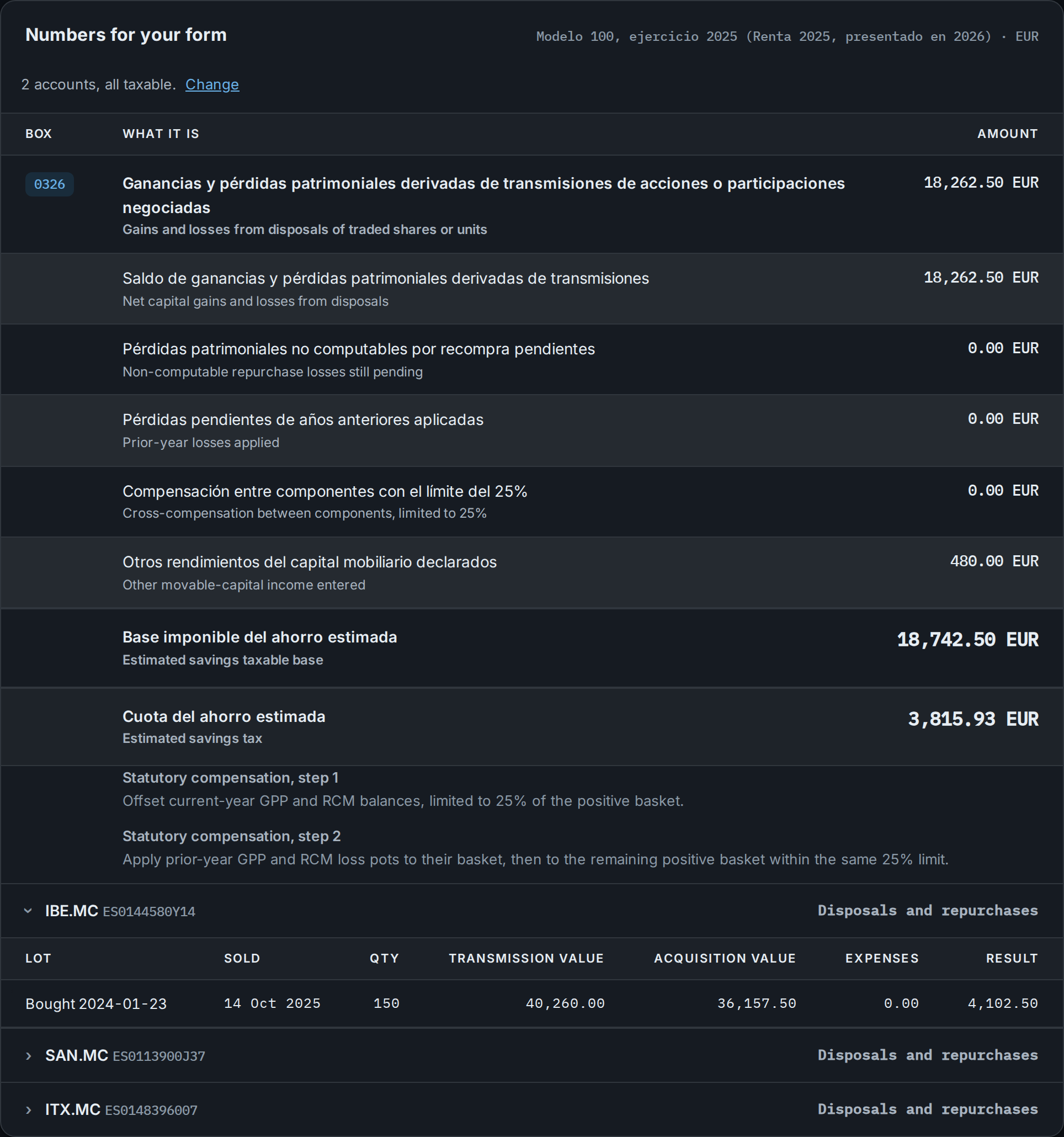
The 30% top band arrived with the 2025 tax year, raised from 28%. Losses can be offset against savings-income gains within limits and carried forward for four years. Because the scale is progressive, your effective rate on a year of gains depends on the total, which is the running figure the pack keeps.
The repurchase rule catches more people than the brackets do
Sell a holding at a loss while you still hold the same security bought close to that sale, and Spanish law says the loss is not yet computable. The window runs two months either side of the sale for a security traded on an EU or EEA regulated market and a year either side for everything else, so a lot you bought before the sale counts just as much as one you bought after it. The loss is not lost: it comes back when you finally let the replacement go.
This is where a spreadsheet quietly goes wrong, because the repurchase often sits in a different account from the sale. The pack matches across every account you put in scope and keeps the deferred amount on its own line, so the figure you carry to the Renta is the one the rule actually allows.
Modelo 720, and what happened to Modelo D-6
If you are Spanish tax resident and hold foreign assets over €50,000 in any one category, whether bank accounts, securities and investments, or real estate, you must file the informational Modelo 720 between 1 January and 31 March. Holdings at a foreign broker count as securities. After the first filing you only re-file a category if its value grows by more than €20,000, or when you dispose of a declared asset.
The penalties changed in 2022. The original Modelo 720 flat-rate penalties were ruled disproportionate by the EU Court of Justice and repealed by Ley 5/2022. It now falls under the ordinary General Tax Law penalties, which are far lower. The obligation is real; the ruinous fines are gone.
You may have read about Modelo D-6, the old declaration for foreign securities. For most retail portfolio investors it generally no longer applies: it was narrowed to significant stakes and then folded into the foreign-investment registry. The Banco de España ETE return is a separate obligation with its own thresholds. If D-6 or ETE might touch you, ask a Spanish adviser, but ordinary broker holdings are captured by Modelo 720.
Relief on foreign withholding
Foreign dividends are taxable in Spain, and tax withheld at source can usually be credited so the same income is not taxed twice. The credit is generally the lower of the foreign tax actually paid or the Spanish tax on that income. Treaty rates matter: many treaties cap dividend withholding at 15%, and anything withheld above the treaty rate is reclaimed from the source country rather than deducted in Spain. AllInvestView records the withholding on each dividend so you have the figures to claim the credit correctly.
- Modelo 720 report, the foreign-asset declaration with a BOE-format export.
- Modelo 720 for foreigners, what expats in Spain must declare, in plain English.
- Spanish capital gains tax, how the savings brackets work with examples.
- Investing in Spain, brokers, exchanges and the wider Spanish tax picture.
- Cuenta Financia Europa, the new account's investment rules and treatment when you withdraw.
- Interactive Brokers taxes in Spain, euro conversion, FIFO and the two-month rule on an IBKR account.
- Import your trades, so the repurchase matching has a full year of both sides to work with.
- Investment tax reporting guide, cost basis, FIFO and cross-border reporting.
Not tax advice. This page summarises the main Spanish investment tax rules for the 2025 and 2026 tax years. Rates, thresholds and reporting rules change and your circumstances differ. Confirm your position with the Agencia Tributaria or a qualified Spanish tax adviser before acting.
 AllInvestView