Gains and income on shares
- Rule
- Flat 25% Abgeltungsteuer plus the 5.5% solidarity surcharge on that tax, about 26.375%.
- Line
- Anlage KAP
- Pack
- Prepared. Share income and losses across your accounts, matched FIFO per securities account.
The German pack works out the advance lump sum on every accumulating fund you hold, from its opening value and the year's Basiszins, capped at the real gain and cut by the partial exemption for its class. It puts each result on its own KAP-INV line, with share income and the saver's allowance on Anlage KAP beside it.
What the Finanzamt expects from a portfolio, and how much of it the pack has already worked out.
| Item | The rule | Form and line | What the pack produces |
|---|---|---|---|
| Gains and income on shares | Investment income is charged a flat 25% Abgeltungsteuer plus the 5.5% solidarity surcharge on that tax, about 26.375% in all. | Anlage KAP | Prepared Share income and share losses across the accounts you include, matched FIFO per securities account. |
| Advance lump sum on funds | An accumulating fund pays nothing out, so Germany taxes a notional return: the opening value times the Basiszins times 0.7, capped at the fund's actual gain. | Anlage KAP-INV, Zeilen 9 to 13 | Calculated One figure per fund class, from a per-lot table showing the opening and closing price, distributions, the cap and the result. |
| Selling a fund | The gain is netted under section 19 and reduced by the partial exemption, and everything already taxed as an advance lump sum comes off it. | Anlage KAP-INV, Zeilen 14, 17, 20, 23 and 26 | Prepared One disposal line per fund class, with the amounts already taxed added to the cost of the lot. |
| Teilfreistellung | Equity funds get a 30% exemption, mixed funds 15%, domestic real-estate funds 60% and predominantly foreign ones 80%. | Applied inside KAP-INV | Applied You confirm the class of each fund once, with the document you used as evidence, and the rate follows from there. |
| Sparer-Pauschbetrag | The first €1,000 per person, or €2,000 jointly assessed, is free of Abgeltungsteuer. | Anlage KAP | Applied Tell the pack how much your banks already used and it claims what is left on the sheet. |
| Church tax | Members pay 8% in Bavaria and Baden-Württemberg and 9% elsewhere, charged on the tax rather than the income. | Anlage KAP | Applied Choose your rate once and it is shown as its own line, with the reduction it causes already in the base. |
| Submitting the return | Anlage KAP and KAP-INV attach to your income tax return, and you need them to claim unused allowance or to declare a foreign broker. | Anlage KAP and KAP-INV | You file Everything leaves as a file for you or your Steuerberater. |
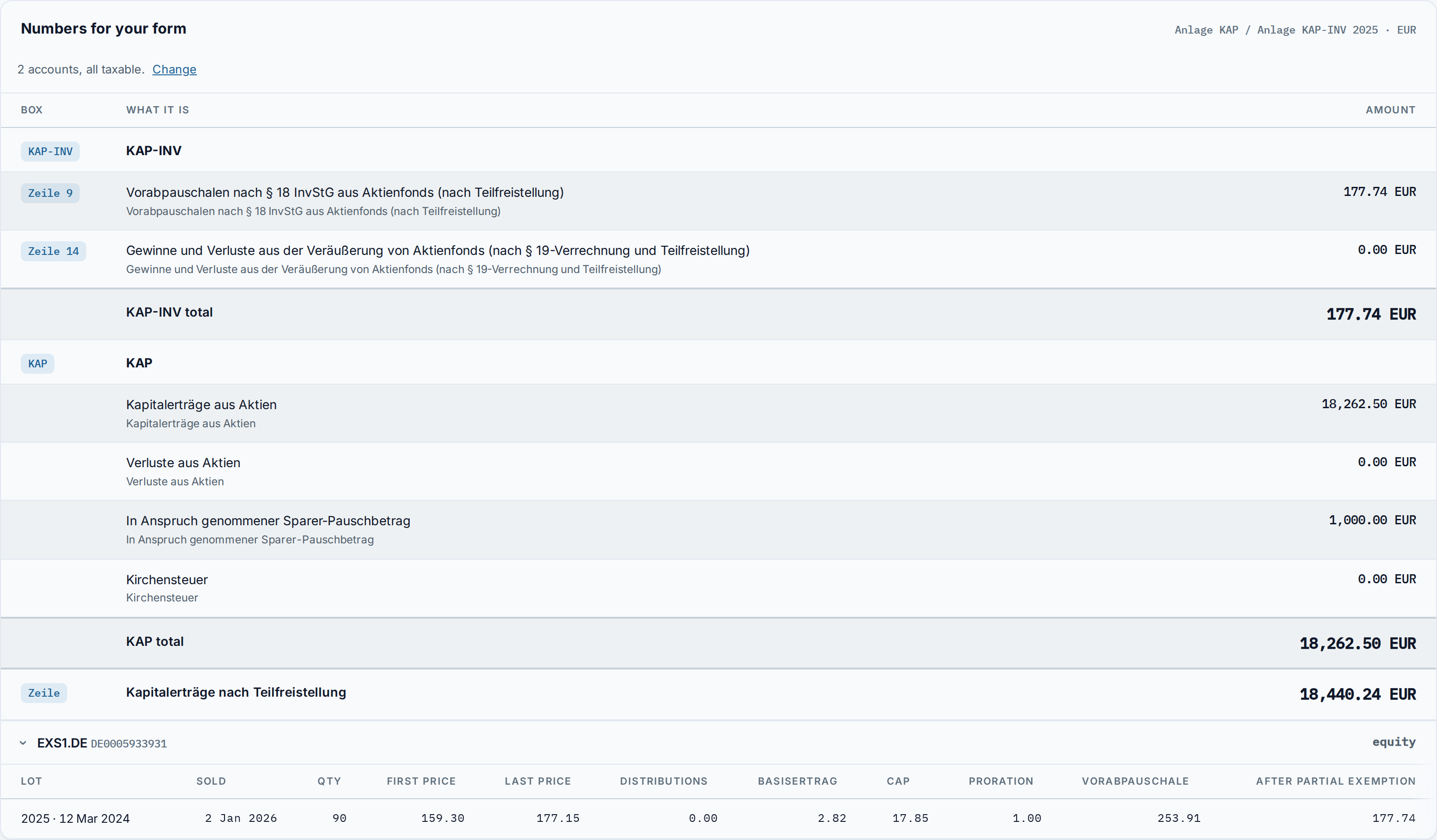
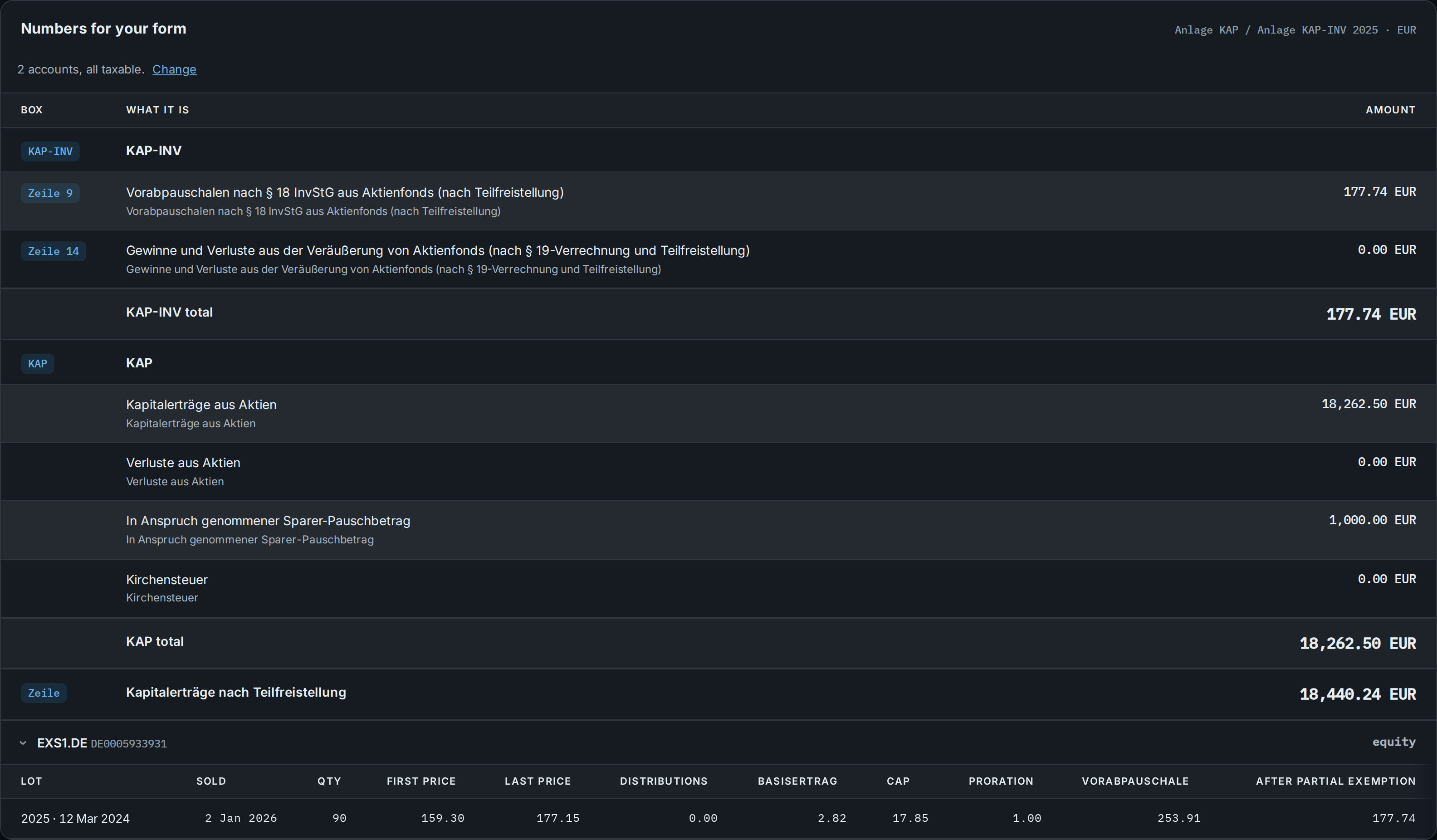
KAP-INV comes first, with the advance lump sum and the disposal line for each fund class on their own numbered rows. Anlage KAP follows with share income, share losses, the saver's allowance used and the church tax. Open the fund underneath and the whole advance calculation is laid out per lot: opening price, closing price, distributions, the cap, and the amount left after the partial exemption.
Open the German pack AllInvestView
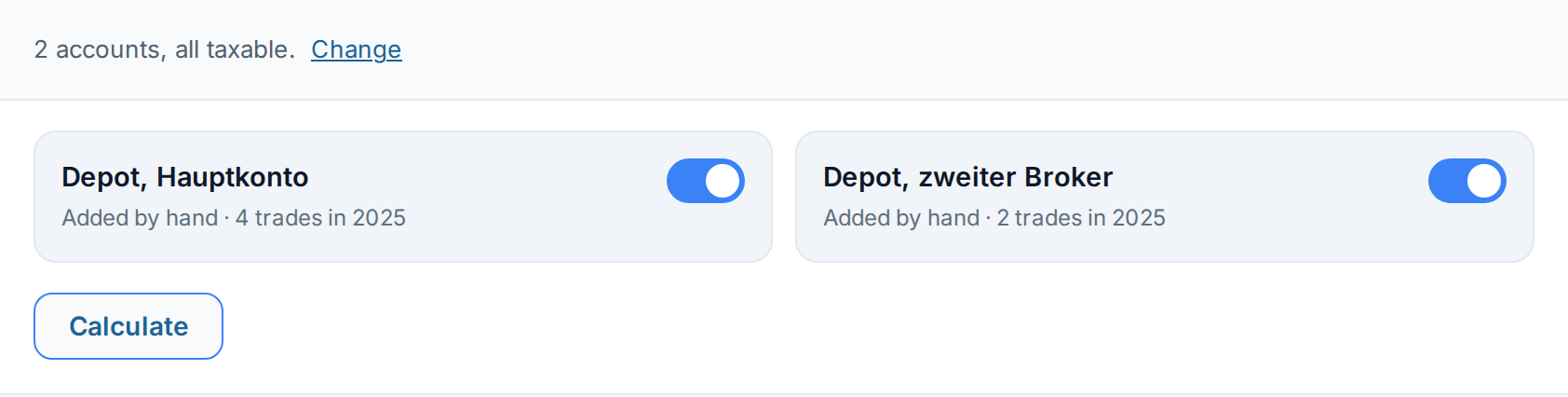
Before it calculates, the pack asks which Depots belong in this return. Germany has no tax-free investment wrapper to declare, so the German cards carry a switch and nothing more. The same control shows ISA and pension chips to a British reader and a PEA chip to a French one.
See the accounts stepAllInvestView
PDF, Excel and CSV carry the KAP and KAP-INV lines together with the per-lot fund detail behind them. A fund whose class you have not confirmed blocks its own figures, and the export waits for it. Once the year is closed the calculation revision is frozen, so the advance amounts you reported stay comparable next year.
See what exportsAllInvestView
It does not file with the Finanzamt, and the tax on the sheet is an estimate built from the answers you gave about filing status, church tax and allowance already used.
Each fund needs its class confirmed once, and the advance lump sum needs a price at both ends of the year. Where a classification, a price or an exchange rate is missing, or where a lot predates the 2018 reform, the pack blocks that figure rather than inventing one.
Germany taxes investment income, meaning capital gains, dividends and interest, under the Abgeltungsteuer: a flat withholding tax of 25% rather than your personal income-tax rate. On top sits the solidarity surcharge at 5.5% of the tax, bringing the effective rate to about 26.375%. The 2021 reform that spared most wage earners did not spare capital-income withholding, and the Federal Constitutional Court upheld the surcharge in 2025. Church members add church tax of 8% in Bavaria and Baden-Württemberg or 9% elsewhere, again on the tax; the resulting reduction is built into the withholding and lands around 27.8% to 27.99% combined.
For both 2025 and 2026 the headline 25% is unchanged. Your bank usually withholds at source and pays the Finanzamt, which is why many investors never file for it. You still need Anlage KAP to claim unused allowance, to declare a broker abroad, or to reconcile withholding across accounts.
Every taxpayer has a tax-free Sparer-Pauschbetrag of €1,000 a year, or €2,000 for a jointly assessed couple, unchanged for 2025 and 2026. You normally claim it with a Freistellungsauftrag at each bank, splitting the allowance between them. If you do not, tax is withheld and you recover the allowance later through Anlage KAP.
The Vorabpauschale, or advance lump sum, is the part of German fund taxation that confuses almost every investor who did not grow up with it.
A distributing fund pays dividends, and Germany taxes them as they arrive. An accumulating fund pays nothing out, so there is no cash flow to tax during the year. Rather than wait until you sell, Germany taxes a notional minimum return each year instead. That notional amount is the Vorabpauschale.
The Basiszins is set annually by the Federal Ministry of Finance: 2.53% for 2025 and 3.20% for 2026. A worked example makes it concrete:
The advance lump sum is not an extra tax, it is a pre-payment. Everything you have been taxed on is added to your cost, so the gain when you finally sell is smaller by exactly that much. It moves when you pay, not how much. And there is no Vorabpauschale in a year the fund did not rise.
Because investment funds pay some tax at fund level, Germany grants a Teilfreistellung on the investor's side to avoid taxing the same money twice. It applies to distributions and to capital gains alike:
| Fund type | Exemption |
|---|---|
| Equity fund, at least 51% equities | 30% |
| Mixed fund, at least 25% equities | 15% |
| Domestic real-estate fund | 60% |
| Predominantly foreign real-estate fund | 80% |
A gain on a broad equity ETF is therefore taxed on 70% of its value at 26.375%, an effective rate near 18.5% before the allowance. The pack asks you to confirm each fund's class once, and records the document you relied on, because the class decides both this rate and which KAP-INV line the amount belongs on.
Anlage KAP is the capital-income schedule attached to your income tax return. You need it to claim unused Sparer-Pauschbetrag, to request the Günstigerprüfung that applies your marginal rate when it is lower than 25%, to declare income from a foreign broker where no German tax was withheld, or to reconcile withholding across accounts. Anlage KAP-INV is the fund schedule beside it, and it is where the advance lump sum and fund disposals actually go, one numbered line per fund class.
Not tax advice. This page summarises the main German investment tax rules for the 2025 and 2026 tax years, including a Basiszins of 2.53% for 2025 and 3.20% for 2026. Rates and rules change and your circumstances differ. Confirm your position with the Finanzamt or a qualified Steuerberater before acting.
Bring the history in once and the advance lump sum, the partial exemption and the allowance keep themselves current year after year.
Investment income and capital gains are taxed under the Abgeltungsteuer at a flat 25%, plus the solidarity surcharge of 5.5% of that tax, giving an effective rate of about 26.375%. Church members pay an additional 8% or 9% church tax on the tax, which slightly reduces the base.
The saver's allowance is 1,000 euros per person, or 2,000 euros for a jointly assessed couple, for both 2025 and 2026. Investment income up to this amount is tax-free, usually claimed through a Freistellungsauftrag with your bank or broker.
The Vorabpauschale is an advance lump-sum tax on accumulating funds and ETFs that do not distribute. Because there is no dividend to tax during the year, Germany taxes a notional minimum return instead: the fund value at the start of the year multiplied by the Basiszins, times 0.7, capped at the fund's actual gain that year and reduced by any Teilfreistellung. Your bank collects the tax in January of the following year, and it is credited against the gain when you eventually sell.
The base rate is set each year by the Federal Ministry of Finance. It is 2.53% for 2025 and 3.20% for 2026. There is no Vorabpauschale in a year where the fund did not rise in value.
Teilfreistellung is a partial tax exemption that compensates for tax paid at fund level. Equity funds holding at least 51% equities get a 30% exemption, mixed funds at least 25% get 15%, domestic real-estate funds get 60%, and predominantly foreign real-estate funds 80%. It applies to both distributions and capital gains from the fund.
Yes. The German filing pack works out the advance lump sum for each fund lot and year from the opening value and the Basiszins, caps it at the fund's actual gain, applies the Teilfreistellung for the fund class you confirmed, and puts the result on the KAP-INV line for that class. It also adds the amounts already taxed to the cost when the lot is sold.
On KAP-INV it fills the Vorabpauschale lines 9 to 13 and the fund disposal lines 14, 17, 20, 23 and 26, one pair per fund class. On Anlage KAP it shows share income, share losses, the saver's allowance used and the church tax, without claiming line numbers there.