Three-Fund Portfolio: Returns Since 1997, Funds and Rebalancing
A three-fund portfolio owns the whole US stock market, the stock markets of the rest of the world and the US bond market, through one index fund each. You choose the split and put it back once a year. It's the most popular portfolio on the Bogleheads forum.
With Vanguard's three index funds at 60/20/20, $10,000 at the end of 1996 grew to $109,333 by 23 October 2026, 8.4% a year. The S&P 500 made more, 10.0% a year, but fell 55.3% at its worst against 46.4%.
Three-fund portfolio returns since 1997
60% Vanguard Total Stock Market, 20% Total International Stock and 20% Total Bond Market, rebalanced every January, against the S&P 500 and a 60/40.
- Three-fund
- S&P 500
- 60/40
Month-end values (the last one 23 October 2026) on a log scale, so the same percentage gain takes the same height in 2000 as in 2020. Move along the chart to read any month.
| Dec 1996 to Oct 2026 | $10,000 became | A year | Worst fall | Worst year | Years with a loss | Worst 10 years |
|---|---|---|---|---|---|---|
| Three-fund 60/20/20 | $109,333 | 8.4% | −46.4% | −30.0% (2008) | 8 of 29 | +0.1% a year |
| Same, all US (80/20) | $134,031 | 9.1% | −45.2% | −28.6% (2008) | 6 of 29 | −0.5% a year |
| S&P 500 | $169,837 | 10.0% | −55.3% | −37.0% (2008) | 6 of 29 | −3.5% a year |
| 60/40 | $98,620 | 8.0% | −33.8% | −20.1% (2008) | 6 of 29 | +0.7% a year |
How much of a three-fund portfolio should be international?
The same test for every mix: down the side, how much is in stocks; across the top, how much of the stocks sits abroad. Each cell is the return a year from 1997 to 2026. Pick one.
| In stocks | 0% | 20% | 25% | 30% | 40% | 50% |
|---|
Rows are the share in stocks; the rest is the bond fund. The stronger the green, the more return a year. ★ marks the 60/20/20 tested above.
Over ten years at a time
83 of 239Ten-year stretches in which the three-fund beat the same portfolio with all its stocks in the US. Every one of them ended between January 2007 and November 2013, after the decade when US stocks went nowhere.
The gap was never large either way: the best stretch for international added 0.8 points a year, the worst cost 1.8. Owning both means never having all your stocks in the market that's doing worst.
Year by year
Calendar-year returns with dividends reinvested. 2026 runs to 23 October. Years in red are the three-fund's losses.
- Three-fund
- S&P 500
The S&P 500 fell 9.1%, 12.0% and 22.2% in three straight years. The bond fund gained each year, and the three-fund lost 7.2%, 8.9% and 13.9%.
US stocks lost 37.0%, international stocks 44.1% and bonds gained 5.2%. The three-fund lost 30.0%, and bonds had grown to 30% of it before the January rebalance bought stocks back.
International stocks made 32.2% against 17.1% for US stocks. The three-fund made 18.1%, its first year of gains ahead of the S&P 500 (17.7%) since 2007.
Three-fund portfolio at Vanguard, Fidelity and Schwab
Every big US broker has its own three funds, and they cost almost the same. Use the set your broker sells without a fee. Fees checked 25 October 2026, blended at 60/20/20.
Vanguard ETFs
Used in the buy listThe same three indexes as the test, as ETFs any US broker sells.
- VTIVanguard Morningstar Total Stock Market ETF60%0.03% a year
- VXUSVanguard Total International Stock ETF20%0.05% a year
- BNDVanguard Total Bond Market ETF20%0.03% a year
Vanguard mutual funds
The funds testedThe funds in the test. $3,000 minimum each.
- VTSAXVanguard Morningstar Total Stock Market Index Fund Admiral Shares60%0.04% a year
- VTIAXVanguard Total International Stock Index Fund Admiral Shares20%0.09% a year
- VBTLXVanguard Total Bond Market Index Fund Admiral Shares20%0.04% a year
Fidelity
No minimums. FZROX and FZILX cost nothing but can only be held at Fidelity.
- FSKAXFidelity Total Market Index Fund60%0.015% a year
- FTIHXFidelity Total International Index Fund20%0.06% a year
- FXNAXFidelity U.S. Bond Index Fund20%0.025% a year
Schwab
No minimums. SWISX, like the SCHF ETF, leaves out emerging markets.
- SWTSXSchwab Total Stock Market Index Fund60%0.03% a year
- SWISXSchwab International Index Fund20%0.06% a year
- SWAGXSchwab U.S. Aggregate Bond Index Fund20%0.04% a year
Fewer funds: two or one
| Fund | What it holds | Fee | Good to know |
|---|---|---|---|
VT + BNDVanguard Total World Stock ETF and Total Bond Market ETF | Stocks from every market in one fund, about 60% of them US | 0.05% a year | Two funds instead of three. VT sets the US share for you. |
VASGXVanguard LifeStrategy 80/20 Fund | 80% stocks, 20% bonds, in four Vanguard index funds | 0.10% a year | A mutual fund that rebalances itself. Adds international bonds. |
VTTSXVanguard Target Retirement 2060 Fund | Mostly stocks today, 40% of them international | 0.08% a year | Moves toward bonds as 2060 gets closer. $1,000 minimum. |
If you buy in Europe
| UCITS fund | ISIN | Fee | Good to know |
|---|---|---|---|
V80AVanguard LifeStrategy 80% Equity UCITS ETF (EUR) Accumulating | IE00BMVB5R75 | 0.25% a year | One fund, global stocks and bonds, rebalanced for you. |
VWCE + AGGHVanguard FTSE All-World UCITS ETF (USD) Accumulating and iShares Core Global Aggregate Bond UCITS ETF EUR Hedged (Acc) | IE00BK5BQT80 / IE00BDBRDM35 | 0.13% a year | 0.14% and 0.10%, about 0.13% blended at 80/20. You rebalance. |
Most European brokers can't sell US-listed ETFs such as VTI to retail investors, so a world stock ETF plus a hedged bond ETF is the usual way to build it there.
What your money buys
Whole shares of VTI, VXUS and BND at the 23 October 2026 close. With fractional shares you can split any amount exactly.
| ETF | Price | Shares | Cost |
|---|---|---|---|
| Total | |||
| Cash left over | |||
The cash left over is what whole shares can't use up.
How to rebalance a three-fund portfolio
Put each fund back to its weight, by selling what grew or by sending new money to what fell behind.
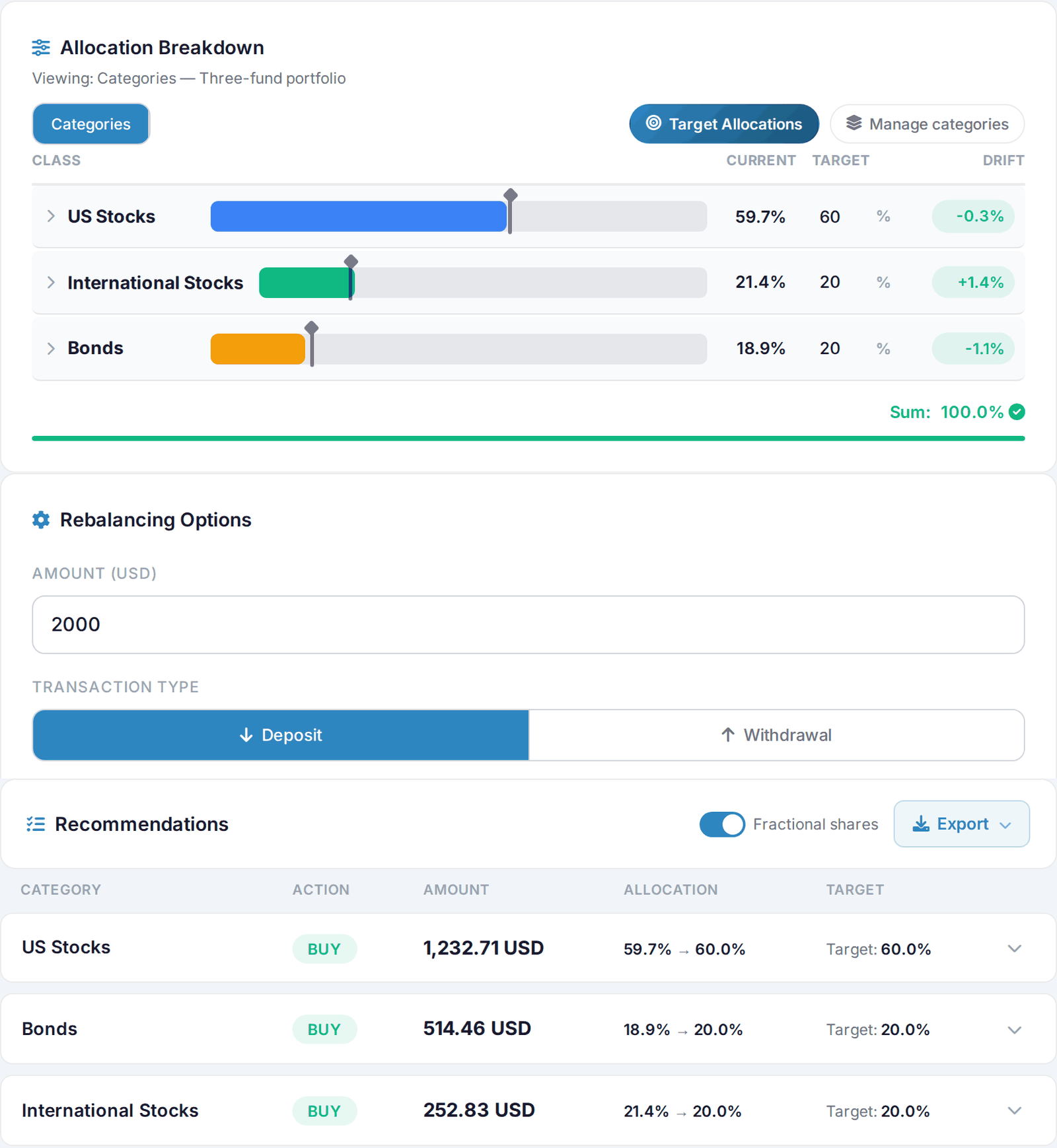
$10,000 split 60/20/20 in VTI, VXUS and BND on 2 January 2026 was worth $10,866 by 23 October: 61.8% US stocks, 20.0% international and 18.2% bonds. Type in your own amounts.
| Fund | Now | Target | Trade |
|---|---|---|---|
| Total |
Left alone, the same $10,000 would have grown to $121,056, but it would no longer be the split you chose: 85.6% US stocks, 9.1% international and 5.3% bonds today. Rebalancing is what keeps it.
In a US taxable account, bond fund interest is taxed as income every year, so the bond fund usually belongs in an IRA or 401(k). The international fund pays foreign tax that you can claim as a credit only in a taxable account, so it often goes there.
Your three funds against their targets, with the trades to fix it
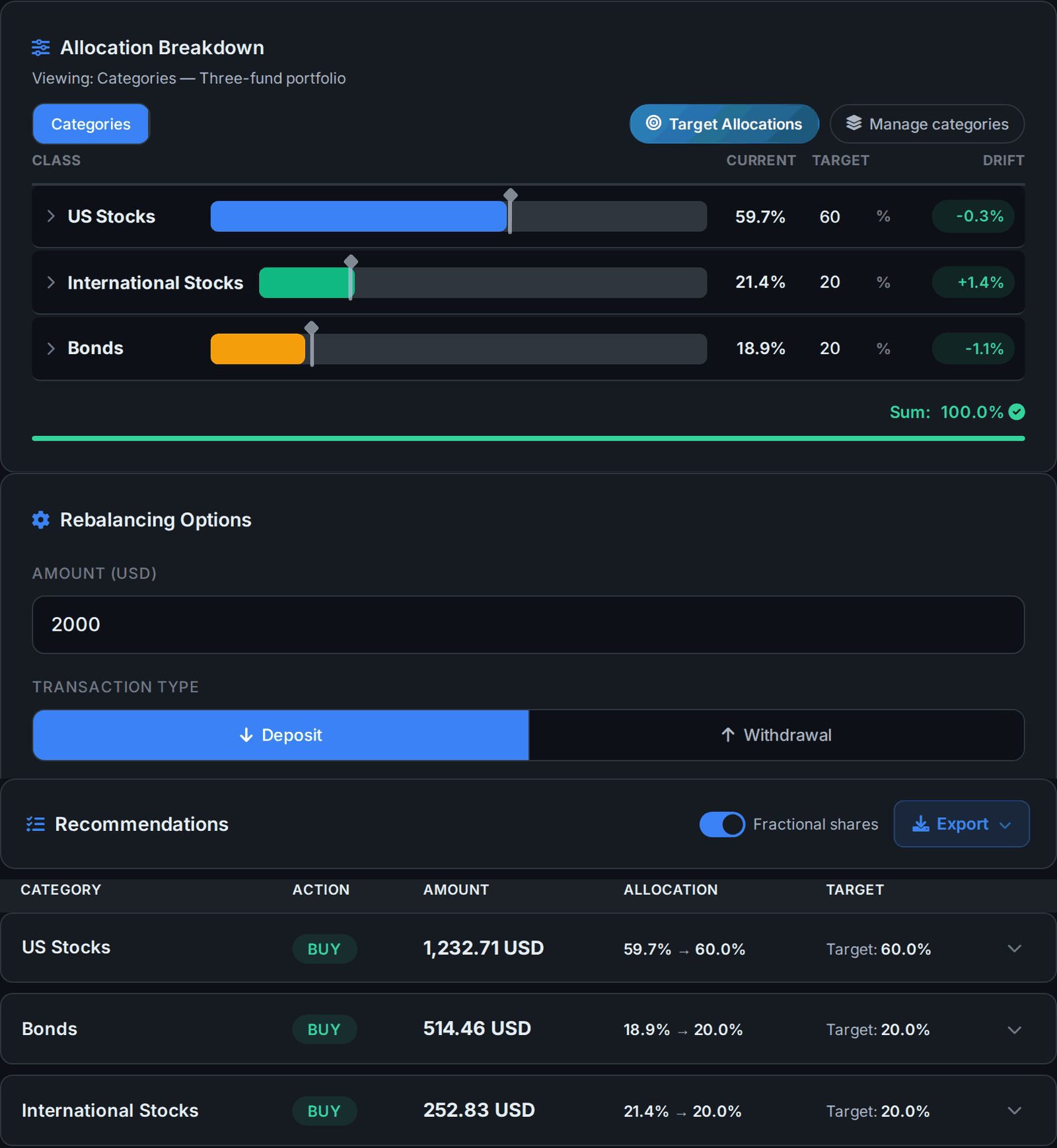
AllInvestView adds up your US, international and bond funds from every broker and account, so a three-fund portfolio split across a 401(k), an IRA and a taxable account shows as one, each fund against its target from live prices. Enter what you're adding and it splits the money between the funds, or lists the sells and buys if you allow selling, with the estimated tax on each sell from your own capital gains rules. Three funds fit easily in the free plan's ten holdings.
Read the rebalancing guide
AllInvestView
Three-fund vs total world, 60/40 and Golden Butterfly
The same test for all four: $10,000 on 2 January 2019 to 22 October 2026, rebalanced every January.
Three-fund
60% US stocks, 20% international stocks, 20% US bonds.
Total world
One fund with every stock market, no bonds.
60/40
60% S&P 500 and 40% US bonds.
Golden Butterfly
20% each in two stock funds, long and short Treasuries, and gold.
What the three-fund portfolio gives up
Four costs worth knowing before you settle on it.
An S&P 500 fund ended with $169,837 against $109,333. About two fifths of the gap is the international fund, since the same 80/20 with all its stocks in the US ended at $134,031; the rest is the 20% in bonds. In the 2000s abroad was the stronger half.
From October 2007 to March 2009 the 60/20/20 fell 46.4% and took until February 2011 to get back to its high. If that would make you sell, pick a row lower in the grid: 42/18/40 fell 35.3%.
In 2022 stocks and bonds fell together and the three-fund lost 17.5%. Some Bogleheads add a fourth fund for international bonds; a Golden Butterfly adds gold for that kind of year.
Spread over a 401(k), an IRA and a taxable account, the split is hard to see and each fund can only be traded where it sits. That's where a tracker that adds up every account earns its keep.
Track your three funds in one place
Sync or import your brokers and AllInvestView shows your US, international and bond funds against their targets across every account, the return of the whole portfolio, the dividends and the tax when you sell.
Questions about the three-fund portfolio
What is a three-fund portfolio?
A portfolio built from three index funds: one that holds the whole US stock market, one that holds stocks from the rest of the world, and one that holds the US bond market. You pick the split, buy the three funds and put them back to that split about once a year. It's the most popular portfolio on the Bogleheads forum, and Taylor Larimore wrote a book about it in 2018.
What are the three funds in the Bogleheads three-fund portfolio?
At Vanguard: Total Stock Market (VTSAX, or the VTI ETF), Total International Stock (VTIAX or VXUS) and Total Bond Market (VBTLX or BND). At Fidelity: FSKAX, FTIHX and FXNAX. At Schwab: SWTSX, SWISX and SWAGX, or the SCHB, SCHF and SCHZ ETFs. Each set costs 0.03% to 0.05% a year blended at 60/20/20.
What has the three-fund portfolio returned?
With Vanguard's three index funds at 60/20/20, $10,000 at the end of 1996 grew to $109,333 by 23 October 2026, 8.4% a year with dividends reinvested and a rebalance every January. It lost money in 8 of the 29 full years. The worst was 2008, down 30.0%, and the deepest fall from a high was 46.4%, from October 2007 to March 2009.
How much of a three-fund portfolio should be international?
There's no single right number. The Bogleheads wiki's examples put between 20% and about 50% of the stocks abroad, and Vanguard's target-date funds hold 40%. In this test, at 80% stocks, each extra 10 points of the stocks abroad cost about 0.3 points a year since 1997, because US stocks did far better from 2010. From 2000 to 2009 it went the other way: US stocks lost 2.2% over the decade and international stocks gained 25.4%.
Is the three-fund portfolio better than the S&P 500?
Not over this stretch. An S&P 500 index fund turned $10,000 into $169,837 from the end of 1996, 10.0% a year, against $109,333. It also fell 55.3% at its worst against 46.4%, and lost 37.0% in 2008 against 30.0%. The three-fund gives up some return for bonds, which held it up from 2000 to 2002, and for the rest of the world, which paid off in 2025.
How often should you rebalance a three-fund portfolio?
Once a year is enough for most people, and it's what the test does. In a normal year the funds end only a few points off: 2021 ended at 64.6% US stocks, 18.6% international and 16.8% bonds. After 2008 bonds had grown to 30%, and the January rebalance moved that money back into stocks near the bottom. Left alone since 1997, bonds would be 5.3% of the portfolio today.
Is there a one-fund version of the three-fund portfolio?
Yes. Vanguard's Target Retirement funds and its LifeStrategy 80/20 Fund (VASGX) hold the same total-market index funds plus international bonds and rebalance for you, for 0.08% to 0.10% a year. VT and BND make it two funds. In Europe, Vanguard's LifeStrategy 80% Equity UCITS ETF does it in one.
Other portfolios and tools
Sources and how the numbers were worked out
- Bogleheads wiki, Three-fund portfolio, for the three funds and the example splits.
- Taylor Larimore, The Bogleheads' Guide to the Three-Fund Portfolio (Wiley, 2018), with a foreword by John C. Bogle.
- Vanguard fact sheets for VTSAX, VTIAX and VBTLX, whose published yearly returns the test matches.
- Vanguard, The case for international equities in target-date funds, for the 40% of stocks held abroad.
- Fund fees from the issuers, checked 25 October 2026: Vanguard (VTI, VXUS, BND, VTSAX, VTIAX, VBTLX, VT, VASGX, VTTSX, V80A, VWCE), Fidelity (FSKAX, FTIHX, FXNAX, FZROX, FZILX), Schwab (SWTSX, SWISX, SWAGX, SCHB, SCHF, SCHZ) and iShares (ITOT, IXUS, AGG, AGGH).
- IRS, Foreign tax credit, for the credit on tax an international fund pays abroad.
The test uses daily closing prices in US dollars with dividends and interest reinvested, before tax and with no trading costs; fund fees are already in the prices. The three funds are Vanguard's Total Stock Market Index (VTSAX), Total International Stock Index (VTIAX) and Total Bond Market Index (VBTLX) Admiral Shares, with the Investor Shares (VTSMX, VGTSX, VBMFX) before 2004, 2011 and March 2003 respectively, because the early Admiral price data misses some distributions. The international fund began in April 1996, so $10,000 goes in at the close on 31 December 1996, and each mix is rebalanced to its weights on the first trading day of every year, to the close on 23 October 2026. The S&P 500 is the Vanguard 500 Index Fund (VFINX) and the 60/40 holds it with the same bond fund. Worst fall is the largest drop from a previous high in daily values; the worst 10 years is the lowest yearly return over any ten years ending at a month end. The 2026 rebalancing example and the buy list use VTI, VXUS and BND. The comparison with the total world, 60/40 and Golden Butterfly portfolios uses the shorter 2019 to 2026 test from the portfolio examples page. Past returns don't tell you future ones, and none of this is a recommendation to buy a particular fund.