SPY stays near $760
The November call expires worthless or close to it, and you still own a December call with four weeks of time value. That leftover time value, less the $642, is the profit.
At $760: +$761. At $750: +$306
A calendar spread sells an option that expires soon and buys the same strike further out. You'll also see it called a time spread or a horizontal spread. The option you sold loses its value faster than the one you own, so if the stock sits near the strike, the gap between them grows and that gap is your profit.
On 23 October 2026 SPY closed at $759.97. Selling the 20 November $760 call at $14.54 and buying the 18 December $760 call at $20.96 cost $642, and that's the most it can lose. If SPY ends at $760 on 20 November and December's volatility holds, it makes about $761, 119% of the cost. It makes money between about $741.28 and $780.24, and those edges move with volatility.
$20.96 − $14.54 = $6.42, $642 a spread
$642, if SPY runs far from $760 either way
The December call is worth about $14.03: +$761
Real prices from the 23 October close. Pick where SPY might close on 20 November, when the short call expires, and how December's volatility might move by then.

Delta is about −0.2, so today the spread barely moves with SPY. At midpoint prices it would have cost $6.32: buying at the ask and selling at the bid cost $10.50 more.
On 20 November the November call is worth only what it's in the money. The December call still has four weeks left, so its value is an estimate at the volatility you pick.
Profit or loss of one SPY $760 call calendar bought for $642, by where SPY closes when the short call expires and where the December call's volatility is then.
| SPY on 20 Nov | Volatility 3 points lower | Unchanged | 3 points higher |
|---|---|---|---|
| $700 −7.9% | −$628 | −$593 | −$530 |
| $720 −5.3% | −$547 | −$441 | −$304 |
| $730 −3.9% | −$436 | −$281 | −$102 |
| $740 −2.6% | −$241 | −$38 | +$178 |
| $750 −1.3% | +$68 | +$306 | +$547 |
| $755 −0.7% | +$272 | +$519 | +$768 |
| $760 the strike | +$510 | +$761 | +$1,012 |
| $765 +0.7% | +$283 | +$532 | +$781 |
| $770 +1.3% | +$91 | +$330 | +$574 |
| $780 +2.6% | −$201 | +$7 | +$228 |
| $790 +4.0% | −$388 | −$224 | −$36 |
| $800 +5.3% | −$499 | −$380 | −$230 |
| $820 +7.9% | −$588 | −$540 | −$459 |
The November call expires worthless or close to it, and you still own a December call with four weeks of time value. That leftover time value, less the $642, is the profit.
Both calls drift toward zero, and the one you own loses more dollars than the one you sold. The loss can't pass the $642 you paid.
Deep in the money, both calls trade close to what they're in the money and the gap between them shrinks toward zero. A rally hurts a calendar as much as a fall.
The calendar's value over the four weeks with SPY held at three prices and both volatilities unchanged. Most of the gain comes in the last week.
| Date | Days left on the short call | SPY at $740 | SPY at $760 | SPY at $780 |
|---|---|---|---|---|
| 23 Oct opened | 28 | − | $0 paid $642 | − |
| 6 Nov | 14 | −$14 | +$121 | −$8 |
| 13 Nov | 7 | +$19 | +$252 | +$37 |
| 19 Nov | 1 | −$15 | +$531 | +$25 |
| 20 Nov short expires | 0 | −$38 | +$761 | +$7 |
An option at the money loses time value faster the closer it gets to expiry. On 23 October the two calls lose value at different speeds, and the spread gains about $6.7 a day net. In the final week the November call's decay speeds up while the December call still has a month to go, which is why the line at $760 goes from +$252 to +$761 in seven days. The same clock works against you away from the strike: at $740 and $780 the last day took the result down, not up.
A calendar owns the longer option, and longer options react more to implied volatility. That makes the spread long volatility, or long vega.
One point of implied volatility moved the December call by about $118 and the November call by about $84 on 23 October. Net, the calendar gains or loses about $34 for each point.
They're the SPY prices where the December call is worth what you paid plus whatever the November call is in the money, and that value depends on volatility on the day. Nobody knows them for sure when you open the trade.
On 23 October December traded at a higher volatility than November at the money, 16.6% against 16.0%, so this calendar bought the dearer month. It's better when the month you sell is the expensive one, as it often is just before an event.
SPY options at the 23 October close, the short leg sold at the bid and the long leg bought at the ask.
| Strike 20 Nov / 18 Dec | Cost | Nov vol | Dec vol | Wants SPY to |
|---|---|---|---|---|
| $740 | $657 | 19.2% | 19.3% | dip 2.6% |
| $750 | $651 | 17.6% | 17.8% | dip 1.3% |
| $760 this guide | $642 | 16.0% | 16.6% | stay put |
| $770 | $608 | 14.6% | 15.3% | rise 1.3% |
| $780 | $528 | 13.5% | 14.3% | rise 2.6% |
The strike is your forecast: the calendar does best when SPY ends at it. Lower strikes trade at higher volatility in both months, which is the volatility skew, and December's edge over November grows as the strike rises: 0.1 points at $740, 0.8 at $780. The $780 calendar costs less because both of its calls are further out of the money.
| Long $760 call | Days | Ask | Vol | Calendar cost |
|---|---|---|---|---|
| 27 Nov 2026 | 35 | $16.14 | 15.6% | $160 |
| 18 Dec 2026 this guide | 56 | $20.96 | 16.6% | $642 |
| 15 Jan 2027 | 84 | $25.87 | 16.1% | $1,133 |
All three sell the same 20 November call at $14.54. A long leg one week out is cheap, but it's left with only a week of time value when the short one expires, so there's little to collect. The January call costs almost twice the December one as a spread and carries more vega, so it gains more if volatility rises and loses more if it falls. One month between the legs, as here, is the usual middle ground.
The same $760 strike and dates with puts: sell the November put at $11.65 and buy the December put at $16.57, for $492 against $642. Interest on the strike favours the call, about $2.29 a share, and the December dividend favours the put, about $1.98, so the two nearly cancel. Most of the $1.50 gap is volatility: on 23 October the December put traded at 15.0% against 16.6% for the December call.
State Street's 2026 schedule puts SPY's December ex-dividend date on 18 December, the day the long call expires. SPY's price falls by about the dividend that morning, so the December call is worth less than it would be without it, and every figure on this page already prices that in. The short November call ends first, so it carries no dividend assignment risk. As the holder of an American-style call you could exercise on 17 December to collect the dividend, but it only pays when the call is in the money and its time value left is smaller than the dividend, and this trade closes on 20 November.
SPY's price change over every 20-trading-day stretch since October 2006, the length of this calendar's short leg, with today's breakevens (−2.46% and +2.67%) laid over it.
Each bar is a half-point bucket of SPY's price change over 20 trading days, the trading days from 23 October to 20 November 2026, for every start date from 23 October 2006 to 25 September 2026. The end buckets also hold every move past −9.5% and +9.5%. Bars are coloured by the middle of each bucket; the percentages come from the moves themselves.
Just under half the time SPY ended four weeks inside today's breakevens. That's not a 48% chance of winning. At either edge the result is zero, the big gains need SPY within a few dollars of $760, and the edges move with volatility. SPY rose more often than it fell over these 20 years, so a calendar centred on today's price lost to rallies more often than to drops. A strike a little above the price, such as $770, leans with that drift.
Amazon reports on 29 October, with its call at 2pm Pacific, after the market closes. Prices are from the 23 October close, when Amazon ended at $248.00.

The 30 October $250 straddle cost $19.53 at the midpoints, 7.9% of the price. Taking the 30 October volatility out of the 6 November one leaves about 33.8% for the week after the report.
| Amazon | 6 Nov vol 30% | 33.8% | 40% |
|---|---|---|---|
| $220 −11.3% | −$120 | −$119 | −$115 |
| $235 −5.2% | −$89 | −$69 | −$29 |
| $240 −3.2% | −$29 | +$4 | +$66 |
| $245 −1.2% | +$94 | +$140 | +$219 |
| $250 the strike | +$304 | +$356 | +$442 |
| $255 +2.8% | +$108 | +$155 | +$235 |
| $260 +4.8% | −$6 | +$29 | +$93 |
| $265 +6.9% | −$64 | −$42 | +$4 |
| $280 +12.9% | −$100 | −$98 | −$91 |
Estimates for the close on 30 October, when the short call expires, with the 6 November call at the volatility in each column. At 33.8% the breakevens are about $239.78 (−3.3%) and $261.67 (+5.5%).
The short option is the expensive one: it carries the whole report. Once the news is out, its volatility collapses and it's worth only what it's in the money by the close of 30 October. The trade wins if Amazon moves less than the roughly 7.9% the straddle priced and the 6 November call holds on to enough volatility. Both breakevens sit inside that 7.9%, so a move as big as the options priced is a loss, and a big one costs nearly the whole $120.
Two ways to change the shape of the tent: add a second calendar, or move one strike.
A put calendar below the price and a call calendar above it, on the same dates. On SPY, the $740 put calendar cost $454 and the $780 call calendar $528, $982 together. With volatility unchanged, it makes money on 20 November from about $729.52 to $789.72, against $741.28 to $780.24 for the single calendar.
Buy the later option at a different strike from the one you sell. A long call below the short one makes the spread bullish. Push the long call deep in the money and a year or more out, and you have the poor man's covered call.
The cards use the SPY $760 call calendar. Values before 20 November are model estimates with both volatilities unchanged.
Decide on a target before you open the trade. The final week holds the biggest gains and the sharpest swings. Closing a few days early gives up part of that last stretch and most of its risk.
On 20 November you can close both legs, or keep the December call and sell a shorter call against it, which turns one calendar into a running series. Holding the December call on its own is a different trade: a plain long call.
SPY options are American-style and settle in shares, so a short call in the money can be assigned. If SPY closes within cents of $760 on 20 November, you won't know whether you'll be assigned until after the close. Buy the short call back before the bell. Early assignment on a short call usually comes the day before an ex-dividend date; on a put calendar, watch a short put that's deep in the money.
Under Cboe's margin rules the long option is paid in full, the premium from the short one can go toward it, and the short leg must expire on or before the long one. For a same-strike calendar that means you put up the debit. A cash account only takes spreads on European-style index options that expire together, so an SPY calendar needs a margin account. In an IRA it depends on the options level your broker allows for spreads.
Five ways to trade a stock that you expect to stay in a range.
| Strategy | The legs | Up front | Wins when | Volatility rising | Most you can lose |
|---|---|---|---|---|---|
| Calendar spread | Sell a near option, buy a later one, same strike | You pay | The stock sits at the strike when the short leg expires | Helps | The debit |
| Diagonal | Like a calendar, with the strikes apart | You pay | The stock drifts toward the short strike | Usually helps | The debit, with the long call below the short one |
| Butterfly | Three strikes, one expiry | You pay | The stock ends at the middle strike at expiry | Hurts | The debit |
| Iron condor | Four strikes, one expiry | Paid to you | The stock stays between the short strikes | Hurts | A wing's width less the credit |
| Short straddle | Sell a call and a put, same strike | Paid to you | The stock barely moves | Hurts | No limit on the upside |
The calendar and the diagonal are the range trades here that want volatility to rise. That makes them useful when implied volatility is low, and a balance to a book of iron condors and short straddles. For the trades with one expiry, the options payoff calculator draws the payoff with your own strikes.
IRS Publication 550 taxes each option on its own, and treats positions sold or marketed as offsetting, a spread included, under the straddle rules.
A short option that expires or is bought back is a short-term gain or loss. Calendars are almost always held under a year, so the long leg's result is short-term too.
The two legs offset each other, so the straddle rules in Publication 550 can apply. A loss on one leg closed while the other is still open can be deferred, and the long leg's holding period doesn't run while the short leg is open.
You sell 100 SPY shares at $760, and the premium you received is added to the sale price. Exercising the long call to cover makes its cost part of the shares' basis.
Other countries have their own rules. Our options tax tracker keeps each closed option and the open ones apart for your report.
They depend on the long option's volatility on the day the short one expires. Three points less volatility in December moves the SPY breakevens from $741.28 and $780.24 to $748.11 and $772.70.
The trade works best when the option you sell is priced at a higher volatility than the one you buy. Buying a back month that's already rich, such as just before an event that falls in it, starts you on the wrong side.
Pinned at $760 on expiry day, you can't tell whether the short call will be assigned. Close it before the bell instead of finding out over the weekend.
A short call that expires on or just after an ex-dividend date can be assigned the day before. SPY goes ex-dividend on 18 December, so a short December call carries that risk where the November one doesn't.
The +$761 needs SPY within a few dollars of $760. In 20 years of four-week stretches SPY ended inside the breakevens 48.2% of the time, and at the edges the result is zero. Size it so that losing the $642 is fine.
A calendar is two options that only make sense together. AllInvestView puts both legs in one position, whether the trades sync from your broker or come from a file.
When you sell a call and own a later one at the same strike on the same stock, the options book groups them as a calendar. Sell the next month's call against the same long call and it stays in that position, so you see what the whole series has made.
 AllInvestView
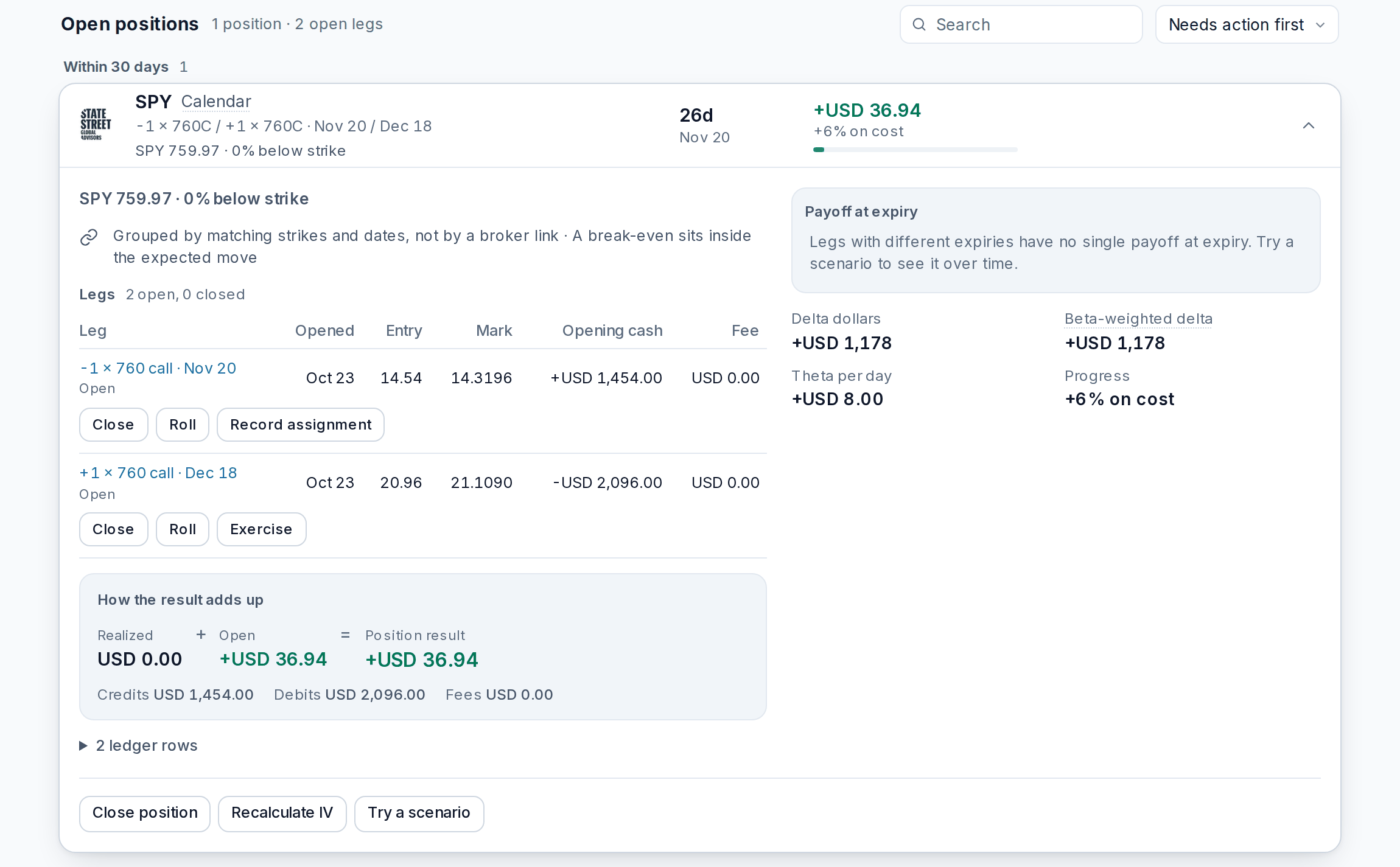
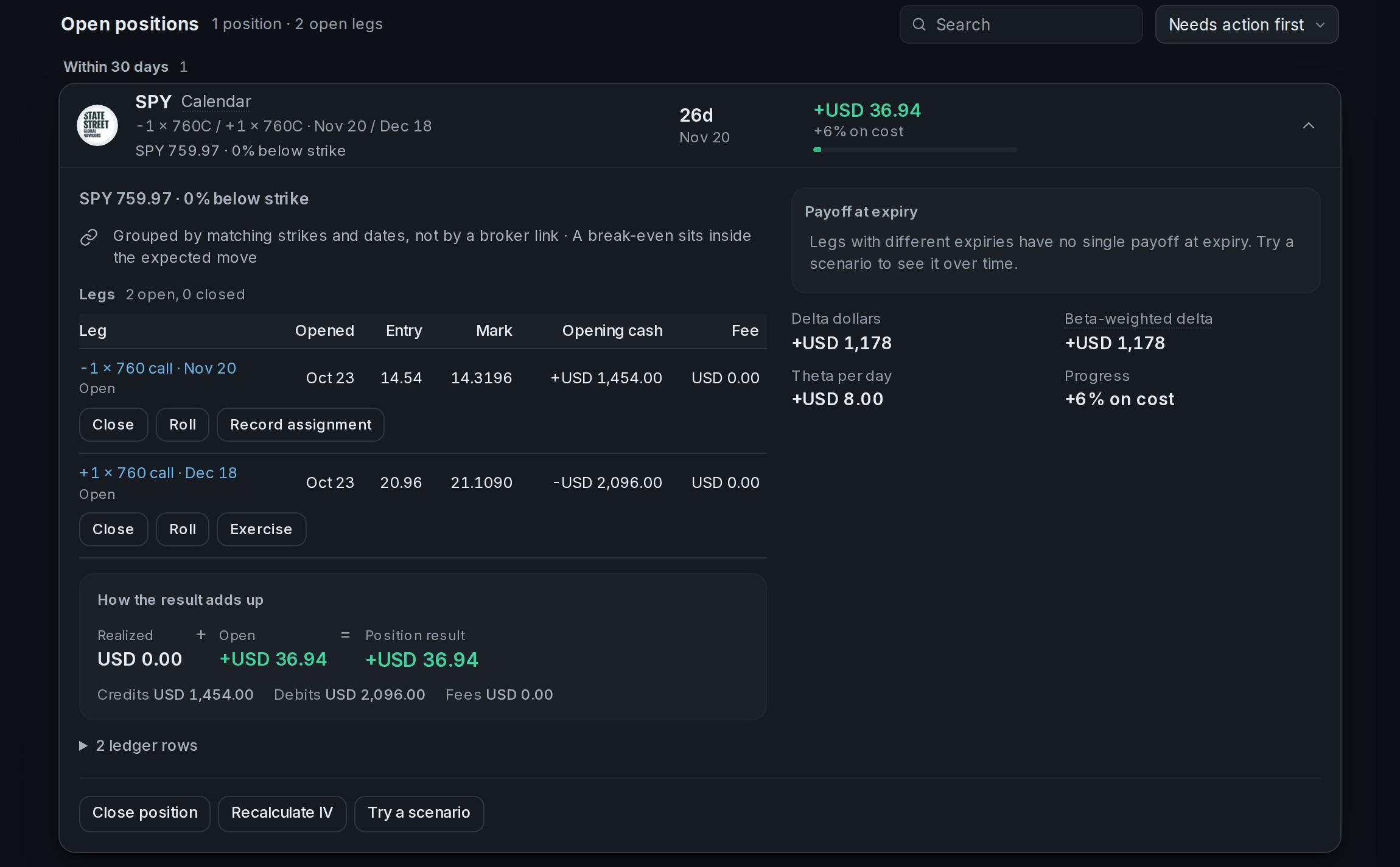
Calendars, diagonals, butterflies, iron condors, covered calls, shares, ETFs, bonds and dividends on one dashboard, synced from your brokers or imported from a file, with every closed trade's result kept.
A calendar spread sells an option that expires soon and buys one at the same strike that expires later. It's also called a time spread or a horizontal spread. On 23 October 2026, selling SPY's 20 November $760 call at $14.54 and buying the 18 December $760 call at $20.96 cost $642, which is also the most it can lose.
From time decay. The option you sold loses its value faster than the one you bought, so if the stock stays near the strike the gap between them widens. If SPY closes at $760 on 20 November, the November call expires worthless and the December call is still worth about $14.03 if its volatility holds: a gain of about $761 on the $642 paid.
What you paid for it, when both options share a strike and the one you own expires later. For the SPY calendar that's $642. The loss grows toward it as SPY moves away from $760: about $593 at $700 on 20 November and $540 at $820, with volatility unchanged.
At the money it's neutral: the SPY calendar had a delta of about −0.2, so it barely moved with SPY. Put the strike above the price and it leans bullish, below the price and it leans bearish, because the best result comes when the stock ends at the strike.
At the same strike and dates they cost different amounts. SPY's $760 put calendar cost $4.92 against $6.42 for the call calendar, and not much of that is carry: interest favours the call, the December dividend favours the put, and they nearly cancel. Most of the $1.50 is that the December put traded at a lower volatility than the December call on 23 October. Pick the one with the better fill, and watch early assignment: short calls before an ex-dividend date, short puts deep in the money.
A put calendar below the price and a call calendar above it, all on the same dates. On SPY, a $740 put calendar and a $780 call calendar cost $982 together. With volatility unchanged it makes money on 20 November between about $729.52 and $789.72, against $741.28 to $780.24 for the single $760 calendar, but it costs more and makes less if SPY ends right at $760.
The option that expires just after the report carries the expected move, so its volatility is high. Amazon reports on 29 October. Its 30 October $250 call traded at 71.3% volatility against 55.8% for 6 November, and a calendar selling the first and buying the second cost $120. It wins if Amazon moves less than the roughly 7.9% the options priced and the later option keeps enough of its value.
Calendars are almost always held under a year, so the result is short-term. The two legs offset each other, so the straddle rules in IRS Publication 550 can apply: a loss on one leg closed while the other is still open can be deferred, and the long leg's holding period doesn't run while the short leg is open.
Checked on 25 October 2026.
Costs use the ask for options bought and the bid for options sold, before commissions. Greeks and every value before expiry come from AllInvestView's options pricing engine, a standard model, with a 3.94% rate, SPY's December dividend as a $1.99 payment going ex on 18 December, with none before 20 November (Amazon pays none) and each option's volatility solved from its midpoint price, held fixed unless a column says otherwise. The four-week moves are SPY's price change over each overlapping stretch of 20 trading days, from closes without dividends. This guide explains how the trade works; it isn't advice to make it.