Apple sits still
The short call expires worthless and you keep $245. The long call loses about $135 of time value in four weeks, and it was bought at the ask, $1.48 above the midpoint. Net: about −$38.
A poor man's covered call is a covered call without the shares. Instead of 100 shares you buy a call that's deep in the money and expires a year or more away, then sell a short-dated call above the price against it, month after month. You collect the same kind of premium for about a third of the money, and every move in the stock counts about three times as much against what you put in.
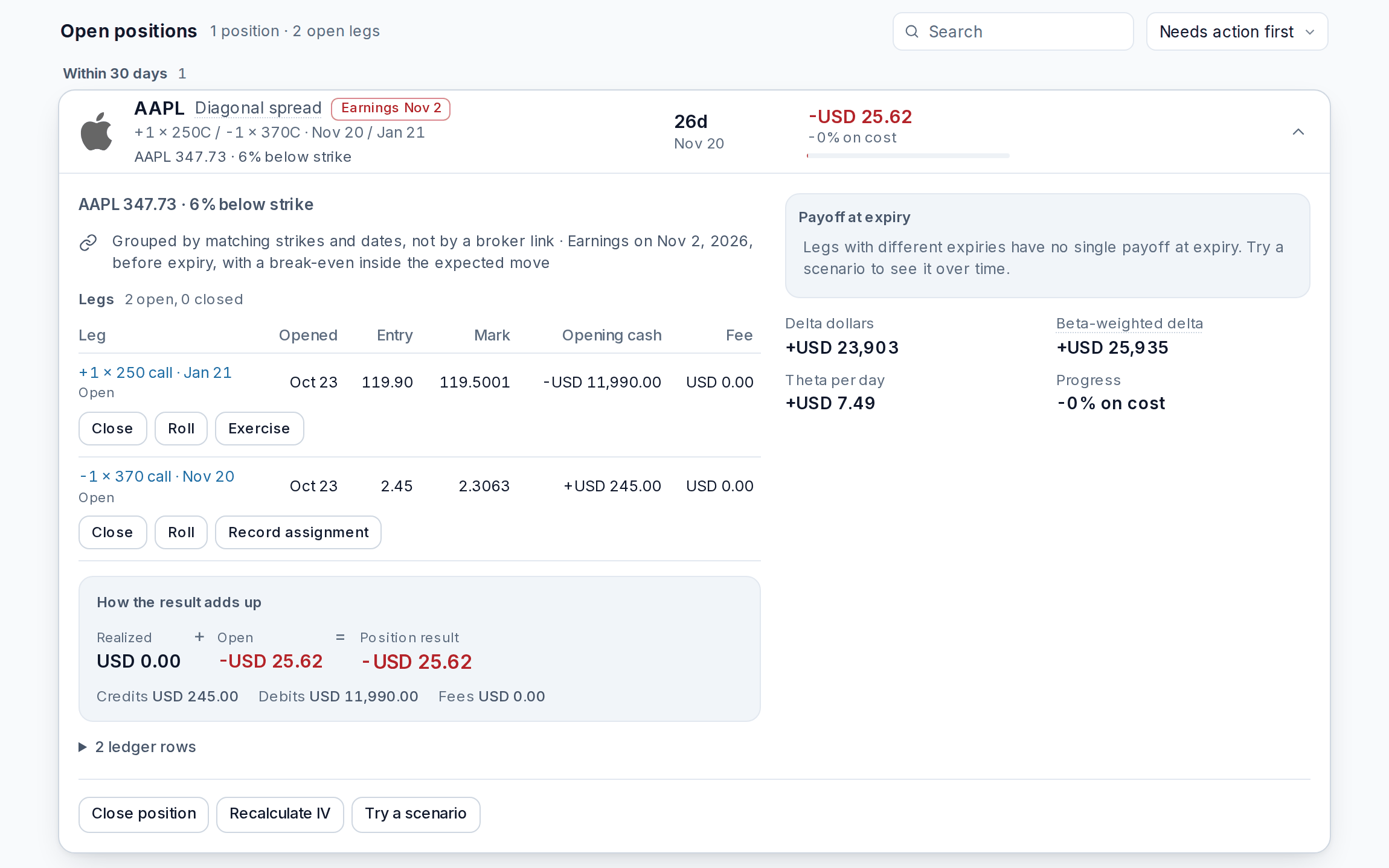
On 23 October 2026 Apple closed at $347.73. Buying the January 2028 $250 call and selling the 20 November $370 call cost $11,745, against $34,773 for 100 shares. The $370 call paid $245: 2.1% of the money in for four weeks, against 0.7% for the shares. If Apple falls 10% by 20 November, the PMCC loses about 25% of its cost and the shares about 9%.
($119.90 − $2.45) × 100 = $11,745
$370 − $250 = $120, more than $117.45
About +$1,947 at $370, 16.6% of the cost
Real prices from the 23 October close. Drag where Apple might close on 20 November, when the short call expires, and compare the PMCC with a covered call on 100 shares that sold the same $370 call. Switch to percent to see each result against the money it needed.
The $250 call has a delta of 0.87 and the $370 call 0.20, so the pair moves like 67 shares. Of the $119.90, $22.17 is time value: the part you lose bit by bit if Apple goes nowhere.
On 20 November the $370 call expires and the $250 call still has 14 months to run, so it's valued with its 23 October volatility. The covered call includes the $27 dividend, as Apple has gone ex-dividend between 4 and 10 November in each of the last six years.
The same Apple outcomes on 20 November, side by side. In dollars the PMCC lands close to the shares; on a third of the money, that's about three times the percent.
| Apple on 20 Nov | PMCC on $11,745 | % | Covered call on $34,773 | % |
|---|---|---|---|---|
| $278.18 falls 20% | −$5,646 | −48.1% | −$6,683 | −19.2% |
| $312.96 falls 10% | −$2,978 | −25.4% | −$3,205 | −9.2% |
| $330.34 falls 5% | −$1,536 | −13.1% | −$1,467 | −4.2% |
| $347.73 unchanged | −$38 | −0.3% | +$272 | +0.8% |
| $365.12 rises 5% | +$1,507 | +12.8% | +$2,011 | +5.8% |
| $370.00 the short strike | +$1,947 | +16.6% | +$2,499 | +7.2% |
| $382.50 rises 10% | +$1,838 | +15.6% | +$2,499 | +7.2% |
| $417.28 rises 20% | +$1,609 | +13.7% | +$2,499 | +7.2% |
The short call expires worthless and you keep $245. The long call loses about $135 of time value in four weeks, and it was bought at the ask, $1.48 above the midpoint. Net: about −$38.
Above $370 the short call costs you a dollar for every dollar Apple rises, while the long call gains a little less, because it still carries time value. The PMCC peaks at $370 and gives a little back above it.
The long call loses less than the shares in dollars, because its value can't go below zero, but much more against what you paid. Over 15 months the most you can lose is the $11,745.
Apple's January 2028 LEAPS calls at the 23 October ask. The long call stands in for the shares, so you want it to move almost like them, with as little time value as you can afford.
| Strike | Cost | Delta | Time value per share | Sell calls above |
|---|---|---|---|---|
| $200 | $16,280 | 0.94 | $15.07 | $362.80 |
| $230 | $13,670 | 0.90 | $18.97 | $366.70 |
| $250 this guide | $11,990 | 0.87 | $22.17 | $369.90 |
| $270 | $10,315 | 0.84 | $25.42 | $373.15 |
| $280 | $9,600 | 0.81 | $28.27 | $376.00 |
| $300 | $8,145 | 0.76 | $33.72 | $381.45 |
A cheaper long call isn't a better deal. The $300 call costs $3,845 less than the $250, but carries $11.55 a share more time value, moves less like the shares and pushes the strike rule up to about $381, so you can only sell calls far above the price for little premium. Most PMCC traders look for a delta around 0.75 to 0.90 and at least a year to expiry, so the long call outlives many short calls.
The $250 call's time value if Apple stays at $347.73 until January 2028, with its volatility unchanged. That is the cost the short calls have to beat.
| Date | Days left | Call worth | Time value left | |
|---|---|---|---|---|
| 23 Oct 2026 midpoint | 455 | $118.43 | $20.70 | |
| 20 Nov 2026 first short call ends | 427 | $117.07 | $19.34 | |
| 22 Jan 2027 | 364 | $113.96 | $16.23 | |
| 23 Apr 2027 | 273 | $109.34 | $11.61 | |
| 23 Jul 2027 | 182 | $104.67 | $6.94 | |
| 22 Oct 2027 | 91 | $100.42 | $2.69 | |
| 17 Dec 2027 | 35 | $98.58 | $0.85 |
That's about $1.38 a share a month, or $138 per contract, before you sell anything. The first $370 call brought $245, so a month like this one leaves roughly $100 after decay; a month where you can only get $100 for a call you're happy to sell barely pays for the long call. Many traders roll the long call to a later expiry once it has six months or so left, while it still sells easily and has value to carry over.
Apple's 20 November calls at the 23 October bid, sold against the $250 long call. The history column counts the four-week stretches of the last ten years in which Apple rose past that strike's distance.
| Strike | Premium | Delta | Rose past it since 2016 | Strike rule |
|---|---|---|---|---|
| $355 | $715 | 0.42 | 54.0% | Fails |
| $360 | $520 | 0.34 | 46.0% | Fails |
| $365 | $365 | 0.27 | 38.8% | Fails |
| $370 this guide | $245 | 0.20 | 31.5% | Passes |
| $375 | $160 | 0.15 | 25.1% | Passes |
| $380 | $107 | 0.10 | 18.6% | Passes |
Each bar is a 1% bucket of Apple's price change over 20 trading days, the length of this trade, for every start date from 24 October 2016 to 25 September 2026. The two end buckets also hold every move larger than 19% either way.
Apple rose a lot in these ten years, so short calls were often tested: in almost a third of four-week stretches it ended past where the $370 call sits. A closer strike pays more but fails the strike rule here and caps you sooner; a farther one leaves more room and pays little. On a stock that trends up, a PMCC spends a lot of its life rolling short calls.
If Apple jumps far above both strikes, the two calls end up moving almost dollar for dollar together. What's left is the gap between the strikes, minus what you paid.
The gap between the strikes is $120 and the trade cost $117.45 a share. Even if both calls were worth only what they're in the money, closing the pair returns $120.
It pays $120 more up front, but the gap is $115 and the cost $116.25 a share. A rally big enough to strip the long call's time value leaves the pair worth less than you paid.
In practice the long call keeps some time value for months, so a rally doesn't hit the worst case right away. The rule is about what you're left with if Apple runs and the short call is assigned or rolled at a bad moment. As you collect more premium over the months, the cost you carry falls and closer strikes start to pass.
The cards use the $250/$370 Apple trade. Prices after 23 October are model values with each option's 23 October volatility.
Buy back the short call and sell a later one at a higher strike, ideally for a net credit. You keep the long call and give Apple more room.
The short call is nearly worthless after a drop, so you can buy it back cheaply and sell the next month. Don't chase premium by selling below the strike rule; a bounce would then cap you at a loss.
Apple reports on 2 November 2026 after the close, before the $370 call expires. A short call over earnings collects a bit more premium and takes the risk of a jump.
An early assignment usually comes the day before an ex-dividend date, when a short call is deep in the money and its time value is below the dividend. If you're assigned, you're short 100 shares: sell the long call and buy the shares back, or buy the shares. Exercising the long call throws away its time value.
Three ways to own Apple's upside on 23 October, through 20 November.
| Strategy | What you hold | Money in | Apple unchanged | Apple −10% | Dividends |
|---|---|---|---|---|---|
| Covered call | 100 shares, short the $370 call | $34,773 | +$272 | −$3,205 (−9.2%) | Yes, $27 this quarter |
| Poor man's covered call | The Jan 2028 $250 call, short the $370 call | $11,745 | −$38 | −$2,978 (−25.4%) | No |
| The long call alone | The Jan 2028 $250 call | $11,990 | −$283 | −$3,223 (−26.9%) | No |
The short call is what turns a leveraged long call into an income trade: in a quiet month it covers the long call's time value, $245 against about $135 of decay in these four weeks. The covered call stays the calmer choice for shares you already own. The poor man's covered put is the mirror image for a falling stock: buy a deep in-the-money put a year or more out and sell short-dated puts below the price. If you'd rather be paid to wait for shares, see the cash-secured put and the wheel strategy.
IRS Publication 550 treats each option on its own, and a long call and a short call on the same stock can together be a straddle.
Premium you keep when a short call expires is a short-term capital gain on the expiry date. Buying one back closes it with a gain or loss, normally short-term.
Sold for a gain after more than a year, a long call is normally long-term. If you exercise it, what you paid for it goes into the cost of the shares, and their holding period starts the next day.
A long call and a short call on the same stock are offsetting positions. A loss on one leg can be deferred while you hold a gain on the other. And if the long call wasn't yet held more than a year when you sold a call against it, its holding period starts again once that short call ends.
Other countries have their own rules. Our options tax tracker keeps each realized option and the open ones apart for your report.
The $365 call pays $120 more than the $370, but the pair could end up worth less than its cost on a big rally. Check the gap against what you paid before every sale.
The January 2028 $300 call costs less but carries $33.72 a share of time value and a 0.76 delta. You pay more for decay and get less of the stock's move.
A 10% fall in Apple costs the PMCC about 25% of what you put in. Size it by what the long call could lose, not by the premium.
With Apple at $385 in early November, the long call still holds $16.23 a share of time value, about $1,600. Sell the call and buy the shares instead.
Apple reports on 2 November and has gone ex-dividend in early November for six years running, both before this short call expires. Look at the calendar before you pick the expiry.
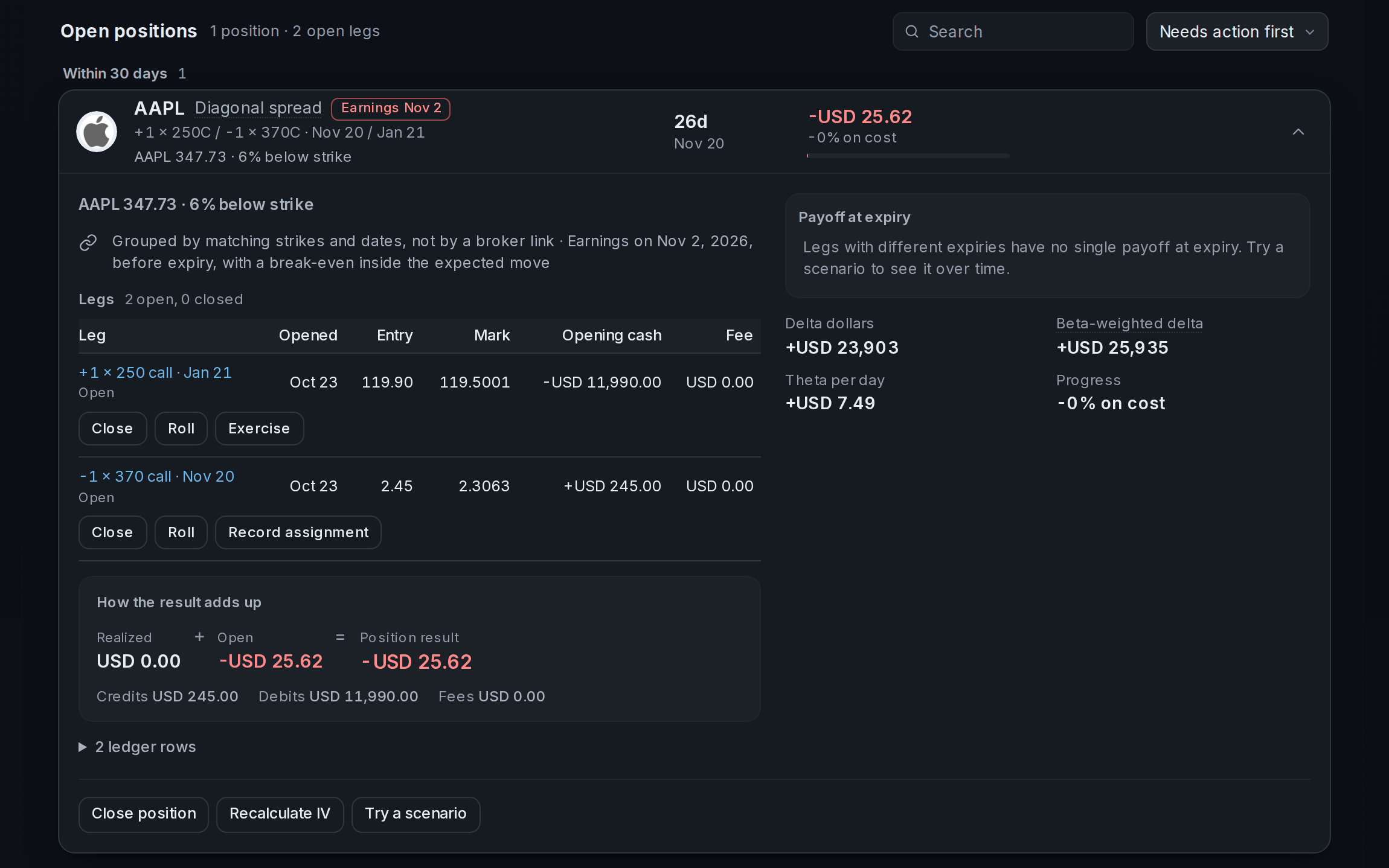
A long call and the short calls you sell against it are one trade. AllInvestView shows them together, whether the trades sync from your broker or come from a file.
The long call and the short call with an earlier expiry are grouped as one diagonal position. When one short call ends and you sell the next against the same long call, they stay in that position, so you see what the whole PMCC has made.
AllInvestView
Diagonals, covered calls, spreads, shares, ETFs, bonds and dividends on one dashboard, synced from your brokers or imported from a file, with every closed trade's result kept.
It's a covered call that uses a long-dated call instead of 100 shares. You buy a deep in-the-money call a year or more out and sell short-dated calls above the price against it. On 23 October 2026, buying Apple's January 2028 $250 call and selling the 20 November $370 call cost $11,745, against $34,773 for 100 shares.
The cost of the long call minus the premium from the short call, usually a quarter to a half of what 100 shares cost. The Apple example needed $11,745, about a third of the shares. That's also the most you can lose.
The most you can lose is what you paid. The most you can make while the short call is open comes if the stock ends right at its strike: on 20 November the Apple PMCC would show about $1,947 at $370. Over many months, the profit is the premium you keep from the short calls plus the change in the long call's value.
Most traders buy a long call with a delta around 0.75 to 0.90 and at least a year to run, and sell short calls around 0.20 to 0.30 delta, about a month out. In the Apple example the $250 long call had a delta of 0.87 and the $370 short call 0.20. Check that the gap between the strikes is bigger than what you paid.
You're short 100 shares. Sell the long call and buy the shares back, or buy the shares and keep the long call. Don't exercise the long call while it still has time value: with Apple at $385 in early November, that would throw away about $1,600.
It earns more on the money in and loses more on it too. On 20 November the Apple PMCC makes 16.6% of its cost at $370 against 7.2% for the shares, and a 10% fall costs it about 25% against 9%. It gets no dividends and pays for the long call's time value, so it suits traders who want covered call income on a stock they couldn't buy 100 shares of.
Short calls normally give short-term gains or losses. The long call is long-term if sold after more than a year, but a long call and a short call on the same stock can form a straddle. That can defer losses, and if the long call wasn't yet held more than a year when you sold a call against it, its holding period starts again when that short call ends.
Checked on 25 October 2026.
Costs use the ask for options bought and the bid for options sold, before commissions. Deltas, time decay and every value after 23 October come from AllInvestView's Black-Scholes engine with a 3.94% rate, a 0.31% dividend yield and each option's volatility solved from its midpoint price, held fixed (35.1% for the $250 call, 24.4% for the $370 call). The covered call is bought at the $347.73 close and counts a $0.27 dividend. Four-week moves are Apple's price change over each overlapping stretch of 20 trading days, using closes adjusted for splits and dividends.