JPMorgan falls hard
Below $300 the put gains a dollar for every dollar the shares lose. You can sell the shares at $300 by exercising it, or sell the put and keep the shares.
At $232.11 the collar loses $3,128; the shares alone lose $9,947
An options collar puts a floor and a ceiling on shares you own. You buy a put below the price, which sets the most you can lose, and sell a call above it, which pays for the put and caps what you can make. When the call pays for all of the put, it's a zero-cost collar.
On 23 October 2026 JPMorgan closed at $331.58. On 100 shares, buying the 15 January 2027 $300 put cost $455 and selling the $360 call paid $485, a $30 credit. Until 15 January the most those shares can lose is $3,128 (9.4%) and the most they can make is $2,872 (8.7%), however far JPMorgan moves.
$4.55 − $4.85 = −$0.30, a $30 credit
$300.30: the most you can lose is $3,128
$360.30: the most you can make is $2,872
Real prices from the 23 October close. Drag where JPMorgan might close on 15 January, when both options expire, and compare the collar with the shares alone and with the $300 put alone.

The put has a delta of −0.18 and the call 0.25, so today the collar moves like 57 shares. Both strikes are about the same distance away: the put 9.5% below the price, the call 8.6% above.
At expiry each option is worth only what it's in the money, so the lines are exact. A $165 January dividend, if JPMorgan pays one as in past years, is left out. Each line would collect it, unless the collar's call is assigned the day before.
Profit or loss on 15 January on 100 JPMorgan shares bought at $331.58. Between $300 and $360 the collar moves dollar for dollar with the shares; outside that range it stops.
| JPMorgan on 15 Jan | Collar | Shares alone | Shares and the put paid $455 |
|---|---|---|---|
| $232.11 falls 30% | −$3,128 | −$9,947 | −$3,613 |
| $265.26 falls 20% | −$3,128 | −$6,632 | −$3,613 |
| $300.00 the put strike | −$3,128 | −$3,158 | −$3,613 |
| $315.00 falls 5% | −$1,628 | −$1,658 | −$2,113 |
| $331.58 unchanged | +$30 | $0 | −$455 |
| $348.16 rises 5% | +$1,688 | +$1,658 | +$1,203 |
| $360.00 the call strike | +$2,872 | +$2,842 | +$2,387 |
| $397.90 rises 20% | +$2,872 | +$6,632 | +$6,177 |
Below $300 the put gains a dollar for every dollar the shares lose. You can sell the shares at $300 by exercising it, or sell the put and keep the shares.
Both options expire worthless. You keep the shares and the $30, and you're free to set up the next collar.
The call is assigned and your shares are sold at $360. That's the price of the free put: every dollar above the cap belongs to whoever bought your call.
JPMorgan's 15 January options at the 23 October close: each put at the ask, and a call at the bid that pays for all or nearly all of it. The closer the floor, the closer the cap.
| Put bought | Call sold | Net | Most you can lose |
|---|---|---|---|
| $290 at $3.05 | $370 at $2.91 | −$14 | $4,172 |
| $300 this guide | $360 at $4.85 | +$30 | $3,128 |
| $310 at $6.65 | $350 at $7.80 | +$115 | $2,043 |
| $320 at $9.55 | $340 at $11.65 | +$210 | $948 |
| $330 at $13.40 | $330 at $16.80 | +$340 | None |
Puts cost more than calls the same distance away, because more investors want to buy protection than to give away their gains. On 23 October the $300 put was priced at 25.9% volatility and the $360 call at 22.3%, which is why the free cap sits a little closer to the price (8.6%) than the floor (9.5%). And the last row isn't a collar any more: with both strikes at $330, the result is $182 whatever happens, which is the same as selling the shares for $333.40 in January. A pair that tight can be taxed as a sale.
The same $300 put at four expiries, at the 23 October ask, and the highest call whose bid pays for it.
| Expiry | Days | $300 put | Call that pays for it | Net | Cap |
|---|---|---|---|---|---|
| 18 Dec 2026 | 56 | $2.47 | $355 at $3.45 | +$98 | +7.1% |
| 15 Jan 2027 this guide | 84 | $4.55 | $360 at $4.85 | +$30 | +8.6% |
| 19 Mar 2027 | 147 | $7.90 | $365 at $8.25 | +$35 | +10.1% |
| 17 Jun 2027 | 237 | $11.80 | $370 at $12.65 | +$85 | +11.6% |
The floor stays at $300, but each step out in time lifts the cap: from $355 in December to $370 in June. The longer collar gives JPMorgan more room to rise and protects you for longer without another trade. The cost is in the quotes. Later expiries trade less, so the gap between bid and ask widens, and you cross it on both legs. On the January collar, buying at the ask and selling at the bid cost $37.50 against the midpoints; at midpoint prices the same collar would have paid $67.50.
JPMorgan's price change over every 12-week stretch since October 2006, the length of this collar, with today's floor (−9.5%) and cap (+8.6%) laid over it.
Each bar is a 2% bucket of JPMorgan's price change over 57 trading days, the trading days from 23 October 2026 to 15 January 2027, for every start date from 23 October 2006 to 4 August 2026. The end buckets also hold every move past −28% and +28%. It lays this collar's strikes over past prices; it doesn't price past options.
Over these 20 years JPMorgan rose more often than it crashed, so the cap cost something twice as often as the put saved something. On average a 12-week stretch made 3.2% on the shares and 1.8% inside the collar's range, and the swings were half as wide: a standard deviation of 6.7 points against 13.3. A collar suits a holder who cares more about the bad 14% than the extra gains, such as someone with a big unrealized gain or a large share of their wealth in one stock. For an index version over 18 years, see how Cboe's collar index did in our protective put guide.
The cards use the $300/$360 JPMorgan collar. Prices after 23 October are model values with each option's 23 October volatility.
Close both options and open a later collar with higher strikes. Closing the call costs more than the put brings back, but the new collar locks in most of the rise.
Before expiry the put is worth a bit more than what it's in the money. If you want to keep the shares, sell the put and keep that time value. If you want out, buy back the call, now worth next to nothing, and exercise the put to sell at $300.
JPMorgan reported its fourth quarter between 12 and 15 January in each of the last five years, so results will very likely come out before this collar expires. A gap either way lands on the floor or the cap, which is what the collar is for.
A short call deep in the money can be assigned the day before the stock goes ex-dividend, when its time value is less than the dividend. JPMorgan has gone ex-dividend between 4 and 6 January in each of the last six years.
Four things you can do on 23 October with 100 JPMorgan shares, through 15 January.
| Strategy | What you do | Cost today | JPMorgan −20% | JPMorgan +20% | The catch |
|---|---|---|---|---|---|
| Hold the shares | Nothing | $0 | −$6,632 | +$6,632 | The whole fall is yours |
| Protective put | Buy the $300 put | $455 | −$3,613 | +$6,177 | You pay for the cover every time |
| Covered call | Sell the $360 call | $485 paid to you | −$6,147 | +$3,327 | Income, but the fall is still yours |
| Collar | Buy the put and sell the call | $30 paid to you | −$3,128 | +$2,872 | Gains stop at $360 |
The fifth choice is to sell the shares. That ends the risk, but it also realizes the gain now, and for many collar users the tax bill is the reason they're still holding. A collar keeps you in the stock with a known worst case. If you want protection and can live with the cost, the protective put keeps the upside open; a put spread collar also sells a lower put, which makes the trade cheaper but stops the protection below that strike.
IRS Publication 550 treats a put bought on stock you own as an offsetting position, so a collar falls under the straddle rules, and a very tight one can count as a sale.
A loss on one side is deferred up to the unrealized gain on the other at year-end. If you've held the shares a year or less when you buy the put, their holding period starts again when the collar ends; shares already held over a year stay long-term.
A call that expires is a short-term gain and a put that expires is a capital loss. If the call is assigned, its premium is added to the sale price; if you exercise the put, its cost comes off it.
A collar that removes nearly all your risk and nearly all your gain can be a constructive sale under section 1259, taxed as if you sold. The law sets no exact width. The $330/$330 pair above is a sale in all but name; the $300/$360 band leaves an 18% range.
Other countries have their own rules. Our options tax tracker keeps each closed option and the open ones apart for your report.
It costs nothing in cash and pays for itself in upside. In 30.4% of JPMorgan's 12-week stretches since 2006 the shares rose past the cap, with a median of 5.8 points given up.
If JPMorgan ends above $360, your shares are sold and the whole gain is realized, the tax bill many collar users wanted to put off. Pick the call as a price you'd be content to sell at.
A $320/$340 collar leaves 6% of room, and $330/$330 leaves none. Past a point you've sold the shares in all but name, and the IRS can treat it that way.
JPMorgan usually goes ex-dividend in the first week of January. With the call deep in the money that week, expect to be assigned the day before and to miss the $1.65.
The June $300 put's quotes were $1.05 apart and the $370 call's $1.40, against $0.45 and $0.30 for January. Opening the June collar at the ask and bid cost $122.50 against the midpoints, and closing early costs part of it again.
A collar is three positions doing one job. AllInvestView shows the put and the call with the shares they protect, whether the trades sync from your broker or come from a file.
When you hold the shares, a long put below the price and a short call above it on the same stock, the options book groups them as a collar. You see the floor and the cap next to the shares, not a losing put and a short call on their own.
 AllInvestView
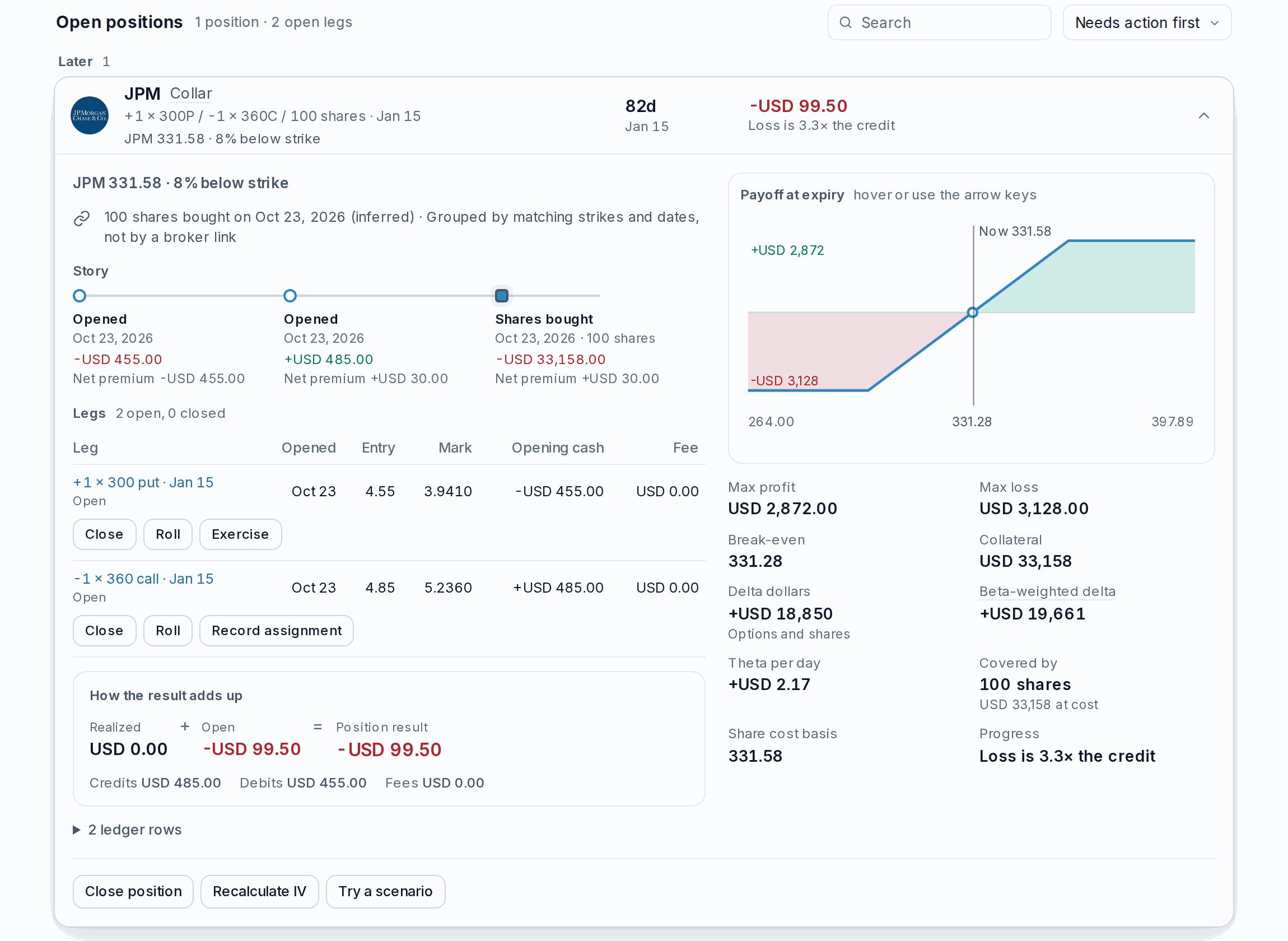
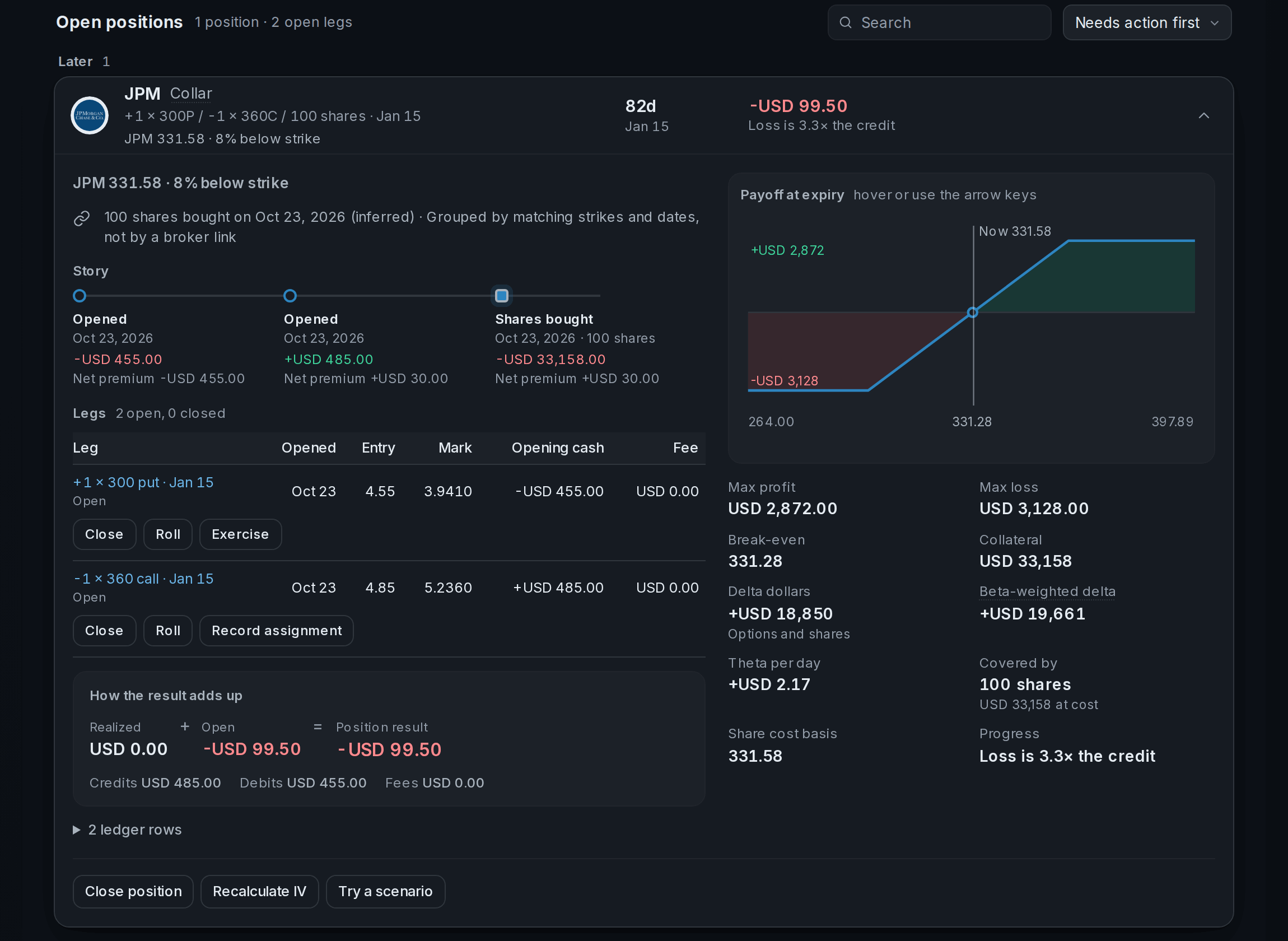
Collars, protective puts, covered calls, spreads, shares, ETFs, bonds and dividends on one dashboard, synced from your brokers or imported from a file, with every closed trade's result kept.
A collar is a put bought and a call sold on shares you own. The put sets a floor under the shares and the call sets a cap on them, and the premium from the call pays for some or all of the put. On 23 October 2026 a collar on 100 JPMorgan shares at $331.58 limited the result by 15 January to between a $3,128 loss and a $2,872 gain.
A collar where the call you sell brings in at least what the put costs, so you pay nothing up front. Buying JPMorgan's 15 January $300 put at $4.55 and selling the $360 call at $4.85 left a $30 credit. You still pay for the protection: any gain above the call strike goes to whoever bought the call.
Start with the put: the most you're willing to lose. Then find the call whose premium pays for it. The closer the put, the closer the call has to be. For JPMorgan in January, the $350 call paid for the $310 put, while the $290 put needed the $370 call and $14 more. Pick the call as a price you'd be content to sell at.
The max loss is the price you paid for the shares minus the put strike, plus what the options cost or minus the credit. The max profit is the call strike minus the share price, plus the credit or minus the cost. For the JPMorgan collar: $331.58 − $300 − $0.30 = $31.28 a share, $3,128, and $360 − $331.58 + $0.30 = $28.72 a share, $2,872.
It's cheaper and gives up more. The $300 JPMorgan put alone cost $455 and left the upside open; the collar cost nothing but stopped gains at $360. If JPMorgan rose 20% by January, the shares with the put would make $6,177 and the collar $2,872. Choose the collar when the cost of the put matters more to you than the gains above the cap.
When you want to keep shares but can't afford a big fall in them: a large unrealized gain you don't want to realize yet, a big part of your wealth in one stock, or a period you'd rather not carry the full risk, such as earnings. In 20 years of JPMorgan's 12-week moves, the $300/$360 band would have halved the swings.
The put on stock you own makes a straddle, so losses can be deferred and, on shares held a year or less, the holding period starts again when the collar ends. The call's premium is a short-term gain if it expires, or part of the sale price if it's assigned. A collar so tight it removes nearly all risk and gain can be taxed as a sale under section 1259.
Checked on 25 October 2026.
Costs use the ask for options bought and the bid for options sold, before commissions. In the worked examples, deltas and every value before expiry come from AllInvestView's Black-Scholes engine with a 3.94% rate, a 1.99% dividend yield and each option's volatility solved from its midpoint price, held fixed (25.9% for the $300 put, 22.3% for the $360 call). Values at expiry are what each option is in the money. The 12-week moves are JPMorgan's price change over each overlapping stretch of 57 trading days, using closes adjusted for splits, without dividends.