LEAPS Options: How They Work, With a Real NVIDIA Trade
LEAPS are options that expire more than a year away. The name stands for Long-term Equity AnticiPation Securities, and Cboe first listed them in 1990. Buy a LEAPS call deep in the money and you get most of the move in 100 shares for a fraction of their price. The most you can lose is what you paid, and you don't get the dividends.
On 23 October 2026 NVIDIA closed at $210.96. Its 21 January 2028 $150 call cost $7,915 at the ask, against $21,096 for 100 shares. Of that, $1,819 is time value, the part you lose if NVIDIA goes nowhere. With a delta of 0.84 it moves like about 84 shares at first, and it breaks even on expiry at $229.15, 8.6% above the close.
A LEAPS call in three numbers
What it costs
Ask × 100
$79.15 × 100 = $7,915, 37.5% of 100 shares
What you pay for time
Price − (stock − strike)
$79.15 − $60.96 = $18.19 a share, $1,819
Breakeven at expiry
Strike + price
$150 + $79.15 = $229.15, NVIDIA +8.6%
Money in$7,915for one NVIDIA LEAPS call, against $21,096 for 100 shares; the most it can lose
If NVIDIA rises 30%+57%+$4,510 on the LEAPS by 21 January 2028, against +$6,454 (+31%) on the shares
If NVIDIA falls 20%−76%−$6,038 on the LEAPS by 21 January 2028, against −$4,094 (−19%) on the shares
A LEAPS example: NVIDIA, 23 October 2026 to 21 January 2028
Real prices from the 23 October close. Drag where NVIDIA might close on 21 January 2028, when the call expires, and compare it with buying 100 shares the same day. Switch to percent to see each result against the money it needed.
NVIDIA (NVDA)Closed at $210.96 on 23 October 2026
Buy 1$150 call, 21 Jan 2028at $79.15
Cost, the most you can lose
$7,915
100 shares would cost
$21,096
In the money by
$6,096
Time value
$1,819
Breakeven on 21 Jan 2028
$229.15
Moves like
84 shares
Time decay today
−$3.71 a day
455 days to expiry, about 15 months. Each dollar in the call moves like $2.23 of NVIDIA stock at first. The call gets no dividends: at NVIDIA's $0.25 a quarter, about $125 per 100 shares by January 2028.
Where does NVIDIA close on 21 January 2028?
LEAPS call, $7,915100 shares, $21,096
LEAPS call+$2,400+30.3% on $7,915
100 shares+$4,344+20.6% on $21,096
NVIDIA ends 20% up: the LEAPS makes $2,400, 30.3% of its cost, against 20.6% for the shares. In dollars it trails them by $1,944.
Results at expiry, before commissions. The shares include about $125 of dividends, five quarterly payments of $0.25 if NVIDIA keeps paying them. The money the LEAPS doesn't tie up, $13,181, is yours to keep elsewhere and isn't counted here.
LEAPS vs 100 shares: fewer dollars, more percent
The same NVIDIA outcomes on 21 January 2028. Above $150 the LEAPS always trails the shares by about $1,944 in dollars: the $1,819 of time value plus the $125 of dividends it doesn't get. On less than half the money, that's the bigger percent once NVIDIA ends above $240.82.
NVIDIA on 21 Jan 2028
LEAPS on $7,915
% of cost
100 shares on $21,096
% of cost
$105.48 falls 50%
−$7,915
−100%
−$10,423
−49.4%
$126.58 falls 40%
−$7,915
−100%
−$8,313
−39.4%
$147.67 falls 30%
−$7,915
−100%
−$6,204
−29.4%
$168.77 falls 20%
−$6,038
−76.3%
−$4,094
−19.4%
$189.86 falls 10%
−$3,929
−49.6%
−$1,985
−9.4%
$210.96 unchanged
−$1,819
−23.0%
+$125
+0.6%
$232.06 rises 10%
+$291
+3.7%
+$2,235
+10.6%
$253.15 rises 20%
+$2,400
+30.3%
+$4,344
+20.6%
$274.25 rises 30%
+$4,510
+57.0%
+$6,454
+30.6%
$316.44 rises 50%
+$8,729
+110.3%
+$10,673
+50.6%
$421.92 doubles
+$19,277
+243.6%
+$21,221
+100.6%
NVIDIA rallies
Past $229.15 the LEAPS makes money, and every dollar NVIDIA rises adds $100 to the call by expiry, just like the shares. Against $7,915 instead of $21,096, that's about 2.7 times the percent.
NVIDIA +30%: +57.0% on the LEAPS, +30.6% on the shares
NVIDIA goes nowhere
The shares keep their value and collect the dividends. The LEAPS loses its whole time value, a little each day at first and faster near the end.
NVIDIA unchanged: −$1,819 on the LEAPS, +$125 on the shares
NVIDIA falls hard
At or below $150 on expiry the call is worthless and the $7,915 is gone. It only loses fewer dollars than the shares below $130.56, a fall of 38.1%, because the shares keep falling and the call can't go below zero.
NVIDIA −20%: −76.3% on the LEAPS, −19.4% on the shares
Six months in: 23 April 2027
NVIDIA by 23 Apr 2027
LEAPS 9 months left
100 shares price only
−30%
−$5,512
−$6,329
−20%
−$4,138
−$4,219
Unchanged
−$780
$0
+20%
+$3,044
+$4,219
+30%
+$5,046
+$6,329
Before expiry the call still has time value, so a fall hurts less than at the end: after a 30% drop the LEAPS has lost $5,512, less than the shares, because the market still prices a chance of NVIDIA coming back above $150. Those are model values with the call's 23 October volatility held fixed; a real quote moves with volatility too.
Choosing the strike: deep in the money or at the money
NVIDIA's 21 January 2028 calls at the 23 October ask. The deeper in the money, the more you pay up front, but the less of it is time value and the lower the breakeven.
Strike
Cost
Delta
Time value per share
Breakeven
NVIDIA needsNeeds
$100
$12,000
0.94
$9.04
$220.00
+4.3%
$120
$10,310
0.91
$12.14
$223.10
+5.8%
$140
$8,655
0.86
$15.59
$226.55
+7.4%
$150 this guide
$7,915
0.84
$18.19
$229.15
+8.6%
$160
$7,185
0.81
$20.89
$231.85
+9.9%
$180
$5,895
0.74
$27.99
$238.95
+13.3%
$200
$4,780
0.67
$36.84
$247.80
+17.5%
$210 at the money
$4,270
0.63
$41.74
$252.70
+19.8%
$230
$3,405
0.55
$34.05
$264.05
+25.2%
$250
$2,690
0.47
$26.90
$276.90
+31.3%
The $210 call at the money costs about half as much as the $150, but nearly all of its $42.70 is time value, so NVIDIA has to rise 19.8% by January 2028 just to break even. The $150 needs 8.6%. A common rule for a LEAPS that stands in for shares is a delta around 0.80, which lands between the $150 and the $160 here. Calls further out of the money are cheaper still and move less: they're a bet on a big rally, not a replacement for the shares. Time value here is the ask minus what the call is in the money, so it includes the half of the spread you pay.
Choosing the expiry: what a month of time costs
The $150 and $210 calls at six expiries on 23 October, at the ask. Divide the time value by the months left and you get what each month costs, per share.
Expiry
$150 call
$150 call
$210 call
$210 call
Ask
A month
Needs
Ask
A month
Needs
15 Jan 2027 2.8 months
$64.25
$1.19
+1.6%
$17.25
$5.90
+7.7%
17 Jun 2027 7.8 months
$70.35
$1.21
+4.5%
$29.95
$3.72
+13.7%
17 Dec 2027 13.8 months
$78.15
$1.24
+8.1%
$40.90
$2.89
+18.9%
21 Jan 2028 15.0 months
$79.15
$1.22
+8.6%
$42.70
$2.79
+19.8%
16 Jun 2028 19.8 months
$84.40
$1.18
+11.1%
$50.05
$2.48
+23.3%
15 Dec 2028 25.8 months
$89.75
$1.12
+13.6%
$57.70
$2.20
+26.9%
For the at-the-money call, a month of time costs much less on a long expiry: $2.20 a share on December 2028 against $5.90 on January 2027. That's the case for LEAPS over short-dated calls. For the deep $150 it's close to flat, $1.12 to $1.24 a month, so there you're choosing how long you want to hold. A later expiry also gives NVIDIA more time to pass the breakeven, but asks for a bigger move to get there.
Equity LEAPS have traditionally expired in January. NVIDIA's chain also had June and December expiries more than a year out, and they work the same way. The furthest one, 19 January 2029, shows why the quote matters: the $150 call was $87.00 bid, $95.00 ask, an $8 spread, against $88.25 / $89.75 for December 2028. Check the bid and the ask before you buy, and use a limit order.
Time decay: when to roll a LEAPS
The time value left in each call if NVIDIA stays at $210.96, with its volatility unchanged, starting from the 23 October midpoint.
From now
$150 call time value left
$210 call time value left
Today 23 Oct 2026
$17.64
$41.54
3 months Jan 2027
$14.14
$36.92
6 months Apr 2027
$10.39
$31.70
9 months Jul 2027
$6.34
$25.48
12 months Oct 2027
$2.35
$17.57
14 months Dec 2027
$0.42
$9.60
Expiry 21 Jan 2028
$0.00
$0.00
The deep $150 call loses its time value almost in a straight line. The at-the-money $210 call is different: $17.57 of its $41.54 is still there with three months left, and it all goes in those last three months. That's why many LEAPS holders sell or roll with six to twelve months left, before the steep part.
Rolling means selling the call you hold and buying a later one, often at a higher strike after a rally. On 23 October, selling the January 2028 $150 call at the $78.05 bid and buying the December 2028 $150 call at the $89.75 ask would have cost $11.70 a share, $1,170, for 11 more months.
20 years of NVIDIA 15-month moves
How often NVIDIA, held for the life of this LEAPS, would have ended above its breakeven. It's NVIDIA's own past, which was exceptional, so read it as a sense of the range, not a forecast.
NVIDIA's 15-month price changes since October 2006
LEAPS makes money: above +8.6%LEAPS loses more: −38.1% to +8.6%LEAPS loses less: below −38.1%
Each bar is a 10% bucket of NVIDIA's price change over 313 trading days, the length of this trade, for every start date from 23 October 2006 to 28 July 2025. The first bucket also holds every fall past 70%, the last every rise past 290%. Bars are coloured by the middle of their bucket; the percentages below count each stretch exactly.
Above the breakeven
Stretches
69.1%
NVIDIA rose more than 8.6% and the LEAPS made money
In between
Stretches
23.2%
The LEAPS lost, and lost more dollars than the shares
Below −38.1%
Stretches
7.6%
Both lost; the LEAPS lost fewer dollars
Below the $150 strike
Stretches
10.7%
A fall of more than 28.9%: the call expires worthless
The middle stretch rose 46%, and the worst fell 82.1%, starting on 27 August 2007. The split by period shows how much the answer depends on when you start: from 2006 to 2015 NVIDIA beat the breakeven in 57.3% of stretches and fell more than 38.1% in 13.9%; from 2016 on, 80.5% and 1.6%. A stock that has done less well would show far fewer winners, and a LEAPS needs the stock to rise more than its time value just to break even.
LEAPS puts: protection that lasts more than a year
A LEAPS put does the opposite job: it pays if the stock or index falls, and one bought against shares you hold sets a floor for more than a year. SPY's 17 December 2027 puts at the 23 October ask, with SPY at $759.97.
Strike
Ask
% of SPY
% a year
Delta
$600 21% below
$14.45
1.90%
1.65%
−0.13
$640 16% below
$19.25
2.53%
2.20%
−0.17
$680 11% below
$25.68
3.38%
2.94%
−0.22
$720 5% below
$34.29
4.51%
3.92%
−0.30
$760 at the money
$45.96
6.05%
5.26%
−0.39
A floor 5% below SPY cost 4.51% of its price for 13.8 months, 3.92% a year; at the money, 5.26% a year. The protective put guide walks through choosing the floor and what it costs against the shares.
LEAPS in other strategies
A LEAPS call can stand in for shares in most strategies built on them.
Poor man's covered call
Sell a short-dated call above the price against the LEAPS each month. The premium pays for the time value you're losing, and caps the upside while it's open.
Shares, a put below the price and a call sold above it to pay for the put. With a long expiry the floor and the cap last longer, and the call pays more.
Managing a LEAPS: profits, dividends, exercise, liquidity and margin
The cards use the January 2028 $150 call on NVIDIA.
Take profits by selling the call
Selling the call collects its time value too; exercising throws it away. If you want the shares, sell the call and buy them, unless the call has almost no time value left.
NVIDIA +20% after six months: the call shows +$3,044 and still holds $6.43 a share of time value, $643 that exercising would give up
Roll before the last months
Sell the call and buy a later expiry, at the same strike or a higher one after a rally. You pay the new call's extra time value and two spreads.
January 2028 $150 into December 2028 $150 on 23 October: $1,170 for 11 more months
Dividends go to shareholders
A call holder gets no dividends, and the price of the call already allows for the ones expected before expiry. NVIDIA pays $0.25 a share each quarter, after raising it from $0.01 in May 2026.
About five payments before 21 January 2028: about $125 per 100 shares
Early exercise rarely pays
Equity LEAPS are American-style, so you can exercise any business day, and nobody can assign a call you own. Exercising early only makes sense just before an ex-dividend date, when the call's time value left is smaller than the dividend.
With NVIDIA unchanged, the $150 call still holds $0.42 of time value a month before expiry, more than the $0.25 dividend
Watch the bid and the ask
Long-dated strikes trade less, and the spread is a cost you pay going in and again going out. Use a limit order near the middle and pick strikes with open interest.
January 2029 $150: $87.00 bid, $95.00 ask. January 2028 $150: $78.05 / $79.15
Margin
FINRA Rule 4210 lets a listed option with more than nine months to expiry be bought on margin with at least 75% of its value down. At nine months or less it has to be paid in full. Many brokers ask for more.
The $150 call: at least $5,936 down while more than nine months are left, until about 21 April 2027
How LEAPS are taxed in the US
Under IRS Publication 550 a call or put you buy gives a capital gain or loss, and a LEAPS is one of the few options you can hold long enough for it to be long-term.
Selling the call
The gain or loss is capital: long-term if you held the call more than a year, short-term otherwise.
Bought 23 October 2026: sold after 23 October 2027, the gain is long-term
Letting it expire
A call that expires worthless is a capital loss of what you paid, on the expiry date, with the call's holding period ending that day.
Worthless on 21 January 2028: a $7,915 long-term loss
Exercising it
What you paid for the call goes into the cost of the shares, and their holding period starts the day after you exercise. The 15 months you held the call don't count.
Exercise the $150 call: the shares cost $229.15 each
Options on a broad-based index such as the S&P 500 (SPX), including its LEAPS, are section 1256 contracts: 60% of the gain or loss is long-term and 40% short-term however long you held them, and open ones are marked to market at year end. Other countries have their own rules. Our options tax tracker keeps each realized option and the open ones apart for your report.
LEAPS vs shares, margin, a short-dated call and a PMCC
Five ways to own NVIDIA's upside on 23 October 2026.
Way in
Money in
Moves like
Most you can lose
What time costs
Dividends
100 shares
$21,096
100 shares
$21,096
Nothing
Yes, about $125 by January 2028
100 shares on margin
$10,548 down, the rest borrowed
100 shares
$21,096, more than you put in
Interest on the $10,548 loan
Yes
LEAPS call, Jan 2028 $150
$7,915
84 shares at first
$7,915
$1,819 over 15 months, about $1.22 a share a month
Margin keeps the dividends and has no time value to lose, but a fall costs the full 100 shares and the loan has to be repaid. A short-dated call is cheapest up front and costs the most per month. The LEAPS sits in between: less money in than either way of owning the shares, a loss capped at the premium, and a monthly cost you can see before you buy.
Five LEAPS mistakes
Buying the cheapest strike
The at-the-money $210 call costs $4,270 against $7,915 for the $150, but $41.74 of its $42.70 is time value and it needs NVIDIA up 19.8% to break even.
Holding into the last few months
An at-the-money LEAPS loses its time value fastest at the end: $17.57 a share in the final three months on the $210 call. Sell or roll while there's time left to sell.
Sizing it like the shares
Putting the shares' money into LEAPS buys much more exposure. Two $150 calls cost $15,830 and move like about 167 shares; a 30% fall by expiry wipes all of it out, where 100 shares lose $6,204.
Ignoring the spread
On thin strikes the gap between bid and ask can be several dollars a share. The January 2029 $150 call was $87.00 / $95.00: $800 a contract between buying and selling at once.
Exercising to get the shares or a dividend
Exercise the $150 call today and you give up $18.19 a share of time value to receive a $0.25 dividend. Sell the call and buy the shares instead.
Track your LEAPS
A LEAPS sits in your portfolio for a year or more. AllInvestView shows it next to your shares and other options, whether the trades sync from your broker or come from a file.
Options book
The call, what it's worth and what it's doing
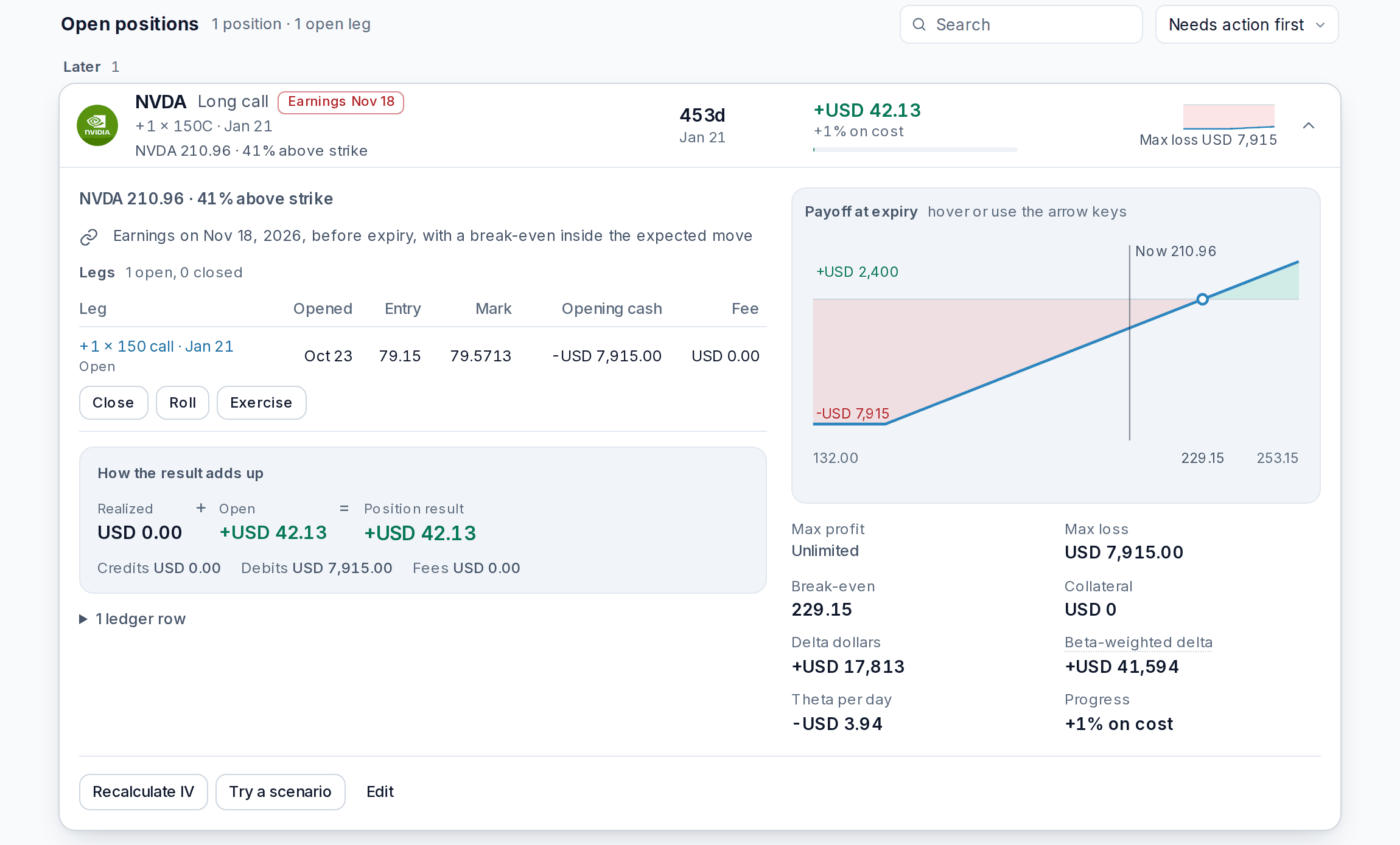
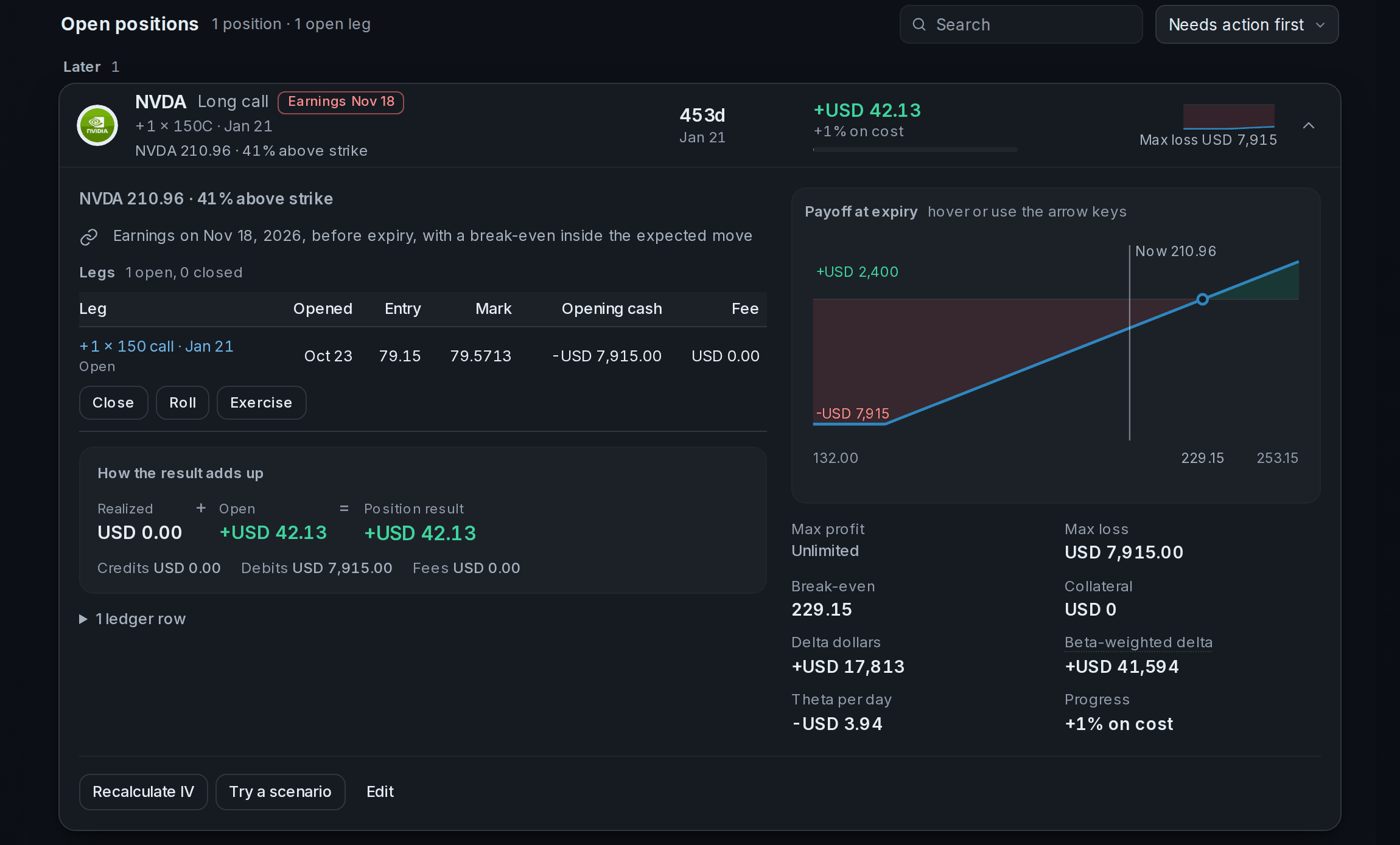
Each position shows the days to expiry, how far the stock is above or below the strike, and the open result against what you paid. Expand it for the payoff at expiry, the break-even and the Greeks.
Delta dollars, beta-weighted delta and daily theta
Earnings before expiry flagged on the position
Close, roll or exercise legs you enter yourself, and try a scenario
Every closed option's result kept for the tax report
AllInvestViewThe NVIDIA January 2028 $150 call in the options book, a demo position staged with the 23 October prices and viewed on 25 October.View full-size View full-size
Every broker in one place
See what your LEAPS really made
LEAPS, spreads, covered calls, shares, ETFs, bonds and dividends on one dashboard, synced from your brokers or imported from a file, with every closed trade's result kept.
Days to expiry and time decay on every option Greeks and scenarios on every position 14-day free trial, no card required
LEAPS are options that expire more than a year away. The name stands for Long-term Equity AnticiPation Securities, and Cboe first listed them in 1990. They work like any other call or put, just with more time: on 23 October 2026, NVIDIA's 21 January 2028 $150 call cost $7,915, against $21,096 for 100 shares.
How long do LEAPS options last?
Equity LEAPS have traditionally expired in January, and many chains also have June or December expiries more than a year out, which work the same way. On 23 October 2026 NVIDIA's furthest expiry was 19 January 2029, about 27 months away.
Are LEAPS better than buying the shares?
They tie up less money and cap the loss at what you paid, but they cost time value and get no dividends. If NVIDIA ends at or above $150, the $150 call trails 100 shares by $1,944 at expiry, its $1,819 of time value plus $125 of dividends. Above $240.82 it makes the bigger percent of the money in; at or below $150, all $7,915 is gone.
What strike should you pick for a LEAPS call?
For a LEAPS that stands in for shares, a common choice is deep in the money, with a delta around 0.80. On NVIDIA's January 2028 calls that was the $150 to $160 strikes: $18.19 to $20.89 a share of time value and a breakeven 8.6% to 9.9% above the price. The at-the-money $210 call cost less but needed NVIDIA up 19.8% just to break even.
When should you sell or roll a LEAPS?
Many holders sell or roll with six to twelve months left, because time value goes fastest at the end. If NVIDIA stays at $210.96, the at-the-money January 2028 $210 call still has $17.57 of its $41.54 of time value with three months left, and loses it all in those three months. Rolling means selling the call and buying a later one.
Do LEAPS pay dividends?
No. Dividends go to shareholders, and a call's price already allows for the ones expected before expiry. NVIDIA pays $0.25 a quarter, about $125 per 100 shares before January 2028. Exercising early to catch one only makes sense when the call's time value left is smaller than the dividend.
Can you buy LEAPS on margin?
Under FINRA Rule 4210, a listed option with more than nine months to expiry can be bought with at least 75% of its value down; at nine months or less it must be paid in full. For the NVIDIA $150 call that's at least $5,936 of the $7,915. Many brokers ask for more.
How are LEAPS taxed in the US?
Selling a LEAPS gives a capital gain or loss, long-term if you held it more than a year. If it expires worthless, the loss is taken on the expiry date. If you exercise a call, what you paid for it goes into the shares' cost and their holding period starts the day after exercise. Options on a broad-based index such as SPX are section 1256 contracts, taxed 60% long-term and 40% short-term.
NVIDIA and SPY closing prices and option quotes (bid and ask) at the 23 October 2026 close; NVIDIA daily closes from October 2006
Costs use the ask for options bought, before commissions. Deltas, time decay and every value before expiry come from AllInvestView's Black-Scholes engine with a 3.94% rate, a 0.47% dividend yield for NVIDIA ($0.25 a quarter over $210.96) and each option's volatility solved from its midpoint price, held fixed (46.4% for the $150 call, 41.4% for the $210 call). The shares' results add five $0.25 dividends. Fifteen-month moves are NVIDIA's price change over each overlapping stretch of 313 trading days, using closes adjusted for splits and dividends.
This guide explains how LEAPS work; it isn't advice to buy them.

 AllInvestView