Cash-Secured Put Calculator
Calculate your CSP premium income, breakeven, and annualized return. Selling 1 put at the $50 strike for $1.50 collects $150 and sets aside $5,000: 36.5% a year if it expires, or the shares cost you a net $48.50 each if assigned.
At expiry
Fix the highlighted field to update these numbers.
Premium you collect now
If it expires worthless
If assigned at $50
- Cash required
- $5,000.00Strike × 100 per contract
- Breakeven
- $48.50Strike less the premium
- Downside cushion
- 6.7%drop before you lose
- Chance of assignment
- If the stock went to $0
- −$4,850.00
Profit or loss at expiry
Price scenarios
| Price at expiry | Cash-secured put | Shares bought now |
|---|---|---|
| $62.40+20.0% | +$150.003.0% | +$1, |
| $57.20+10.0% | +$150.003.0% | +$520.0010.0% |
| $54.60+5.0% | +$150.003.0% | +$260.005.0% |
| $52.00today | +$150.003.0% | $0.000.0% |
| $50.00−3.8%, strike | +$150.003.0% | −$200.00−3.8% |
| $48.50−6.7%, breakeven, assigned | $0.000.0% | −$350.00−6.7% |
| $46.80−10.0%, assigned | −$170.00−3.4% | −$520.00−10.0% |
| $41.60−20.0%, assigned | −$690.00−13.8% | −$1, |
Compare puts
Save this put, then change the strike, premium or expiry to see up to three puts on the same stock side by side.
Figures are at expiry and before taxes. Returns are on the cash you set aside, the strike times 100 shares per contract. Annualized returns scale the period return by 365 divided by the days to expiry, without compounding. The chance of assignment is a Black-Scholes estimate from the volatility you enter, not a forecast, and early assignment isn't modeled. Not investment advice.
If you're assigned: the wheel, with your numbers
The put above is the first step of the wheel. Follow it through assignment and a covered call, and watch what each share costs you come down with every premium.
What each share costs you
The whole cycle
Sell the put
+$150.00Sell 1 put at the $50 strike for $1.50 a share and set aside $5,000.
Get assigned
100 sharesThe stock ends below $50, so you buy the shares for $5,000, a net $48.50 a share after the premium.
Sell a covered call
+$120.00Sell 1 call at the $53 strike for $1.20 a share, 30 days out.
Get called away
+$570.00The stock ends above $53, so the shares sell for $5,300 and the cycle is done.
What each share costs you is the strike less every premium collected so far. For taxes, only the assigned put's premium lowers the shares' cost basis, which is what the wheel view shows; call premiums count on their own.
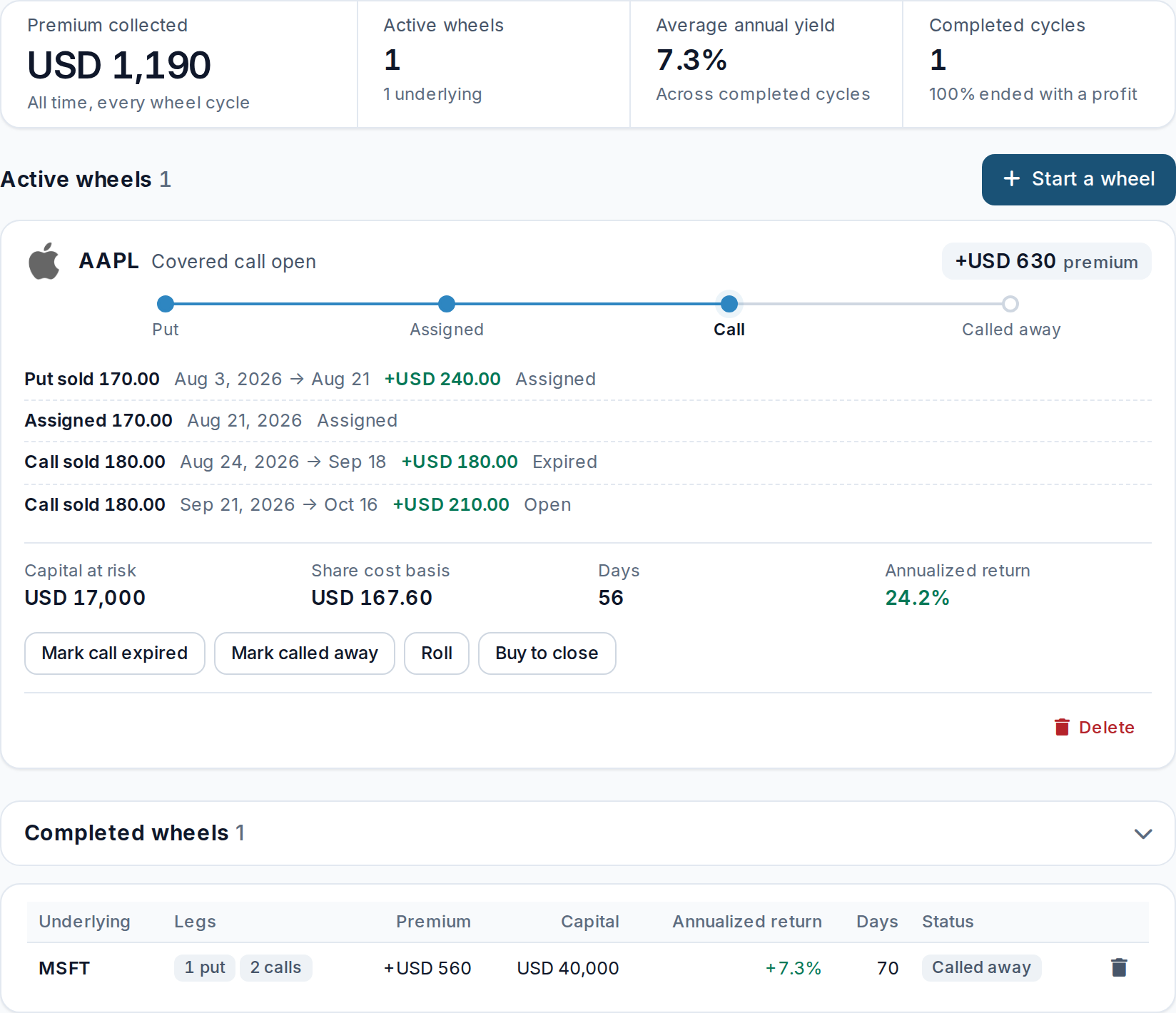
Sold the put? Add it or sync your broker, start a wheel from it, and AllInvestView keeps every premium, the stage and the cost basis together.
Start your free trial14-day free trial, no card required.
What Is a Cash-Secured Put?
A cash-secured put (CSP) is an options strategy where you sell a put option while holding enough cash in your account to buy the stock if you get assigned. For each put contract sold, you need cash equal to the strike price multiplied by 100 shares.
When you sell a cash-secured put, you receive premium income immediately. In return, you take on the obligation to buy 100 shares at the strike price if the stock falls below the strike at expiration. This strategy is popular among investors who:
- Want to buy a stock at a lower price and get paid to wait for it to drop to their target entry
- Seek income from idle cash by collecting premiums on stocks they would be happy to own
- Run the wheel strategy, which starts with selling CSPs as the first step in a systematic income cycle
- Are moderately bullish and believe the stock will stay above the strike price through expiration
The key advantage of a cash-secured put over simply buying the stock is that you get paid premium regardless of whether you are assigned. If the stock stays above the strike, you keep the premium as pure profit and can sell another put.
How to Calculate CSP Returns
Understanding the numbers behind cash-secured puts helps you compare opportunities and manage risk effectively.
Cash-Secured Put Formulas
DTE = Days to Expiration. The denominator uses Strike Price (not stock price) because that is the capital at risk as collateral.
Example: The stock trades at $52 and you sell a $50 put for $1.50 premium with 30 days to expiration.
- Max Profit: $1.50 × 1 × 100 = $150
- Breakeven: $50 - $1.50 = $48.50
- Cash Required: $50 × 100 = $5,000
- Assignment Cost Basis: ($50 - $1.50) × 100 = $4,850
- Annualized Return: ($1.50 / $50) × (365 / 30) × 100 = 36.5%
Understanding Assignment Risk
If the stock drops significantly below the strike, you will be assigned and forced to buy shares at the strike price, which may be well above the market price. Your maximum loss is (Strike Price - Premium) per share, which occurs if the stock goes to zero. Always sell puts only on stocks you genuinely want to own at the strike price.
Why Use Our CSP Calculator?
AllInvestView provides everything you need to analyze and track cash-secured put positions.
Premium Calculator
Calculate your income from selling puts at different strike prices and expirations. Save up to three puts on the same stock and compare their premium, cash and returns side by side.
Assignment Risk Analysis
See exactly what happens if you get assigned. Know your effective cost basis, cash requirements, and how much downside you are exposed to before entering the trade.
Cost Basis Tracking
If assigned, your cost basis is the strike price minus premium received. When an assigned put is booked in AllInvestView, the shares carry that reduced cost basis.
Wheel Integration
Cash-secured puts are step 1 of the wheel strategy. The Wheel Strategy tracker follows each cycle: sell put, get assigned, sell covered call, get called away, and repeat.
How It Works
Analyze and track your cash-secured puts in three simple steps.
Enter Strike & Premium
Enter the stock price, strike, premium received, contracts and days to expiry. The results update as you type.
See Profit/Loss Scenarios
View max profit, breakeven, assignment cost, and annualized return. Understand your risk profile before committing your capital.
Track the Full Lifecycle
Add the put to your portfolio or sync it from a supported broker. If you are assigned, carry on with covered calls in the Wheel Strategy tracker.
Related Options Tools & Guides
Deepen your understanding with these related resources.
Frequently Asked Questions
You need enough cash to purchase 100 shares at the strike price per contract. For example, selling one put with a $50 strike requires $5,000 in cash collateral. This cash is held by your broker and cannot be used for other trades while the put is open. The premium you receive does not reduce the cash requirement, though it is immediately credited to your account.
Your breakeven is the strike price minus the premium received. Below this price, you start losing money if assigned. For example, selling a $50 put for $2.00 gives you a breakeven of $48.00. As long as the stock stays above $48.00, even if you get assigned, your position is not at a loss because the premium offsets the difference between strike and market price.
Assignment means you are obligated to buy 100 shares per contract at the strike price. Your cash collateral is used to purchase the shares. Your effective cost basis is the strike price minus the premium you originally received. Many CSP sellers view assignment as a positive outcome since they picked a stock and price they wanted. After assignment, you can begin selling covered calls against the shares to continue generating income.
Annualized return on a CSP is (Premium / Strike Price) × (365 / DTE) × 100. The strike price is used as the denominator because it represents the capital tied up as collateral. This formula lets you compare puts with different expirations on an equal basis. A 30-day put with 3% return annualizes to 36.5%, while a 60-day put with the same 3% annualizes to only 18.25%.
The wheel strategy is a systematic income generation cycle that starts with cash-secured puts. You sell a CSP on a stock you want to own. If it expires worthless, you keep the premium and sell another put. If you get assigned, you take ownership of the shares and sell a covered call against them. If the covered call expires worthless, you sell another one. If you get called away, you go back to selling puts. AllInvestView's Wheel Strategy tracker keeps the puts, the assignment and the covered calls of each cycle together, with the premium collected, the share cost basis and the annualized return, and expired legs move the cycle forward on their own.
Explore More Options Tools & Guides
All options tools in one place
Track trades, Greeks & P&L
Calls, puts & Greeks explained
Delta, Gamma, Theta & Vega
Visualise profit & loss
CSP → assignment → covered calls
Income strategy analysis
Entry strategy analysis
Complete wheel walkthrough
AAPL, TSLA, NVDA & 50 more
Track your puts and the wheel they start
Add your cash-secured puts or sync them from your broker. AllInvestView keeps each one with its premium, its expiry and, if you are assigned, the shares and the calls that follow.
14-day free trial, no card required.