Free municipal bond calculator

Tax-Equivalent Yield Calculator: What a Muni Bond Is Really Worth

Tax-equivalent yield = tax-free yield / (1 - your tax rate). A muni yielding 3.50% is worth 5.15% to someone in the 32% federal bracket: that is what a taxable bond or CD has to pay to leave them the same. On November 17, 2026 the 10-year Treasury yielded 5.10%, so in the 32% bracket, with the 3.8% net investment income tax, a muni from your state matched it at 3.27%. Enter your own yield, bracket and state tax below.

Federal, state and 3.8% NIIT In-state or out-of-state munis Against a CD, a corporate bond or a Treasury

Your municipal bond

The bond's yield to maturity, or a fund's 30-day SEC yield
Optional, to see what each yield earns in dollars
Federal tax bracket
The rate on your last dollar of taxable income. 2026 brackets
Use 0 for a state with no income tax
The bond is from
Your state usually exempts its own bonds
Compare with today's Treasury
Pick the maturity closest to your bond's
Tax-equivalent yield
5.91%
is what a CD or corporate bond, taxed federally and by your state, has to yield to leave you as much as this muni
A Treasury must yield5.45%no state tax on Treasury interest
Your tax on taxable interest40.80%32% + 5% + 3.8%
Muni earns a year$3,500.00at this yield, tax-free
Taxable bond must earn$5,912.16a year, before tax, at that yield

The muni yield that matches today's Treasuries

US Treasury yields on November 17, 2026, and the yield a muni from your own state needs to leave you as much after tax in each bracket. A muni that yields more pays you more. Tap a row to compare with it in the calculator.

TreasuryYield22%24%32%+ NIIT35%+ NIIT37%+ NIIT
1-year 4.60% 3.59%3.50%2.95%2.82%2.72%
2-year 4.80% 3.74%3.65%3.08%2.94%2.84%
5-year 4.90% 3.82%3.72%3.15%3.00%2.90%
10-year 5.10% 3.98%3.88%3.27%3.12%3.02%
20-year 5.50% 4.29%4.18%3.53%3.37%3.26%
30-year 5.46% 4.26%4.15%3.51%3.34%3.23%
Muni yield = Treasury yield x (1 - federal rate - NIIT). State tax drops out because neither a Treasury nor a muni from your state pays it. From the 32% bracket up every filer's income is above the NIIT thresholds, so those columns (+ NIIT) include the 3.8%.

How tax-equivalent yield is worked out

Three formulas, depending on what you compare the muni with and where it was issued.

The formulas

Against a CD, a corporate bond or a Treasury

Muni from your state vs a CD or corporate bond
TEY = yield / (1 - federal - state - NIIT)
3.50 / (1 - 0.32 - 0.05 - 0.038) = 5.91%

Muni from another state
TEY = yield x (1 - state) / (1 - federal - state - NIIT)
3.50 x 0.95 / 0.592 = 5.62%

Muni from your state vs a Treasury
T = yield / (1 - federal - NIIT)
3.50 / 0.642 = 5.45%

Each one divides what the muni leaves you after tax by what a dollar of the other bond's interest leaves you. With a 32% bracket, a 5% state tax and the NIIT, a 3.50% muni from your state is worth 5.91% in a CD, 5.62% if it came from another state, and 5.45% in a Treasury, whose interest your state does not tax.

Turn it around to find your break-even: a muni from your state pays off when its yield is above the taxable yield x (1 - your tax rate on that taxable yield).

Taxes

What a muni saves you, and what it does not

TaxMuni, your stateMuni, other stateTreasuryCD, corporate
Federal income taxNoNoYesYes
3.8% NIITNoNoYesYes
State and localUsually noUsually yesNoYes

The exemption covers the interest only. A gain when you sell or redeem a muni is taxed, and a muni bought well below its face value can turn part of that gain into ordinary income. Interest on private activity bonds can count toward the alternative minimum tax, so a muni fund that holds them is worth a little less to someone who pays AMT.

You still report tax-exempt interest, on Form 1040 line 2a, and it counts when working out how much of your Social Security benefits is taxed.

2026 federal brackets

Which bracket you are in

RateSingle, taxable income overMarried filing jointly, over
10%$0$0
12%$12,400$24,800
22%$50,400$100,800
24%$105,700$211,400
32%$201,775$403,550
35%$256,225$512,450
37%$640,600$768,700

Use the rate on your last dollar of taxable income, after deductions: that is the rate the next dollar of taxable interest would pay. IRS Revenue Procedure 2025-32.

For the bonds you actually own

Every muni, Treasury and corporate bond, with its yield and the day the cash comes back

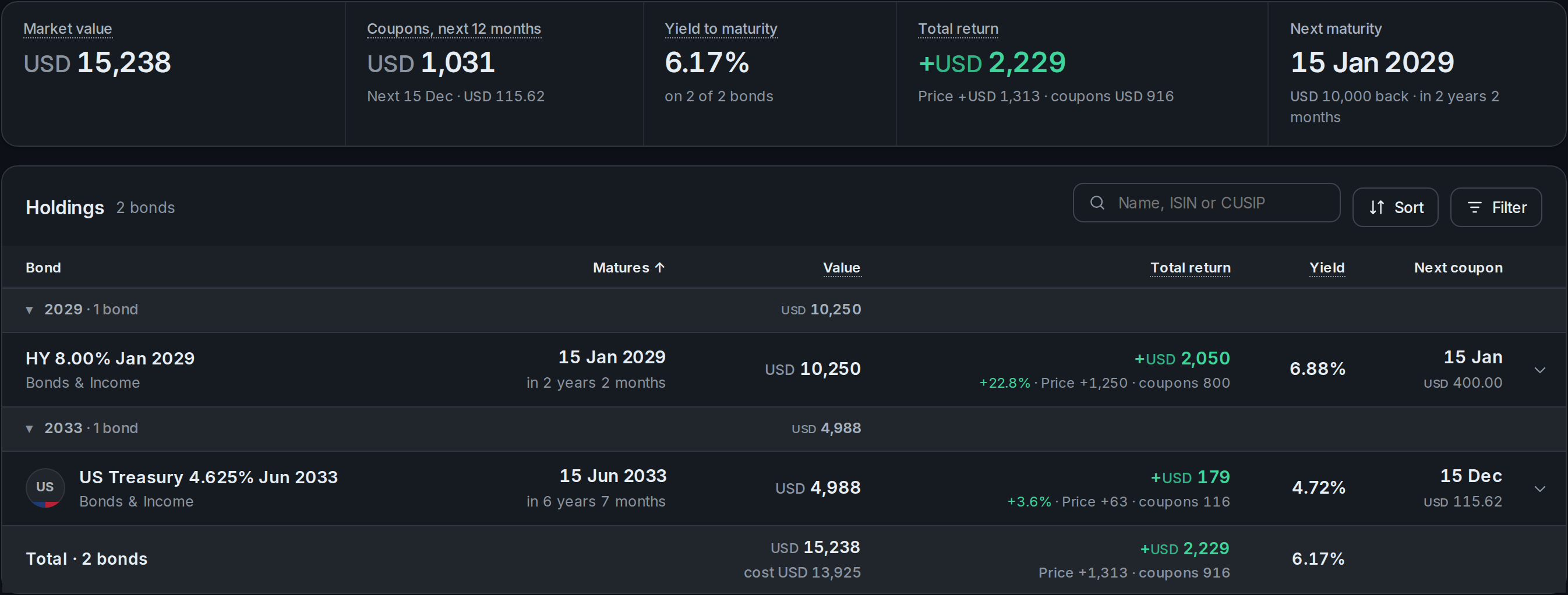
Holding munis next to Treasuries and corporates? Sync your broker or import your history, and AllInvestView lists each bond with its yield to maturity, its value and its maturity date, grouped by type. The strip on top adds up the market value, the coupons due in the next 12 months, the yield of the whole book and the next maturity. Muni funds sit with your stocks and ETFs, with every dividend they pay.

See the bond tracker

AllInvestView AllInvestView bond report: market value USD 15,238, coupons in the next 12 months USD 1,031, yield to maturity 6.17% on 2 of 2 bonds, total return +USD 2,229, next maturity 15 Jan 2029; holdings HY 8.00% Jan 2029 at 6.88% and US Treasury 4.625% Jun 2033 at 4.72% AllInvestView bond report: market value USD 15,238, coupons in the next 12 months USD 1,031, yield to maturity 6.17% on 2 of 2 bonds, total return +USD 2,229, next maturity 15 Jan 2029; holdings HY 8.00% Jan 2029 at 6.88% and US Treasury 4.625% Jun 2033 at 4.72%
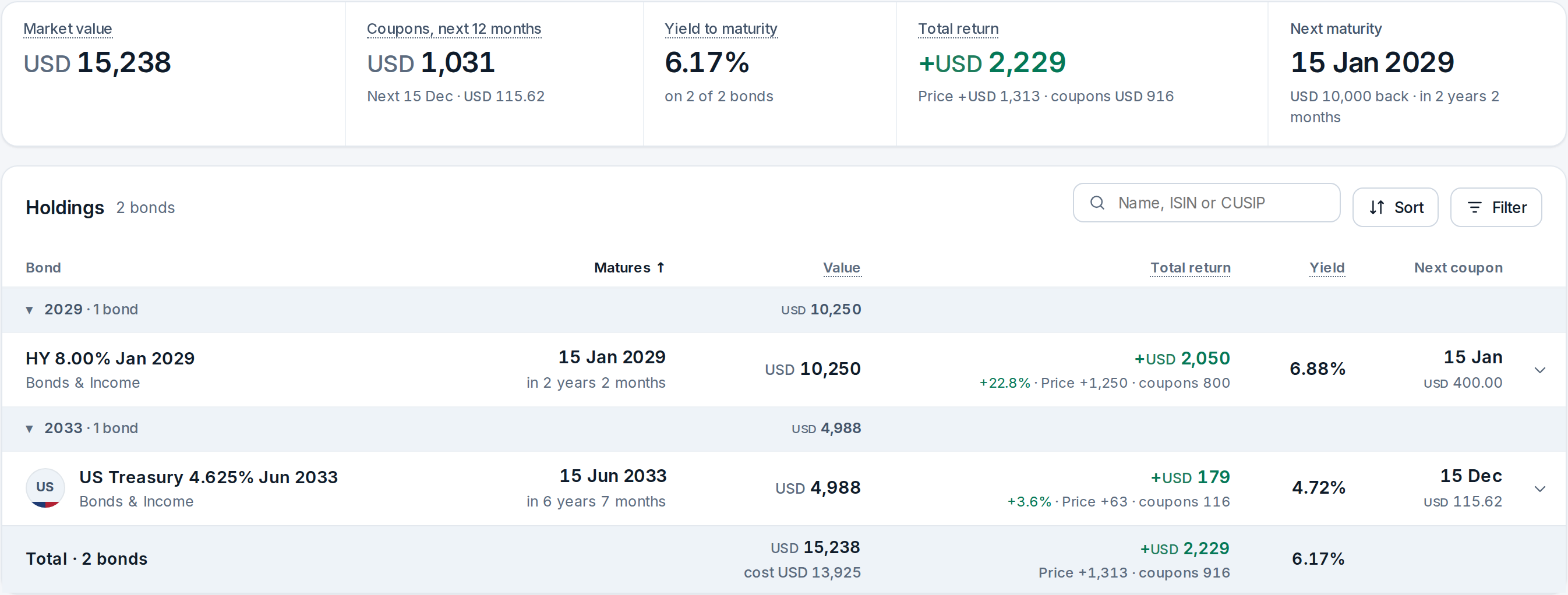
The bond report on a demo book of two example bonds.View full-size View full-size
Your own portfolio

See your munis next to everything else you own

Connect your broker or import your trades, and AllInvestView tracks your municipal, Treasury and corporate bonds with their yields and maturities, alongside your stocks, funds and cash.

Yield and maturity on every bond Coupons due and next maturity at a glance Stocks, ETFs, funds, bonds and crypto

Tax-equivalent yield questions

How do you calculate tax-equivalent yield?

Divide the tax-free yield by one minus your tax rate: TEY = muni yield / (1 - tax rate). A muni yielding 3.50% is worth 3.50 / (1 - 0.32) = 5.15% to someone in the 32% federal bracket, so a taxable bond or CD would have to yield 5.15% to leave them the same. Add your state tax rate for a muni from your own state, and the 3.8% net investment income tax if your income is above $200,000 single or $250,000 joint.

Are municipal bonds tax free?

The interest on most municipal bonds is exempt from federal income tax and from the 3.8% net investment income tax. Your state usually exempts its own bonds and taxes other states' bonds; a few states differ, and bonds from Puerto Rico, Guam and the other territories are exempt in every state. Interest on private activity bonds can count for the alternative minimum tax. Capital gains are taxed like any others, and you still report the tax-exempt interest on your return, where it counts toward the taxable share of Social Security benefits.

Is a muni better than a Treasury?

Treasury interest is taxed federally but not by your state, so compare the two after federal tax only when the muni is from your own state. On November 17, 2026 the 10-year Treasury yielded 5.10%. In the 32% bracket, where the 3.8% net investment income tax also applies to taxable interest, a muni from your own state matched it at 3.27%: anything above that left you more after tax.

At what tax bracket do municipal bonds make sense?

For a muni from your state, when its yield is more than the taxable yield times one minus your tax rate on that taxable yield. The ratio of a muni's yield to a Treasury's of the same maturity tells you the break-even: a muni from your state at 70% of the Treasury yield pays off for anyone whose federal rate, plus the 3.8% NIIT if it applies, is above 30%. A muni from another state, which your state taxes, needs a higher ratio. In the 10% and 12% brackets a taxable bond almost always leaves you more.

How do state taxes change the tax-equivalent yield?

For a muni from your state, which your state does not tax, add the state rate to the federal rate: TEY = yield / (1 - federal - state). For a muni from another state, your state taxes the interest like a corporate bond's, so only the federal saving counts: TEY = yield x (1 - state) / (1 - federal - state). In a state with no income tax the two are the same.

Does this work for muni bond funds?

Yes, with the fund's 30-day SEC yield as the tax-free yield. A national muni fund holds bonds from many states, so only the share from your own state is free of state tax; the fund publishes that share each year. Its income is paid as exempt-interest dividends, in box 12 of Form 1099-DIV, and its capital gain distributions are taxed.

About the numbers

The calculator works in your browser; nothing is saved or sent. It uses the rates you enter, not your full tax return, and leaves out the federal deduction for state and local taxes, which only helps if you itemize and are under the cap. Treasury yields are the US Treasury's daily par yield curve rates, stored each business day; a bond you buy gets its own price. Brackets: IRS Revenue Procedure 2025-32. Net investment income tax: IRS. Tax-exempt interest and private activity bonds: IRS Publication 550.