Free Treasury bill calculator

T-Bill Calculator: What a Treasury Bill Costs and Pays

A T-bill pays no coupon: you buy it for less than its face value and get the full face value back when it matures. On November 17, 2026 a 26-week bill yielded 4.41%, so $10,000 of face value cost $9,784.84 and paid $215.16 of interest 182 days later. Enter your own amount, term and rate below.

4- to 52-week bills, or any days From the yield, discount rate or price After-tax match for a CD or savings account

Your Treasury bill

Term

A bill that would mature on a holiday matures the next business day, so it can run a day longer. Change the date to match your bill, or set any date for a bill you buy from a broker.

I know the

T-bill interest is taxed federally but not by your state or city. Use 0 for a state with no income tax.

You pay
$9,784.84
and get $10,000.00 back 182 days later
Interest at maturity$215.16the discount you bought at
Yield4.410%investment rate, 365-day year
Discount rate4.256%on face value, 360-day year
Price per $10097.8483554.46% a year if rolled at this rate

Today's T-bill yields

US Treasury bill yields on November 17, 2026, with what $10,000 of face value bought that day would cost and pay. Tap a bill to put it in the calculator.

BillYield1 month ago1 year agoPrice per $100$10,000 paysA year rolled
4-week28 days 4.09% 4.12% 4.04% 99.6872 $31.28 4.17%
6-week42 days 4.18% 4.15% 4.03% 99.5219 $47.81 4.25%
8-week56 days 4.26% 4.17% 4.01% 99.3507 $64.93 4.34%
13-week91 days 4.33% 4.26% 3.97% 98.9320 $106.80 4.40%
17-week119 days 4.32% 4.32% 3.87% 98.6111 $138.89 4.38%
26-week182 days 4.41% 4.34% 3.81% 97.8484 $215.16 4.46%
52-week364 days 4.60% 4.46% 3.69% 95.5657 $443.43 4.65%
Yields are the Treasury's daily bill rates on a bond-equivalent basis; the 6-week figure is the midpoint of the 1- and 2-month rates. "A year rolled" is the yield, compounded, if you reinvested at the same rate each time the bill matured.

How a T-bill's price and yield are worked out

One price, quoted two ways, and one tax rule that changes the comparison with a bank.

The formulas TreasuryDirect uses

Discount rate and investment rate

Price = 100 x (1 - discount rate x days / 360)
100 x (1 - 0.042 x 182 / 360) = 97.876667

Yield = (100 - price) / price x 365 / days
2.123333 / 97.876667 x 365 / 182 = 4.351%

That is the 26-week bill auctioned on October 13, 2026: a 4.200% discount rate, a price of $97.876667 per $100 and a 4.351% investment rate. The calculator gives the same figures.

Quoted asDivides the interest byYearOct 13 bill
Discount rateface value360 days4.200%
Investment rateprice paid365 days4.351%

Use the investment rate to compare a bill with a CD, a savings account or a note. For the 52-week bill, which runs longer than half a year, Treasury solves a short quadratic instead, and in a year with a February 29 it counts 366 days. The calculator does both.

Taxes

Why a bill can beat a CD with a higher rate

The interest on a T-bill is taxed federally but is exempt from state and local income tax. A CD or savings account is taxed by both. To leave you the same after tax, the bank has to pay:

Bank APY = bill APY x (1 - federal) / (1 - federal - state)
4.24% x 0.78 / 0.73 = 4.53%

So with a 22% federal bracket and a 5% state tax, a 26-week bill yielding 4.20%, which is 4.24% a year if you keep rolling it, matches a bank paying about 4.53% APY. In a state with no income tax the two are even. The formula leaves out the federal deduction for state taxes, which only helps if you itemize.

Held to maturity, the whole discount is interest, taxed in the year the bill matures and reported on Form 1099-INT. Sell before then and your gain, up to the discount earned so far, is ordinary income; a gain beyond that, or a loss, is a capital gain or loss.

For the bills you actually own

Every bill and bond, with its yield and the day the cash comes back

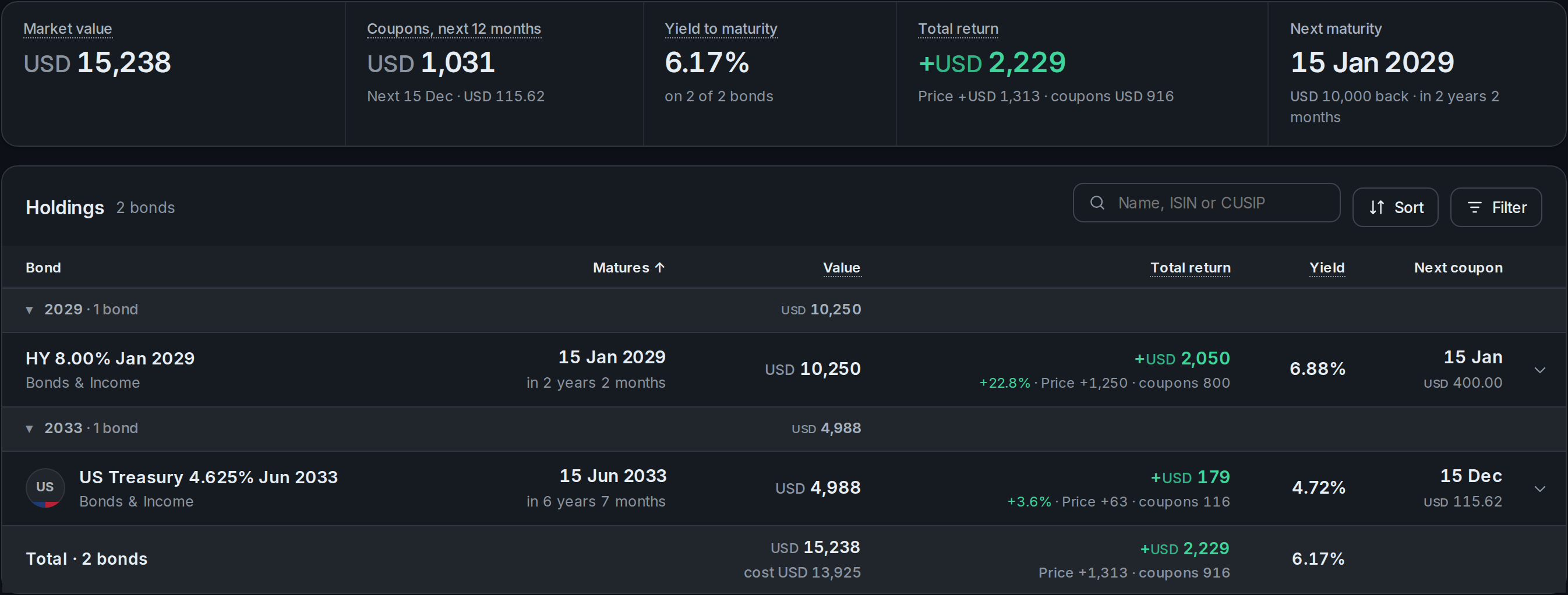
Holding a few bills at a broker and rolling them by hand? Sync your broker or import your history, and AllInvestView lists each bill and bond with its yield to maturity, its value and its maturity date. The strip on top adds up the market value, the coupons due in the next 12 months, the yield of the whole book and the next maturity. Bonds and bills are grouped by the year they mature, next to your stocks and funds.

See the bond tracker

AllInvestView AllInvestView bond report: market value USD 15,238, coupons in the next 12 months USD 1,031, yield to maturity 6.17% on 2 of 2 bonds, total return +USD 2,229, next maturity 15 Jan 2029; holdings HY 8.00% Jan 2029 at 6.88% and US Treasury 4.625% Jun 2033 at 4.72% AllInvestView bond report: market value USD 15,238, coupons in the next 12 months USD 1,031, yield to maturity 6.17% on 2 of 2 bonds, total return +USD 2,229, next maturity 15 Jan 2029; holdings HY 8.00% Jan 2029 at 6.88% and US Treasury 4.625% Jun 2033 at 4.72%
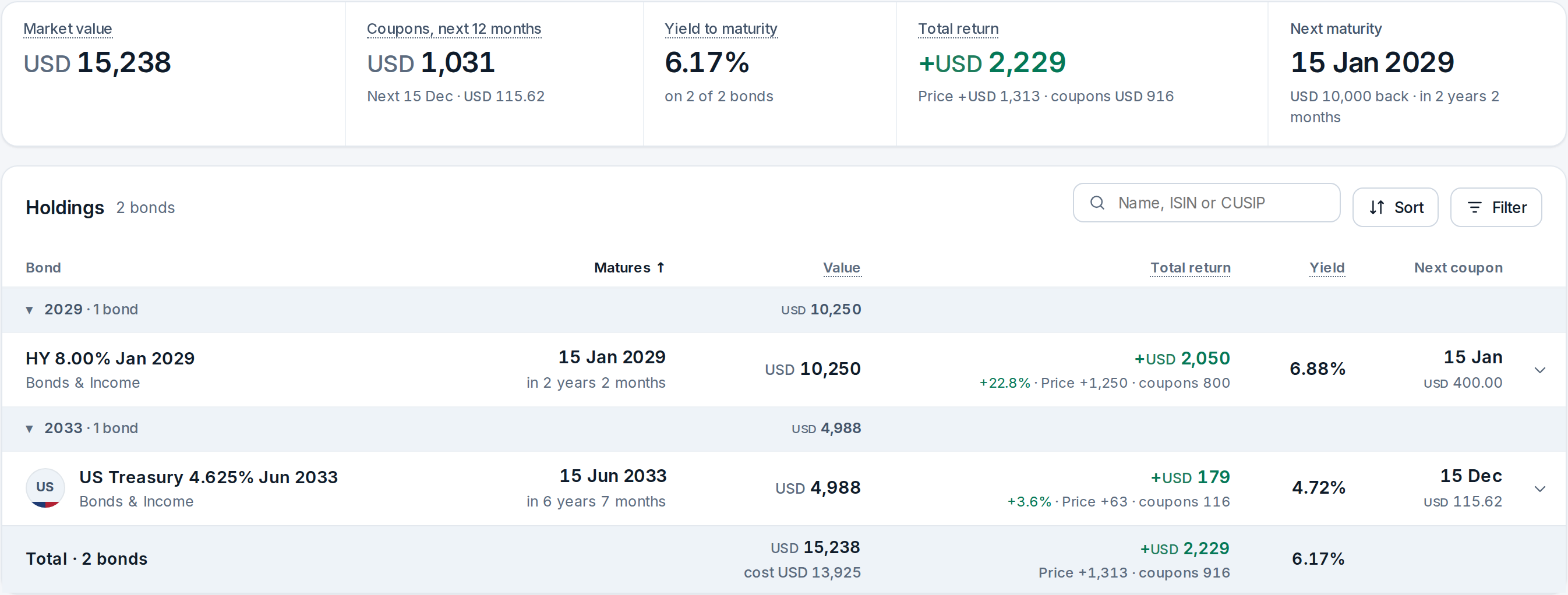
The bond report on a demo book of two example bonds.View full-size View full-size
Your own portfolio

See your T-bills next to everything else you own

Connect your broker or import your trades, and AllInvestView tracks your bills, notes and bonds with their yields and maturities, alongside your stocks, funds and cash.

Yield and maturity on every bond Market value, coupons and next maturity at a glance Stocks, ETFs, funds, bonds and crypto

T-bill questions

How do you calculate the interest on a T-bill?

A Treasury bill pays no coupon. You buy it below face value and get the full face value back at maturity; the difference is your interest. Price per $100 = 100 / (1 + yield x days / 365) for bills of up to half a year. A 26-week bill at 4.2% costs 100 / (1 + 0.042 x 182 / 365) = $97.9487 per $100, so $10,000 of face value costs $9,794.87 and earns $205.13.

How much does a $10,000 T-bill pay?

On November 17, 2026 a 26-week bill yielded 4.41%. $10,000 of face value cost $9,784.84 and paid back $10,000 at maturity 182 days later, so it earned $215.16. A 4-week bill at 4.09% earned $31.28 on the same $10,000.

What is the difference between the discount rate and the investment rate?

The discount rate is the discount as a share of face value over a 360-day year: (100 - price) / 100 x 360 / days. The investment rate, also called the bond equivalent or coupon equivalent yield, is the interest as a share of what you paid over a 365-day year. The investment rate is always the higher of the two and is the one to compare with a CD, a savings account or a note's yield. TreasuryDirect shows both for every auction.

Are T-bills taxed?

The interest is subject to federal income tax but exempt from state and local income tax. It is taxed in the year the bill matures or you sell it, not while you hold it. At maturity the whole discount is interest, reported on Form 1099-INT; on a sale before then, your gain up to the discount earned so far is ordinary income, and a gain beyond that, or a loss, is a capital gain or loss. That state exemption is why a CD or savings account taxed by your state has to pay more than a bill to leave you the same; the calculator works out how much more.

How do I buy T-bills?

At auction through TreasuryDirect.gov, in multiples of $100 from $100, or through a brokerage account, which can also buy bills already trading. 4-, 6-, 8-, 13-, 17- and 26-week bills are auctioned every week and the 52-week bill every four weeks. Most individual buyers place a non-competitive bid and get the rate set at the auction.

Is a T-bill or a high-yield savings account better?

Compare the bill's yield, compounded the way a savings account's APY is, after taxes. A bill locks today's rate until it matures and is backed by the US government, but you have to sell it or wait for maturity to get the cash; a savings account can change its rate any day but pays out at once. In a state with income tax, the bill's state exemption counts: with a 22% federal bracket and a 5% state tax, a 26-week bill yielding 4.20% (4.24% a year if you keep rolling it) leaves you as much as a savings account paying about 4.53% APY.

About the numbers

The calculator works in your browser; nothing is saved or sent. Prices follow the formulas on TreasuryDirect and are rounded to six decimals per $100, as Treasury does; we checked them against the published results of every bill auction issued June 2023 to March 2024 and July to October 2026. The yields above are the US Treasury's daily par yield curve rates for bills, stored each business day; a bill you buy at auction or from a broker gets its own rate, which can differ by a few hundredths. The after-tax comparison uses the brackets you enter, not your full tax return. Tax treatment: IRS Publication 550.