Free savings bond calculator

Savings Bond Calculator: What Your EE and I Bonds Are Worth

Every savings bond has an official cash-in value that goes up on the first of the month. In November 2026 a $100 EE bond bought in January 2000 for $50 is worth $124.64, and a $1,000 I bond bought in January 2020 is worth $1,310.00. Any EE or I bond issued in November 1996 or earlier has stopped earning interest, and so has every Series E bond. Enter what's printed on your bond below.

Series EE, I, E and savings notes Treasury's own values, January 2025 to May 2027 Stopped earning? 5-year penalty? It tells you

Your bond

Series
Kind
Issue date

Treasury publishes values six months ahead, so you can see what the bond will be worth if you wait.

Have a stack? Add each one and see the total.
Worth in November 2026
$124.64
You paid $50.00, so it has earned $74.64 of interest
Earns interest untilJanuary 2030its 30-year final maturity
Last 12 months–growth in its cash-in value
Next increase– 
Interest this year–since December 31

Has your bond stopped earning?

A savings bond stops growing at final maturity. After that it is worth the same every month, so holding it gains nothing.

Final maturity

When each series stops

SeriesIssuedEarns forStopped if issued
EE1980 on30 yearsNovember 1996 or before
I1998 on30 yearsnone yet; the first reach 30 years in September 2028
EMay 1941 to Nov 196540 yearsall, by Nov 2005
EDec 1965 to Jun 198030 yearsall, by Jun 2010
Savings notes1967 to 197030 yearsall, by Oct 2000

The calculator shows the month your bond stopped. A matured bond keeps its value and you can still cash it at any time, but there's no reason to wait. The interest becomes taxable for the year the bond matured if you haven't reported it already, whether you cash it or not.

Treasury's count, September 30, 2026

Millions of bonds nobody has cashed

103.1 million paper bonds

had stopped earning but had not been cashed, out of 268.4 million paper savings bonds still outstanding. Most are EE bonds (82,673,787) and Series E bonds (19,751,346).

Stopped earningStill earning

Found an old bond in a drawer, or inherited a few? Check each one above. Paper bonds can be cashed at many banks or by mail with Treasury's FS Form 1522.

The I bond rate: 5.51% for bonds bought November 2026 to April 2027

An I bond's rate has two parts: a fixed rate it keeps for 30 years, and an inflation rate that changes every six months.

How Treasury combines them

Fixed rate plus inflation

Rate = fixed + 2 x inflation + fixed x inflation
1.40% + 2 x 2.04% + 1.40% x 2.04% = 5.51%

The inflation rate is the change in the CPI-U over six months, which the formula doubles to a yearly figure. Treasury announces it each May 1 and November 1, and your bond switches to the latest one every six months from the month you bought it. The rate can't go below zero, even when prices fall.

So an older I bond earns its own rate now. The January 2020 bond in the example has a 0.20% fixed rate and earns 3.54% through December 2026. Pick an I bond in the calculator to see its rate.

Against Treasury yields, Nov 24, 2026

A new I bond against a Treasury

What you buyRateLocked for
New I bond5.51%6 months, then resets
1-year Treasury4.59%1 year
5-year Treasury4.69%5 years

Right now the I bond pays more than a Treasury for the next six months. After that its rate follows inflation, while the Treasury's rate is set for the whole term. The I bond can't be cashed for a year and costs three months of interest if you cash it before five; a Treasury can be sold any day at the market price.

Each person can buy up to $10,000 of electronic I bonds a year at TreasuryDirect.

The rate on a new I bond, 1998 to 2026

What a newly bought I bond earned for its first six months (blue) and the fixed rate it kept for life (amber, dashed), at each May and November announcement.

0%2%4%6%8%10% 1998200220062010201420182022 9.62%, May 2022 5.51% now
Rate for the first six monthsFixed rate, kept for 30 years

EE bonds: 2.90%, or about 3.53% if you wait 20 years

For EE bonds bought November 2026 to April 2027. The fixed rate is low, but Treasury guarantees the bond doubles at 20 years.

The 20-year step

Why an EE bond's value jumps

$1,000 at 2.90% for 20 years = about $1,779
Treasury tops it up to $2,000
2^(1/20) - 1 = 3.53% a year

Every EE bond bought since June 2003 is guaranteed to be worth twice its price at 20 years. If its interest hasn't got it there, Treasury adds the difference in a single step on the 20th anniversary. Cash it a month before and you get only the interest it has earned so far. Paper EE bonds from those years cost half their face value, so for them doubling means reaching the face value printed on the bond. The calculator shows the month your bond doubles.

Against a 20-year Treasury

Is a new EE bond worth it?

Only if you would hold it the full 20 years, and even then the 20-year Treasury yielded 5.33% on November 24, 2026, against the EE bond's 3.53%. The EE bond's pluses are that its value can never fall, the interest is tax deferred until you cash it, and it may be tax free for education costs.

EE bonds bought from May 1997 to April 2005 earn a variable rate, and the ones from before May 1997 follow older rules; their values in the calculator come straight from Treasury, so you don't need to work any of that out.

For the rest of your bonds

Treasuries, corporates and bond funds, with their yields and maturities

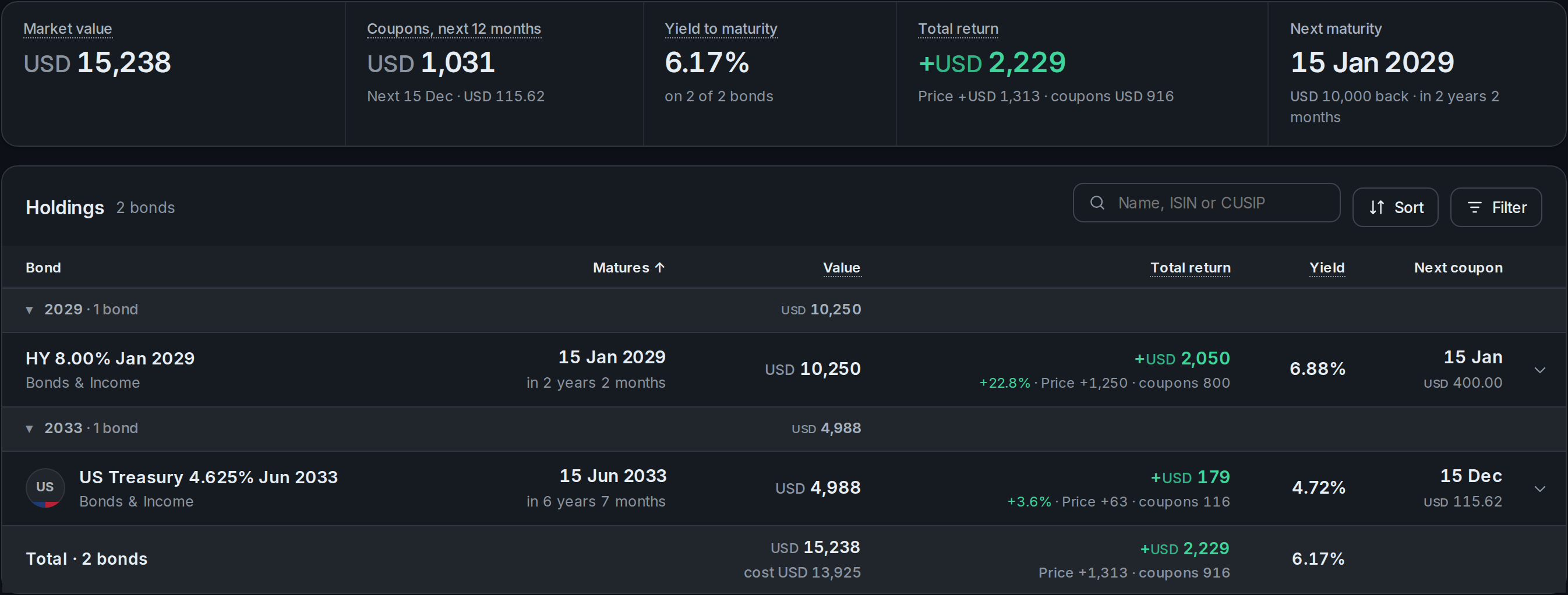
Savings bonds are only part of most people's fixed income. Sync your broker or import your history, and AllInvestView lists every Treasury, corporate bond and bond fund with its yield to maturity, its value and the day it pays back. The strip on top adds up the market value, the coupons due in the next 12 months, the yield of the whole book and the next maturity. Bonds are grouped by the year they mature, next to your stocks and funds.

See the bond tracker

AllInvestView AllInvestView bond report: market value USD 15,238, coupons in the next 12 months USD 1,031, yield to maturity 6.17% on 2 of 2 bonds, total return +USD 2,229, next maturity 15 Jan 2029; holdings HY 8.00% Jan 2029 at 6.88% and US Treasury 4.625% Jun 2033 at 4.72% AllInvestView bond report: market value USD 15,238, coupons in the next 12 months USD 1,031, yield to maturity 6.17% on 2 of 2 bonds, total return +USD 2,229, next maturity 15 Jan 2029; holdings HY 8.00% Jan 2029 at 6.88% and US Treasury 4.625% Jun 2033 at 4.72%
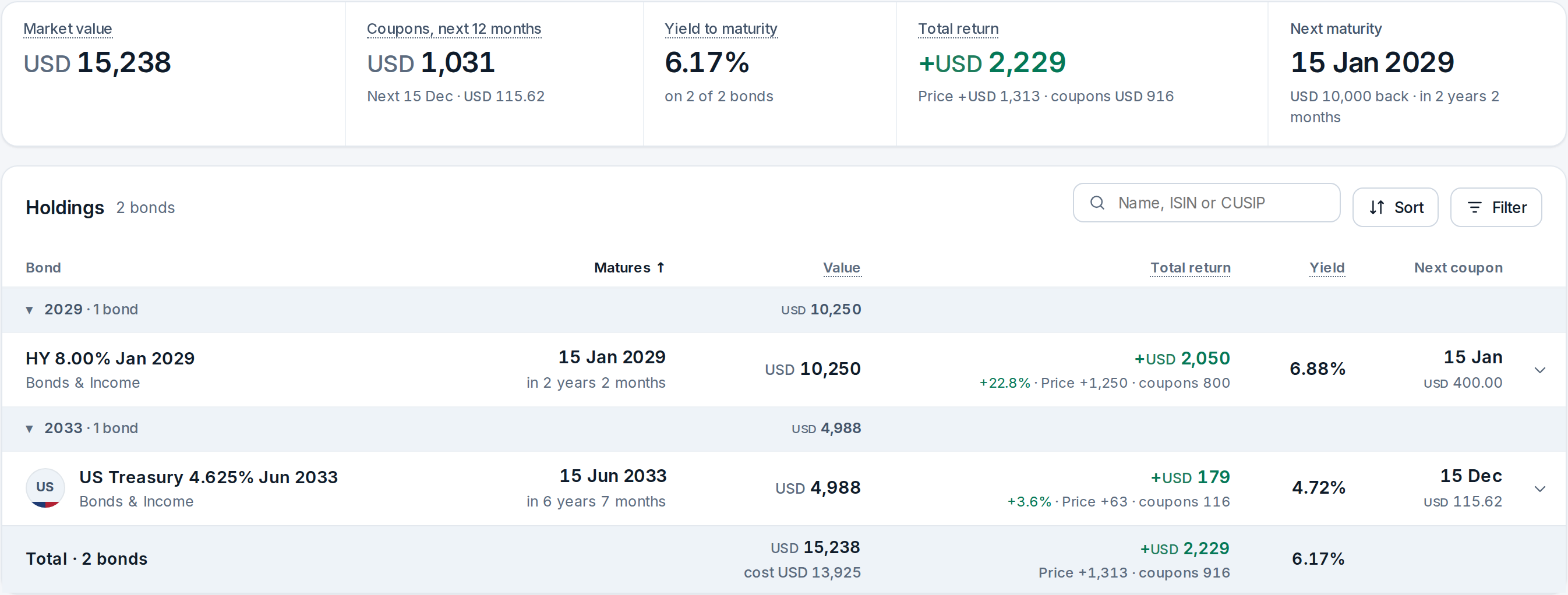
The bond report on a demo book of two example bonds.View full-size View full-size
Your own portfolio

See your bonds next to everything else you own

Connect your broker or import your trades, and AllInvestView tracks your Treasuries, notes and bond funds with their yields and maturities, alongside your stocks, funds and cash.

Yield and maturity on every bond Coupons and next maturity at a glance Stocks, ETFs, funds, bonds and crypto

Savings bond questions

How do I find out what my savings bond is worth?

You need three things printed on the bond: the series (EE, I or E), the face value and the issue date, month and year. Enter them in the calculator above and it shows the value Treasury pays for that bond in November 2026, the interest it has earned and whether it is still earning. The figures come from the same value files as TreasuryDirect's own calculator. Bonds you hold electronically show their value in your TreasuryDirect account.

When do savings bonds stop earning interest?

EE and I bonds earn interest for 30 years. Series E bonds issued before December 1965 earned for 40 years and later ones for 30, so every E bond stopped earning by June 2010. Savings notes also stopped after 30 years. In November 2026, any EE or I bond issued in November 1996 or earlier has stopped earning and will never be worth more, so there is no reason to keep it.

What is the I bond rate right now?

I bonds bought from November 2026 to April 2027 earn 5.51% a year for their first six months: a fixed rate of 1.40%, which stays with the bond for 30 years, plus an inflation rate of 2.04% for six months. Every six months from the month you bought it, the inflation part changes to the latest figure Treasury announced, each May and November.

Can I cash an I bond or EE bond before 5 years?

Yes, after the first 12 months. If you cash it before it is 5 years old you lose the last 3 months of interest. The values in the calculator already leave those 3 months out, as TreasuryDirect does, so the figure shown is what you would actually receive.

Do I pay tax on savings bond interest?

The interest is subject to federal income tax but not to state or local income tax. Most people report it all in the year they cash the bond, or in the year it stops earning if they never cash it, even though no money arrives then. You can choose to report it each year instead. If you use EE or I bond money for qualified higher education costs, some or all of the interest may be tax free (IRS Form 8815, with income limits).

Does an EE bond really double in value?

EE bonds bought since June 2003 are guaranteed to be worth at least twice their price after 20 years; Treasury adds the difference in one step if the rate has not got there. An EE bond bought November 2026 to April 2027 earns 2.90% a year, and the doubling works out to about 3.53% a year if you keep it exactly 20 years. Cash it earlier and you only get the fixed rate. Paper EE bonds from those years cost half their face value, so for them doubling means reaching the face value.

About the numbers

Values are the US Treasury's own, from the Savings Bonds Value Files that TreasuryDirect's savings bond calculator uses: the redemption value of a $25 bond for every issue month, scaled to your face value. They cover January 2025 to May 2027. Values for bonds under five years old already leave out the last three months of interest; a value of zero means the bond can't be cashed yet. For electronic bonds, TreasuryDirect works out each bond's value itself and can differ from the scaled figure by a few cents. We checked the calculator against TreasuryDirect for 44 bonds of every series. I bond rates come from Treasury's I bond interest rates table; outstanding and matured paper bonds from its savings bonds issues, redemptions and maturities report as of September 30, 2026. Treasury yields are the daily par yield curve rates we store each business day. The calculator runs in your browser; your list is saved only in this browser. Tax treatment: IRS Publication 550.