Disposal detail
- Rule
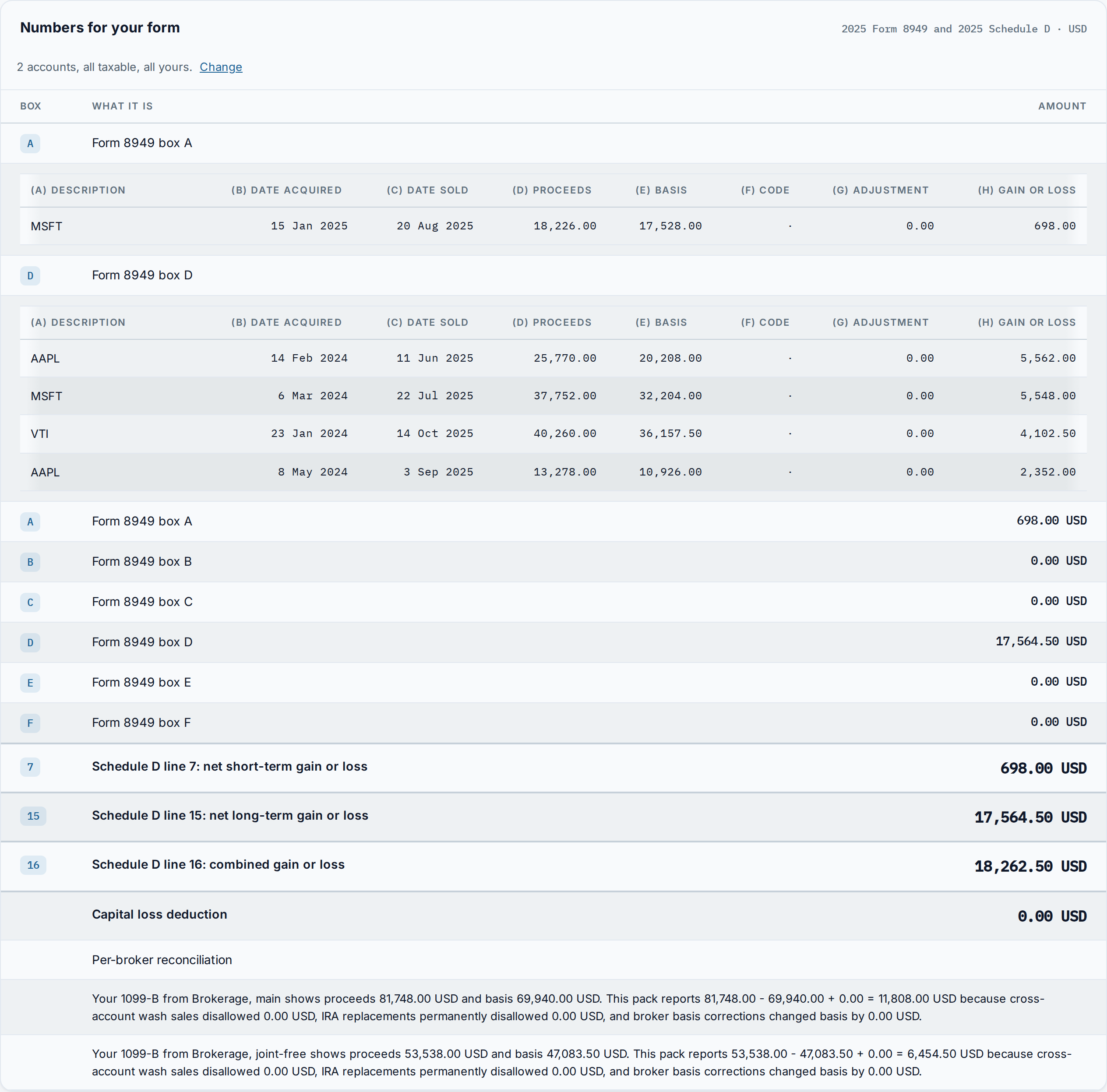
- Description, acquisition and sale dates, proceeds, basis, adjustment code and amount, gain or loss.
- Line
- Form 8949, columns (a) to (h)
- Pack
- Prepared. One row per supported stock disposal, all eight fields filled.
A foreign broker gives you the trade; the federal return wants a particular row. The US pack writes Form 8949 columns (a) through (h) for each supported stock disposal, sorts them into the right checkbox group, and totals them into Schedule D.
Each requirement behind the capital gains pages, and how far the pack takes it before you review.
| Item | The rule | Form and line | What the pack produces |
|---|---|---|---|
| Disposal detail | Every sale needs its description, acquisition and sale dates, proceeds, basis, any adjustment code and amount, and the resulting gain or loss. | Form 8949, columns (a) to (h) | Prepared One row per supported stock disposal, with all eight fields filled. |
| Checkbox grouping | Rows are split by whether a 1099-B was issued and whether basis was reported to the IRS, giving groups A through F. | Form 8949, boxes A to F | Prepared Confirm the 1099-B facts for each sale once and the rows sort themselves. |
| Basis method | FIFO is the default lot order. Another lot applies only where a timely written identification supports it. | Behind column (e) | Prepared FIFO out of the box, with a specific-lot allocation recorded against its instruction date and confirmation reference. |
| Wash sales | A replacement purchase within the window disallows the loss. A replacement inside an IRA disallows it permanently rather than moving the basis. | Form 8949, columns (f) and (g) | Reconciled Matching runs across every taxpayer account in scope, not one broker at a time. |
| Totals and netting | Short and long results carry into Schedule D, with loss netting and a capital-loss deduction of $3,000, or $1,500 filing separately. | Schedule D lines 7, 15 and 16 | Prepared The three lines, the deduction line, and a per-broker sentence reconciling each 1099-B to the pack. |
| Rate and NIIT estimates | The long-term rate depends on filing status and taxable income, and net investment income above the threshold carries a 3.8% surtax. | Estimate only | Estimated The long-term band split and a NIIT estimate appear once the filing inputs exist. |
| Submitting the return | Form 8949 and Schedule D go with your federal return. | Form 8949 with Schedule D | You file Everything leaves as a file for you or your preparer. |
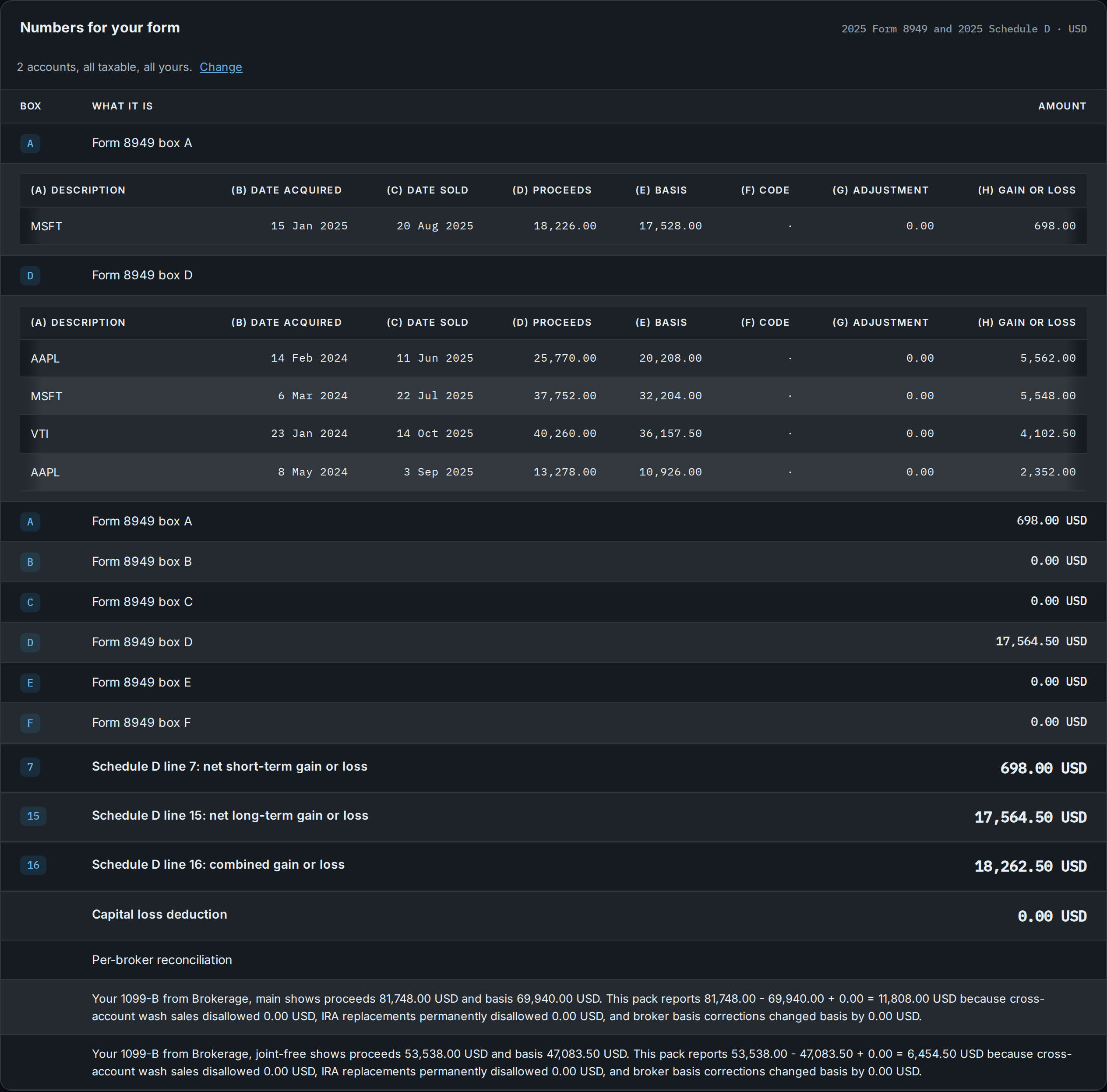
Box A and box D carry their disposals with all eight Form 8949 columns, in the order the paper form prints them. The six box totals follow, then Schedule D lines 7, 15 and 16 and the capital-loss deduction. At the bottom, one sentence per broker reconciles the 1099-B proceeds and basis to the pack's own figure and says exactly what moved it.
Open the US pack AllInvestView
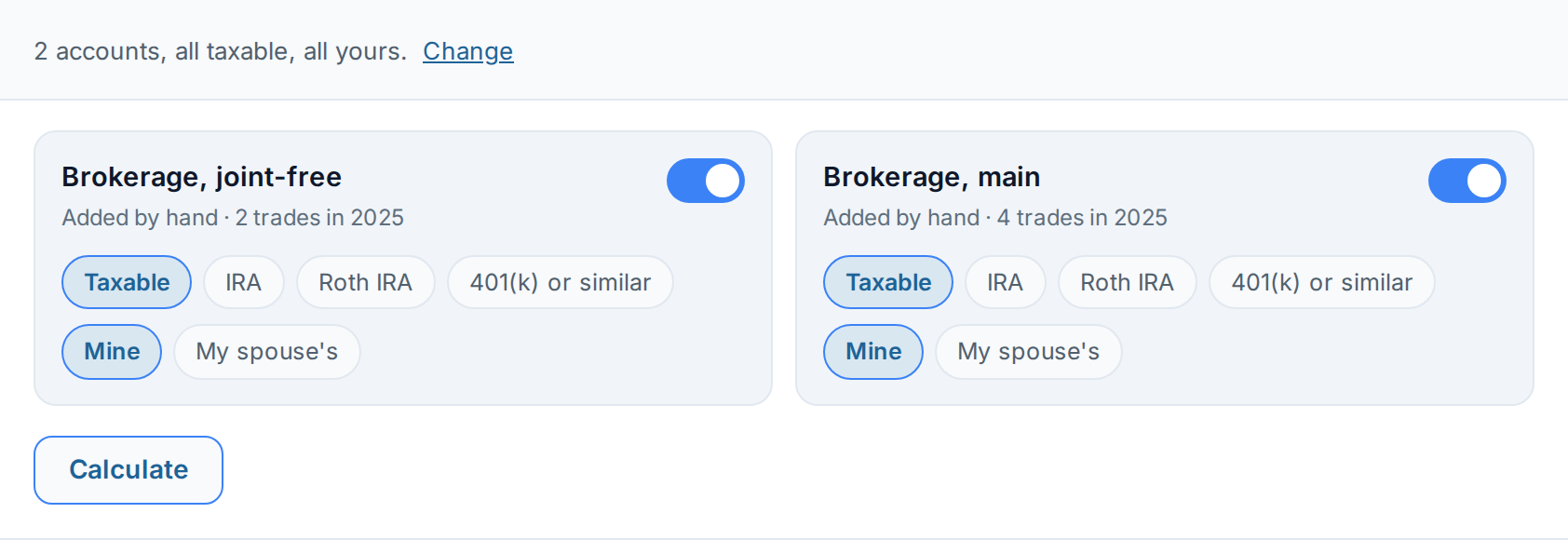
A broker only sees its own activity, so the pack asks which accounts are yours and what each one is before it matches anything. Each card carries the wrappers an American investor really holds: taxable, IRA, Roth IRA or another deferred plan such as a 401(k). Marking an account as an IRA is what lets the pack treat a replacement bought there as a permanent disallowance rather than a basis adjustment.
See the accounts stepAllInvestView
PDF, Excel and CSV take the 8949 rows, the Schedule D totals and the wash-sale evidence together. A missing 1099-B fact keeps the buttons inactive, because an incomplete 8949 is not worth exporting. Closing the year freezes the calculation revision, so the working papers your preparer signed off stay exactly as they were.
See what exportsAllInvestView
It does not file with the IRS, and the long-term band split and the 3.8% surtax are estimates built from the income and filing status you enter.
The US calculation is scoped to stock rows: bonds, options and other instruments are outside it. It follows the published 2025 Form 8949 and Schedule D until the official 2026 forms are available. A missing exchange rate, a security it cannot identify or a missing 1099-B fact blocks the total, and a sale beyond the position the pack can match stops the total until the opening history is added.
A foreign broker will give you the trade, but not the row. The pack turns each supported stock disposal into Form 8949 columns (a) through (h): the security description, the acquisition and disposal dates, proceeds, basis, the adjustment code and amount, and the gain or loss.
FIFO supplies the default lot order. Where you made a timely written specific-lot identification, the pack can use that evidence instead, and it keeps the instruction timestamp and confirmation reference alongside the allocation. The 1099-B status attached to each sale decides whether the row belongs under checkbox A, B, C, D, E or F.
Your broker only sees the activity it holds. The pack matches wash sales across every taxpayer account included in the calculation, so a replacement purchase somewhere else still adjusts the loss sale. It also treats a replacement bought inside an IRA as a permanent disallowance rather than adding the loss to a taxable replacement lot.
That account-wide pass is why the accounts on the return matter so much here. Ownership and account type start from sensible defaults you can change on the scope step, and a security the pack cannot identify stops the affected total instead of presenting it as ready.
Form 8949 rows feed short-term and long-term totals for Schedule D lines 7, 15 and 16. The pack applies loss netting and the capital-loss deduction of $3,000, or $1,500 for married filing separately.
The long-term calculation uses the bands for your filing status. For a single filer in 2026 that is 0% through $49,450, 15% through $545,500 and 20% above that taxable-income breakpoint. It can also estimate the 3.8% Net Investment Income Tax once the required income and filing-status inputs are present.
Not tax advice. The pack prepares working figures from the records you provide. Review the output against your own records and the current IRS instructions, or ask a qualified tax adviser, before filing.
Bring the stock history together, settle the facts that affect matching, and export the finished pack.
It creates the eight Form 8949 fields for each supported disposal and sorts them into checkbox groups A through F. The result includes the three supported Schedule D totals, loss netting, wash-sale evidence, and PDF, Excel or CSV exports.
The normal lot order is FIFO. The pack uses another lot only where a timely written identification supports that choice.
Yes. It matches replacement purchases across the taxpayer accounts included in the calculation. A replacement purchase in an IRA makes the related loss permanently disallowed.
The calculation currently covers stock disposals. It leaves out other instrument types, including bonds and options, and a sale beyond the position the pack can match stops the total until the opening history is added, rather than being estimated.
No. AllInvestView prepares working figures and exports for you or your tax adviser to review. You remain responsible for completing and submitting the federal return.