Roll out
Buy back the call and sell the same strike further out. The cap stays where it was, and you're paid for the extra time.
30 Oct $340 → 20 Nov $340 call: +$5.55, $555 for 21 more days
Rolling an option means closing the option you hold and opening another of the same type with a different strike, expiry or both, in one order. The two legs net to a credit or a debit. On 23 October 2026, with Apple at $347.73, buying back the 30 October $340 call at $9.80 and selling the 18 December $350 call at $13.35 brought in $3.55 a share, $355 a contract.
The price the shares can be called away at went up $10, and the call got 49 more days to run.
$13.35 − $9.80 = +$3.55 a share, +$355 a contract
Pick the side you're short. Five later expiries, seven strikes, and each cell is what that roll pays or costs per share: the later option's bid minus the ask you pay to buy back the old one. Multiply by 100 for a contract.
Short the 30 Oct $340 call. Apple $347.73, so it's $7.73 in the money with $1.79 of time value left. Buying it back costs $9.80.
| Roll to strike → | $340same | $345+$5 | $350+$10 | $355+$15 | $360+$20 | $365+$25 | $370+$30 |
|---|---|---|---|---|---|---|---|
| 6 Nov+7 days | |||||||
| 13 Nov+14 days | |||||||
| 20 Nov+21 days | |||||||
| 18 Dec+49 days | |||||||
| 15 Jan 2027+77 days |
| Roll to strike → | $355same | $350−$5 | $345−$10 | $340−$15 | $335−$20 | $330−$25 | $325−$30 |
|---|---|---|---|---|---|---|---|
| 6 Nov+7 days | |||||||
| 13 Nov+14 days | |||||||
| 20 Nov+21 days | |||||||
| 18 Dec+49 days | |||||||
| 15 Jan 2027+77 days |
Read down a column and every strike pays more on a later row. Read across and the credit shrinks as the strike moves your way: on the call side each $5 step up gives back as much as $3.10 a share. A roll for a credit is a trade between more time and a better strike.
A roll moves the date, the strike or both. Which way depends on the side you're short and on where the stock has gone.
Buy back the call and sell the same strike further out. The cap stays where it was, and you're paid for the extra time.
The covered call move when the stock runs through the strike: more room for the shares to rise, with the extra time paying for it.
The put seller's version: a lower price to buy the shares at, paid for with more time.
With no time added, nothing pays for the better strike, so it almost always costs money.
Say you bought 100 Apple shares on 2 October at $333.69 and sold the 30 October $340 call for $6.50. Three weeks later Apple closed at $347.73, $7.73 above the strike. Here are the choices on the 23 October quotes, and what each one leaves you if the shares are called away.
| Choice on 23 October | Roll pays | Cap | Total if called away |
|---|---|---|---|
| Let the shares godo nothing | None | $340 | +$1,281 |
| Roll outto the 20 Nov $340 call | +$555 | $340 | +$1,836 |
| Roll up and outto the 18 Dec $350 call | +$355 | $350 | +$2,636 |
| Roll up, pay a debitto the 20 Nov $350 call | −$25 | $350 | +$2,256 |
Each total is the shares sold at the cap, (strike − $333.69) × 100, plus the $650 first premium and whatever the roll paid or cost.
Every expiry after 30 October holds Apple's results. The 20 November $340 call trades at 28.2% implied volatility against 23.3% for the 30 October call, so rolling out pays $26.43 a contract for each extra day, against $7.24 for the December roll. Some of that is a price for the report, and it tends to drain out once the numbers are in.
The December roll's +$2,636 needs Apple at $350 or higher on 18 December. Apple has 56 days to fall instead of 7, and the shares carry all of that. The premium collected covers the first $10.05 a share of any drop.
Now the other side. You sold the 30 October $355 put and Apple has dropped to $347.73. Assignment means buying 100 shares at $355, $7.27 above the market.

Buy 100 Apple at $355 and keep the premium you already took. Then sell a covered call on them, the next step of the wheel.
Buy back at $8.90, sell at $11.00. If you're assigned, you pay $35,000, or $347.90 a share after this roll's credit. The cash stays tied up 21 more days, across the report.
$10 lower and 49 more days. Assigned, you'd pay $34,500.
$10 lower for the same 21 days costs $0.05 a share after the buyback.
Rolling down keeps you from buying at a price you no longer like. It doesn't make the move against you disappear: $727 of the $890 buyback is Apple below the strike, and it's booked against the premium you took on 23 October. Roll only if a 20 November $350 put on Apple is a trade you'd open today with fresh cash.
A credit roll feels like getting paid, and it is, but it doesn't undo the call you bought back. Follow one covered call from the first sale to 18 December.
That loss is booked on 23 October whatever Apple does next. The $355 credit is the new call's premium less that buyback. The chain is ahead on premium, the call you closed isn't, and the roll only beats letting the shares go if Apple finishes above $336.45.
Start with the time value left in the option you're short. That's all you'd still be paid for waiting.
With a week to go the 30 October call holds $1.79 of time value; the other $7.73 of its price is Apple above the strike. Holding on for the week can earn you that $1.79 at most. The same strike in December still holds $11.67, and selling it is what makes the roll pay.
Most of the jump from $1.79 to $5.62 for one more week is the 2 November report: every expiry after it is dearer.
The new strike and date are a trade you'd place with fresh money, the old option has little time value left, and the roll pays a credit or a small debit you've decided the better strike is worth.
Buy it back without opening another when most of the premium is earned or the reason for the trade has gone. Many sellers close once about half the premium is kept.
If you're happy to sell the shares at the strike, or buy them with the put, do nothing. Letting the Apple shares go at $340 locks in +$1,281.
Apple pays $0.27 a quarter. It usually declares with its results and goes ex-dividend about a week later: 8 November in 2024, 10 November in 2025. Exercising the day before the ex-date gets the holder the dividend, so an in-the-money short call with less than $0.27 of time value left is the one most likely to be assigned early before the ex-date. A short call that runs past that date, like the 20 November $340, can be assigned early once its time value thins out.
Expiries after 2 November cost more because they include Apple's results. Selling them is a bet that the move comes in smaller than priced. If you'd rather not be short across the numbers, close the option and sell the next one after the report, once volatility has come back down.
Apple's closes since 2006: 5,215 four-week stretches starting from 3 January 2006 to 25 September 2026, each with a call written above that day's price.
Going in the money said little about the month after. When a stretch ended above a 5% call, Apple rose over the next four weeks 63.9% of the time, against 62.4% for any four weeks (63.5% after a 2% call, 64.3% after a 10% one). A call that's gone in the money isn't a reason to chase the stock with a higher strike. Roll for the new trade itself.
Many sellers only roll for a credit. Rolling the $340 call, the first listed expiry that still paid a credit moves further out with every $5 of strike.
The shading rises with the time added to find a credit: 5 days to 4 November, 28 to 27 November, 49 to 18 December, 77 to 15 January.
Keeping a credit at $360 means going to January, 84 days from 23 October, for $1.80 a share. Each roll like that buys a little cap with a lot of time, and a stock that keeps climbing has you rolling again. A small debit can be the better trade: the 20 November $350 costs $25, a week shorter than the 27 November credit of $40.
For tax a roll is two trades: closing one option and opening another. IRS Publication 550 covers both.
The difference between what you got for the option and what you paid to buy it back is a short-term capital gain or loss, dated the day of the buyback. The exception is a covered call on shares held more than a year: a loss on buying it back can count as long term under the qualified covered call or straddle rules.
If the 18 December call expires, its $1,335 is a short-term gain that day. If it's assigned, the premium is added to what you get for the shares, and the gain is short or long term by how long you held them.
A covered call is qualified when it trades on an exchange, has more than 30 days to expiry when written and isn't deep in the money. The 30 October call had 28 days, so with the shares it formed a straddle, and a loss on it is deferred by any unrecognized gain still on the shares at year end. In this chain the shares go on 18 December, so nothing is left to defer and the $330 counts in 2026. The December call, 56 days and out of the money, is qualified. An in-the-money qualified call pauses the shares' holding period while it's open; a call that isn't qualified, like one rolled deep in the money, makes a straddle and can restart the clock on shares held a year or less.
The wash sale rules apply to options. The IRS has no test for when an option with a different strike or expiry is substantially identical to the one you closed, so a loss on a buyback followed by a new option on the same stock within 30 days is one to check with your tax adviser.
Every way an option can end, taxed with real Apple trades: how options are taxed.
The +$355 is the new premium less a $980 buyback. The chain booked a $330 loss on 23 October. Judge a roll by the chain's total, not by the credit.
If you wouldn't open the new option today with fresh money, rolling into it only keeps the risk open longer. A falling stock can't be fixed with premium.
Keeping a credit at $360 takes January. Each step adds weeks of holding the stock for a little more cap.
An in-the-money short call with less time value than the $0.27 dividend can be exercised the day before Apple goes ex-dividend. The shares leave a day early and the dividend goes with them.
Rolling into November sells Apple's 2 November report along with the time. If the stock jumps on the numbers, the new call is the one in the money.
A roll chain is hard to add up by hand once it has a few legs. AllInvestView keeps it as one position, next to your shares, ETFs and bonds.
A roll you record is linked to the option it replaced, and a broker roll is matched to it when the match is clear: same portfolio, same number of contracts. The covered call then stays one position however many times you roll it, and its story shows the roll as a single step: the net, what closing and opening each came to, and the premium so far.
The result line covers the options: −USD 310.87 here, the $330 buyback loss plus the open call. The shares are $1,404 up at the 347.73 mark, so call and shares together are $1,093.13 ahead.
 AllInvestView
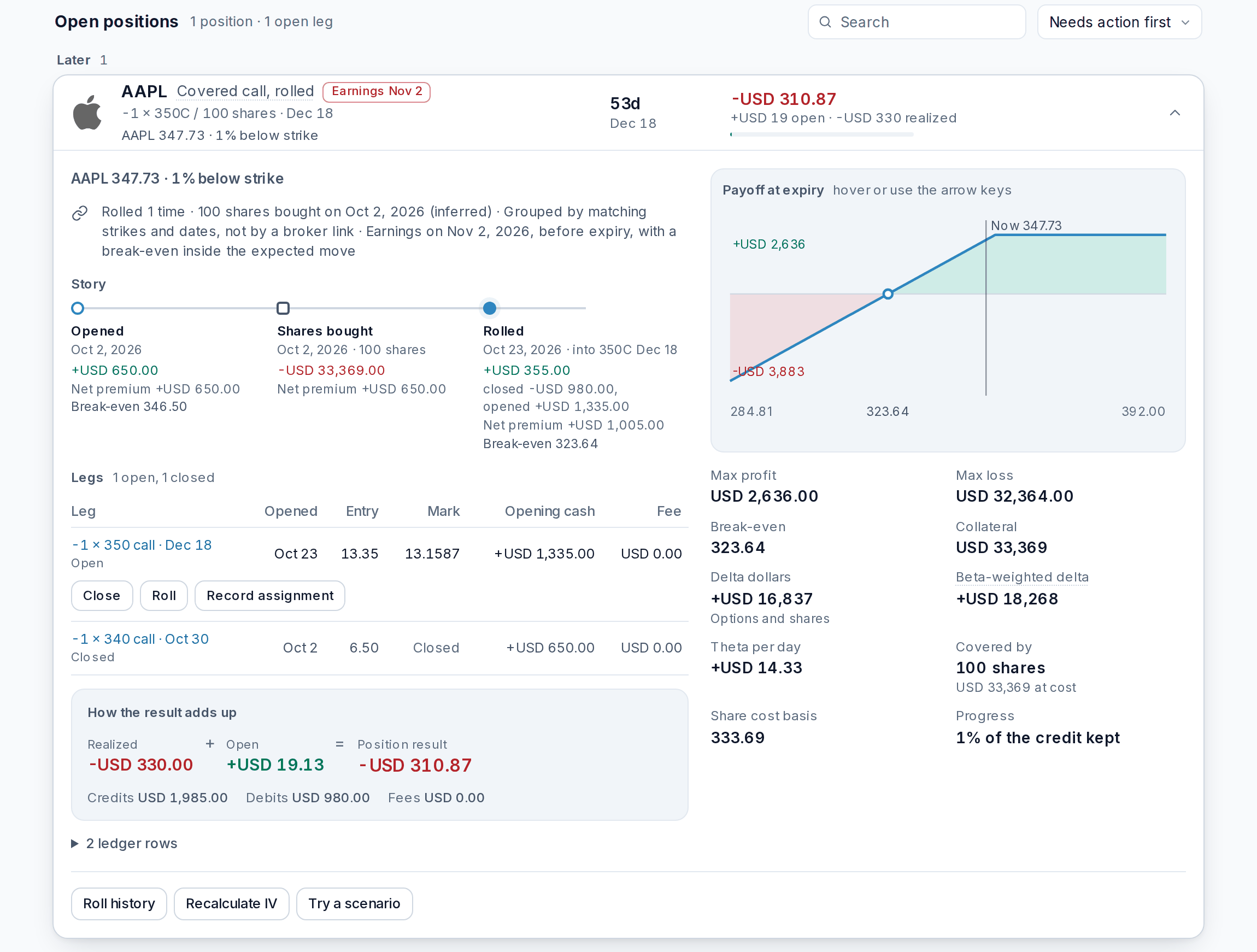
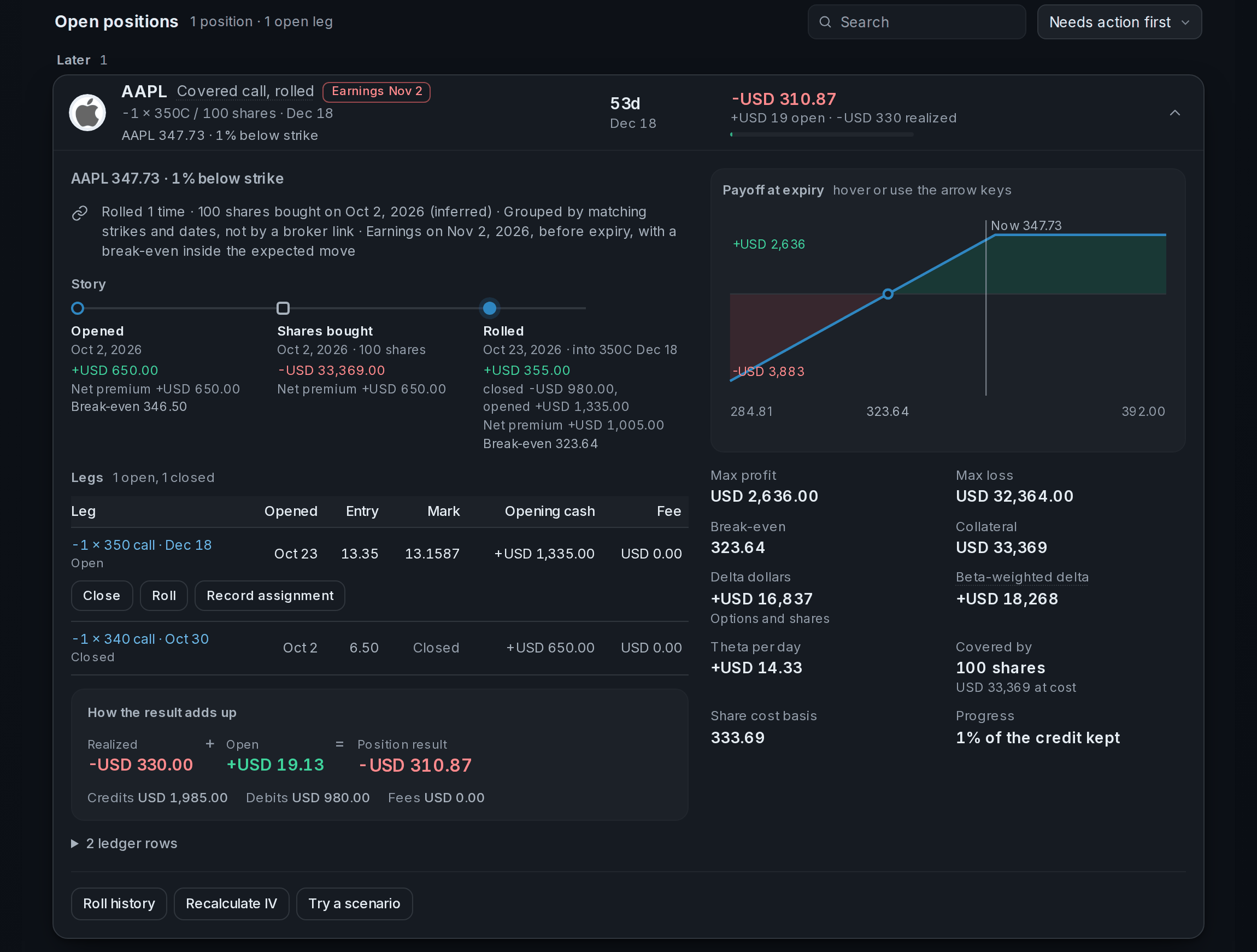
Options, shares, ETFs, bonds and dividends on one dashboard, synced from your brokers or imported from a file. Rolls you record, and broker rolls that match clearly, stay linked to the option they replaced, with realized and open P&L kept apart, and your tax report comes from the same trades.
It means closing the option you hold and opening another of the same type with a different strike, expiry or both, in one order. The two legs net to a credit or a debit. On 23 October 2026 buying back Apple's 30 October $340 call at $9.80 and selling the 18 December $350 call at $13.35 was a $3.55 credit, $355 a contract.
Send one order that buys back the call you sold and sells a later call on the same shares. When the stock has run through the strike, the usual move is up and out: a higher strike further away. Apple's 30 October $340 call rolled to the 18 December $350 call raised the cap by $10 and still paid $355.
A credit is a good habit, not a rule. Keeping one pushes you further out in time: to roll Apple's $340 call up to $360 for a credit you had to go to January 2027. At $350 the 20 November call cost $25, a week shorter than the first credit, $40 for 27 November.
When the call you're short has little time value left and the new strike and date are a trade you'd open today. With a week to go Apple's 30 October $340 call held $1.79 of time value; the same strike in December held $11.67. If you're happy to sell the shares at the strike, letting them go is also fine.
Buy back the put and sell one at a lower strike further out, a roll down and out. On 23 October Apple's 30 October $355 put cost $8.90 to buy back and the 20 November $350 put sold for $11.00: a $2.10 credit, with a $5 lower price to buy the shares at and 21 more days with the cash tied up.
No. Buying back the old option books its gain or loss that day, whatever the new option pays. In the Apple chain the call sold for $650 and bought back for $980 is a $330 loss on 23 October, even though the roll itself was a $355 credit.
Yes. Assignment can come any time, and it gets likelier as the option goes deeper in the money with little time value left, and the day before an ex-dividend date. An in-the-money call with less time value than the dividend, $0.27 a quarter for Apple, is the one most likely to be assigned early before the ex-date.
As two trades. The buyback is a closing transaction, a short-term capital gain or loss on that day (a loss on a covered call written on shares held more than a year can count as long term under the qualified covered call or straddle rules), and the new option is a separate position taxed when it expires, is closed or is assigned. A covered call with 30 days or less to run can form a straddle with the shares and defer a loss, and the IRS has no test for when options with a different strike or expiry are substantially identical for wash sales.
Checked on 26 October 2026.
Options bought back at the ask and sold at the bid, 100 shares a contract, commissions left out. Implied volatilities are solved from the bid-ask midpoint with AllInvestView's options pricing engine (Black-Scholes, 3.94% rate). The 2 October sale of the 30 October $340 call at $6.50 is not a quote: it's our engine's price for that call at Apple's 2 October close with 24% volatility, rounded. Four-week stretches are 20 trading days, close to close. Nothing here is investment or tax advice.