Dollars per $1 in the stock
A 0.52 delta call moves about 52 cents for each dollar Apple moves. A put's delta is negative: the $350 put's −0.48 gains about 48 cents when Apple falls $1.
Apple +$1: call +$0.52, put −$0.48
The options Greeks tell you how much an option's price changes when one thing changes and the rest stays put: delta for a $1 move in the stock, gamma for how fast delta itself moves, theta for one day passing, vega for one point of implied volatility and rho for one point of interest rates.
Here they are on one real option. On 23 October 2026 Apple closed at $347.73 and its 18 December $350 call was quoted at $13.35 bid and $13.65 ask, $13.50 at the midpoint. Its delta of 0.52 means it gains about $52 a contract when Apple rises $1, and its theta means it loses about $14 a contract for each day that passes.
 Apple 18 Dec 2026 $350 call · $13.50 · 56 days left · IV 25.2%
Apple up $1, the call up about $0.52.
Apple up $10, delta goes from 0.52 to 0.63.
One day passes, Apple flat: the call loses $0.14.
IV from 25.2% to 26.2%: the call gains $0.54.
Rates up 1 point: the call gains $0.25.
Delta, theta, vega and rho are the change in the option's price for a small change in one input; gamma is the change in delta. Add them up and you get a fast estimate of what a move will do. Here is that estimate for the Apple call against the price the pricing model gives when everything is recalculated.
| What changes | Greek used | Estimate | Full reprice | A contract |
|---|---|---|---|---|
| Apple up $1, to $348.73 | Delta 0.5156 | +$0.52 | +$0.52 | +$52 |
| Apple up $10, delta alone | 10 × delta | +$5.16 | +$5.73 | +$573 |
| Apple up $10, with gamma | Delta + ½ × gamma × 10² | +$5.74 | +$5.73 | +$573 |
| Apple down $10, to $337.73 | Delta + gamma | −$4.57 | −$4.57 | −$457 |
| One day passes, Apple flat | Theta −0.1383 | −$0.14 | −$0.14 | −$14 |
| IV up 5 points, to 30.2% | 5 × vega 0.5427 | +$2.71 | +$2.71 | +$271 |
| Rates down 0.25 points | −0.25 × rho 0.2544 | −$0.06 | −$0.06 | −$6 |
Delta alone misses $0.57 on a $10 move because delta doesn't stay put: it climbs as Apple rises. Gamma fixes most of that. For small moves, one day or a few volatility points, the Greeks are close to exact. For large moves or weeks of time, reprice the option instead.
Start from the real call on 23 October. Move Apple's price, take days off the clock or change implied volatility, and pick a Greek to see how it changes across Apple's price.
Prices and Greeks come from a Black-Scholes model with a 3.94% rate and Apple's $1.08 yearly dividend, the same inputs as the rest of this guide. Theta is per calendar day. The model treats the option as European; Apple options can be exercised early, which mostly matters for puts deep in the money.
Delta runs from 0 to 1 for calls and from 0 to −1 for puts. It has three uses, and traders switch between them without saying so.
A 0.52 delta call moves about 52 cents for each dollar Apple moves. A put's delta is negative: the $350 put's −0.48 gains about 48 cents when Apple falls $1.
One contract covers 100 shares, so delta × 100 is the number of shares it acts like right now. Multiply by the price for the dollar exposure, often called delta dollars.
Delta is often read as the probability of expiring in the money. It's near, not equal: the model's own chance that Apple ends above $350 on 18 December is 47.7%, a bit under the 0.52 delta.
| Strike | Call price | Call delta | Put delta | Model chance above strike | Call IV |
|---|---|---|---|---|---|
| $300 in the money | $51.13 | 0.91 | −0.09 | 89.2% | 30.2% |
| $320 | $34.00 | 0.80 | −0.20 | 77.0% | 28.5% |
| $340 | $19.40 | 0.63 | −0.37 | 58.7% | 26.3% |
| $350 near the money | $13.50 | 0.52 | −0.48 | 47.7% | 25.2% |
| $360 | $8.78 | 0.40 | −0.60 | 36.1% | 24.1% |
| $380 | $2.98 | 0.18 | −0.79 | 16.2% | 22.6% |
| $400 out of the money | $0.88 | 0.07 | −0.87 | 5.7% | 22.3% |
Near the money the call's delta minus the put's adds up to about 1: 0.52 and −0.48 at $350. Holding a call and shorting a put with the same strike and expiry behaves much like owning 100 shares. Further out the two drift apart (0.94 at $400) because each option's delta uses its own IV. The chance column is the model's, not a forecast.
Gamma is how much delta moves for each $1 in the stock. It's highest near the money and grows as expiry gets close while the stock stays near the strike, which is why short-dated options swing from worthless to valuable so fast.
Each curve uses its own option's IV on 23 October: 21.5% for 30 October, 25.2% for 18 December and 27.9% for 17 September 2027.
Buyers of options are long gamma: delta grows in the direction the stock moves, so gains speed up and losses slow down. Sellers are short gamma and feel the opposite. That's the risk in selling options with a few days left: a $10 swing can turn a 0.25 delta into a 0.62.
Theta is what the option loses when one day passes and nothing else moves. It's almost always negative for buyers and positive for sellers, and for an option near the strike it speeds up toward expiry.
Apple held at $347.73 and IV at 25.2% the whole way. At expiry the call is $2.27 out of the money and worth nothing.
Theta here counts calendar days, so Friday to Monday counts as three. Some platforms quote theta per trading day, which makes each figure larger, about 365 ÷ 252 times for the same yearly decay. Check which one your broker shows before comparing numbers.
Vega is the change for one point of implied volatility; rho, for one point of interest rates. The same $350 strike across five Apple expiries shows the trade-off: vega and rho grow with time to expiry while daily theta gets smaller.
| Expiry | Days | Call price | Theta a day | Vega per IV point | Rho per rate point |
|---|---|---|---|---|---|
| 30 Oct 2026 | 7 | $3.20 | −$0.30 | $0.19 | $0.03 |
| 20 Nov 2026 | 28 | $9.70 | −$0.20 | $0.38 | $0.12 |
| 18 Dec 2026 the example | 56 | $13.50 | −$0.14 | $0.54 | $0.25 |
| 19 Mar 2027 | 147 | $24.58 | −$0.09 | $0.87 | $0.67 |
| 17 Sep 2027 | 329 | $40.68 | −$0.07 | $1.28 | $1.48 |
A 5-point drop in IV takes $0.94 off the 7-day call but $6.40 off the September 2027 one. That's why LEAPS buyers care most about the volatility they pay.
Options that span an earnings report usually carry extra IV, and it usually drops once the news is out. Long vega loses that part even when the stock moves your way. The implied volatility guide runs it on Apple's 2 November report.
A quarter-point rate cut takes about $0.06 off the December call and $0.37 off the September 2027 call, $37 a contract. Calls gain when rates rise; puts lose.
For a whole position, multiply each leg's Greek by 100 and by the number of contracts, flip the sign for legs you sold, and add. Shares count as delta 1 each and nothing else. Here are six Apple positions built from the same 23 October prices.
| Position | Delta shares | Gamma shares per $1 | Theta a day | Vega per IV point |
|---|---|---|---|---|
| Long callBuy the Dec $350 call, $1,350 | +51.6 | +1.16 | −$13.83 | +$54.27 |
| Covered call100 shares, sell the Dec $370 call for $538 | +71.6 | −1.06 | +$10.56 | −$46.15 |
| Cash-secured putSell the Dec $330 put for $685 | +27.8 | −0.89 | +$10.25 | −$45.67 |
| Bull call spreadBuy Dec $350, sell Dec $380, $1,052 | +33.1 | +0.30 | −$5.90 | +$17.94 |
| Long straddleBuy the Dec $350 call and put, $2,758 | +3.2 | +2.31 | −$24.41 | +$108.54 |
| Calendar spreadSell Nov 20 $350, buy Dec 18 $350, $380 net | +2.1 | −0.38 | +$6.21 | +$15.86 |
The long call, straddle and bull call spread. You need a move, or a rise in IV, before time eats the premium.
The covered call and the cash-secured put. Quiet days pay you; a jump in IV or a sharp fall in Apple costs you, and a sharp rise pays less than the shares would. The calendar spread is the mix: at these prices it earns theta and gains when IV rises in both months.
The straddle's delta is almost zero, so it doesn't care much which way Apple goes at first. Its gamma of 2.31 means its delta rises about 2.3 shares for each $1 Apple rises and falls about 2.3 for each $1 it falls, so it leans whichever way Apple moves. This spread cuts every Greek of the long call: the bull call spread keeps 33 of the call's 52 shares of delta for $1,052 instead of $1,350, and pays less than half the theta.
A delta hedge cancels the direction. Say you own the December $350 call (delta 51.6 shares) and short 52 Apple shares: the position starts close to delta neutral. With IV and rates held fixed, what's left is mostly gamma, which earns on moves, and theta, which costs every day.
| Apple next day | Call | 52 short shares | Hedged result |
|---|---|---|---|
| Flat, $347.73 | −$14 | $0 | −$14 |
| +$3 | +$146 | −$156 | −$10 |
| +$5 | +$258 | −$260 | −$2 |
| −$5 | −$257 | +$260 | +$3 |
| +$10 | +$559 | −$520 | +$39 |
| −$10 | −$470 | +$520 | +$50 |
This is the bet behind a hedged long option, in plain sight: in this one-day example Apple has to move about $5, roughly what its implied volatility already prices, for gamma to pay for theta. With the 52-share hedge the exact break-even is +$5.34 or −$4.45, because 52 shares is a little more than the call's 51.6. Over many days of resetting the hedge, each stretch between resets gains or loses roughly half the gamma held at the time times the gap between its move squared and the move squared the IV priced, so the result depends on the path. Market makers who sell options run the same sum the other way. Most investors never hedge to zero, but the same arithmetic tells you how much a quiet week will cost a long option, or pay a short one.
Delta is a snapshot. The December call's 0.52 becomes 0.63 after a $10 rise and 0.40 after a $10 fall, and a 7-day option changes far faster. Check gamma before you size a trade on delta.
A 0.52 delta call had a 47.7% model chance of ending in the money, and the model's odds are not a forecast. Use delta as a rough guide to the odds, not a promise.
With Apple flat, the call lost $0.14 a day with eight weeks left and $0.82 a day with one day left. Near the strike, holding a long option into the final two weeks costs far more per day than the first ones did.
The September 2027 call moves $1.28 for each IV point, more than a $2 move in Apple does. Buying long-dated options when IV is high can cost more than the direction earns.
50 deltas of Apple and 50 deltas of a $20 stock aren't the same risk. Convert to delta dollars (delta × price) before adding, and to beta-weighted delta to compare with the market.
Greeks matter most on the trades you already hold. AllInvestView keeps every option you own next to your shares, ETFs and bonds, and adds up delta and theta per position and for the whole book.
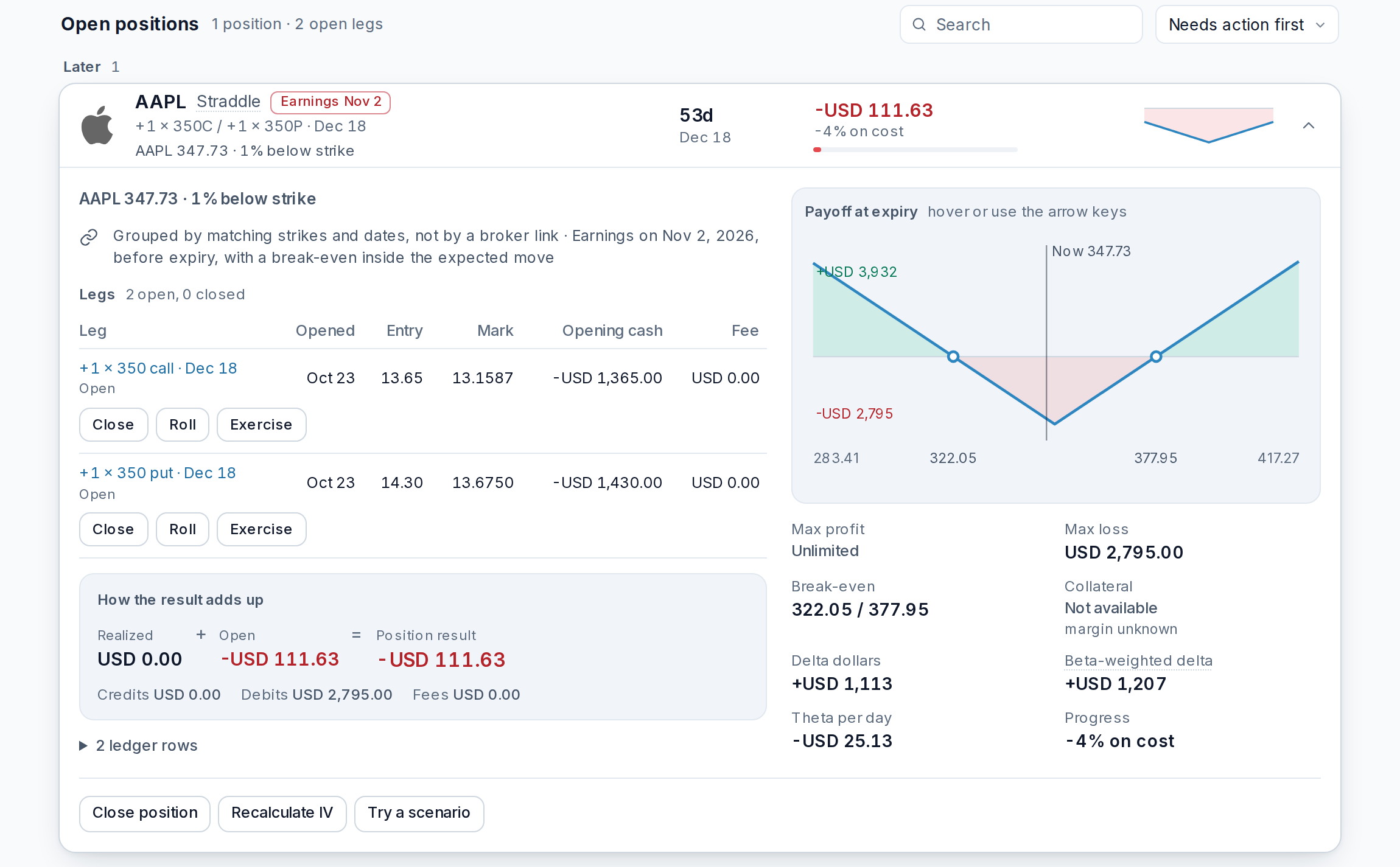
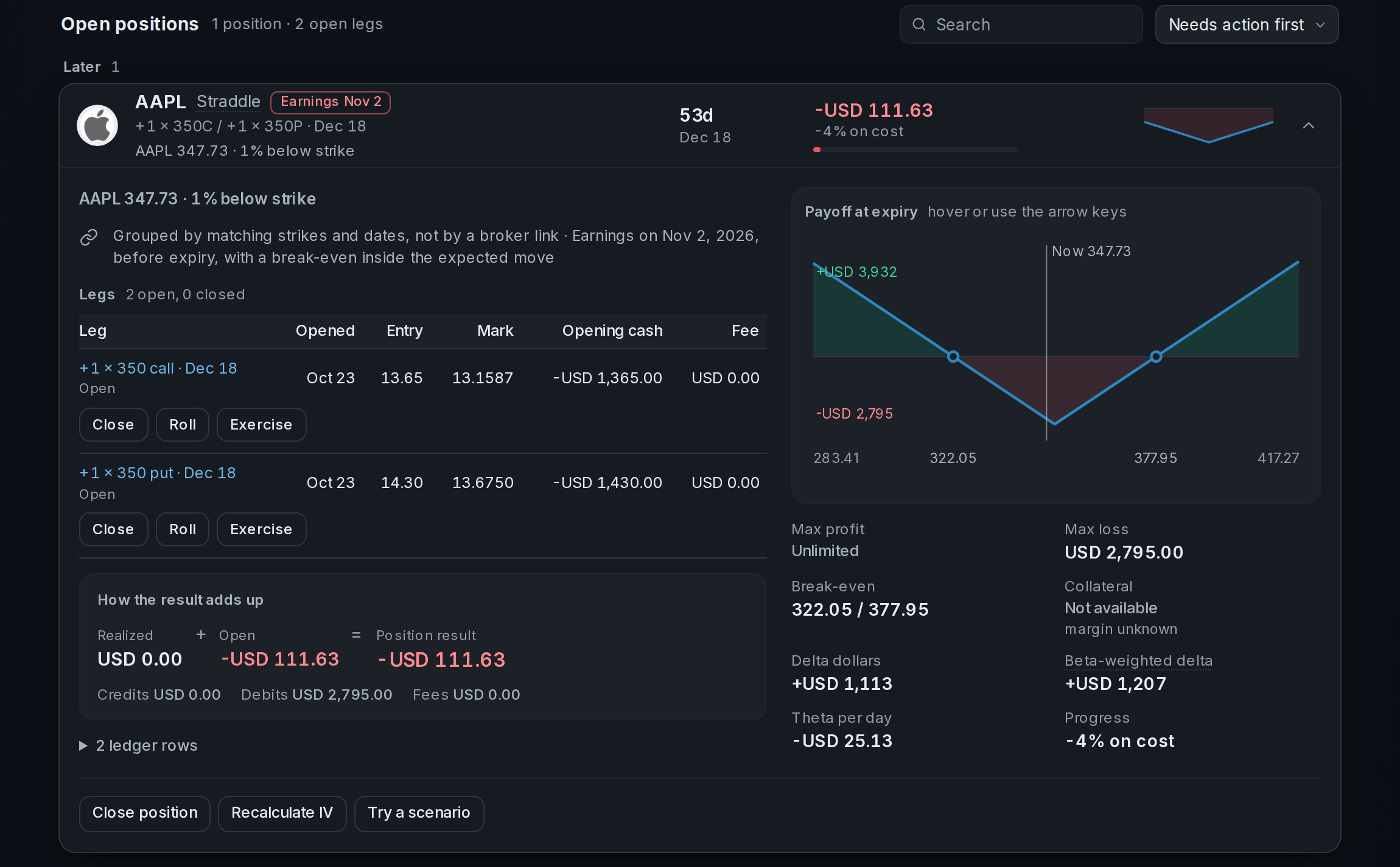
Each open position shows what it's worth now, its delta in dollars, its beta-weighted delta and its theta per day, with calls, puts and shares grouped into one strategy. Here it's the Apple $350 call and put from this guide, held together as a straddle.
 AllInvestView
 AllInvestView
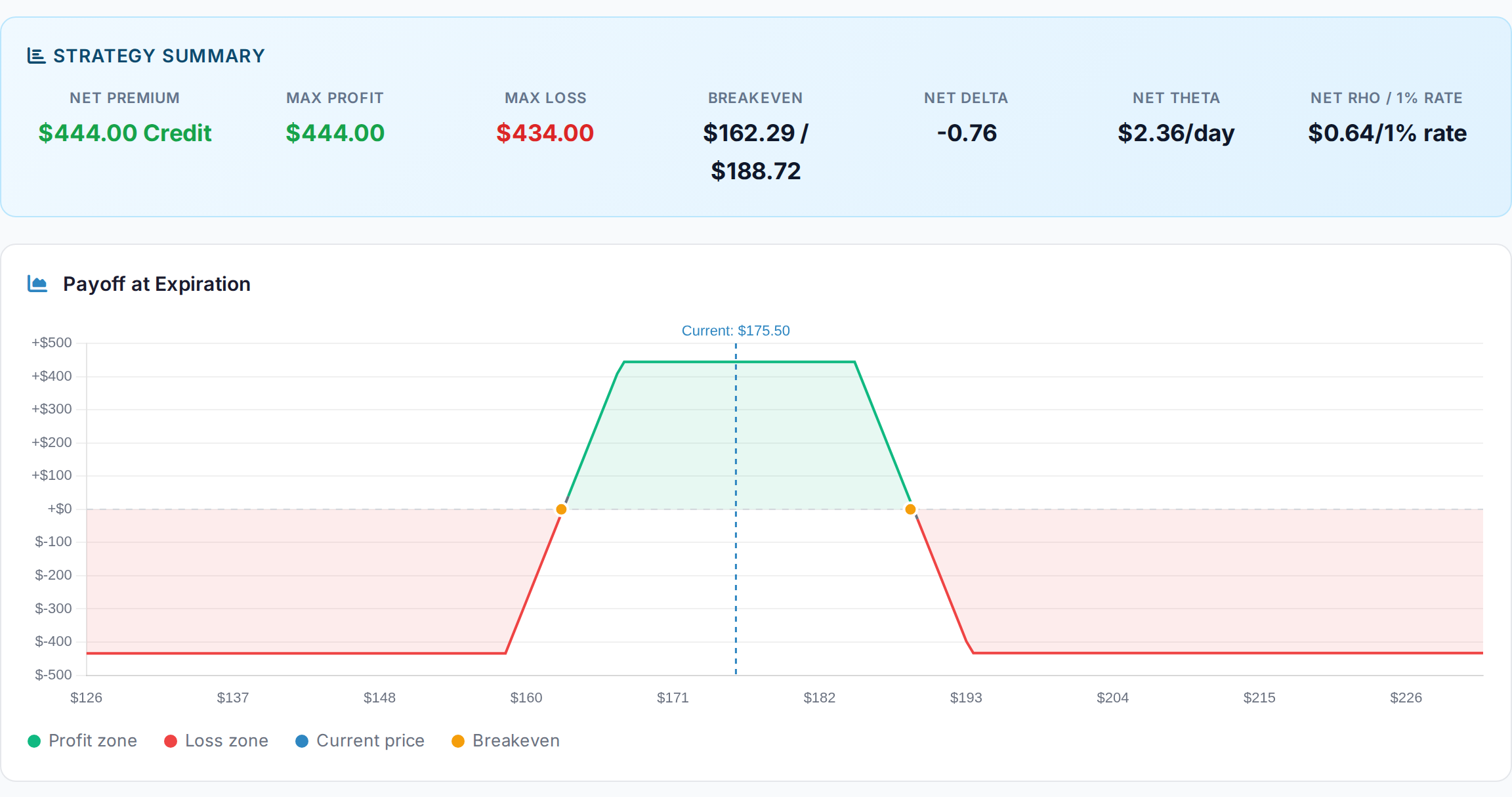
Build a position leg by leg and the Strategy Builder prices each option and shows its delta, gamma, theta, vega and rho, then the combined Greeks, the payoff at expiry and a scenario grid across prices and dates.
Options, shares, ETFs, bonds and dividends on one dashboard, synced from your brokers or imported from a file, with Greeks, delta dollars and scenarios on your open options.
They measure how an option's price changes when one input changes: delta for the stock price, gamma for how fast delta changes, theta for time passing, vega for implied volatility and rho for interest rates. On 23 October 2026 Apple's 18 December $350 call had a delta of 0.52, gamma 0.012, theta −$0.14 a day, vega $0.54 and rho $0.25.
The option moves about 50 cents for each $1 the stock moves, so one contract acts like 50 shares. Options near the money have a delta near 0.50, like Apple's $350 call at 0.52 with Apple at $347.73. Delta changes as the stock moves; that change is gamma.
Roughly, not exactly. Apple's $350 call had a 0.52 delta, while the pricing model's own chance of Apple ending above $350 on 18 December was 47.7%. Both come from the model, so neither is a forecast.
Because time value runs out. An option you buy is almost always worth less each day the stock stands still, so its theta is negative; if you sold it, the same theta is a daily gain. With Apple flat, its $350 call lost $0.14 a day with 56 days left and $0.82 a day with one day left.
How much delta changes for each $1 in the stock. It's highest near the money, and more so close to expiry. Apple's 7-day $350 call had a gamma of 0.038, more than three times the December call's 0.012, so a $5 move either way swung its delta from 0.25 to 0.62.
Delta explains most of an option's daily move, and theta explains what a quiet day costs. Gamma matters most close to expiry, vega for long-dated options and around earnings, and rho mainly for LEAPS.
Multiply each leg's Greek by 100 and by its contracts, make it negative for legs you sold, and add them up. Shares count as delta 1 each. A bull call spread buying Apple's December $350 call and selling the $380 call has a delta of 51.6 − 18.5 = 33.1 shares and a theta of −$5.90 a day.
Gamma and vega are nearly the same: Apple's $350 call and put both had a vega of $0.54. Near the money the deltas differ by about 1 (0.52 for the call, −0.48 for the put), and theta differs a little because of interest and dividends.
Checked on 26 October 2026.
Prices and Greeks come from AllInvestView's options pricing engine (Black-Scholes) with a 3.94% rate and Apple's $1.08 yearly dividend, each option's implied volatility solved from its bid-ask midpoint. Theta is per calendar day, vega per point of volatility and rho per point of interest rate. The model chance above the strike is the risk-neutral N(d2). Position Greeks multiply each leg by 100 shares a contract and add the legs. Nothing here is investment advice.