Glossary · stock valuation

Earnings Per Share (EPS): What It Is, the Formula and How to Calculate It

Earnings per share is a company's net income, less any dividends on preferred stock, divided by the average number of common shares over the period: the profit that belongs to each share. Alphabet earned $132.2 billion in 2025 over an average of 12,230 million diluted shares, an EPS of $10.81.

It's the E in the P/E ratio and the number analysts forecast every quarter. Quote sites show diluted EPS, which also counts the shares that stock options and convertibles could still create. EPS in dollars says little on its own; what matters is how fast it grows, and whether it grows from profit or from buybacks.

The formula
Net income − preferred dividends÷Average shares

Alphabet 2025: $132,170m ÷ 12,230m = $10.81 diluted, or $10.91 on its 12,116m basic shares.

Alphabet, 2025$10.81diluted EPS, up 34% from $8.04 in 2024
Tesla, 2025$1.18 to $1.08basic to diluted: 303m more shares from stock awards
Oracle, 10 years+96%EPS growth, on profit up only 25%: buybacks

EPS calculator

Enter the profit and the share counts from the income statement, all in millions. Add the share price for the P/E and earnings yield, and last year's EPS for the growth. It starts with Alphabet's 2025 annual report.

Profit and shares

Net income is the figure for the company's own shareholders. The extra shares are the difference between the diluted and basic averages on the income statement; leave 0 if you only want basic EPS.

Optional

Diluted EPS
0
Basic EPS-profit ÷ basic shares
Dilution-extra shares
P/E ratio-add a share price
Earnings yield-EPS ÷ price

The same profit over more shares

Options and RSUs add shares, so each one gets a little less of the profit.

Basic shares
-
Diluted shares
-

Companies work out EPS with the average share count over the year, not the count on the last day. Convertible bonds and preferred stock can also change the profit used for diluted EPS (the interest or dividends they would no longer be paid), so a company's own figure can differ by a cent or two from this simpler sum.

Basic vs diluted EPS

Basic EPS divides the profit by the shares that exist. Diluted EPS adds every share that stock options, restricted stock units and convertible bonds could still become. For most big companies the gap is a cent or two; for companies that pay their staff in shares it can be a tenth of the EPS.

1Tesla's 2025 profit$3,794mnet income for common shareholders
2÷ 3,225m basic shares$1.18basic EPS
+Stock awards303mshares from options and RSUs, 9.4% more
=÷ 3,528m diluted shares$1.08diluted EPS, the figure quote sites show

How many more shares diluted EPS counts, latest fiscal year

Extra shares, as % of basic
TSLATesla · 2025
$1.18 → $1.08
PLTRPalantir · 2025
$0.69 → $0.63
METAMeta · 2025
$23.98 → $23.49
ORCLOracle · May 2026
$5.94 → $5.83
AMZNAmazon · 2025
$7.29 → $7.17
GOOGLAlphabet · 2025
$10.91 → $10.81
NVDANvidia · Jan 2026
$4.93 → $4.90
AAPLApple · Sep 2025
$7.49 → $7.46
MSFTMicrosoft · Jun 2026
$18.00 → $17.95
KOCoca-Cola · 2025
$3.05 → $3.04

Weighted average basic and diluted shares, and basic → diluted EPS, as reported in each company's latest annual report. Oracle's year ended in May 2026, Nvidia's in January 2026, Microsoft's in June 2026 and Apple's in September 2025; the rest are calendar 2025.

Tesla and Palantir have large stock option and share awards outstanding, so their diluted share counts run 8% to 9% above the basic ones. Coca-Cola, Microsoft and Apple barely move. With a loss, diluted EPS equals basic: Ford lost $2.06 a share both ways in 2025, because adding shares would only make a loss look smaller.

What is a good EPS?

No dollar figure is good or bad on its own, because EPS depends on how many shares a company has. Look at how fast it grows, where the growth comes from, and what you pay for it.

Latest fiscal yearsNVR vs Nvidia
NVR EPS$436.55
Nvidia EPS$4.90
NVR profit$1.3bn
Nvidia profit$120.1bn

The homebuilder NVR's EPS is 89 times Nvidia's, yet Nvidia earned 90 times as much. NVR has about 3 million shares, each priced in the thousands of dollars; Nvidia has over 24 billion. Comparing two companies' EPS in dollars tells you nothing.

Fiscal year to January 2024Nvidia: the same year, two EPS
As first reported$11.93
After the 10-for-1 split$1.19

Nvidia split each share into ten in June 2024, and every past EPS was divided by ten. Nothing about the profit changed. When you look at a company's EPS over time, make sure every year is on the same share basis; quote sites and annual reports adjust for splits.

Microsoft's diluted EPS by fiscal year (to June)

As reported in each annual report; 2016 and 2017 as restated in the 2018 report for the new revenue accounting rules. The dashed outline on 2018 is EPS without the tax charge.

Ten years$2.56 → $17.95Microsoft's EPS grew about 21.5% a year from fiscal 2016 to 2026.
Shares over the same years−7%Diluted shares fell from 8,013 million to 7,453 million: almost all the growth came from profit.
Price you pay for itP/EDivide the share price by EPS to see what each dollar of profit costs: what a good P/E is, and the PEG ratio to set it against growth.

A good EPS is one that rises year after year from a growing business, matches or beats what analysts expected, and isn't propped up by one-off gains. A single year can mislead: Microsoft's fell in 2018 only because of a tax charge, and its 2026 figure includes gains from its investment in OpenAI.

Why EPS can grow faster than profit

Buybacks cut the number of shares the profit is split between, so EPS rises even when profit doesn't. Six companies that bought back shares for ten years, from the fiscal year ending in 2015 (early 2016 for the two retailers) to the one ending ten years later:

Net income growth vs EPS growth over ten fiscal years

Net incomeDiluted EPS
OracleMay 2015 to May 2025
shares −36%EPS $2.21 → $4.34
Lowe'sJan 2016 to Jan 2026
shares −40%EPS $2.73 → $11.85
AppleSep 2015 to Sep 2025
shares −35%EPS $2.31 → $7.46
JPMorgan ChaseDec 2015 to Dec 2025
shares −26%EPS $6.00 → $20.02
WalmartJan 2016 to Jan 2026
shares −17%EPS $1.52 → $2.73
Coca-ColaDec 2015 to Dec 2025
shares −2%EPS $1.67 → $3.04

Net income, weighted average diluted shares and diluted EPS from each company's annual reports. Apple's 2015 EPS and shares are adjusted for its 4-for-1 split in 2020, Walmart's for its 3-for-1 split in 2024.

Oracle is the clearest case: profit up 25%, EPS up 96%, because its share count fell by more than a third. Coca-Cola, at the bottom, bought back very few shares, so its EPS grew almost exactly with its profit. Neither is better on its own. Buybacks return cash to shareholders, but EPS growth that comes from them stops when the buybacks do, so check the net income line too.

Adjusted EPS vs GAAP EPS

The EPS in the annual report follows the accounting rules (GAAP in the US). Most companies also publish an adjusted, or non-GAAP, EPS that leaves out items they see as one-off. Analysts usually forecast the adjusted figure, so it's the one in earnings headlines.

Third quarter of 2025Meta: a one-time tax charge
Reported EPS$1.05
Tax charge$15.93bn
Without it$7.25

The 2025 US tax law led Meta to book a non-cash charge of $15.93 billion against its deferred tax assets. Reported profit fell to $2.71 billion; without the charge it would have been $18.64 billion. Meta gave both figures in its results.

Fiscal 2025 and 2026Microsoft: adjustments go both ways
2025 GAAP$13.64
2025 adjusted$14.13
2026 GAAP$17.95
2026 adjusted$17.28

Microsoft's adjusted EPS takes out the effect of its investment in OpenAI. In fiscal 2025 that raised its EPS by 49 cents; in fiscal 2026 it lowered it by 67 cents. On GAAP, EPS grew 32%; adjusted, 22%.

Read the reconciliation

US companies that publish an adjusted EPS must also show how they get to it from the GAAP figure. If the adjustments are large, read what they are before trusting the adjusted number.

One-offs that come back

Restructuring charges that appear every year aren't one-off. Compare several years of the gap between the two figures; a gap that never closes is part of the business.

Compare like with like

A "beat" or "miss" compares the reported figure with analysts' estimates on the same basis. Check whether a headline uses GAAP or adjusted EPS before reading much into it.

Trailing, forward and quarterly EPS

The same company has several EPS figures, depending on the period and the adjustments. Microsoft's, from its fiscal 2026 annual report and its quarterly results:

EPSWhat it coversMicrosoftWhere you see it
BasicFiscal year to June 2026, over shares that exist$18.00Income statement
DilutedThe same year, counting options and RSUs$17.95Income statement, quote sites
AdjustedDiluted, without the effect of OpenAI$17.28Earnings release, analysts' estimates
Trailing 12 monthsThe last four quarters, October 2025 to September 2026$19.16The P/E on stock pages
QuarterlyJuly to September 2026$4.92Each earnings release
ForwardAnalysts' estimate for the next 12 monthsChanges with each estimateThe forward P/E

Trailing EPS is the sum of the last four quarters, so it moves every time a company reports. Microsoft's four quarters of fiscal 2026 add up to $17.96, a cent more than the annual $17.95, because each quarter is divided by its own average share count.

EPS and the ratios built on it

Coca-Cola at the end of 2025, on its 2025 EPS of $3.04 and its $69.91 share price.

RatioFormulaCoca-ColaTells you
Earnings per shareNet income ÷ average shares$3.04The profit behind each share
P/E ratioShare price ÷ EPS23.0What you pay for each $1 of yearly profit
Earnings yieldEPS ÷ share price4.3%The P/E upside down, to set against a bond yield
Payout ratioDividend per share ÷ EPS67.1%How much of the profit is paid out as dividends
PEG ratioP/E ÷ yearly EPS growth, in %2.06Whether the P/E is paid for by growth

EPS for every stock you own

Each stock page shows the EPS and the forward EPS beside the P/E, and each earnings recap sets the EPS against what analysts expected.

Stock page

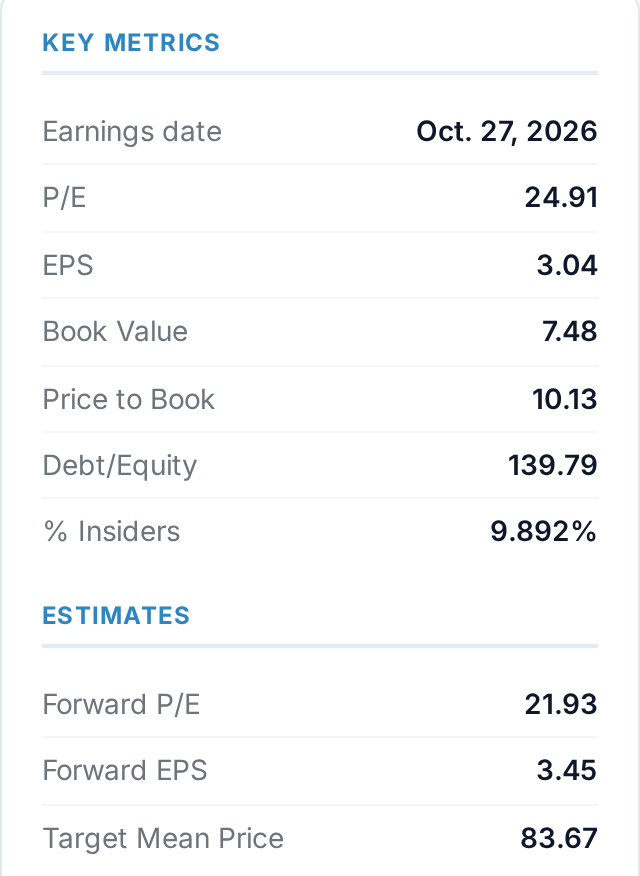
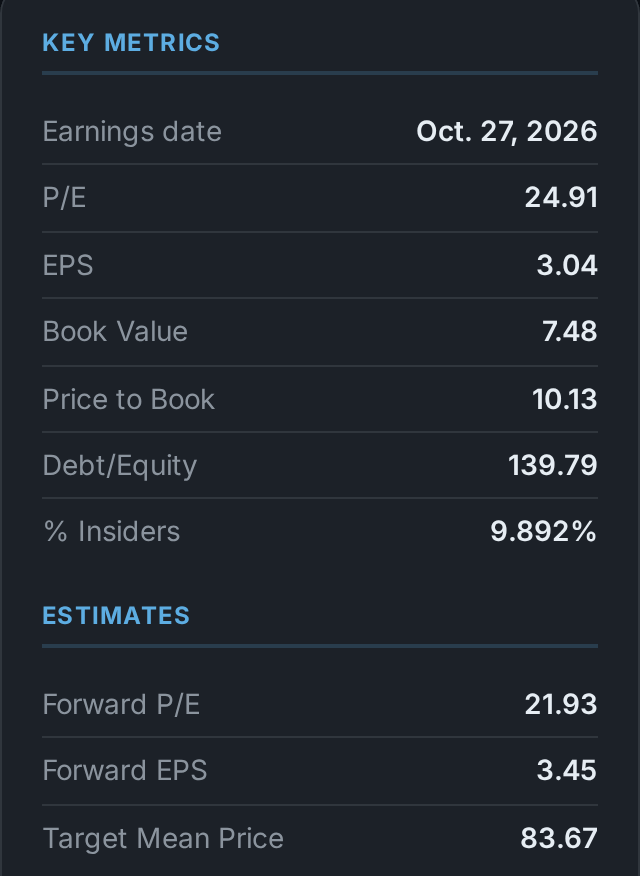
Coca-Cola: EPS and forward EPS

Every stock page lists the trailing EPS with the P/E, book value and debt to equity in its key metrics. The estimates underneath give the forward EPS analysts expect and the forward P/E built on it. After each report, the earnings recap shows whether EPS beat or missed the estimate and how the shares moved.

Open Coca-Cola's stock page
AllInvestView AllInvestView stock page for Coca-Cola (KO), key metrics: P/E 24.91, EPS 3.04, book value 7.48, price to book 10.13, debt/equity 139.79, insiders 9.892%; estimates: forward P/E 21.93, forward EPS 3.45, target mean price 83.67 AllInvestView stock page for Coca-Cola (KO), key metrics: P/E 24.91, EPS 3.04, book value 7.48, price to book 10.13, debt/equity 139.79, insiders 9.892%; estimates: forward P/E 21.93, forward EPS 3.45, target mean price 83.67
Coca-Cola's stock page with figures from our development database, not today's.View full-size View full-size

To follow results as they come out, the earnings recaps cover each company's quarter: EPS and revenue against the estimates, and the share price move after the report.

Every broker in one place

Your holdings, their earnings and your returns together

All your accounts in one portfolio, with each holding's EPS, P/E and earnings dates on its stock page, and your own returns, dividends and tax in the same place.

Stock pages with EPS and estimates Multi-broker portfolio Free plan available

Questions about earnings per share

How do you calculate earnings per share?

Start from net income, take off any preferred dividends, and divide what's left by the weighted average share count for the year. Alphabet earned $132.2 billion in 2025 and had no preferred stock; over 12,116 million basic shares that is $10.91 a share, and over 12,230 million diluted shares $10.81.

What is a good EPS?

There is no good EPS in dollars. The homebuilder NVR earned $436.55 a share in 2025 and Nvidia $4.90 in its year to January 2026, yet Nvidia's profit was 90 times NVR's: it simply has about 8,000 times as many shares. A good EPS is one that grows year after year from rising profit, is close to or above what analysts expected, and looks reasonable against the share price (the P/E).

What is the difference between basic and diluted EPS?

Basic EPS splits the profit over the shares already issued. Diluted EPS also counts the shares that options, RSUs and convertibles could add, so it's the same or lower. Tesla's 2025 basic EPS was $1.18; with 303 million more shares from its stock awards, diluted EPS was $1.08. Quote sites usually show the diluted figure.

What is adjusted EPS?

EPS worked out by the company itself after taking out items it sees as one-off or outside its main business, such as a tax charge, a restructuring or gains on investments. It is not defined by the accounting rules, so each company chooses its own adjustments and must reconcile them to the reported (GAAP) figure in its results. Meta reported $1.05 a share for the third quarter of 2025; without a one-time tax charge of $15.93 billion it would have been $7.25.

Can EPS be negative?

Yes, when the company loses money. Ford lost $8.2 billion in 2025, $2.06 a share. With a loss, diluted EPS is the same as basic: adding shares would make the loss per share look smaller, so the accounting rules leave them out. A negative EPS also means there is no meaningful P/E.

What is the difference between trailing and forward EPS?

Trailing EPS is what the company actually earned over the last 12 months, usually the sum of its last four quarters. Forward EPS is what analysts expect it to earn over the next 12 months. Microsoft's trailing EPS to September 2026 was $19.16; a forward P/E divides the price by the forward estimate instead.

Why can EPS grow faster than net income?

Because buybacks shrink the number of shares the profit is divided by. Oracle's net income rose 25% between its fiscal years to May 2015 and May 2025, but it bought back so many shares that its diluted share count fell 36%, and its EPS nearly doubled, from $2.21 to $4.34.

How is EPS related to the P/E ratio?

The P/E is the share price divided by EPS. Coca-Cola closed 2025 at $69.91 and earned $3.04 a share, a P/E of 23.0. Turn it upside down and you get the earnings yield: $3.04 ÷ $69.91 = 4.3% a year.

Sources

Checked on 30 October 2026.

Company figures are as reported in each company's filings with the SEC; ten-year comparisons are adjusted for stock splits. None of this is personal investment advice.