Plenty of room
Apple, Microsoft and JPMorgan pay a dividend and still keep most of what they earn, much of it for buybacks. The dividend can grow fast from here.
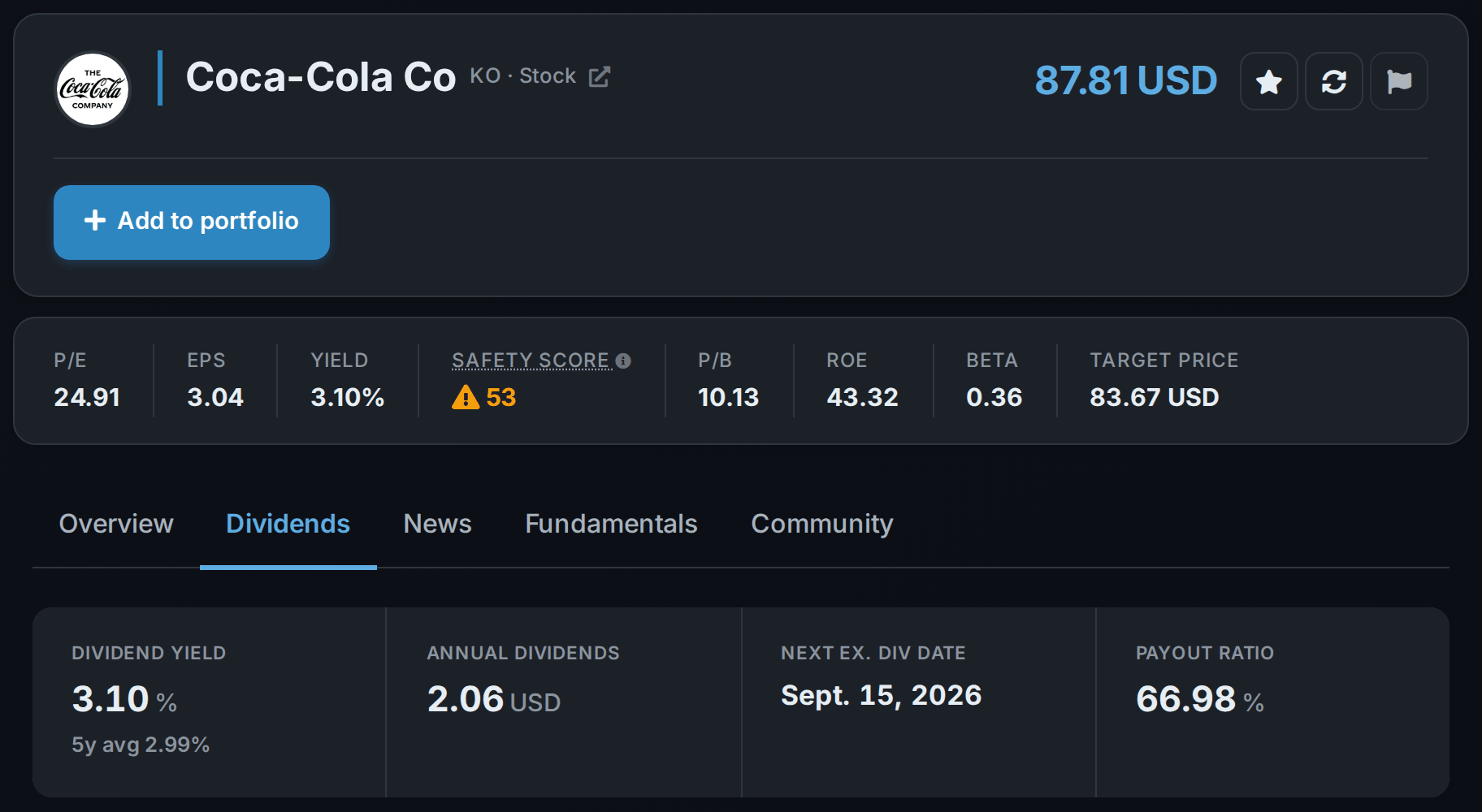
The payout ratio is the part of a company's earnings it pays out as dividends. Divide the dividend per share by earnings per share. Coca-Cola paid $2.04 a share in dividends in 2025 and earned $3.04, a payout ratio of 67%. The other 33% stayed in the business.
Most steady dividend payers sit between 30% and 70%. A low ratio leaves room to raise the dividend or ride out a bad year. Above 100%, the company paid out more than it earned that year. REITs, and companies with large accounting charges, look high on earnings and are better judged on the cash they make.
Or with company totals: dividends paid ÷ net income. Coca-Cola 2025: $2.04 ÷ $3.04 = 67.1%.
Use per-share figures or the company's totals from its annual report. Add free cash flow if you have it to see the cash payout ratio too. It starts with Coca-Cola's 2025 numbers.
Companies rarely change the dividend as fast as earnings move, so a bad year shows up in the payout ratio first. Orange bars are above 100%.
Use dividends and earnings for the same 12 months. Annual reports give both per share. Quote pages often show a trailing 12-month payout ratio, which moves every quarter as new results come in.
One the company can keep paying through a bad year. Here are 14 well-known dividend payers, from Apple to AbbVie, on their 2025 annual reports.










Dividends per share (declared, or paid where the report gives only that) and diluted earnings per share under US GAAP, from each company's 2025 annual report (fiscal years ending June 2025 for Microsoft and Procter & Gamble, September 2025 for Apple and December 2025 for the rest). The dashed line is 100%. Bars past 150% are cut short.
Apple, Microsoft and JPMorgan pay a dividend and still keep most of what they earn, much of it for buybacks. The dividend can grow fast from here.
Enough paid out to matter, enough kept to cover a weak year and keep raising the dividend. Most analysts would call this a healthy payout ratio.
Coca-Cola, Procter & Gamble and Verizon: staples, telecoms and utilities, whose profits hold up better than most in a downturn. Normal for them, a stretch for a business that's cyclical.
PepsiCo paid out 94% of its 2025 earnings. If profit fell by about 6%, the dividend would be more than the company earns.
Altria, Chevron, Pfizer and AbbVie paid out more than they earned in 2025. Sometimes it's an accounting charge, as with AbbVie. Sometimes earnings fell and the dividend is next, as at Intel.
There's no single good number. A payout ratio of 70% is fine for Coca-Cola, whose profits hold up better than most in a downturn, and stretched for a chipmaker whose profits can halve in a year. Compare a company with its own history and its sector, and look at the trend: a ratio climbing year after year while the dividend stays flat says earnings are falling.
Diluted EPS and dividends declared per share from Intel's annual reports.

A strong year. The dividend took under a third of earnings.
Earnings fell 60% and the dividend went up 5%. Three quarters of earnings went out.
Cut announced on 22 February 2023, from $0.365 to $0.125 a quarter. Earnings fell again.
A loss of $4.38 a share. On 1 August 2024 Intel suspended the dividend from the fourth quarter.
The dividend barely changed in 2022, and earnings fell 60%. The payout ratio went from 29% to 75% in one year, and the cut was announced a month after those results. Even after it, 2023's dividends were 185% of earnings. With the share price falling, the yield made the stock look like a bargain for income. The payout ratio said the dividend was outrunning the business.
Earnings per share follow accounting rules. A dividend is paid in cash. When the two drift apart, use the measure the company's cash really comes from.

$3.217 ÷ $1.17$3.217 ÷ $4.28Property companies charge depreciation on buildings that often hold their value, so earnings understate the cash. REITs report funds from operations (FFO) and adjusted FFO (AFFO), and the payout ratio is judged on those. A US REIT must also pay out at least 90% of its taxable income to keep its tax status.
$6.65 ÷ $2.36$6.65 ÷ $10.00AbbVie's GAAP earnings carry the cost of the companies it bought: $3.50 a share of amortization and $3.56 of changes in what it owes on past deals. Neither is cash out the door this year. The adjusted figure is the company's own, so check the cash flow statement before you lean on it.
cash out to shareholders= 75% cash payoutDividends paid divided by free cash flow: operating cash flow minus capital spending. It's the hardest version to flatter. Earnings can include gains that never arrive as cash; free cash flow can't. Round numbers here, for illustration.
The same ratio upside down, used in the UK: earnings per share ÷ dividend per share. Coca-Cola's 2025 cover is $3.04 ÷ $2.04 = 1.49×. Below 1× the dividend wasn't covered by earnings; 2× is often called comfortable.
What's kept is 1 − payout ratio. Multiply it by return on equity for the sustainable growth rate: a company earning 15% on equity that keeps 60% can grow about 9% a year without issuing new shares, as long as its debt grows in step with its equity.
Buybacks also return cash but aren't in the payout ratio; dividends plus buybacks over net income is the total payout ratio. ETFs and funds don't report one: what they pay out comes from the dividends and interest they receive, gains they've realized and sometimes your own capital handed back. See dividend yield for funds.
Stock pages show the payout ratio, and the dividend safety score built on it sits beside your holdings in the portfolio, from every broker you add.
The Dividends tab puts the payout ratio next to the yield, a year of dividends and the ex-dividend date. The safety score above it, from 0 to 100, weighs the payout ratio on earnings and on free cash flow, debt against earnings and how long the dividend has gone without a cut. REITs get thresholds of their own, and utilities count operating cash flow too.
See the dividend tracker AllInvestView
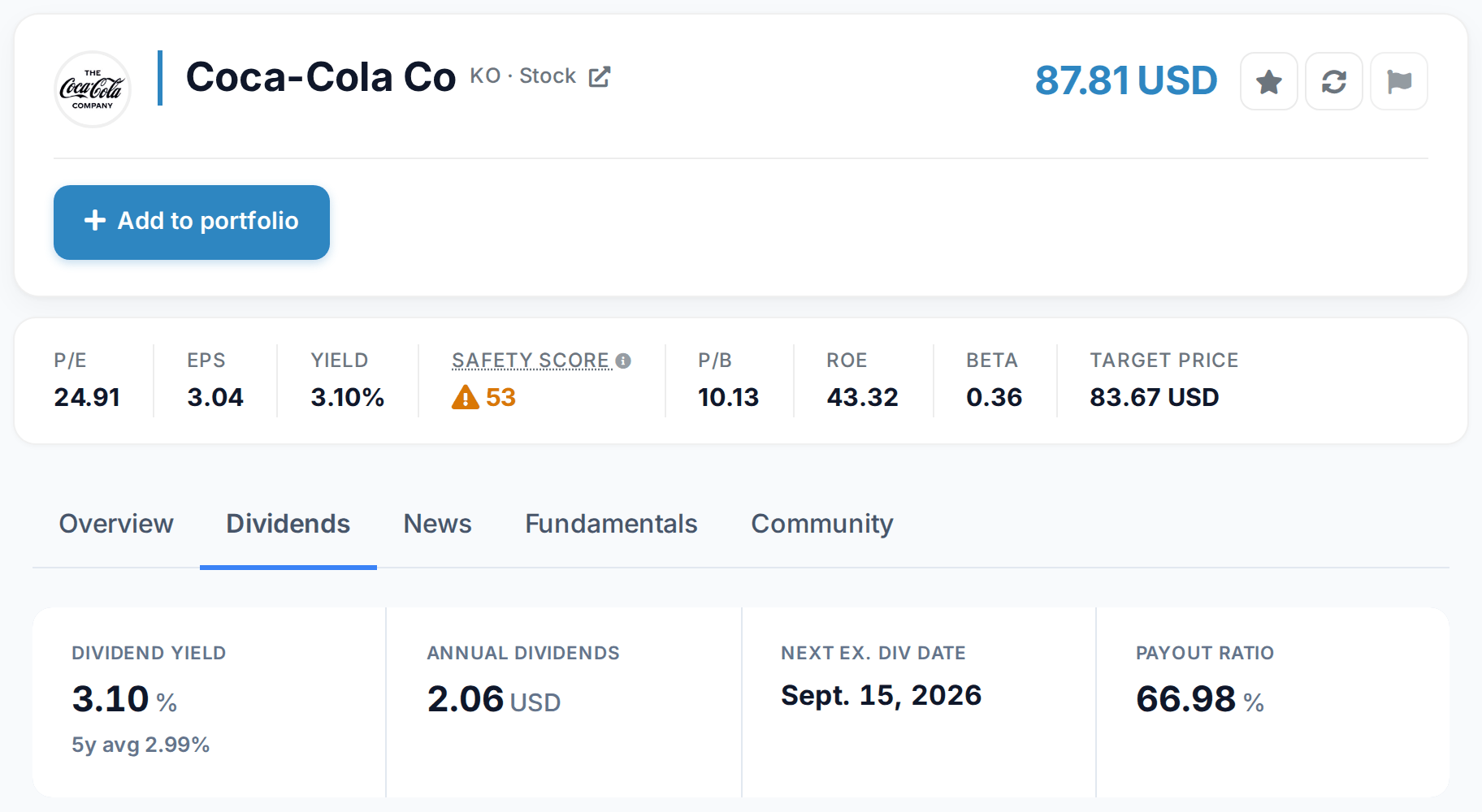
All your accounts in one portfolio, with dividend safety scores beside your holdings, their yield and yield on cost, a calendar of payments and what the coming year should pay you.
Divide the dividends per share for a year by the earnings per share for the same year and multiply by 100. Coca-Cola paid $2.04 in 2025 and earned $3.04 a share, so its payout ratio was 67%. With company totals it's dividends paid divided by net income.
For most companies, somewhere between 30% and 60%: enough to pay a real dividend with room to keep raising it through a bad year. Stable businesses like consumer staples and telecoms often run at 60% to 80%. Above 100% for more than a year, ask how the dividend is being paid.
Yes. It means the company paid more in dividends than it earned that year. It can be an accounting charge that cost no cash, as with AbbVie's 282% on 2025 GAAP earnings against 67% on its adjusted figure. Or earnings fell, as at Intel, where 185% in 2023 came between a cut and a suspension.
The company made a loss and still paid a dividend, so the dividend came from cash, borrowing or past profits. The number itself means nothing. Look at free cash flow and at how long the losses are expected to last.
On earnings they look stretched because depreciation on their buildings cuts reported profit without costing cash. Realty Income paid out 275% of its 2025 GAAP earnings but 75% of its adjusted funds from operations (AFFO), the measure REITs are judged on. A US REIT must also pay out at least 90% of its taxable income.
The payout ratio compares the dividend with the company's earnings and tells you how safe it is. The dividend yield compares it with the share price and tells you how much income you get for your money. A high yield with a payout ratio over 100% is the pairing to be careful with.
The part of earnings a company keeps: 100% minus the payout ratio. Coca-Cola kept 33% of its 2025 earnings. Multiplied by return on equity, it gives the growth rate a company can fund from its own profits.
Checked on 23 October 2026.
Payout ratios are worked from the per-share figures each company reports. None of this is personal investment advice.