
Mutual fundVanguard 500 Index Admiral (VFIAX)
PriceNAV
Premium or discountNone
You buy new shares from the fund and sell them back to it, priced at the day's NAV: $631.84 on 31 December 2025.
Net asset value (NAV) is what a fund owns minus what it owes, divided by the number of shares. It's the value of one share, worked out once a day after the market closes. On 30 September 2025 the SPDR S&P 500 ETF Trust (SPY) held $682.3 billion of assets, owed $2.0 billion and had 1.02 billion units: a NAV of $666.31.
A mutual fund's price is its NAV. ETFs and closed-end funds trade on an exchange, so their price can sit above NAV (a premium) or below it (a discount). SPY's price stayed within 0.5% of its NAV every day in the five years to September 2025. Adams Diversified Equity Fund ended 2025 at $23.32, 5.7% below its $24.72 NAV.
SPY on 30 September 2025: ($682.26bn − $1.97bn) ÷ 1,020.98m units = $666.31.


Enter a fund's total assets, total liabilities and shares outstanding from its latest report. Add the market price to see the premium or discount, and your own shares to see what they're worth. It starts with SPY on 30 September 2025.
(Price − NAV) ÷ NAV. Left of the middle mark the fund trades at a discount, right of it at a premium. The four cards are real funds on the dates shown.

Every fund publishes a statement of assets and liabilities in its annual report. This is SPY's on 30 September 2025, rounded to millions.
SPDR S&P 500 ETF TrustLiabilities were 0.3% of the assets, so SPY's NAV is almost exactly the value of its stocks. Most of what it owed was a dividend already declared to its holders.
US mutual funds must work out their NAV at least once every business day, normally when the New York Stock Exchange closes at 4 pm Eastern.
Buy and sell orders for a mutual fund are collected during the day. None of them has a price yet.
The fund values every holding at its closing price, or a fair value when a market is shut or a price is stale.
The day's dividends and interest go in, a day's share of the fees comes out, and the total is divided by the shares.
Orders that reached the fund before the cutoff are filled at that NAV, and it's the price your broker shows for the fund.
A mutual fund has one price a day, its NAV. ETFs and closed-end funds trade all day on an exchange at whatever buyers pay, which can be more or less than what the fund holds is worth.
ADX at the end of 2025: ($23.32 − $24.72) ÷ $24.72 = −5.7%, a discount. A positive result is a premium.
You buy new shares from the fund and sell them back to it, priced at the day's NAV: $631.84 on 31 December 2025.
Large dealers can swap blocks of 50,000 units for the stocks inside, so the price can't drift far from NAV. In the five years to September 2025, SPY's price was never 0.5% away from it.
That can break in a panic: in March 2020 the iShares investment grade bond ETF (LQD) traded about 5% below its NAV.
A closed-end fund doesn't buy its shares back on demand at NAV, so its price can stay below NAV for years. ADX returned 25.7% on its market price in 2025 and 18.9% on NAV, because its discount narrowed.
For a big index ETF the price and the NAV stay very close, so the price is a fair guide to what the fund holds. For a closed-end fund, check the discount before you buy: buying at a 5.7% discount gets you $1 of assets for about 94 cents, but the discount can widen after you buy.
Vanguard 500 Index Fund is one portfolio of $1.48 trillion split into four share classes. On 31 December 2025 they had four different NAVs.
The NAV depends on the price each class started at and how many shares it has, not on what it holds. At those NAVs, $10,000 is 15.8 Admiral Shares or 29.9 Institutional Select Shares, the same slice of the portfolio either way. The returns differ only by the fee: from 0.14% a year for Investor Shares to 0.01% for Institutional Select.
Judge a fund by what it holds, its fee and its total return. A $10 NAV isn't a bargain and a $600 NAV isn't expensive: you get the same slice of the portfolio for every dollar you put in.
When a fund goes ex-dividend, the dividend is set aside for its holders and the NAV falls by the same amount. Here is how SPY's NAV per unit moved in its year to 30 September 2025.
The scale starts at $540, not $0, so the steps are big enough to see. The $7.25 paid out was SPY's four quarterly dividends; on each ex-dividend date the NAV fell by that quarter's amount.
Watching only the NAV, or the price, understates what a fund paid you. A bond fund or a high-dividend fund can end a year with its NAV where it started and still have paid you several percent in income. That's why total return, with the distributions counted, is the fair way to judge it.
AllInvestView values each fund you hold at its latest price: the NAV for a mutual fund, the market price for an ETF. Every broker's holdings land in one portfolio, with total return that counts the dividends.
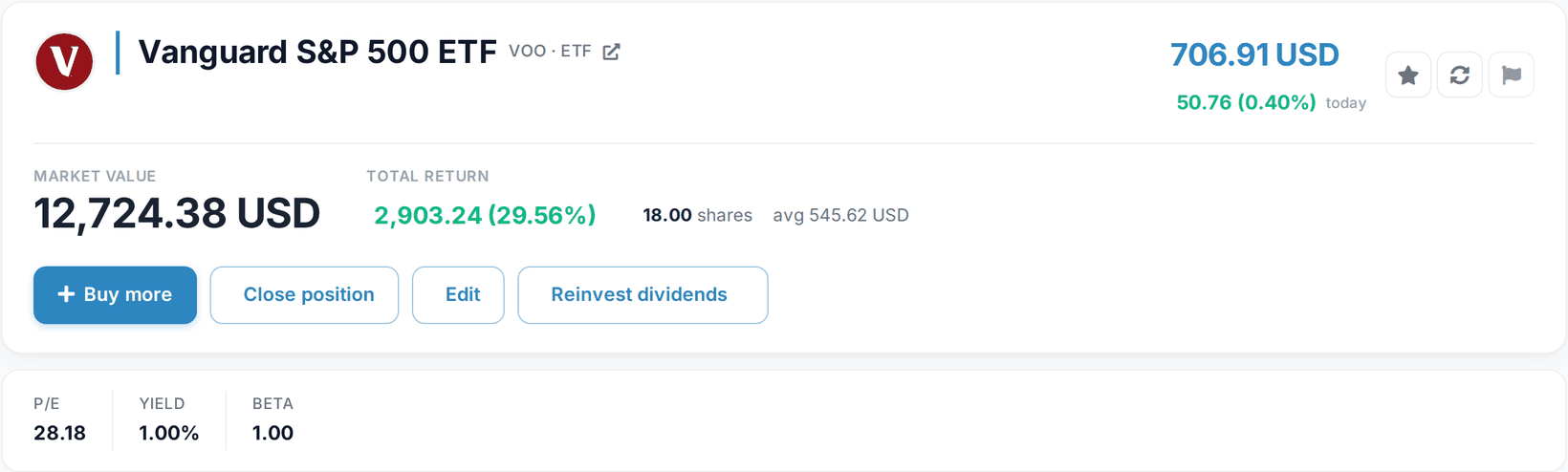
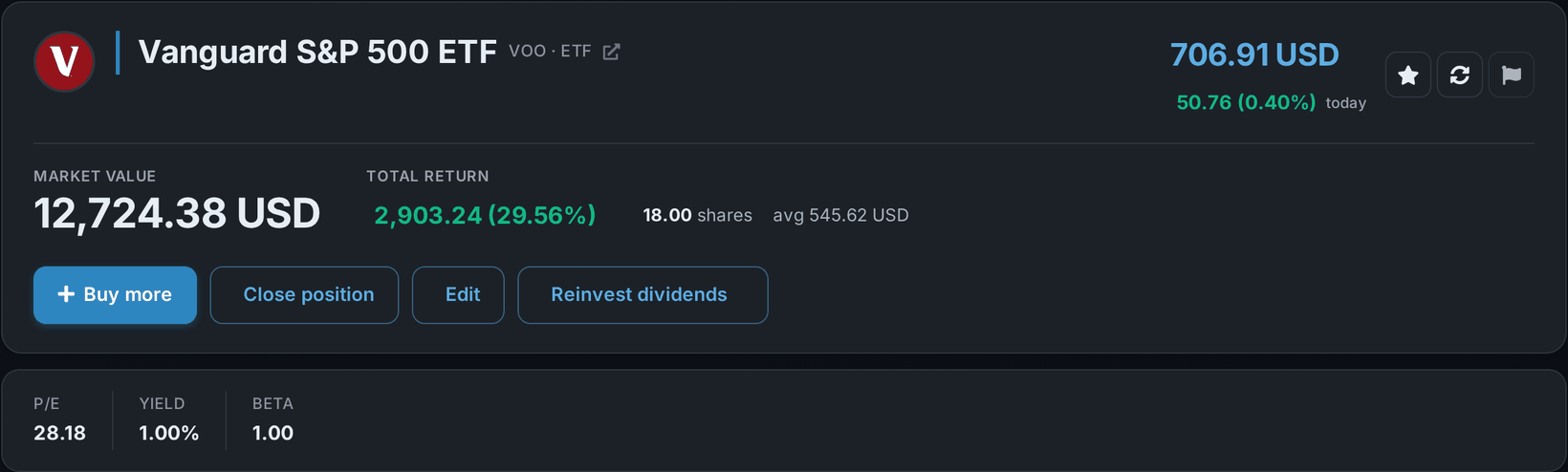
Each fund you own gets its own page: the latest price, the day's move, what your shares are worth and your total return. Market value is your shares times the price, so 18 shares at $706.91 come to $12,724.38. Reinvested dividends buy more shares, and the return counts them.
Look inside your ETFs for free AllInvestView
Mutual funds, ETFs, stocks, bonds and crypto from all your accounts in one portfolio, with total return, dividends, fees and tax in the same place.
Add up everything the fund owns at the day's closing prices, take off everything it owes, and divide by the number of shares. On 30 September 2025 SPY had $682.26 billion of assets and $1.97 billion of liabilities, so $680.29 billion of net assets over 1,020.98 million units: $666.31 a unit.
It's the price of one share. A mutual fund works out its NAV once a day after the US market closes, usually at 4 pm Eastern, and orders the fund receives before then get that day's NAV. An order that arrives after the cutoff gets the next business day's.
For a mutual fund, yes: its price is its NAV. ETFs and closed-end funds trade on an exchange, so their price can differ from NAV. SPY's price was never 0.5% away from its NAV at the daily calculation in the five years to September 2025. Adams Diversified Equity Fund, a closed-end fund, ended 2025 at $23.32 against a NAV of $24.72, a 5.7% discount.
No. NAV only tells you how the fund's assets are split into shares. Vanguard 500 Index Fund's Admiral Shares had a NAV of $631.84 at the end of 2025 and its Institutional Select Shares $335.01, but both own the same portfolio and returned 17.83% and 17.86% that year. The difference came from fees, not the share price.
Either the investments fell in value, or the fund paid out a dividend or capital gain. A distribution comes out of the fund's assets, so the NAV falls by about that amount on the ex-dividend date. You haven't lost that money: it's paid to you, or reinvested in more shares.
It's how far the market price is from the NAV: (price − NAV) ÷ NAV. A price above NAV is a premium, below it a discount. Big ETFs stay very close because large investors can swap fund shares for the underlying holdings. Closed-end funds don't buy their shares back on demand at NAV, so many trade at a discount for years.
Yes. A fund takes its fees out of its assets a little every day, so the NAV you see is already after costs. On SPY's 0.0945% a year, that's about a sixth of a cent per unit a day at a NAV of $666.
Checked on 24 October 2026.
Fund figures are taken from each fund's audited annual report. None of this is personal investment advice.