Glossary · bonds

Bond Duration: How Much a Bond's Price Moves When Rates Move

Duration, in years, tells you roughly what percentage a bond's price changes for a 1 point change in interest rates. A 10-year Treasury paying 5.00%, bought at par at the 26 October 2026 10-year yield of 5.00%, has a modified duration of 7.79. If yields rise 1 point it falls about 7.8% (exactly −7.44%); if they fall 1 point it gains about 7.8% (exactly +8.18%).

The longer the duration, the bigger the swing. Duration is shorter than maturity because the coupons pay you back along the way, so a 30-year Treasury has a duration of about 15. Only a zero-coupon bond's duration equals its maturity.

The formula
% price change≈−modified duration×Δ yield

The 10-year Treasury at 5.00%, yields up 1 point: −7.79 × 1 ≈ −7.8%.

2-year Treasury1.89at 4.68%falls about 1.9% if yields rise 1 point
10-year Treasury7.79at 5.00%falls about 7.8% if yields rise 1 point
30-year Treasury14.92at 5.31%falls about 14.9% if yields rise 1 point

Bond duration calculator

Enter the coupon, the yield to maturity and the years left. You get the Macaulay and modified duration, convexity, DV01 and what a move in rates would do to the price, by duration and repriced exactly. It starts with the 10-year Treasury above.

The bond

Coupons per year

Coupon and yield are yearly percentages. Commas work as decimal points too (5,31). A negative rate move tests a fall in yields.

Modified duration
0
Macaulay duration-average wait for your money, weighted by what each payment is worth today
Convexity-how much the price curve bends away from the duration line
DV01-value change for a 0.01 point move
Price per 100--

What a move in rates would do to this bond

The dashed bar is the duration estimate, the solid bar is the bond repriced at the new yield. The gap between them is convexity: it trims the losses and adds to the gains.

Yields moveDuration saysWith convexityExactOn your bond

Cash flows and the balance point

Each bar is a payment. The solid part is what it is worth today at your yield.

When the years fall between coupon dates, the first coupon comes sooner and the price includes accrued interest. Bond funds and callable bonds publish effective duration instead, which allows for cash flows that change with rates.

Duration vs maturity: a 30-year Treasury has a duration of 15

Each Treasury maturity priced at par on its 26 October 2026 yield. Maturity grows in a straight line; duration bends, because the coupons pay part of your money back long before the end.

Macaulay duration by maturity, in years

Par TreasuryMaturity (zero-coupon)
7.9910-year 12.5220-year 15.3230-year 30.0030-year zero-coupon Maturity

Years to maturity

The shaded gap is the money the coupons hand back early. On the 30-year bond it halves the duration.

MaturityYieldMacaulayMac.ModifiedMod.Yields +1 point+1Yields −1 point−1
1-yearat 4.47%4.47%0.990.97−0.96%+0.97%
2-yearat 4.68%4.68%1.931.89−1.87%+1.91%
3-yearat 4.79%4.79%2.832.76−2.72%+2.81%
5-yearat 4.84%4.84%4.504.39−4.28%+4.51%
7-yearat 4.91%4.91%6.015.86−5.67%+6.07%
10-yearat 5.00%5.00%7.997.79−7.44%+8.18%
20-yearat 5.35%5.35%12.5212.19−11.24%+13.27%
30-yearat 5.31%5.31%15.3214.92−13.39%+16.75%
30-year zerono couponsat 5.31%5.31%30.0029.22−25.29%+34.04%

Price changes are exact, repriced at the new yield. A higher coupon or a higher yield shortens duration: more of your money comes back early, and later payments count for less today.

2022: what duration did to bond funds

Treasury yields climbed through 2022. Here are the year's total returns of Treasury funds, ranked by how long the bonds they hold are, with dividends reinvested.

2-year yield0.73% 4.41%
10-year yield1.52% 3.88%
30-year yield1.90% 3.97%

Total return, 31 December 2021 to 30 December 2022

US Treasury funds, shortest bonds first

SHYTreasuries due in 1 to 3 years
−3.9%
IEITreasuries due in 3 to 7 years
−9.5%
IEFTreasuries due in 7 to 10 years
−15.2%
TLHTreasuries due in 10 to 20 years
−25.2%
TLTTreasuries due in more than 20 years
−31.2%
EDVZero-coupon Treasury STRIPS due in 20 to 30 years
−39.2%
ZROZZero-coupon Treasury STRIPS due in 25 years or more
−41.3%

The broad US bond market

AGGiShares Core U.S. Aggregate Bond ETF
−13.0%
BNDVanguard Total Bond Market ETF
−13.1%

The longer the bonds, the bigger the fall. All seven hold only US Treasuries; what separates them is how far away the money is. The two zero-coupon funds, EDV and ZROZ, fell most: the bonds they hold pay nothing until maturity, so their duration is closest to their maturity.

Macaulay vs modified vs effective duration, and DV01

Three numbers share the name. Macaulay is a time, modified is a price sensitivity, and effective is the one measured by repricing.

Time

Macaulay duration

The weighted average time until you get your money back, each payment weighted by what it is worth today. Frederick Macaulay set it out in 1938.

Unit
Years
Use it
To match a bond to the date you need the money; it is the balance point on the cash-flow timeline
Formula
Σ (t × PV of payment) ÷ price
Price sensitivity

Modified duration

Macaulay duration divided by (1 + yield ÷ coupons per year). It reads as the % change in price for a 1 point change in yield. The 10-year Treasury: 7.99 ÷ 1.025 = 7.79.

Unit
% per 1 point of yield, quoted in years
Use it
To estimate the gain or loss on a plain bond for a rate move
Formula
Macaulay ÷ (1 + y ÷ f)
Measured

Effective duration

Worked out by repricing the bond with yields shifted up and down. It works when cash flows change with rates, as with callable bonds and mortgage-backed securities, and it's the number bond funds publish.

Unit
% per 1 point of yield
Use it
For callable bonds, mortgage-backed securities and funds
Formula
(P down − P up) ÷ (2 × P × Δy)
DV01

The dollar value of a basis point: what a bond gains or loses when yields move 0.01 point. It's modified duration × value × 0.0001, so $10,000 of the 10-year Treasury has a DV01 of 7.79 × $10,000 × 0.0001 = $7.79. Traders add up DV01s to see a whole book's rate risk in dollars.

Macaulay duration by hand

A 3-year bond paying 5% once a year, yield 5%, price 100.

YearCashPresent valuePVWeightYear × weightt × w
154.7620.04760.0476
254.5350.04540.0907
310590.7030.90702.7211
Total115100.0001.00002.859

Present value is cash ÷ 1.05year; the weight is present value ÷ price. Macaulay duration is the sum of year × weight, 2.859 years. Modified duration is 2.859 ÷ 1.05 = 2.723.

Duration in Excel

=DURATION(settlement, maturity, coupon, yld, frequency, [basis]) returns the Macaulay duration, and =MDURATION() takes the same arguments and returns the modified duration. Coupon and yield go in as decimals, frequency is 1, 2 or 4.

The 10-year Treasury above, settled on 26 October 2026:

=DURATION(DATE(2026,10,26), DATE(2036,10,26), 0.05, 0.05, 2)

gives 7.99, and MDURATION with the same inputs gives 7.79. For a bond you don't hold yet, the yield to maturity calculator finds the yield from its price first.

Convexity: why duration overstates losses

Duration is a straight line. A bond's real price moves along a curve, and the further rates move, the more the two part. Here is the 30-year Treasury at 5.31%, bought at par.

Price change of the 30-year Treasury for a move in yields

ExactDuration line
+64.67%exact +44.77%duration −32.96%exact −44.77%duration at +3

Change in yield, points

Yields +0.5 point
−7.06%exact−7.46%duration
Yields +1 point
−13.39%exact−14.92%duration−13.26%with convexity
Yields +3 points
−32.96%exact−44.77%duration−29.76%with convexity
Yields −3 points
+64.67%exact+44.77%duration+59.78%with convexity

For small moves duration is close: half a point costs this bond 7.06%, against 7.46% by duration. For big moves it overstates the losses and understates the gains. Adding convexity fixes most of the gap: % change ≈ −modified duration × Δy + ½ × convexity × Δy², with this bond's convexity of 333.6. A plain bond's convexity is always positive. Callable bonds and mortgage-backed securities can have negative convexity: when rates fall, the issuer calls the bond or homeowners refinance, so the price gains less than duration says.

Duration of a bond portfolio or fund

Average each bond's duration, weighted by its market value. A fund does the same sum across everything it holds and publishes the result, usually as effective duration.

Two Treasuries, one duration

$10,000 of the 2-year and $10,000 of the 30-year, both at par:

Half the money at 1.89 and half at 14.92 gives 8.41: close to the 10-year's 7.79, but with very different bonds underneath. A 1 point rise in yields costs the two-bond book about 8.4% by duration.

If you hold to maturity

A Treasury held to maturity still pays back its face value. Duration is about the price along the way: what you would get if you sold before then, and what your statement shows in between.

Bond report · Risk

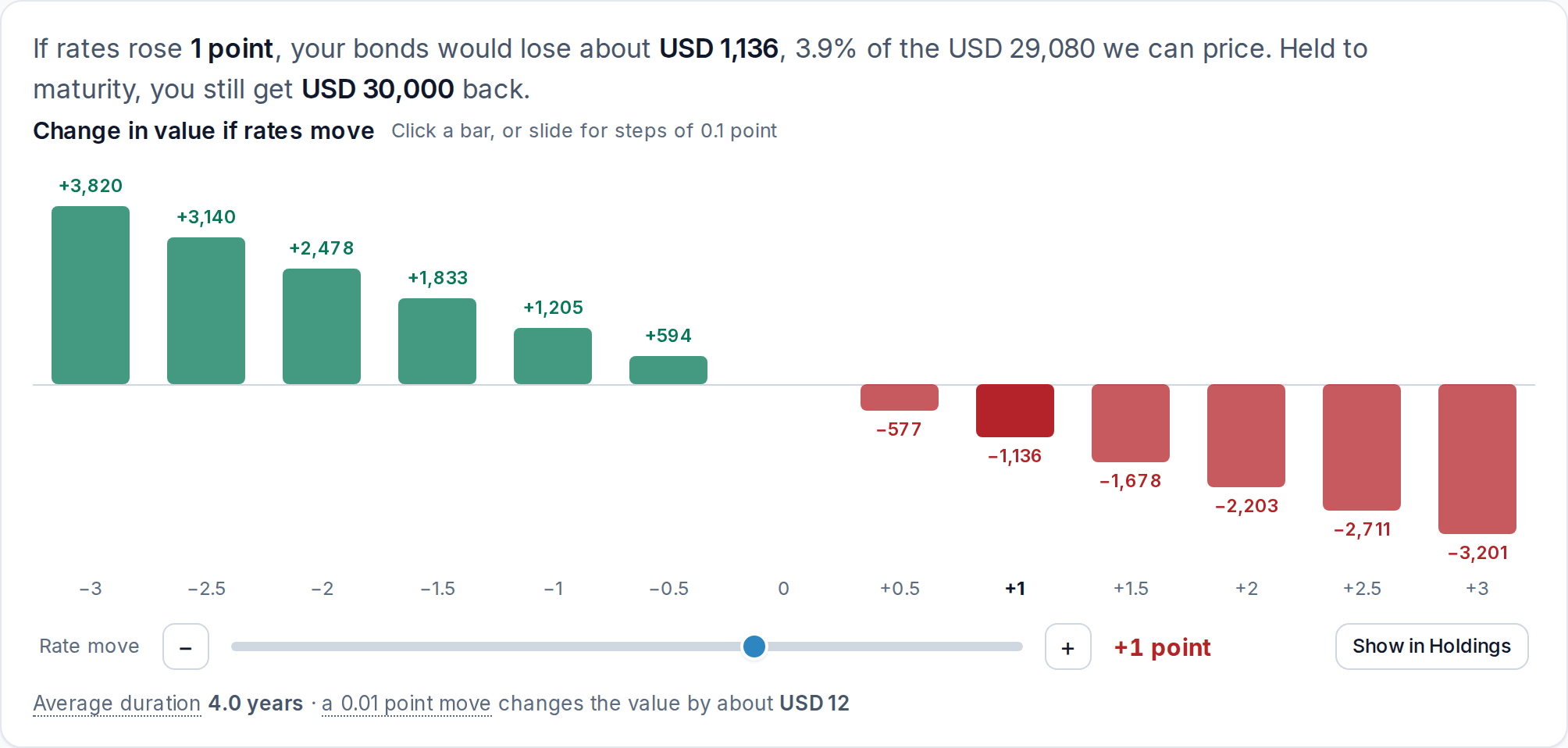
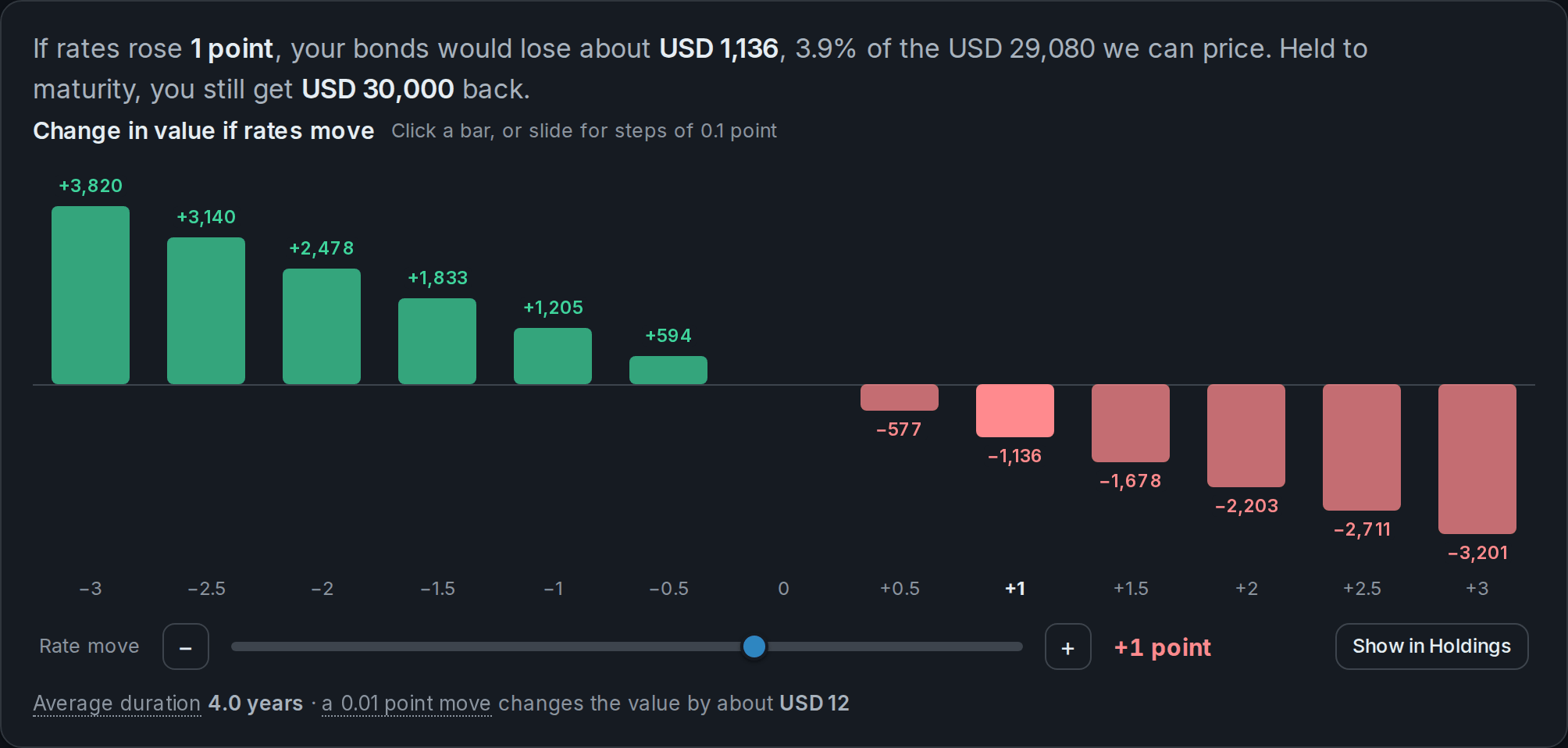
Your bonds' duration and what a rate move would do

AllInvestView shows each bond's duration and convexity, and your bond book's average duration with what a 0.01 point move is worth. The Risk tab uses duration and convexity to estimate what each bond would gain or lose for rate moves from −3 to +3 points, in your own currency. Next to it, what you still get back if you hold every bond to maturity.

See the bond tracker
AllInvestView Change in value if rates move in the bond report: a 1 point rise would lose about USD 1,136, 3.9% of USD 29,080, with USD 30,000 back at maturity; average duration 4.0 years and about USD 12 for a 0.01 point move Change in value if rates move in the bond report: a 1 point rise would lose about USD 1,136, 3.9% of USD 29,080, with USD 30,000 back at maturity; average duration 4.0 years and about USD 12 for a 0.01 point move
A demo book of three example bonds: average duration 4.0 years, about USD 12 for a 0.01 point move, and about USD 1,136 of USD 29,080 lost if rates rose 1 point.View full-size View full-size

Your own bonds get the same treatment in the bond report: each bond's yield, duration and convexity, the book's average duration and the gain or loss for any rate move. To check a single bond's yield before you buy, use the yield to maturity calculator.

Bonds next to everything else

Know what a rate move would do to your bonds

Your bonds, bond funds, stocks and cash in one portfolio, with each bond's duration and convexity and your bond book's rate risk in your own currency.

Duration and convexity per bond Rate moves from −3 to +3 points Free plan available

Questions about bond duration

What is bond duration in simple terms?

It's how much a bond's price moves when interest rates move, measured in years. A duration of 7.79 means the price moves about 7.8% for each 1 point change in yields: down when yields rise, up when they fall. That is the 10-year Treasury bought at par at 5.00% on 26 October 2026.

What is the difference between Macaulay and modified duration?

Macaulay duration is the weighted average time until a bond pays you back, in years: 7.99 for the 10-year Treasury at 5.00%. Modified duration divides it by 1 plus the yield per coupon period, 7.99 ÷ 1.025 = 7.79, and reads as the % price change for a 1 point move in yields. Use Macaulay for timing and modified for price risk.

Is a higher duration better or worse?

Neither on its own: it's a bigger bet on rates. A 30-year Treasury with a modified duration of 14.92 gains 16.75% if yields fall 1 point and loses 13.39% if they rise 1 point, while a 2-year Treasury moves about 1.9% either way. A long duration suits you if you expect rates to fall or can sit through the drops.

What is the difference between duration and maturity?

Maturity is the date the bond pays back its face value. Duration is when, on average, you get your money back, counting every coupon, so it is shorter: a 30-year Treasury at 5.31% has a Macaulay duration of 15.32 years. Only a zero-coupon bond's duration equals its maturity.

How do you calculate the duration of a bond portfolio or fund?

Average each bond's duration, weighted by its market value. $10,000 of a 2-year Treasury (modified duration 1.89) and $10,000 of a 30-year (14.92) give a portfolio duration of about 8.41. Bond funds do the same sum across all their holdings and publish it, usually as effective duration.

What is a good duration for a bond fund?

There's no single good number: it follows the bonds the fund holds. Short funds hold bonds due within a few years, like SHY's 1 to 3 year Treasuries; long funds hold bonds due in 20 years or more, like TLT; zero-coupon funds such as EDV and ZROZ are the longest because the bonds they hold pay nothing before maturity. In 2022 SHY lost 3.9%, TLT 31.2% and ZROZ 41.3%, and each fund's own page publishes its current effective duration.

What is bond convexity?

Convexity measures how much a bond's price curve bends away from the straight line duration draws. For the 30-year Treasury at 5.31%, with a convexity of 333.6, duration says a 3 point rise in yields costs 44.77%; the real fall is 32.96%. Plain bonds have positive convexity, so their losses are smaller and their gains bigger than duration predicts.

Sources

Checked on 28 October 2026.

Treasury figures are par bonds with semiannual coupons, priced at the FRED constant-maturity yields of 26 October 2026. Fund returns are from adjusted closing prices, with distributions reinvested. None of this is personal investment advice.