Fund distributions
A mutual fund or ETF that sells at a gain passes it on as a capital gain distribution, box 2a of Form 1099-DIV. You pay tax on it that year even if you never sold a share, and even if you reinvested it.
An unrealized gain is how much an investment you still own has gone up since you bought it: what it's worth today minus what you paid, its cost basis. It's a gain on paper. It becomes a realized gain when you sell, and in the US that's when it's taxed. An unrealized loss is the same thing when the price is below what you paid.
Ten Meta shares bought for $3,820.50 on 1 September 2021 were worth $7,251.80 on 30 September 2026: an unrealized gain of $3,431.30, or 89.8%. In November 2022 the same shares showed an unrealized loss of 76.7%. Their owner paid no tax at either point, because nothing was sold.
10 × $725.18 = $7,251.80, minus the $3,820.50 they cost, is $3,431.30. Divide by the cost for the percentage: 89.8%.
The gap between the blue line and the dashed one is the unrealized gain or loss on any day. It changed every trading day and none of it was taxed.

The paper loss of 2022 never cost anything, and the gain of 2025 shrank by $648 before anyone could spend it. An unrealized number tells you where you stand today. Only a sale fixes it, and the sale decides the tax. The $56.75 of dividends these shares paid since 2024 isn't in the gain: dividends are income the day they're paid.
Closing prices on the purchase day and at each month-end, plus the lowest and highest closes in between, not adjusted for dividends.
Enter what you hold, what you paid a share and today's price. You'll see the gain or loss on each holding, the total, and the tax you'd owe if you sold everything at the rate you pick.
The shaded bar is the cost basis and the dark mark is where it ends. The blue bar is today's value: past the mark is a gain, short of it a loss.
It starts with three real holdings valued on 30 September 2026: the ten Meta shares above, 60 Apple shares bought on 3 January 2023 and 30 Nike shares bought on 2 January 2024. The tax is a flat estimate on the net gain: in a real sale, losses first offset gains of the same term, and up to $3,000 a year of a net loss can come off other income. State tax isn't included.
100 Apple shares bought on 3 January 2023 at $125.07, for $12,507.00. Forty of them sold on 31 December 2024. Sixty still held on 30 September 2026.

| Realized gain or loss | Unrealized gain or loss | |
|---|---|---|
| What it is | Sale proceeds minus the cost of the shares sold | Today's value minus the cost of the shares you still hold |
| When it changes | Never: it's fixed on the trade date | Every time the price moves |
| US tax | Goes on that year's return: Form 8949 and Schedule D | Nothing until you sell, with the exceptions below |
| A loss | Offsets gains, then up to $3,000 a year of other income | Does nothing for your taxes until you sell |
| In total return | Yes | Yes, together with dividends |
Selling part of a position splits it: the shares you sold give a realized gain that's done, the shares you kept carry on as an unrealized one. Which shares count as sold depends on the cost basis method. With one purchase it makes no difference; with several lots it can change the realized gain a lot.
In the US the rule is simple: no sale, no tax. The exceptions are where people get caught.
US tax law taxes a gain once it's realized, which for shares means a sale (or a swap for something else). A stock that triples while you hold it adds nothing to your tax bill. That's why the date you sell, and which lots you sell, matter so much: they decide the year, the rate and whether a loss is there to offset the gain.
When someone dies, their heirs get the shares with a cost basis equal to their value on the date of death. Apple shares bought at $125.07 and worth $333.02 when inherited have a $333.02 basis, so the unrealized gain of the owner's lifetime is never taxed as income. Gifts don't get this: the person receiving them takes over the giver's basis.
A mutual fund or ETF that sells at a gain passes it on as a capital gain distribution, box 2a of Form 1099-DIV. You pay tax on it that year even if you never sold a share, and even if you reinvested it.
Section 1256 contracts, such as futures and options on broad indexes like the S&P 500, are treated as sold at their value on the last business day of the year: 60% long-term and 40% short-term, on Form 6781.
Someone who qualifies as a trader can choose mark-to-market under section 475(f): every position in the trading business is valued at year-end and counts as ordinary income or loss, with no wash sales and no $3,000 limit. Shares held as investments stay outside it.
A covered expatriate is treated as having sold everything the day before leaving the US tax system, with a large amount of the gain excluded. Canada does something similar when you leave the country, and when you die.
Mostly on investment funds: every year in three of them, every eight years in Ireland.
Tax on an assumed yearly return on your investments, sold or not, at 36%. If your actual return was lower, counting price rises you haven't sold, you can show the actual return instead.
Accumulating funds and ETFs on the tax agency's list are taxed on their rise in value each year as share income, sold or not. A fall in value is a loss you can use.
Investing in DenmarkMost EU-based funds and ETFs are treated as sold every eight years, and the gain is taxed at the exit tax rate: 38% from 2026, 41% before. The tax paid counts against the tax when you really sell.
Deemed disposal calculatorFunds that don't pay out enough are taxed each year on a notional return: the value at the start of the year × the base rate (3.20% for 2026) × 70%, capped at what the fund actually gained, less any payouts.
Vorabpauschale calculatorA minimum tax on households worth more than $100 million, counting unrealized gains as income, was in the 2023 budget proposal at 20% and in the 2024 and 2025 ones at 25%.
Never passedThe court upheld a one-time tax on Americans' shares of foreign companies' profits, and said it wasn't deciding whether a gain you haven't realized can be taxed.
Question left openThe first version would have taxed unrealized gains inside large super accounts. The law passed in March 2026 taxes realized earnings only, from 1 July 2026.
Unrealized part droppedThe same idea from two other sides: the losses you can still use, and why a company's profit can jump without it selling anything.
The 30 Nike shares in the calculator cost $3,196.50 on 2 January 2024 and were worth $1,062.00 on 30 September 2026: an unrealized loss of $2,134.50. Sell them and the loss becomes realized. It cancels $2,134.50 of other gains you realize that year, such as selling the rest of the Apple shares, or up to $3,000 of other income.
That's tax-loss harvesting. The catch is the wash sale rule: buy the same shares back within 30 days before or after the sale, in any of your accounts, and the loss is put off until you sell the new shares, or lost for good if you bought them back in an IRA.
Since 2018, US accounting rules make companies put the rise or fall in value of the shares they own into net income, sold or not. Berkshire holds hundreds of billions of dollars of shares, so its reported profit swings with the stock market.
Warren Buffett tells shareholders every year to look at operating earnings instead. Bonds a company holds as available for sale are different: their unrealized gains and losses go to other comprehensive income, and those it holds to maturity aren't marked to market at all.
Each broker shows the gain on the shares it holds. Your real number is all of them together, worked out from the same cost basis your tax return will use.
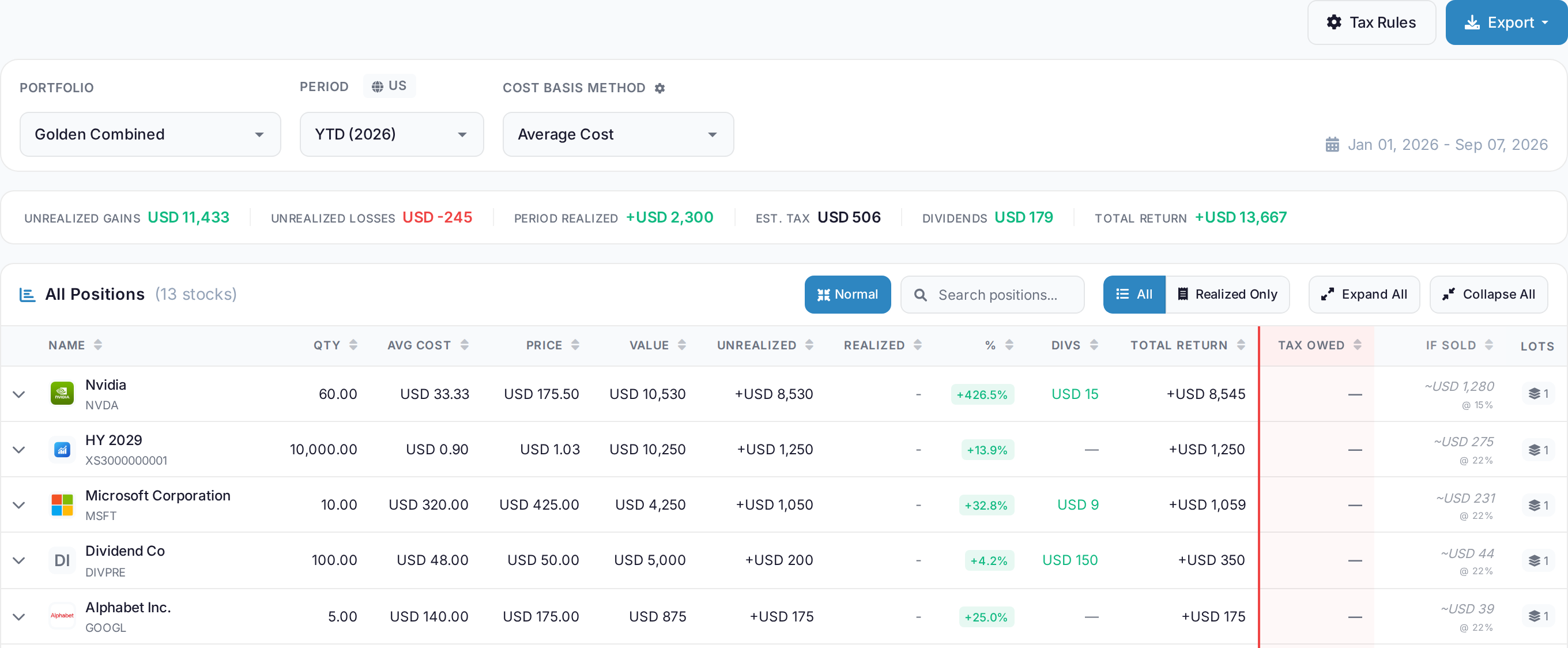
Every position shows its unrealized gain or loss next to what you realized in the period, your dividends and the tax you would owe if you sold today, under the tax rules of your country. Pick a combined portfolio and it covers the accounts you put in it, at any broker, with FIFO, LIFO, HIFO or average cost.
See the capital gains tax report AllInvestView
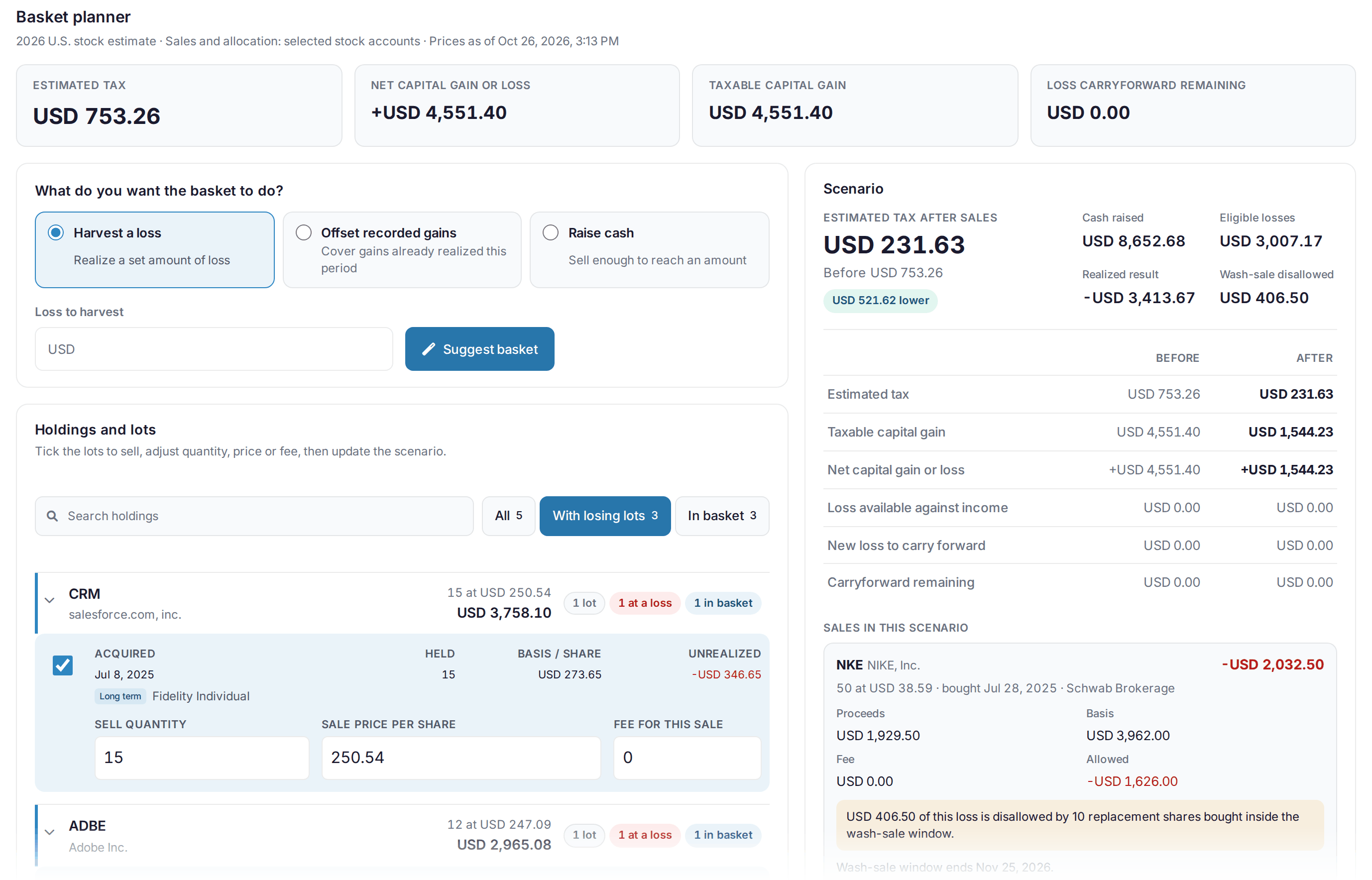
The basket planner lists each lot at a loss with its unrealized loss, the account it sits in and whether it is short or long term. Pick the lots to sell and it shows the tax before and after, and the part of a loss a wash sale would block.
Read the tax-loss harvesting guideAllInvestView
Connect your brokers or import your history and see each holding's gain or loss on its real cost basis, what you've realized this year, every dividend, and the tax you'd owe if you sold. Tax reports for the US, the UK, Canada, Australia, Ireland, Germany, Spain and more.
In the US, not until you sell. A share that doubles in value adds nothing to your tax bill while you keep it. The exceptions are fund capital gain distributions (the fund sold, so you pay even though you didn't), futures and broad index options, which are taxed at their year-end value, and the exit tax on some people who give up US citizenship. A few countries tax some unrealized gains without a sale: the Netherlands, Denmark and Germany every year, and Ireland every eight years on most funds.
A realized gain is locked in by a sale: you got the money and the gain goes on that year's tax return. An unrealized gain is on investments you still hold and moves with the price every day. Buy 100 Apple shares at $125.07, sell 40 at $250.42 and keep 60 at $333.02: $5,014.00 is realized and $12,477.00 is unrealized.
Multiply the shares you hold by today's price, then subtract what those shares cost you, buying fees included. Ten shares bought at $382.05 and now at $725.18: $7,251.80 − $3,820.50 = $3,431.30. Divide by the cost, $3,820.50, for the percentage: 89.8%.
Not while you hold the investment. Sell it and the loss becomes realized: it offsets your realized gains, and in the US up to $3,000 a year of what's left can come off your other income, with the rest carried forward. Buy the same shares back within 30 days before or after the sale and the wash sale rule delays the loss, or removes it for good if you bought them in an IRA.
No. A dividend is income when it's paid, and it's taxed that year even if you reinvest it. A reinvested dividend buys new shares whose cost basis is the dividend, so it adds to your cost basis rather than to your unrealized gain.
In the US they are never taxed as income. Heirs get the shares with a cost basis equal to their value on the date of death, so the gain built up during the owner's life disappears. Shares bought for $20 and worth $150 at death have a $150 basis for the heir.
Not for ordinary investors. A minimum tax on households worth over $100 million that would have counted unrealized gains, proposed at 20% and then 25% in the 2023 to 2025 budgets, never passed. In Moore v. United States (2024) the Supreme Court upheld a one-time tax on foreign company profits and said it was not deciding whether gains you haven't realized can be taxed.
Usually the cost basis. A broker may use average cost or the lots it chose, it may leave out shares transferred in from another broker, and some show a return that includes dividends. Each broker also only sees its own accounts, so your total unrealized gain is the sum of all of them.
Checked on 28 October 2026.
Share prices are closing prices from the exchange, not adjusted for dividends. US federal rules for individuals unless a country is named. It isn't personal tax advice.