Slow growth, or profits at a peak
Banks, insurers, homebuilders and oil producers. Investors pay less where earnings grow slowly or swing with the economy. Intel was at 10.6 at the end of 2021, just before its profit fell away.
The P/E ratio is a share's price divided by the company's earnings per share over the last year. It tells you how many dollars you pay for each dollar of yearly profit. Coca-Cola closed 2025 at $69.91 and earned $3.04 a share that year, a P/E of 23.0.
The S&P 500 ended 2025 at about 28.5 times its earnings, against a median of 17.6 since 1950. Big banks and insurers traded at 12 to 14 times earnings in January 2026, chipmakers near 49. A good P/E depends on how fast the earnings will grow, so compare a company with its own history and its closest competitors.
Or for the whole company: market cap ÷ net income. Coca-Cola: $69.91 ÷ $3.04 = 23.0.



Enter the share price and earnings per share, or the market cap and a year of net income. Add the growth you expect to see the forward P/E, the PEG ratio and how long the company would take to earn back its price. It starts with Coca-Cola at the end of 2025.
At a flat profit the answer is the P/E itself. If earnings grow, the company gets there sooner, which is why fast growers carry high P/E ratios. Gold bars take more than 20 years; striped bars are cut short.
Use earnings for the same 12 months as the price you compare them with: the last four quarters, or the last full year. Quote pages use the last four reported quarters, so the P/E moves every day with the price and every quarter with the earnings.
There is no single number. Here are 15 well-known companies, from Exxon Mobil to Tesla, priced on 31 December 2025 against a year of profit from their annual reports.









Market cap is the 31 December 2025 close times the shares outstanding on the cover of each company's annual report (all share classes); net income is for the fiscal year in that report. Per share, with diluted earnings, Coca-Cola comes out at 23.0 instead of 22.9. The dashed line is the S&P 500 at about 28.5. Bars past 60 are cut short: Palantir was at 262 and Tesla at 445.
Banks, insurers, homebuilders and oil producers. Investors pay less where earnings grow slowly or swing with the economy. Intel was at 10.6 at the end of 2021, just before its profit fell away.
Exxon Mobil at 17.4, Pfizer at 18.2 and Coca-Cola at 22.9. Steady businesses whose profits grow at a few percent a year.
Meta, Alphabet, Amazon, Microsoft, Apple, Netflix and Nvidia. Investors pay more today because they expect profit to keep rising faster than the market's.
Walmart at 40.6 and Costco at 47.2 are prized for steady growth. Tesla at 445 and Palantir at 262 are priced on the profit investors expect years from now.
A P/E is only cheap or expensive next to the growth behind it. Coca-Cola at 23 and Nvidia at 37.7 can both be fair prices if Nvidia's profit grows much faster. So judge a P/E against the company's own past P/E and against its nearest rivals: Walmart with Costco, Coca-Cola with PepsiCo, Microsoft with other software companies.
Each month's average price over the last 12 months of reported earnings, from Robert Shiller's data. The highest readings came when earnings collapsed, not when prices peaked.
The line stops at 50; from December 2008 to September 2009 the P/E was above it, as bank losses wiped out most of a year of the index's earnings. Shiller uses reported earnings, so his P/E runs above the operating-earnings figures many sites quote.
US companies in January 2026, from Aswath Damodaran's data at NYU Stern. Each row is the industry's combined market value over the combined profit of its money-making companies, beside the yearly earnings growth analysts expect over the next five years.
Growth is the yearly earnings growth analysts expect over the next five years. Industries with fast expected growth, like software and chips, carry higher P/E ratios; restaurants are the exception here, at 32.8 times earnings on 3.5% expected growth.
The P/E uses last year's profit. What you get as a shareholder is next year's, and the ten after it.

$51.50 a share on $4.86 of 2021 earnings looked cheap. Earnings fell to $1.94, then $0.40, then a loss in 2024, and the shares ended 2024 at $20.05.
$20.37 a share (after the 2024 split) on $0.174 of earnings looked absurd. Two years later Nvidia earned $2.94 a share, so that $20.37 price was 6.9 times its earnings, and the shares were at $142.62.
A loss leaves no P/E to read. Ford's came after about $10.7 billion of charges on its electric vehicle programmes, so the price-to-sales ratio is the one left to compare.
Check what is in the "E" before trusting the ratio. One-off gains, like selling a business, push a P/E down; write-downs and restructuring charges push it up. Look at the last five years of earnings, and whether the industry is at the top or the bottom of its cycle: oil, steel and chip companies often look cheapest on P/E just as their profits peak.
All of them put the price over a slice of the business. Pick the one that fits the question you're asking.
| Ratio | Divides the price by | Useful when | Misleads when |
|---|---|---|---|
| Trailing P/E | Earnings per share over the last 12 months | Profits are steady; it uses reported numbers | There is a loss, a one-off gain or charge, or a cycle at its peak |
| Forward P/E | Earnings analysts expect over the next 12 months | Profit is changing fast | The forecasts are too optimistic, as they often are |
| PEG ratio | P/E ÷ expected yearly earnings growth | Comparing growth companies | Growth is a guess, or very low |
| CAPE (Shiller P/E) | Ten years of earnings, adjusted for inflation | Judging the whole market over the long run | Used for timing: it can stay high for years |
| Earnings yield | The P/E flipped: earnings ÷ price | Comparing shares with bond yields | Earnings are about to change, same as the P/E |
| P/S | Revenue per share | There is a loss, or earnings swing | Profit margins differ |
| P/B | Book value per share | Valuing banks and insurers | The value is in brands, software or patents |
If Coca-Cola's earnings grew 7% to about $3.25 a share, the same $69.91 price would be 21.5 times next year's earnings. The forward P/E is lower than the trailing one whenever profit is expected to rise. More on the forward P/E.
Robert Shiller's cyclically adjusted P/E divides the price by the average of ten years of inflation-adjusted earnings, so one bad year can't distort it. The S&P 500's CAPE was 39.6 in December 2025, close to its record of 44.2 in December 1999.
1 ÷ P/E gives the profit you buy with each dollar. At 28.5 times earnings, the S&P 500 yielded 3.5% at the end of 2025, while the 10-year Treasury paid 4.18%. Shares earn less today and are bought for the growth.
Each stock page shows the trailing P/E, earnings per share and the forward P/E; the comparisons put two stocks' P/E side by side with price to book, P/S and EV/EBITDA.
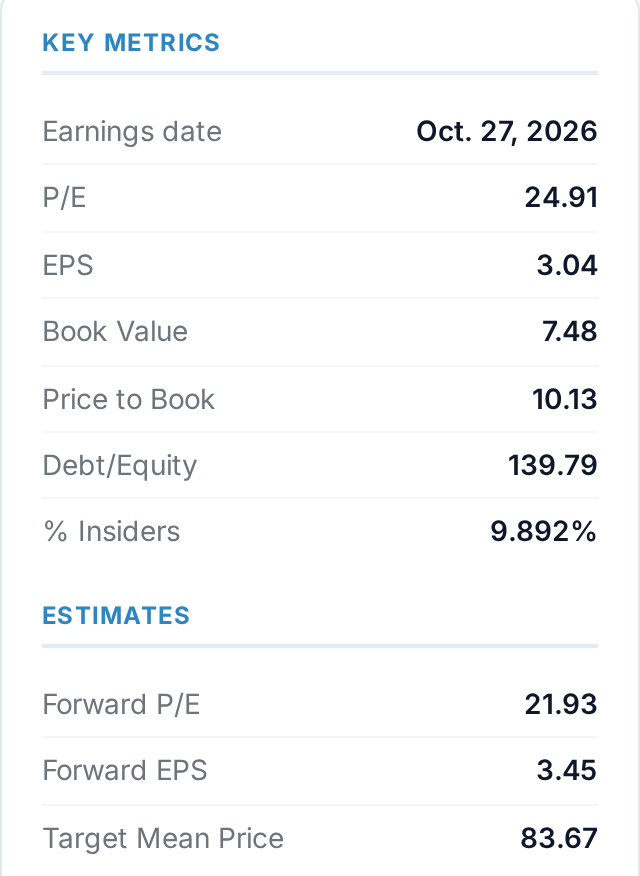
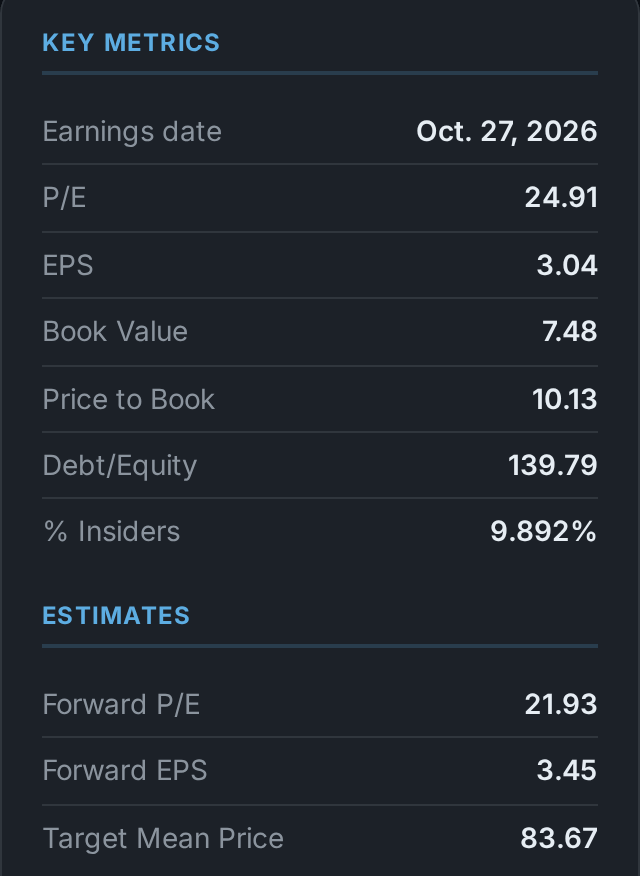
Every stock page lists the trailing P/E with the earnings per share behind it, the book value and price to book. The estimates underneath give the forward P/E and the earnings per share analysts expect. The same page has the price chart, dividends and a DCF valuation.
Open Coca-Cola's stock pageAllInvestView
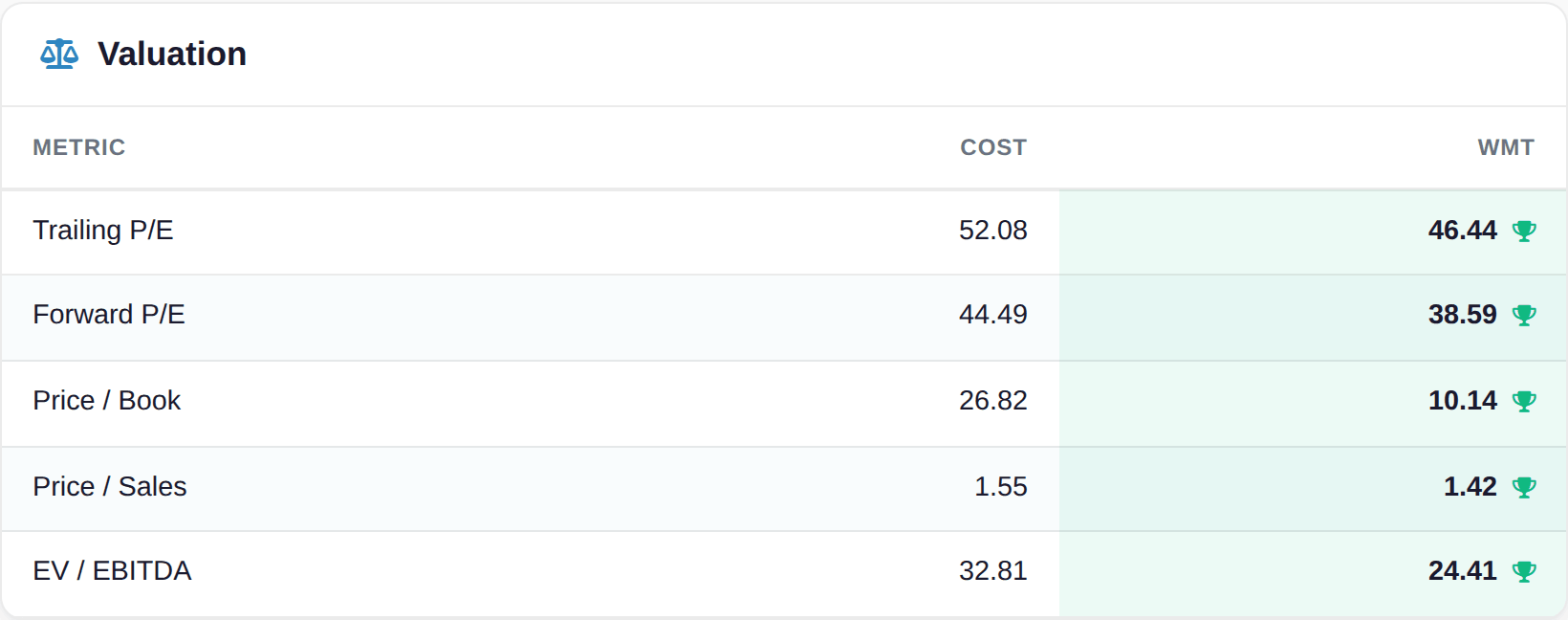
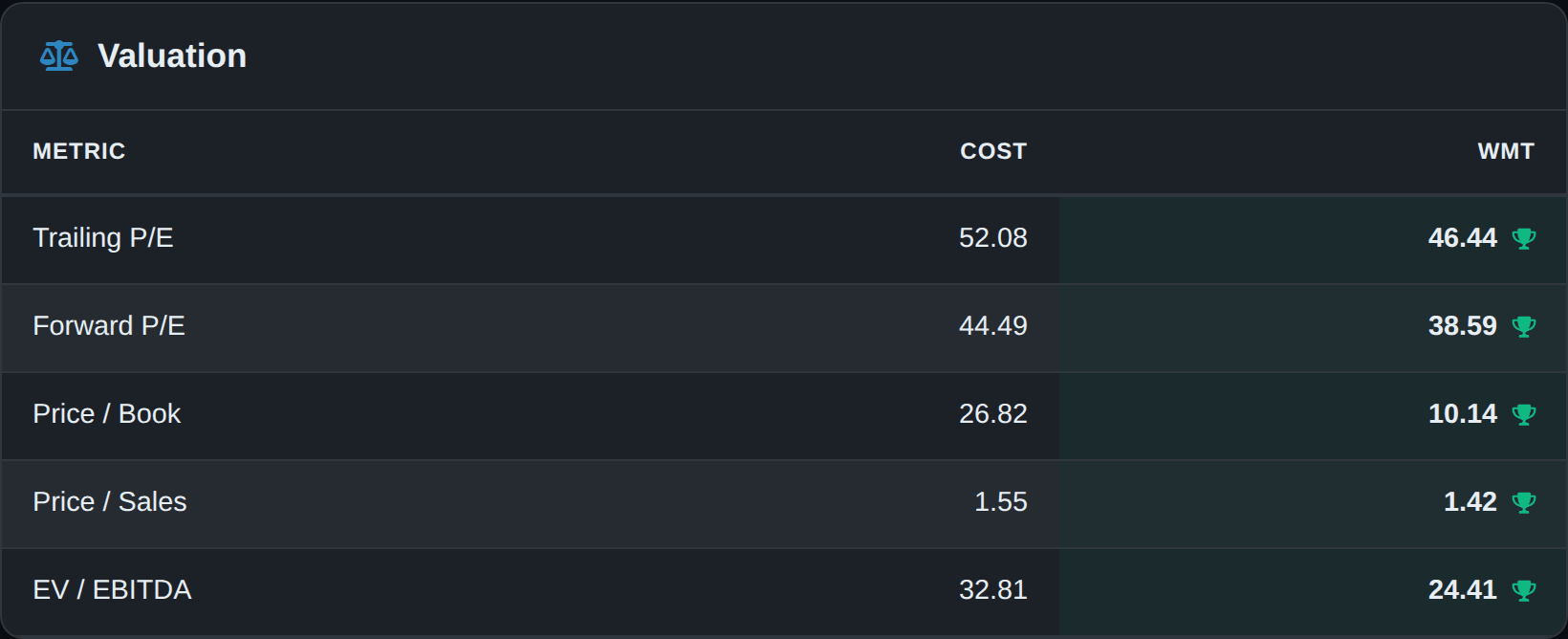
Pick any two stocks and see their valuation ratios in one table, with the lower of each marked. Trailing and forward P/E sit beside price to book, price to sales and EV/EBITDA. Earnings growth, return on equity, debt and dividends are further down the same comparison.
Compare Costco and WalmartAllInvestView
All your accounts in one portfolio, with each holding's P/E, EPS and forward P/E on its stock page, side-by-side comparisons, and your returns, dividends and tax in the same place.
Divide the share price by the earnings per share for the last 12 months. Coca-Cola closed 2025 at $69.91 and earned $3.04 a share that year, so its P/E was 69.91 ÷ 3.04 = 23.0. For the whole company it's the same sum: market value divided by a year of net income.
It depends on the industry and on how fast earnings are growing. Since 1950 the S&P 500's P/E has had a median of about 17.6. In January 2026 big US banks traded at about 14 times earnings, utilities at 20, software at 37 and chipmakers at 49. A P/E below a company's competitors and its own history can be good value, as long as its earnings aren't about to fall.
Neither on its own. A low P/E means you pay less for each dollar of today's profit, but it often means investors expect that profit to shrink. Intel traded at 10.6 times earnings at the end of 2021, then made a loss in 2024 and the shares fell 61%. Nvidia was at 117 times earnings in January 2023 and two years later earned enough to make that price 6.9 times earnings.
A company that lost money over the last year has no meaningful P/E. Most sites show N/A or a dash rather than a negative number. Ford lost $8.2 billion in 2025, so it had no P/E at the end of the year. For loss-making companies, the price-to-sales and price-to-book ratios still work.
The trailing P/E uses earnings the company has already reported over the last 12 months. The forward P/E uses the earnings analysts expect over the next 12 months, so it is lower whenever profit is expected to grow. Quote pages show the trailing figure as "P/E" unless they say otherwise.
About 28.5 at the end of 2025, using Robert Shiller's data: the index's average December price over its reported earnings for the last 12 months. That is above its median of about 17.6 since 1950; it was higher in only about 7% of months since then. On a cyclically adjusted basis, using ten years of earnings, it was 39.6.
You are paying $20 for each $1 of yearly profit. Put the other way round, the earnings yield is 1 ÷ 20 = 5%: if earnings stayed flat, the company would take 20 years to earn its share price. If earnings grow 10% a year, it takes about 11.
Checked on 28 October 2026.
Company ratios are worked from each annual report's net income and the end-of-2025 share price. None of this is personal investment advice.