Market-to-book is the same ratio
Use totals instead of per-share figures: JPMorgan's market value, $322.22 × 2,696.2 million shares = $868.8 billion, over its $342.4 billion of common equity is again 2.54.
The price-to-book ratio divides a company's share price by its book value per share: the shareholders' equity on its balance sheet, what would be left for the owners if it sold everything at book value and paid its debts. JPMorgan Chase ended 2025 at $322.22 on $126.99 of book value per share, a P/B of 2.54. Investors paid $2.54 for each $1 of its net assets.
Under 1 means the market values a company below its net assets, which Benjamin Graham looked for. Six big US banks traded between 1.06 and 2.54 at the end of 2025, the whole US market at 4.61 in January 2026, and companies whose value is in brands, software or years of buybacks run far higher or have no usable P/B at all.
Book value per share = (shareholders' equity − preferred stock) ÷ shares. JPMorgan: 322.22 ÷ 126.99 = 2.54.



Enter the share price and the book value: straight from the balance sheet, or as a figure per share. Add goodwill for the price to tangible book, and earnings per share for the P/E and Graham's test (he used the average of the last three years). It starts with JPMorgan Chase at the end of 2025.
The gap is what investors pay for profits they expect the assets to earn.
Quote sites use the latest quarterly balance sheet and today's price, so their P/B moves every day and jumps when a new report comes out. Banks also report a tangible book value per share in their results, worked out with their own adjustments for tax, so it can differ a little from the plain subtraction here.
Graham set the classic limit in The Intelligent Investor. Today it fits banks and insurers better than most of the market.
"Current price should not be more than 1½ times the book value last reported. However, a multiplier of earnings below 15 could justify a correspondingly higher multiplier of assets. As a rule of thumb we suggest that the product of the multiplier times the ratio of price to book value should not exceed 22.5."
Benjamin Graham, The Intelligent Investor, chapter 14
Below the net assets on paper. Usually a company earning little on its book, or losing money: Citigroup ended 2024 at 0.69, Intel at 0.87.
Where banks, insurers and oil companies sit. Most of what they own, loans, bonds, oil fields and plants, is on the balance sheet.
Around the whole market's 4.61. Amazon, Alphabet, Microsoft and Coca-Cola: brands and software that the balance sheet barely counts.
Book value says little here. Buybacks shrink it (Apple) or the real assets were never booked (Nvidia, Eli Lilly). Negative book, as at McDonald's, gives no P/B at all.









Price is the 31 December 2025 close. Book value per share is shareholders' equity less preferred stock, over shares outstanding, from the last balance sheet on or before that day (Nvidia's quarter ended 26 October 2025, with the share count from that report's cover; Intel's and Apple's years and quarters end in late December). The dashed line is a P/B of 1. Bars past 10 are cut short: Tesla was at 20.5, Nvidia at 38.1, Eli Lilly at 38.3 and Apple at 45.3.
Every bank in the chart, from Citigroup to JPMorgan, traded under 3 times book; Tesla, Nvidia, Eli Lilly and Apple between 20 and 46. That is not because the banks were cheap and the others dear. A bank's book is mostly loans and bonds, which are on the balance sheet. Apple's and Nvidia's real assets, their designs, software and brands, hardly appear on it at all.
A bank's balance sheet is mostly loans and bonds, so its book covers most of what it owns. Its P/B then mostly follows how much profit it earns on that book: its return on equity.
Price-to-book
C 1.06BAC 1.43WFC 1.75 USB 1.42GS 2.37JPM 2.54JPMorgan Chase16.8%2.54Goldman Sachs14.9%2.37U.S. Bancorp13.1%1.42Wells Fargo12.5%1.75Bank of America10.6%1.43Citigroup6.9%1.06
JPMorgan earned 16.8% on its equity in 2025 and traded at 2.54 times book; Citigroup earned 6.9% and traded at 1.06. A bank earning well above what shareholders could get elsewhere is worth more than its book; one earning less is worth about its book or under. ROE here is 2025 net income less preferred dividends, over the average of common equity at the start and end of the year.
US companies in January 2026, from Aswath Damodaran's data at NYU Stern: each industry's combined market value over its combined book value, with its return on equity.
The dashed line is a P/B of 1; bars past 10 are cut short. Restaurants and home improvement retailers include big companies with negative book value (McDonald's, Starbucks, Lowe's), which shrinks the industry's total book and sends its P/B to 75 and 132; their ROE means little for the same reason.
Banks, insurers, homebuilders and utilities all traded under 2.1 times book. Their balance sheets hold loans, bonds, houses being built and power plants, so book value covers most of what they own and P/B is a fair yardstick for them.
Software and chipmakers traded at 9 to 13 times book with returns on equity around 30%. Most of what they spend on research is expensed rather than booked as an asset, so their book value understates what they own.
Book value is an accounting figure. Buybacks, acquisitions and research that never reaches the balance sheet can push it a long way from what the company is worth.
Apple spent almost all it earned buying back its own shares, plus $117 billion in dividends. Paying out more than its profit shrank its equity from $134.0 billion in September 2017 to $73.7 billion in September 2025, so its P/B soared while its profits grew.
Its equity turned negative in 2016, the year it spent $11.2 billion on buybacks, and has stayed below zero since. That reflects payouts, not a failing business: it earned $8.6 billion in 2025. A negative P/B means nothing; judge it on its P/E.
Pfizer looks close to book value at 1.64, but goodwill and intangibles from its acquisitions, $125.0 billion, are larger than its $86.5 billion of equity. Take them out and its tangible book is negative, about −$6.77 a share.
Research, software and brands built in-house are mostly expensed as they are paid for. That is why Microsoft traded at 9.19 times book and Nvidia at 38.1: their book leaves out most of what they own.
Intel ended 2024 at 0.87 times book after losing $18.8 billion that year. A low P/B can mean the market expects the assets to earn less, or to be written down. Check the return on equity and the trend in book value before calling it cheap.
A bank at 1.5 times book and a software company at 9 are not comparable. P/B is most useful between companies with similar balance sheets; see the industry table and the banks.
Coca-Cola at the end of 2025 on each of them.
| Ratio | Formula | Coca-Cola | Tells you |
|---|---|---|---|
| Price-to-book | Price ÷ book value per share | 9.35 | What you pay for each $1 of net assets on the balance sheet |
| P/E ratio | Price ÷ earnings per share | 23.0 | What you pay for each $1 of last year's profit |
| P/S ratio | Price ÷ revenue per share | 6.3 | A value when there is no profit to divide by |
| PEG ratio | P/E ÷ yearly EPS growth, in % | 2.06 | Whether the P/E is paid for by growth |
| P/E × P/B | P/E ratio × price-to-book | 215 | Graham's limit for defensive investors was 22.5, on three-year average earnings |
Each stock page shows the book value per share and the price-to-book ratio beside the P/E and earnings per share.
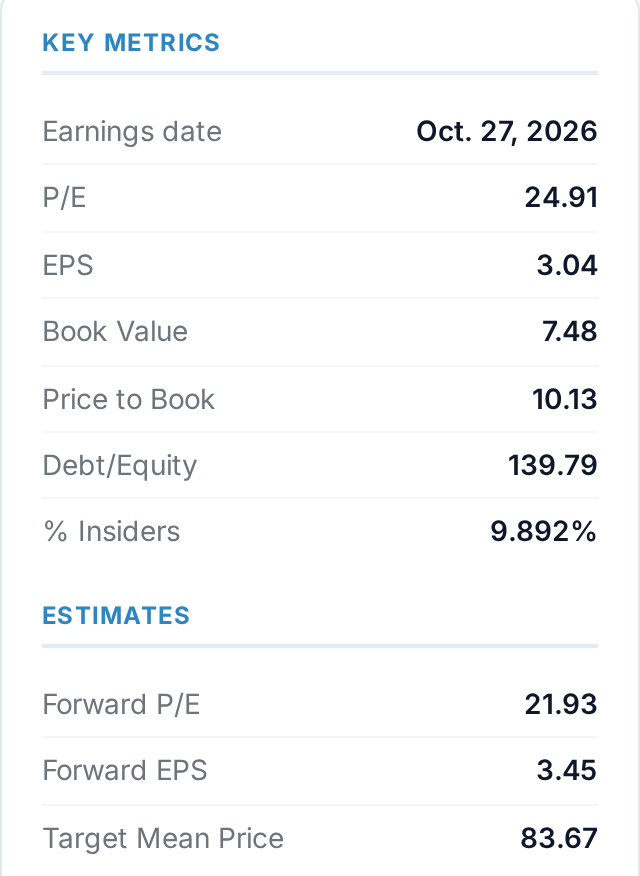
Every stock page lists the book value per share and the price-to-book ratio with the P/E, EPS and debt to equity in its key metrics. The estimates underneath give the forward P/E and the earnings analysts expect next year. To start from the ratio instead, the best value stocks list ranks big companies by their price-to-book.
Open Coca-Cola's stock pageAllInvestView
To start from the ratio, best value stocks by price-to-book ranks large companies from the lowest P/B up, at today's prices.
All your accounts in one portfolio, with each holding's book value, P/B, P/E and EPS on its stock page, and your returns, dividends and tax in the same place.
Divide the share price by the book value per share. Book value per share is the shareholders' equity on the balance sheet, less any preferred stock, divided by the shares outstanding. JPMorgan Chase had $342.4 billion of common equity and 2,696.2 million shares at the end of 2025, $126.99 a share; at $322.22 its P/B was 2.54.
It depends on the industry. Benjamin Graham's rule for defensive investors was no more than 1.5 times book, or a P/E (on three-year average earnings) times the P/B of no more than 22.5. Banks and insurers usually trade between 1 and 3; the whole US market was at 4.61 in January 2026, and software companies at 9.14. Compare a stock with others in its industry, and with how much it earns on its book.
The market values the company at less than its net assets on paper. Sometimes it is a bargain; more often investors expect weak profits or losses. Citigroup ended 2024 at 0.69 times book; after its shares rose 66% in 2025 it was at 1.06. Intel ended 2024 at 0.87 after an $18.8 billion loss.
The shareholders' equity on the balance sheet, after taking off any preferred stock, divided by the shares outstanding. It is what each share would get, on paper, if the company sold everything at the values on its balance sheet and paid off its debts. Coca-Cola's was $7.48 at the end of 2025.
Yes. Market-to-book divides the company's market value by its total book value; price-to-book does the same per share. JPMorgan's market value of $868.8 billion at the end of 2025 over its $342.4 billion of common equity gives the same 2.54.
Because book value is below zero: the company owes more than its assets are worth on paper. That usually comes from years of buybacks and dividends larger than profits, not from distress. McDonald's had -$1.8 billion of shareholders' equity at the end of 2025. A negative P/B means nothing; most sites show N/A.
The same ratio with goodwill and other intangible assets taken out of book value. Goodwill, the premium paid for past acquisitions, cannot be sold on its own, so banks are often quoted on tangible book. On that basis Citigroup's book was $96.63 a share at the end of 2025 and its price to tangible book 1.21.
When return on equity is a year's profit over the same book value, P/B equals the P/E times ROE. So a company that earns more on each dollar of book is worth more times its book. Among six big US banks at the end of 2025, JPMorgan earned 16.8% on its equity and traded at 2.54 times book; Citigroup earned 6.9% and traded at 1.06.
Checked on 30 October 2026.
Company figures are worked from each company's balance sheet as filed with the SEC and the end-of-2025 share price. None of this is personal investment advice.