The trade settles on the 15th, the record date, so you're on Coca-Cola's list. 100 shares get $53 on 1 October.
Ex-Dividend Date: What It Means and When to Buy to Get the Dividend
The ex-dividend date is the first day a stock trades without its next dividend. Buy before it and the dividend is yours. Buy on it or later and it goes to the seller. So the last day to buy is the trading day before. In the US, where trades settle the next business day, the ex-dividend date and the record date have been the same day since 28 May 2024.
Coca-Cola's last dividend shows how it works. Declared on 15 July 2026 at 53 cents a share, it went ex on Tuesday 15 September and was paid on 1 October. If you bought by the close on Monday the 14th, you were paid. If you bought on the 15th, you weren't, and if you sold on the 15th, you still were.
 Coca-Cola (KO), third-quarter dividend 2026
$0.53 a share
DeclaredWed 15 JulThe board sets the amount and the dates.
Last day to buyMon 14 SepOwn the shares at the close and it's yours.
Ex-dividend and record dateTue 15 SepOpened at $88.53 after a $89.35 close.
PaidThu 1 OctCash lands for everyone on the record.
Bought on or before 14 September: paid $53 on 100 shares, even if sold on the 15th.
Bought on 15 September or later: no dividend this quarter. The next one is yours.
US, since 28 May 2024Ex-date = record dateTrades settle the next business day, so the two fall on the same day.
240 real ex-dates92% of the dividendis the median drop at the open, on eight dividend stocks and funds since 2021.
For the lower US tax rateMore than 60 daysheld in the 121 days around the ex-date meets the holding test for a qualified dividend.
Who gets the dividend: buying and selling around the ex-date
What matters is whether you owned the shares when the ex-dividend date opened. The settlement date and the day you're paid don't change it. Here are the trading days around Coca-Cola's September 2026 ex-date.
Thu10Buy: paid
Fri11Buy: paid
Mon14Last day to buy
Tue15Ex-date
Wed16Buy: not paid
A buy on these days gets the 53 centsA buy on these days doesn't; the seller keeps it
The shares now trade without the dividend. You paid $88.53 at the open instead of Monday's $89.35 close.
The buyer owns them before the ex-date, so the dividend goes to the buyer. The price you got still had it in.
You owned the shares when they went ex, so the 53 cents is yours even though you no longer hold them on 1 October.
Ex-dividend date calculator: do I get the dividend?
Put in the dividend's dates and your trade. It works out the ex-date from the record date for your market, the last day to buy, and what you'll be paid. The second tab checks the 61-day holding period for the lower US tax rate.
Do I get the dividend?
-
Last day to buy-own it at this close
Ex-dividend date-
Record date-
Your dividend-
Held long enough for the qualified rate?
-
Days held in the window-
Earliest sale that qualifies-
The window around the ex-date
Does the stock price drop on the ex-dividend date?
Usually by about the dividend, right at the open: the cash is leaving the company and buyers no longer get it. We measured it on the last 240 ex-dates of eight US dividend stocks and funds, from November 2021 to October 2026: the gap between the previous close and the ex-date open, as a share of the dividend.
Median drop at the open, as % of the dividend100%: a drop equal to the dividend

VZVerizon
Opened lower19 of 20Dividend vs price1.59%

JNJJohnson & Johnson
Opened lower19 of 20Dividend vs price0.70%

JEPIJPMorgan Equity Premium Income ETF
Opened lower59 of 60Dividend vs price0.72%

SCHDSchwab U.S. Dividend Equity ETF
Opened lower20 of 20Dividend vs price0.89%
KOCoca-Cola
Opened lower19 of 20Dividend vs price0.73%

ORealty Income
Opened lower46 of 60Dividend vs price0.43%

PEPPepsiCo
Opened lower19 of 20Dividend vs price0.81%

PGProcter & Gamble
Opened lower16 of 20Dividend vs price0.64%
Opened lower217 of 24090% of the ex-dates opened below the previous close.
Median drop92%of the dividend, across all 240. The market prices it out.
Coca-Cola, 15 Sep 2026−$0.82$89.35 close to $88.53 open: the 53 cents plus a weak morning.
Apple, a 0.12% dividend12 of 20opened lower. A dividend that small gets lost in a normal day's move.
Prices are daily opens and closes, adjusted for splits but not for dividends. Each row covers its own last 20 quarterly ex-dates, or 60 monthly for Realty Income and JEPI. A single day's drop is never exactly the dividend, because the rest of the market moves too.
Buying just before the ex-date: does dividend capture work?
The idea is to buy the day before, collect the dividend and sell at the ex-date open. On the same 240 ex-dates, buying at the close and selling at the next open:
Dividend collected0.73%of the price on average, about $73 on $10,000.
Price given back0.68%at the open, about $68 of it.
Left over, before costs0.06%about $5.50 per $10,000 trade. 135 of the 240 came out ahead.
Then the taxOrdinary rateOne night isn't 61 days, so in the US the dividend isn't qualified.
The dividend isn't free money
When the price falls by the dividend, your shares plus the cash on its way to you add up to what you had before the ex-date. That's why a stock's total return counts price and dividends together.
When the timing does matter
If you're buying anyway, buying a few days before the ex-date or after it costs about the same; the dividend just arrives as cash instead of staying in the price. In a taxable account, buying just after can push that income, and its tax, to the next payment.
Ex-dividend date vs record date, by country
The record date is when the company checks its list of shareholders. The ex-dividend date is the trading cutoff that decides who will be on that list, so it depends on how long trades take to settle in each market.
| Market | Trades settle | Ex-dividend date | Since |
|---|---|---|---|
| United States | T+1, the next business day | Same day as the record date | 28 May 2024 |
| Canada | T+1 | Same day as the record date | 27 May 2024 |
| India | T+1 | Same day as the record date | 27 January 2023 |
| United Kingdom | T+2, two business days | One business day before the record dateUsually a Thursday, with the record date on Friday | October 2014 |
| Eurozone | T+2 | One business day before the record date | October 2014 (Spain 2016) |
| Australia | T+2 | One business day before the record date | March 2016 |
Before 28 May 2024, US trades settled in two days and the ex-date was one business day before the record date, so older articles still say that. The UK and the EU plan to move to T+1 on 11 October 2027, which will put their ex-dates on the record date too.
The ex-dividend date and the 61-day rule for qualified dividends
In the US, a dividend from a stock or fund is taxed at the lower qualified rate only if you held the shares for more than 60 days during the 121-day period that begins 60 days before the ex-dividend date. The ex-date sits in the middle of the window.
Bought 14 Sep, sold Friday 13 Nov: 60 days
The count starts the day after the buy, 15 September, and the sale day counts. That's 60 days, one short, so the 53 cents is taxed as ordinary income.
Sold Monday 16 Nov: 61 days
The window ends on Saturday 14 November, so any sale from Monday the 16th counts all 61 days. The dividend is qualified. Held for years, it qualifies every time. See how dividends are taxed.
Special cases: big dividends, options, funds and reinvestment
The rule above covers almost every regular dividend. These are the ones that work differently.
A special dividend of 25% or more
When a dividend is worth 25% or more of the share price, US exchanges set the ex-date on the business day after the payment date. Sell between the record date and the ex-date and the dividend goes to the buyer, through a due bill your broker handles.
Options and early assignment
The day before an ex-date, owners of in-the-money calls sometimes exercise early to collect the dividend. If you've sold covered calls, your shares can be called away that night and the dividend goes with them.
Mutual funds and ETFs
ETFs follow the same ex-date rule as stocks. A mutual fund's price drops by the distribution on its ex-date. Buying in a taxable account just before a big year-end capital gains distribution hands you a tax bill on a gain you didn't have.
Reinvested dividends
With a DRIP, the new shares are bought around the payment date, on the plan's own schedule, not on the ex-date. They count toward the next dividend only if you hold them before its ex-date.
Know which dividends you'll get, across every broker
AllInvestView applies the same rule to your own trades: the shares you held before each ex-date are the ones that get paid, in every account you add. The payments go on your calendar and into one dividend report.
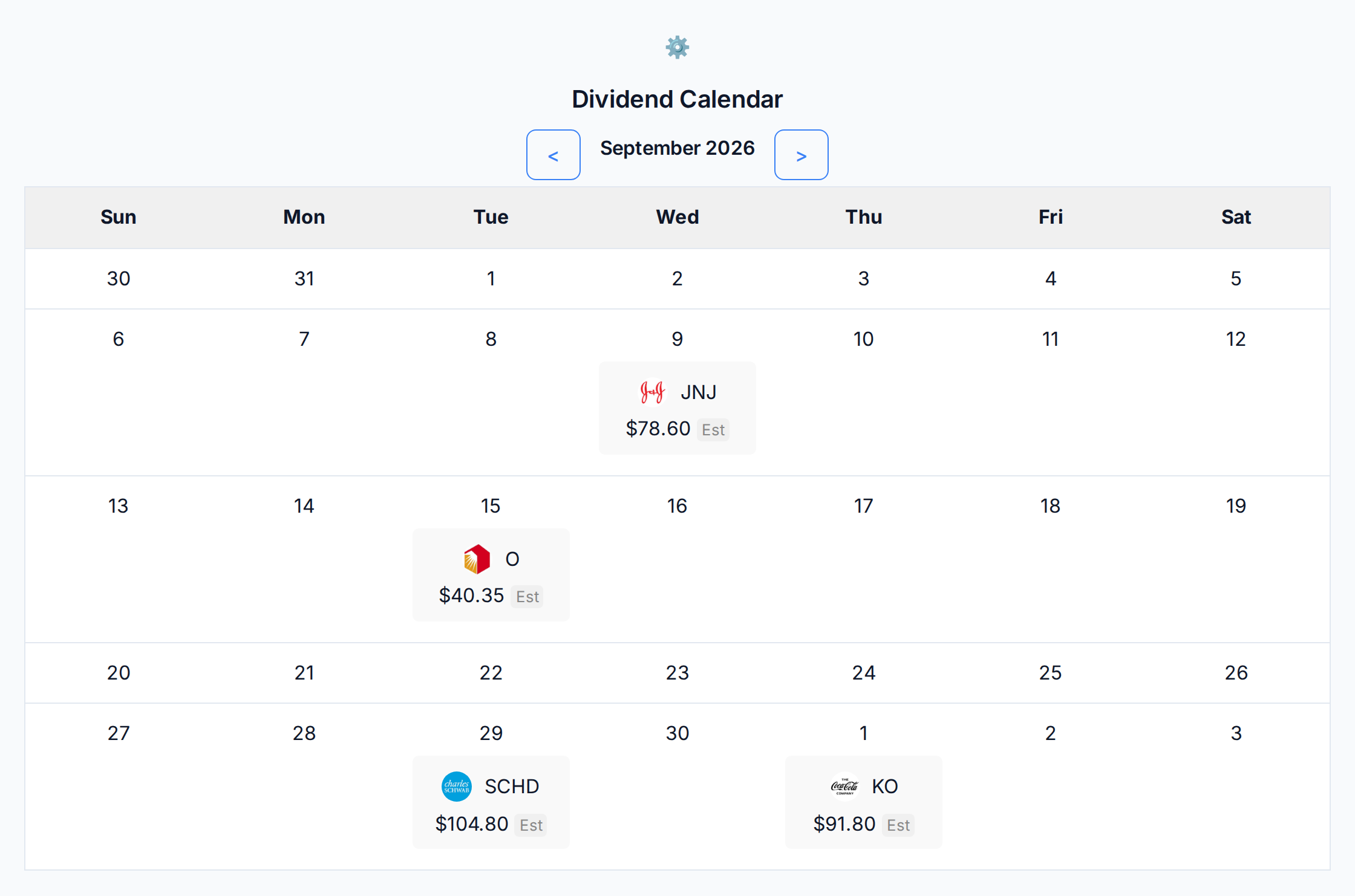
Dividend calendar
Every payment you're owed, on its date
Hold a stock before its ex-dividend date and the payment goes on your calendar for its pay date, with the amount worked out from the shares you held. If your first buy came after the ex-dividend date, the dividend shows as missed instead of counting toward your income.
See the dividend tracker AllInvestView
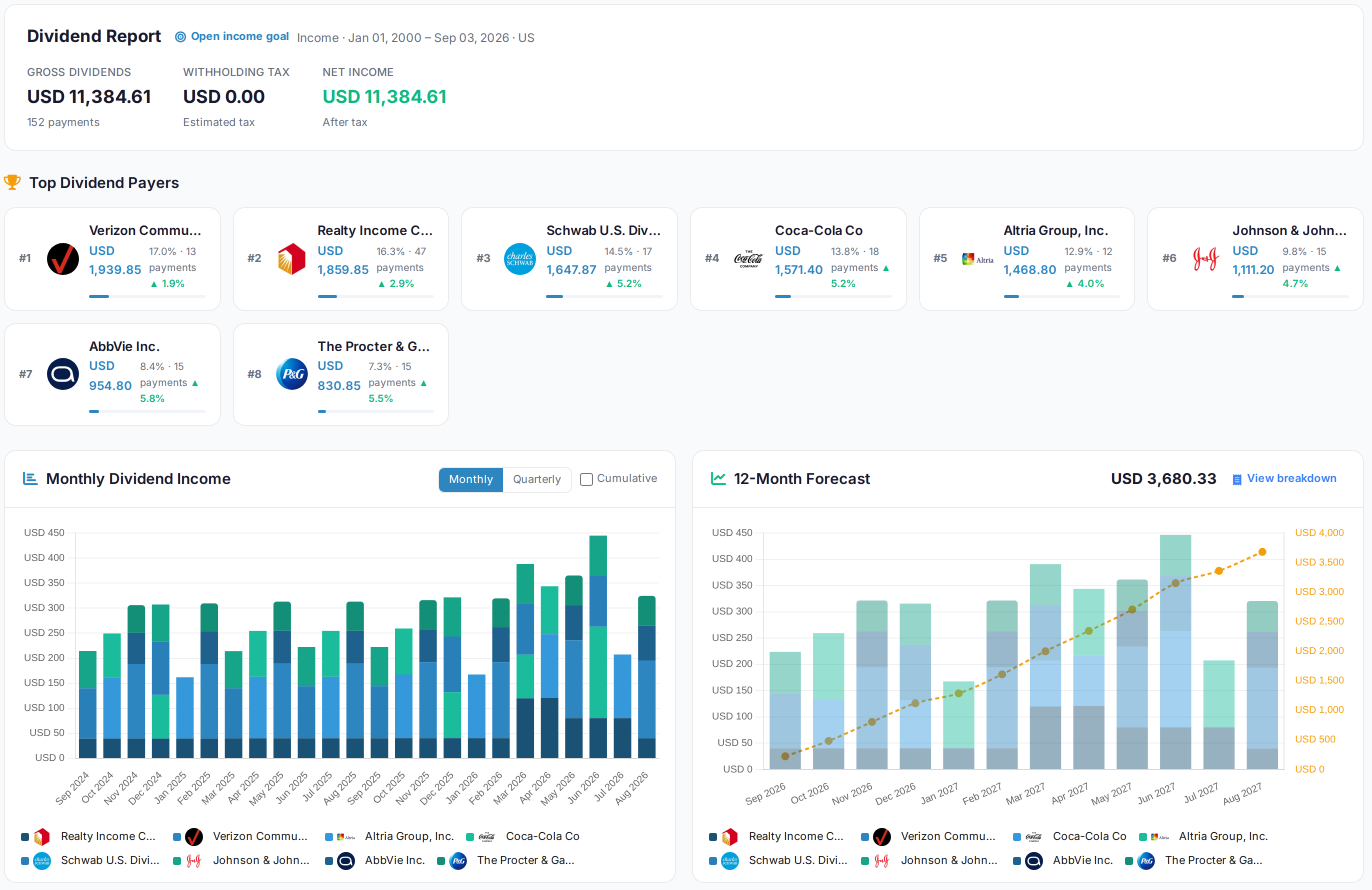
Dividend report
What you were paid, across every broker
Gross, withholding and net for every payment, the top payers with their growth, monthly income by holding and the next 12 months forecast. It covers the accounts you add at every broker in one report.
See the dividend trackerAllInvestView
Every broker in one place
See every dividend you're owed, before it arrives
Add the accounts you hold and AllInvestView counts the shares you owned before each ex-date, puts the payments on a calendar and sends you an email on pay day. No spreadsheet of dates to keep.
Dividend calendar
Income across all your accounts
Free plan available
Questions about the ex-dividend date
What is an ex-dividend date?
It's the first day a stock trades without its next dividend. If you buy before it, the dividend is yours. If you buy on it or later, the seller keeps it. Coca-Cola's last one was Tuesday 15 September 2026: shares bought by the close on Monday 14 September were paid 53 cents each on 1 October.
If I buy a stock on the ex-dividend date, do I get the dividend?
No. A buy on the ex-dividend date settles after the record date, so you aren't on the company's list and the seller gets the payment. Buy at the latest on the trading day before.
Can I sell on the ex-dividend date and still get the dividend?
Yes. If you owned the shares before the ex-dividend date, you keep the dividend even if you sell at the open on the ex-date. The buyer pays a price that no longer includes it.
What's the difference between the ex-dividend date and the record date?
The record date is when the company checks who its shareholders are. The ex-dividend date is the trading cutoff that decides who will be on that list. In the US and Canada, where trades settle one business day after the trade, the two have been the same day since late May 2024. In the UK, the EU and Australia, which settle in two days, the ex-dividend date is one business day before the record date.
Does the stock price drop on the ex-dividend date?
Usually by about the dividend, at the open. On 240 ex-dates of eight dividend stocks and funds from November 2021 to October 2026, 90% opened below the previous close and the median drop was 92% of the dividend. With a small dividend, like Apple's 0.12% of the price, the drop gets lost in the day's normal moves.
How long do I have to hold a stock to get the dividend?
To be paid, you only need to own it before the ex-dividend date, so one night is enough. To have a US dividend taxed at the lower qualified rate, you need to hold it more than 60 days in the 121-day period that starts 60 days before the ex-date. Bought on 14 September 2026, Coca-Cola had to be held until at least Monday 16 November.
Where can I find a stock's ex-dividend date?
In the company's dividend announcement and on its investor relations page, where the record and payment dates are given too. Your broker and stock pages, including AllInvestView's, show the next one, and your dividend calendar shows when the payments for what you hold arrive.
Sources
Checked on 27 October 2026.
- Investor.gov (SEC): Ex-dividend dates, when are you entitled to stock and cash dividends, the ex-date, the record date and the rule for dividends of 25% or more.
- SEC: shortening the securities transaction settlement cycle to T+1, effective 28 May 2024.
- FINRA Rule 11140, Transactions in Securities "Ex-Dividend," "Ex-Rights" or "Ex-Warrants", how the ex-date is set, including large dividends.
- IRS Publication 550, Investment Income and Expenses, the holding period for qualified dividends (more than 60 days in 121, and more than 90 in 181 for some preferred).
- London Stock Exchange: dividend procedure timetable, Thursday ex-dates and Friday record dates.
- ASX: settlement, T+2 since March 2016, and CIRO for Canada's move to T+1 on 27 May 2024.
- ESMA and the UK Accelerated Settlement Taskforce, the move to T+1 on 11 October 2027.
- The Coca-Cola Company: dividend announcement, the dividend declared on 15 July 2026, payable 1 October to shareowners of record on 15 September.
The price-drop and dividend capture figures are worked out by AllInvestView from daily opens and closes adjusted for splits but not dividends, and each company's or fund's own dividends, ex-dates from 1 November 2021 to 23 October 2026. Trading costs and taxes are left out. None of it is investment advice.